Importer of Record for Shipping from China to the USA
One unanswered question can stop a DDP shipment from clearing US customs: Which legal entity is the Importer of Record? The cargo may already be on the water when the customs broker requests the IOR’s legal name, importer number, bond and power of attorney. The US buyer believed the DDP price covered the entire import process, while the Chinese seller expected its logistics provider to handle the entry. Yet no eligible party has formally accepted the customs liability.
The Importer of Record (IOR) is the party legally responsible for the US customs entry. It must exercise reasonable care over tariff classification, customs value, country of origin, duty payment and supporting records, even when a licensed customs broker files the entry. This guide explains who can act as the IOR, what a foreign company needs to qualify, how the role is handled in DDP shipments from China and how customs responsibility differs from other US import compliance roles.
What an Importer of Record Does in the United States
The Importer of Record is accountable for the accuracy and completeness of the US customs entry. It must use reasonable care when providing the information CBP needs to release the goods, assess duties and verify that the declared import details are correct.
The IOR’s customs responsibilities include:
Tariff classification: Confirm the appropriate Harmonized Tariff Schedule of the United States (HTSUS) classification and retain the product information supporting that decision.
Customs value: Declare the correct value using the applicable valuation method. The commercial invoice price cannot simply be accepted when assists, royalties, related-party transactions or other additions affect the entered value.
Country of origin: Identify the correct origin and check whether the product and packaging meet the applicable US marking requirements.
Product description and quantity: Provide enough detail for CBP to identify the goods and review their admissibility. Generic descriptions such as "parts", "samples" or "accessories" rarely provide an adequate basis for a commercial entry.
Duties, taxes and fees: Deposit the estimated amount due at entry and remain responsible for additional amounts assessed when CBP completes its final accounting of the entry, known as liquidation.
Entry records: Retain the documents supporting the declaration and produce them if CBP requests them during an inquiry or audit.
Reasonable care does not require the IOR to prepare every document personally. The supplier may provide product specifications and transaction records, while a licensed customs broker prepares and files the entry. However, the IOR must investigate missing or conflicting information and maintain a defensible basis for the classification, value and origin declared to CBP. Hiring a broker does not transfer this responsibility.
Most customs entry records must be kept for five years from the date of entry, although specific records and entry types can have different retention periods. The file should preserve the commercial documents and technical evidence used to support the declaration, not only the final customs entry form.
Who Can Act as the Importer of Record for a US Shipment
Under US customs law, the Importer of Record can be the owner or purchaser of the merchandise. A licensed customs broker can also take the role when properly designated by the owner, purchaser or consignee. CBP expects an owner or purchaser to have a genuine financial interest in the imported goods.
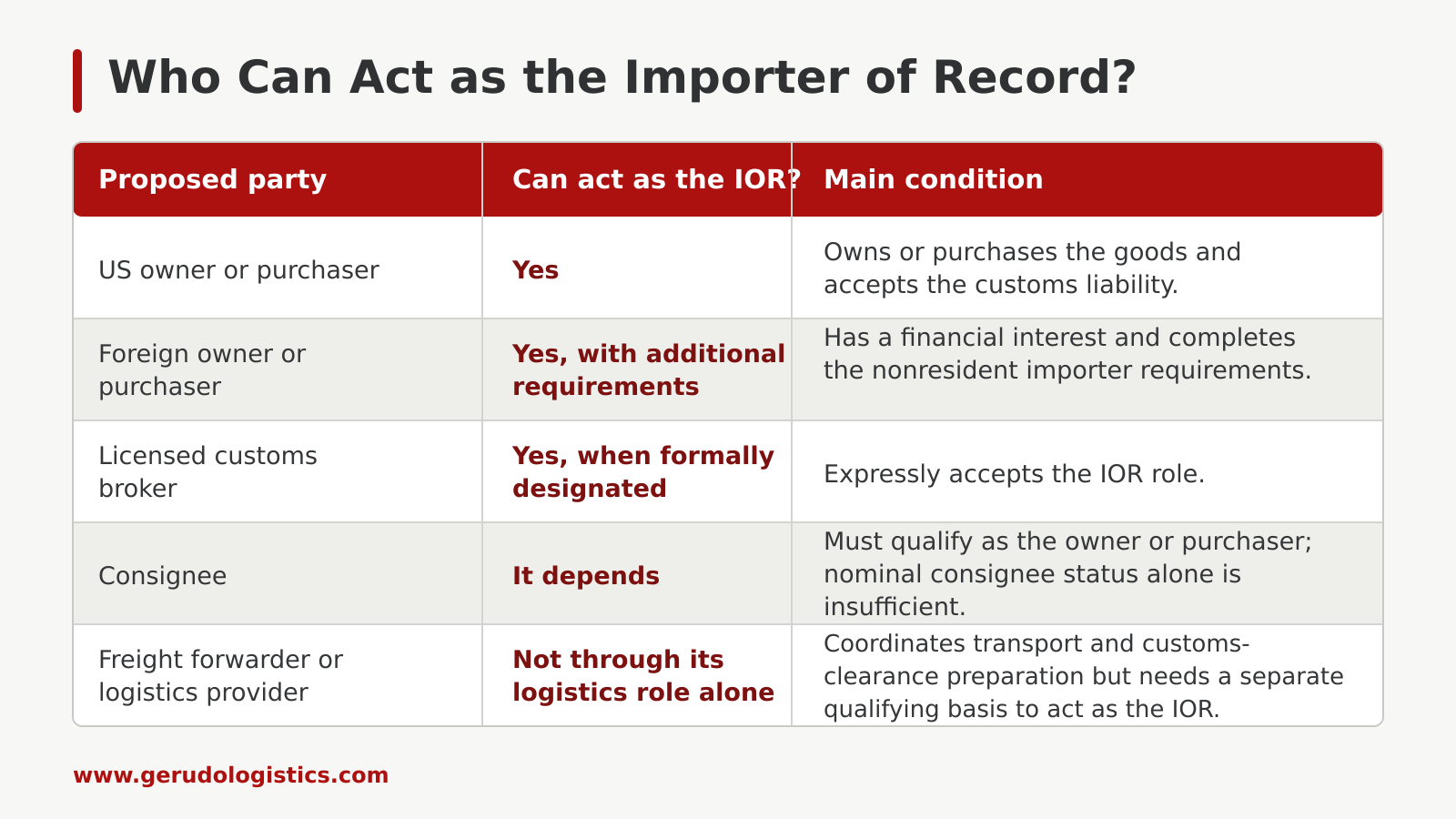
The consignee and IOR can be different entities. CBP Form 7501 records the ultimate consignee and the Importer of Record separately. The same company may fill both roles, but a delivery address, consignee number or appearance on the bill of lading does not establish IOR eligibility by itself.
The distinction also matters when a supplier or logistics provider offers an all-inclusive shipping service. Before the cargo leaves China, the importer should obtain the proposed IOR’s full legal name and confirm the basis on which that party qualifies. If the proposed IOR is a foreign company, it must also complete the nonresident importer arrangements explained in the next section.
US Importer of Record Requirements for a Foreign Company
A foreign company does not need to establish a US subsidiary solely to act as the Importer of Record. A foreign company here means any company not organized under US law — whether based in China, another sourcing country, or elsewhere — that wants to act as the Importer of Record for its own US-bound shipments.
If the company qualifies as the owner or purchaser of the goods, it can operate as a nonresident IOR after establishing its identity with US Customs and Border Protection (CBP), appointing the required resident agent and arranging a customs bond.
Registering an Importer Identity With CBP
The foreign company must create an importer record through CBP Form 5106, Create/Update Importer Identity Form. A company with a US Employer Identification Number normally uses that number for customs transactions. CBP can assign an importer identification number to a foreign business that has no US tax identification number.
The importer number identifies the company in CBP's systems. It is not an import license and does not prove that the company qualifies as the owner or purchaser. The legal name, physical address and company information submitted on Form 5106 must correspond with the entity that will appear as the IOR on the customs entry.
CBP regulations allow Form 5106 to be filed with the first formal entry. In practice, the importer record should be created and checked before the cargo leaves China. This gives the broker time to resolve rejected or inconsistent entity information before the shipment reaches the United States.
An importer number can also become inactive. If it has not been used for one year and has no outstanding transaction attached to it, CBP removes it from its active files. A foreign company returning to the US market after a long gap should have its importer record checked before booking the shipment.
Appointing a US Resident Agent
A nonresident corporation must appoint a resident agent authorized to accept service of legal process on its behalf. For an entry filed at a specific port, the agent must reside in the state where that port is located. For Remote Location Filing, the agent can be located in either the port state or the state from which the remote entry is filed.
A US delivery address, warehouse or consignee does not automatically satisfy this requirement. The appointed party must have express authority to accept service for the foreign corporation. A customs broker can sometimes perform both functions, but the broker's role in filing an entry does not by itself establish the required resident-agent appointment.
The foreign company should confirm that the appointment covers the intended entry arrangement before selecting the arrival port. This is especially relevant when future shipments may enter through several US ports rather than one regular gateway.
Arranging a Customs Bond
The foreign IOR must file a customs bond on CBP Form 301 with a resident corporate surety. The basic importation and entry bond secures the payment of duties, taxes and other charges. It also covers obligations such as producing requested documents, completing an entry and redelivering merchandise when CBP issues a valid demand.
The bond can be arranged as:
Single-transaction bond: Covers one customs entry and is generally considered for occasional imports.
Continuous bond: Covers eligible entries made by the named principal during the bond period and is generally more practical for regular imports.
The correct foreign company must appear as the bond principal. A freight forwarder's or another importer's bond cannot simply be substituted for the foreign IOR's own customs obligation. The bond is also separate from cargo insurance: it protects the US government against customs defaults rather than insuring the goods against loss or damage.
A foreign IOR commonly authorizes a licensed customs broker to submit Form 5106, arrange the bond and file entries through a power of attorney. The power of attorney allows the broker to act for the company but does not transfer the IOR's customs liability. For a nonresident principal, the designated agent must be a US resident authorized to accept service of process. The foreign corporation may also need to provide corporate records confirming that the person signing the power of attorney has authority to bind the company.
Importer of Record Under DDP Shipping From China
Under Delivered Duty Paid (DDP), the seller arranges import clearance and pays the applicable import duties before delivering the goods to the named destination. However, the sales contract cannot determine who qualifies as the Importer of Record under US customs law. The party named as the IOR must still qualify as an owner or purchaser, or act under another basis recognized by CBP.
Paying the freight and duties does not make the Chinese seller the IOR. Likewise, filing the customs entry does not automatically place the broker or freight forwarder in that role. The DDP arrangement must identify an eligible party that has expressly accepted the customs liability.
IOR Structures Used for DDP Shipments
A DDP shipment from China requires an eligible Importer of Record (IOR) before the goods enter the United States. The Incoterm determines the commercial allocation between the seller and buyer, but it does not establish which party qualifies as the IOR under US customs law.
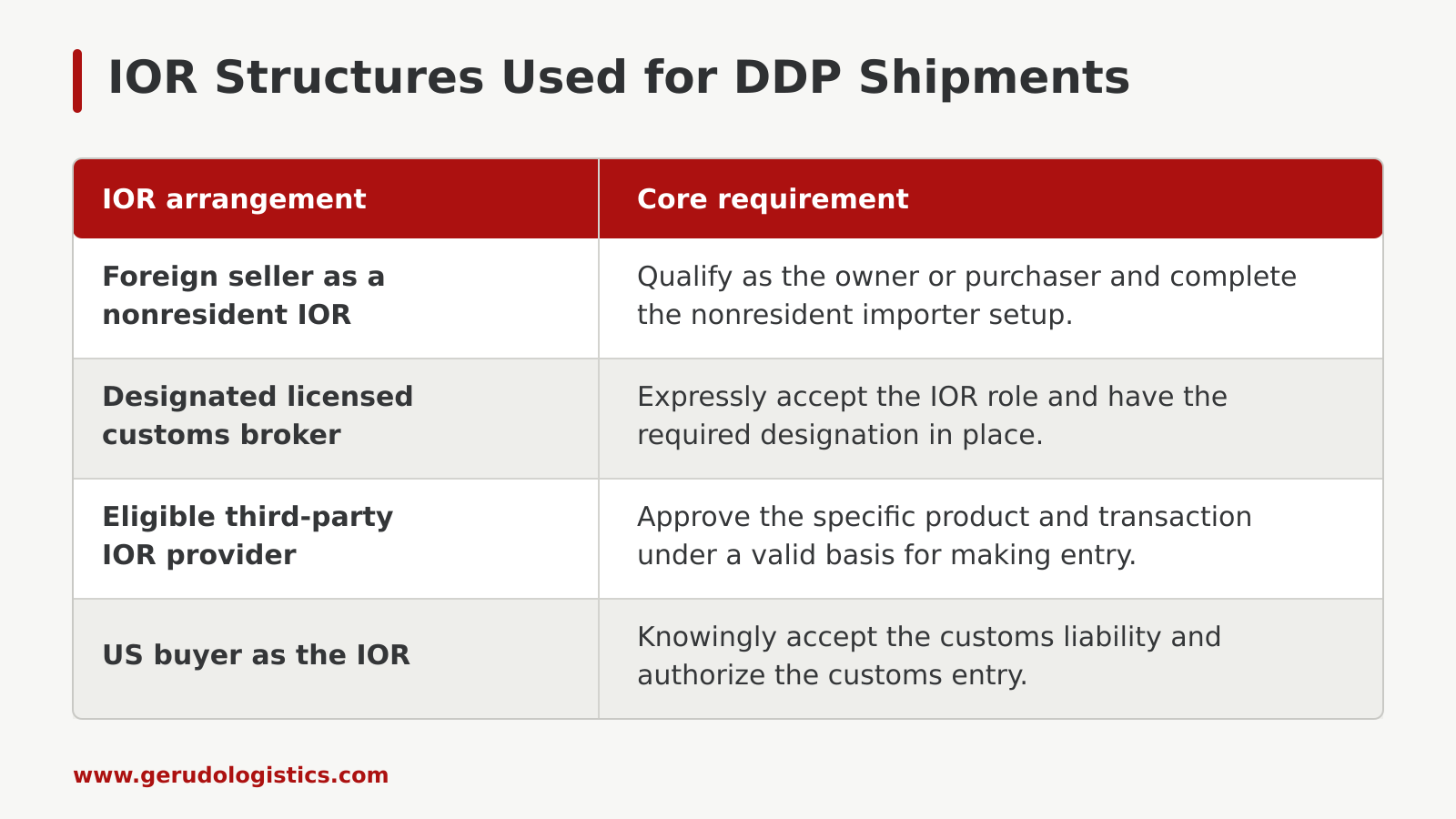
A foreign seller acting as a nonresident IOR most closely follows the standard DDP allocation because the seller handles import clearance and remains responsible for the duties. The seller must still qualify as the owner or purchaser and complete its importer record, resident-agent and customs-bond arrangements before shipment.
A licensed customs broker or third-party IOR provider must expressly accept the proposed arrangement. For a third-party provider, the legal basis may be a qualifying ownership or purchasing interest or an appropriately designated customs broker role. Approval can depend on the product, country of origin, customs value and applicable agency requirements, so acceptance of one shipment does not guarantee approval for future shipments.
If the US buyer acts as the IOR, it assumes responsibility for the accuracy of the customs entry and any resulting liability, even when the seller pays the freight and estimated duties. The buyer’s importer number or bond must not be used without its knowledge and authorization. Because this arrangement differs from the standard DDP allocation, the contract must state the buyer’s role clearly; DAP or an expressly modified term may describe the transaction more accurately.
IOR Details to Verify in a DDP Quote
A DDP quote that only states "duties and customs clearance included" does not establish a workable IOR arrangement. Before the cargo leaves China, obtain written confirmation of the following:
IOR identity: The full legal name of the entity that will appear as the Importer of Record.
Basis of eligibility: Whether the party qualifies as the owner or purchaser, a designated licensed customs broker or another legally eligible entity.
Customs broker role: Whether the broker will act as the IOR or only file the entry as the IOR’s agent.
Importer record and bond: Confirmation that the importer identity is active and that the customs bond names the same legal entity.
Authorization: The party that will sign the broker power of attorney and provide the entry information.
Duty coverage: Which tariffs, taxes and customs fees are included in the DDP price, how they affect the landed cost of the China-to-USA shipment, and who bears additional amounts assessed after entry.
Cargo acceptance: Whether the proposed IOR has approved the exact product, customs value, country of origin and transaction structure.
Failure arrangements: Who pays for storage, examinations, return transport or other costs if the proposed IOR or broker rejects the entry.
The IOR name should be confirmed before booking, rather than supplied after the cargo is already in transit. If the seller cannot identify an eligible IOR, the parties need to revise the import arrangement or use a term such as DAP, under which the buyer handles import clearance.
Importer of Record vs Other US Import Compliance Roles
The customs Importer of Record is responsible for the entry submitted to US Customs and Border Protection. This role does not automatically cover every product compliance responsibility that may apply to regulated goods.
FDA FSVP importer: Food subject to the Foreign Supplier Verification Programs rule requires an eligible US-based FSVP importer. This company can also act as the customs IOR, but it must qualify for and accept both roles separately.
FCC responsible party: Radiofrequency equipment requires a responsible party based on its equipment authorisation route. For certified equipment, responsibility generally rests with the grantee; equipment using Supplier’s Declaration of Conformity requires a responsible party located in the United States.
EPA import responsibilities: Chemicals, pesticides and pesticidal devices can require product-specific EPA filings or compliance checks. For example, an applicable chemical shipment may require a Toxic Substances Control Act certification, while pesticides can require a Notice of Arrival and additional registration or labelling review.
The same company can hold more than one of these roles when it meets the applicable requirements. However, confirming a customs IOR does not prove that the FDA, FCC or EPA responsibilities have been assigned or that the product is admissible.
Dangerous goods classification, packaging, documentation and carrier acceptance also remain separate transport responsibilities. They depend on the functions performed by each party rather than customs IOR status alone.
How Gerudo Logistics Coordinates China-to-USA Shipments
Gerudo Logistics coordinates China-to-USA shipments around the IOR structure agreed by the transaction parties.
Before pickup, our team checks whether the same legal entity appears in the importer record, customs bond and broker authorization. We also compare the arrangement with the Incoterm, commercial invoice and cargo details so unresolved responsibilities can be addressed before booking.
Once the entry arrangement is ready, our team coordinates the shipping process from supplier pickup in China through origin customs declaration, carrier booking, international transport and coordination with the licensed US customs broker through entry preparation, cargo release and final delivery.
Our team reviews the consistency of the product description, quantity, value and country of origin across the shipping documents and broker instructions. Any discrepancies are raised with the relevant party before the customs entry is prepared.
For a shipping review, contact Gerudo Logistics with the product name and use, supplier location, US destination, packing details, cargo-ready date, Incoterm and proposed IOR or broker information. Dangerous goods, chemicals and temperature-controlled cargo also require the relevant classification, SDS, packaging or temperature data.
Do Low-Value Shipments From China Still Need an Importer of Record?
Yes. Low-value shipments from China still need an eligible Importer of Record because they remain subject to customs processing, while current US rules have suspended duty-free de minimis treatment for most commercial goods.
Can I Use Amazon as My Importer of Record for an FBA Shipment?
No. Amazon and its fulfillment centers will not act as the Importer of Record, so you must arrange an eligible IOR and engage any required customs broker directly.
Can I Use One Importer of Record for Shipments From Multiple Chinese Suppliers?
Yes. You can use the same eligible Importer of Record for shipments from multiple Chinese suppliers, provided that entity has a valid basis for making each entry, accepts the resulting customs liability and retains accurate records for every product line.
Can I Change My Importer of Record After the Cargo Has Shipped?
Sometimes, but the change must be completed before the customs entry is finalized and the replacement party must provide the required importer number, bond and broker authorization. After filing, the change requires CBP review and is not guaranteed.
How Much Does a Third-Party Importer of Record Service Cost in the USA?
There is no standard price for a third-party Importer of Record service because the fee depends on the customs value, commodity, duty exposure and regulatory risk. Confirm whether the quote includes the bond, brokerage, government charges and required agency filings.