Dangerous Goods Trucking from a Chinese Factory to Port: What Importers Need to Confirm
Dangerous goods released from a Chinese factory normally need inland transport to reach a dangerous goods warehouse, container terminal or another agreed handover point. The importer does not always arrange this truck. Responsibility depends on the delivery point agreed with the supplier and the service scope agreed with the freight forwarder.
If the freight forwarder collects from the factory, the cargo's road transport status and the actual road carrier must be confirmed before dispatch. If the supplier delivers the cargo, the importer should still verify the receiving location, warehouse acceptance, delivery appointment and cut-off.
At a glance: Dangerous goods ocean booking approval does not confirm that an ordinary truck can collect the cargo in China. The road transport status, carrier scope, pickup documents and receiving arrangement require separate confirmation.
When Does Factory Pickup Require a Dangerous Goods Truck?
A licensed dangerous goods road carrier is generally required when the cargo is regulated as dangerous goods for the road journey in China. The final decision should follow China's road transport rules and the exact shipment condition, including classification, packaging, quantity and any applicable special treatment.
China's Ministry of Transport states that a dangerous goods consignor must appoint an enterprise qualified for dangerous goods road transport. It also requires the carrier to operate within its authorised cargo scope. These requirements appear in the current Provisions on the Administration of Road Transport of Dangerous Goods.
Use the following decision sequence before arranging factory pickup:
Confirm the exact cargo: Match the product name, composition, UN number where applicable, package type, package count and gross weight to the cargo waiting at the factory.
Determine the road transport status: Check the cargo against China's road dangerous goods rules and JT/T 617. An ocean classification or an SDS entry can support the review, but neither should be treated as the sole decision.
Check any quantity-based treatment: Excepted quantity and limited quantity cargo can receive specific road transport treatment when every packaging, marking, documentation and quantity condition is met.
Document any ordinary-goods treatment: Under China's Measures for the Safety Administration of Road Transport of Dangerous Goods, a vehicle carrying no more than 1,000 excepted quantity packages or no more than 8,000 kg gross weight of limited quantity cargo can be managed as ordinary road freight. The consignor must still provide the required written declaration or packaging evidence.
Assign the correct road carrier: Fully regulated dangerous goods require a qualified carrier whose authorised scope covers the cargo. Dispatch should remain pending until this match is confirmed.
An importer should not rely on a supplier saying that the cargo has always moved by an ordinary truck. The previous movement may have involved a different quantity, package format or local arrangement. Ask the freight forwarder to state the current road transport status and the evidence supporting it.
Ocean carrier approval answers a different question. It confirms acceptance for the proposed sea movement under the carrier's conditions. It does not determine whether the factory-to-port road journey qualifies for ordinary freight treatment.
How Dangerous Goods Move from a Factory to Port in China
The correct pickup route depends mainly on whether the shipment moves as less than container load cargo or as a full container load. The receiving point and timing controls differ, so the road plan should identify the exact handover location before the factory releases the cargo.
LCL Factory Pickup to an Approved Dangerous Goods Warehouse
Less than container load dangerous goods usually move from the factory to the dangerous goods warehouse nominated for the consolidation. The warehouse receives the individual packages, completes its acceptance checks and prepares the cargo for loading with other approved shipments.
The forwarder should confirm the following before dispatch:
Receiving warehouse: Use the exact warehouse named for the booking. A general cargo warehouse should not be treated as an alternative.
Warehouse acceptance: Confirm that the warehouse has reviewed the cargo classification, packaging format, quantity and documents.
Delivery reference: Obtain the booking number, warehouse entry reference or other identification required at arrival.
Delivery appointment: Confirm the date, time window and cargo cut-off. Some facilities require advance vehicle registration.
Package condition: Make sure the package count, pallet count, labels and visible condition match the information accepted by the warehouse.
Warehouse acceptance can still fail at the gate if the actual cargo differs from the submitted information. Common triggers include damaged packages, missing marks, changed palletisation, incorrect package counts or a vehicle arriving outside the approved window.
If the warehouse rejects the cargo, the driver needs a confirmed next instruction. The choices can include return to the supplier, delivery to an approved temporary storage location or redelivery after the issue is corrected. The quote should state who authorises the decision and who pays the resulting charges.
FCL Factory Pickup to the Port Terminal
For full container load dangerous goods, the trucking plan usually includes empty container release, positioning at the factory, factory loading, sealing and movement of the loaded container towards the nominated terminal or staging point.
The execution sequence normally includes:
Release the empty container: Confirm the depot, container type, pickup reference and validity of the release.
Position the container: Schedule the tractor and container to arrive when the factory can load it.
Load and seal the container: The cargo must match the approved booking details. The responsible loading party should complete the required checks and records.
Confirm terminal timing: Verify the earliest receiving time, gate appointment, dangerous goods cut-off and any route-specific delivery condition.
Deliver the loaded container: The driver follows the confirmed terminal or staging instructions and provides the required gate information.
Dangerous goods terminal arrangements can vary by port, terminal, UN number and sailing. Some cargo has a narrow receiving window or a direct-loading arrangement. The inland truck should therefore follow the current terminal instruction for that booking. Our dangerous goods port guide explains why terminal acceptance and timing require shipment-specific confirmation.
How to Verify a Dangerous Goods Road Carrier in China
Freight forwarders commonly arrange factory pickup through qualified dangerous goods road carriers. The freight forwarder should identify and verify the actual carrier, match its authorised scope to the cargo, and coordinate the pickup with the supplier and receiving facility.
Ask the freight forwarder to confirm the following in writing:
Actual carrier identity: Obtain the full company name of the road carrier assigned to the pickup.
Authorised cargo scope: Confirm that the carrier's permitted scope covers the dangerous goods category, division or named cargo where required.
Assigned vehicle: Ask whether the vehicle has been selected for the cargo type, weight, package format and route.
Qualified personnel: Confirm that the carrier has checked the driver and escort arrangements required for the journey.
Dispatch status: Separate completed checks from items that remain pending. A quotation alone does not prove that a compliant vehicle has been secured.
Responsible coordinator: Identify who will communicate with the supplier, driver, warehouse and port when the schedule changes.
Importers do not need to audit the carrier's entire compliance system. The freight forwarder should be able to identify the actual carrier and explain how its authorised scope was matched to the cargo.
Be cautious when the actual truck operator cannot be identified before pickup. This can indicate that the quotation was based on a general estimate and that the qualified carrier has yet to accept the shipment.
Documents Required for Dangerous Goods Factory Pickup
Road pickup requires a shipment-specific information set. The ocean booking documents can overlap with it, but they do not automatically provide every item needed for the road journey.
The supplier and freight forwarder should align the following information:
Cargo identity: Product name, composition or technical identity where needed, UN number, proper shipping name, class, subsidiary risk and packing group where applicable.
Safety information: A current Safety Data Sheet that matches the actual product, plus the safety label when the cargo is a dangerous chemical.
Packaging details: Package type, specification, package count, net weight, gross weight, dimensions and photographs of the finished packages.
Road consignment information: Consignor, carrier, consignee, loading party, pickup address, destination, emergency contact and the cargo information required for the road consignment list.
Pickup instruction: Factory contact, release time, loading requirements, vehicle access conditions and reference numbers.
Receiving instruction: Warehouse or terminal address, acceptance confirmation, appointment, cut-off and contact details.
Special supporting documents: Any permit, transfer form, packaging declaration or transport evidence that applies to the specific cargo.
Every document should describe the same shipment. A changed package count, a revised product formula or a different UN number should trigger a new review before dispatch. Read the Gerudo Logisticsdangerous goods shipping documents guide.
When documents conflict, the truck should remain unassigned or on hold until the responsible parties resolve the difference. Sending the vehicle first can convert a document problem into waiting time, return trucking and a missed warehouse cut-off.
Factory Requirements Before Dangerous Goods Pickup
The factory must be ready to release the exact cargo described in the pickup order. A completed production run does not by itself mean the shipment is ready for a dangerous goods vehicle.
The supplier should confirm:
Cargo availability: All packages are complete, accessible and ready within the agreed loading window.
Shipment match: The product, package count, weight, marks and labels match the approved pickup information.
Package condition: Packages show no visible damage, leakage, swelling or contamination.
Vehicle access: The assigned vehicle can enter the site and reach the loading area during the planned time.
Loading resources: The required forklift, loading bay, labour and site contact are available.
Loading responsibility: The supplier and carrier understand who supervises loading and completes the relevant checks and records.
Release authority: Commercial release, document approval and internal factory permission have all been completed.
China's road transport safety measures require the loading party to check the vehicle and personnel documents, confirm that the cargo matches the road consignment information and refuse loading when required conditions are absent. The importer does not perform these checks personally. The importer should ask the forwarder and supplier to confirm that the checks can be completed at the site.
If the cargo is not ready, the safest commercial decision is usually to delay dispatch before the vehicle starts its journey. Once the truck reaches the factory, waiting, overnight parking, failed pickup or return charges can apply.
Dangerous Goods Trucking Costs in China
There is no single per-kilometre rate that accurately prices dangerous goods factory pickup across China. The quote depends on the cargo, carrier scope, vehicle allocation, route, receiving point and schedule.
Provide the same information to every freight forwarder:
Factory pickup address and site restrictions
Exact delivery warehouse, terminal or staging point
Cargo classification and applicable road transport status
Package type, count, dimensions and gross weight
Required vehicle or container type
Target pickup date and receiving cut-off
Loading time and equipment available at the factory
Any special permit, route or timing condition already identified
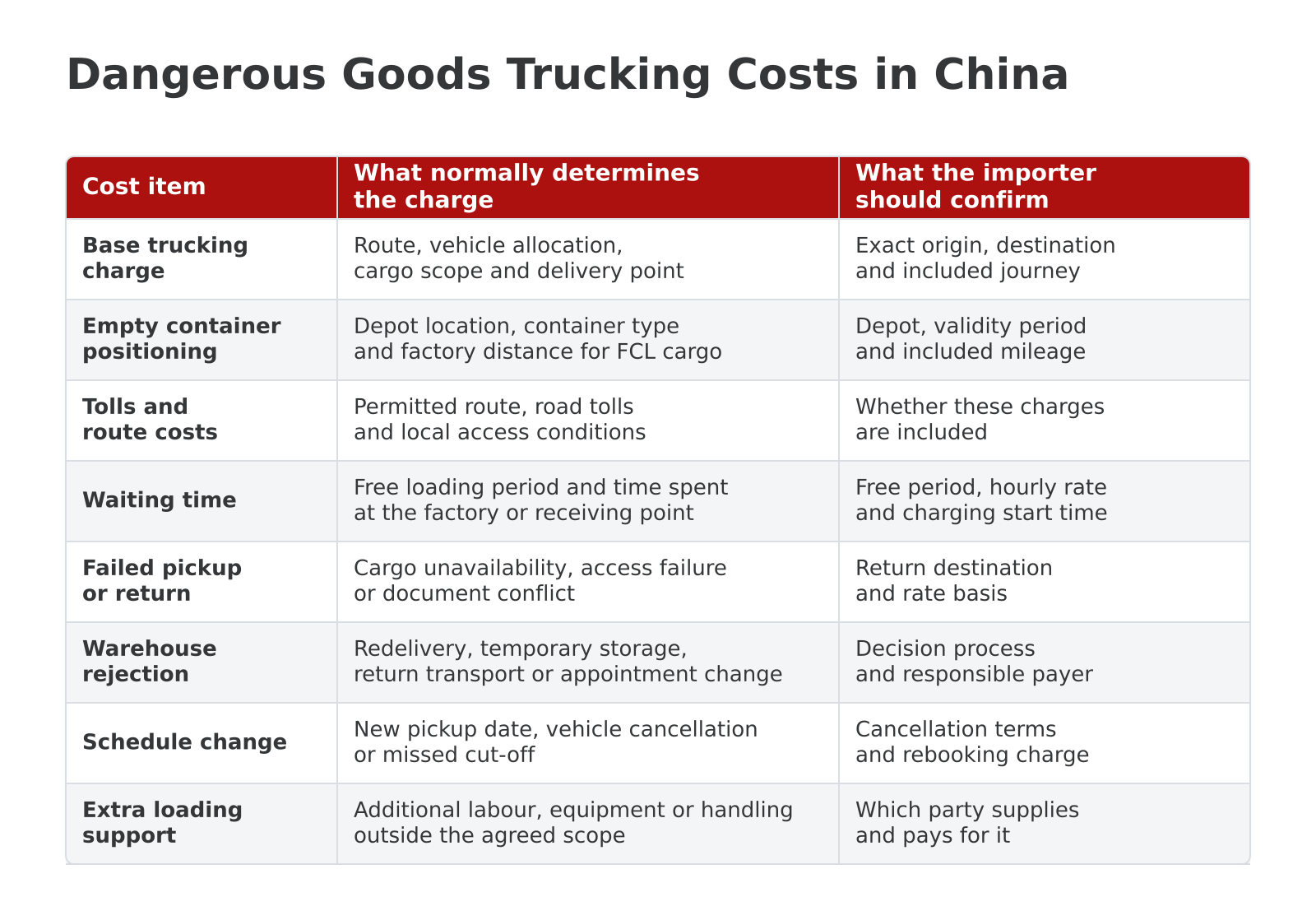
A useful quote separates the confirmed base service from conditional charges. It should also state the quotation validity and the assumptions behind the vehicle allocation.
The lowest initial rate can become expensive when it excludes waiting time, tolls, warehouse appointments or return transport. Compare the complete responsibility and charge structure before authorising factory release.
Checklist Before Dangerous Goods Pickup from a Chinese Factory
Use this final check after the cargo review and before the supplier releases the shipment. Record evidence rather than relying on an informal confirmation that everything is ready.
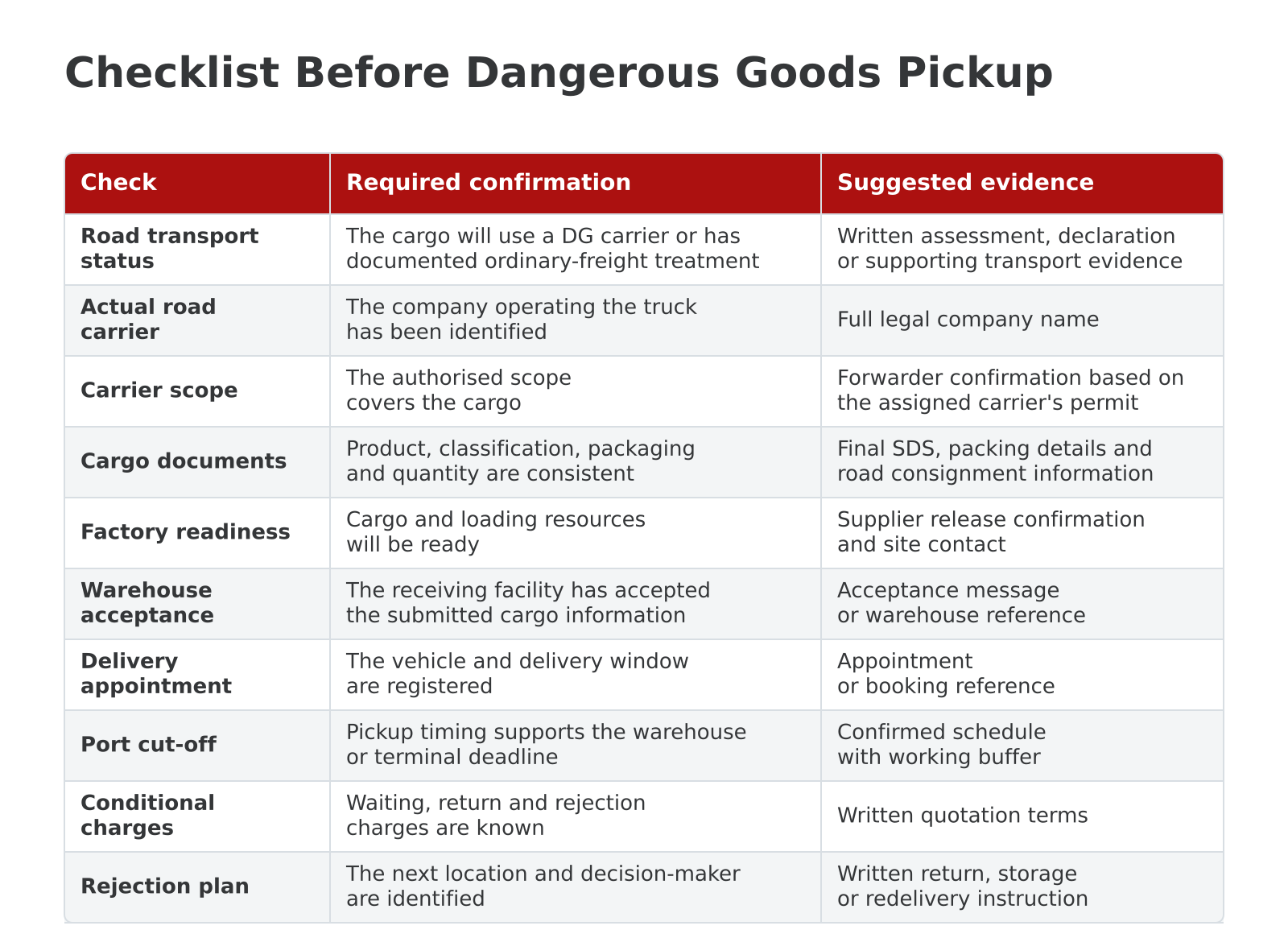
Release the cargo only when unresolved items have a named owner and a deadline. A pending item should remain visible in the shipment plan until it is closed.
How Gerudo Logistics Coordinates Dangerous Goods Factory Pickup
Gerudo Logistics is a dangerous goods specialist freight forwarder in China. Gerudo Logistics does not operate its own dangerous goods truck fleet. The company coordinates qualified road carriers whose authorised scope and assigned equipment fit the confirmed cargo and route.
Gerudo Logistics connects the supplier, actual road carrier, dangerous goods warehouse, port, ocean carrier and customs process. The review covers cargo information, road transport status, pickup documents, receiving acceptance and timing before the factory releases the shipment.
This coordination can support approved dangerous goods shipments in drums, intermediate bulk containers, ISO tanks and other suitable formats. Collection remains subject to the cargo category, package condition, factory address, route, receiving arrangement and acceptance by the actual road carrier.
For a shipment-specific review, contact Gerudo Logistics with the SDS, packing details, factory address and proposed destination.
Frequently Asked Questions for China Inland Transportation
Can Dangerous Goods Share a Truck with General Cargo in China?
Fully regulated dangerous goods and ordinary cargo cannot generally be mixed in the same vehicle. Qualifying excepted quantity or limited quantity packages can be mixed under China's special rules, and shipments below the stated thresholds can receive ordinary-freight road treatment when every condition is documented.
Can Several Dangerous Goods Products Use the Same Pickup Vehicle?
They can share a vehicle only when the carrier approves the combination, its authorised scope covers every product and the loading arrangement meets compatibility and segregation requirements. Provide the classification, packaging and quantity of each product for review.
Can One Truck Collect Dangerous Goods from Several Chinese Suppliers?
A multi-supplier collection can be arranged when the carrier approves every cargo and pickup point, the products can travel together and each supplier can provide consistent documents. The route, loading sequence, total quantity and receiving appointment must be confirmed before the first collection.
Can a Supplier Use Its Own Vehicle for Dangerous Goods Delivery?
An ordinary supplier vehicle should not be used for regulated dangerous goods. A supplier-owned dedicated vehicle is possible only when the company qualifies for the relevant non-commercial dangerous goods transport permission and the vehicle, personnel and cargo scope meet the applicable requirements.
Can Dangerous Goods Be Collected Before Ocean Carrier Approval?
Collection can proceed only when the road journey and a lawful receiving or storage location have been confirmed. Moving cargo while ocean acceptance remains pending creates storage, redelivery and missed-sailing risk, so the importer should approve this exposure in writing.
Does Carrier Liability Insurance Cover the Cargo Value?
Chinese rules require dangerous goods road carriers to hold carrier liability insurance. This does not automatically provide all-risk cargo cover or guarantee payment of the full commercial invoice value, so check the policy limit, exclusions and separate cargo insurance requirement.
Can Rejected Cargo Be Delivered to Another Dangerous Goods Warehouse?
Another warehouse can receive the cargo only after it reviews and accepts the shipment and issues the necessary delivery instruction. The road carrier must also approve the revised destination and route before the vehicle moves.