How to Calculate Landed Cost When Importing from China to the EU
The supplier price shows what the goods cost at an agreed point in the transaction. It does not show what the shipment will cost when it reaches your EU warehouse. Origin charges, international transport, customs duty, import VAT, destination handling and final delivery can all change the commercial result.
An accurate calculation also separates customs value, the import VAT taxable amount and total landed cost. These figures serve different purposes. This guide explains how to calculate each layer, estimate the cash required at import and determine the net landed cost per saleable unit.
EU Landed Cost Calculation Sequence
Landed cost is a commercial calculation rather than a single EU customs formula. Start with the same shipment-level structure used for any import:
Landed cost = Product cost + origin costs + freight and insurance + import charges + destination costs + final delivery + cargo-specific costs
EU imports require additional calculation stages because customs duty and import VAT use different bases. Import VAT can also affect cash flow without remaining in the final product cost.
The EU calculation then moves through four stages. First establish the customs value and calculate the applicable import duties. Next determine the VAT taxable amount. Finally, separate the cash required at import from the permanent cost after any eligible VAT recovery.
The calculation requires a clear VAT assumption. Import VAT can create a cash requirement even when the importer can later recover it. If recovery is unavailable, the VAT remains part of the product cost.
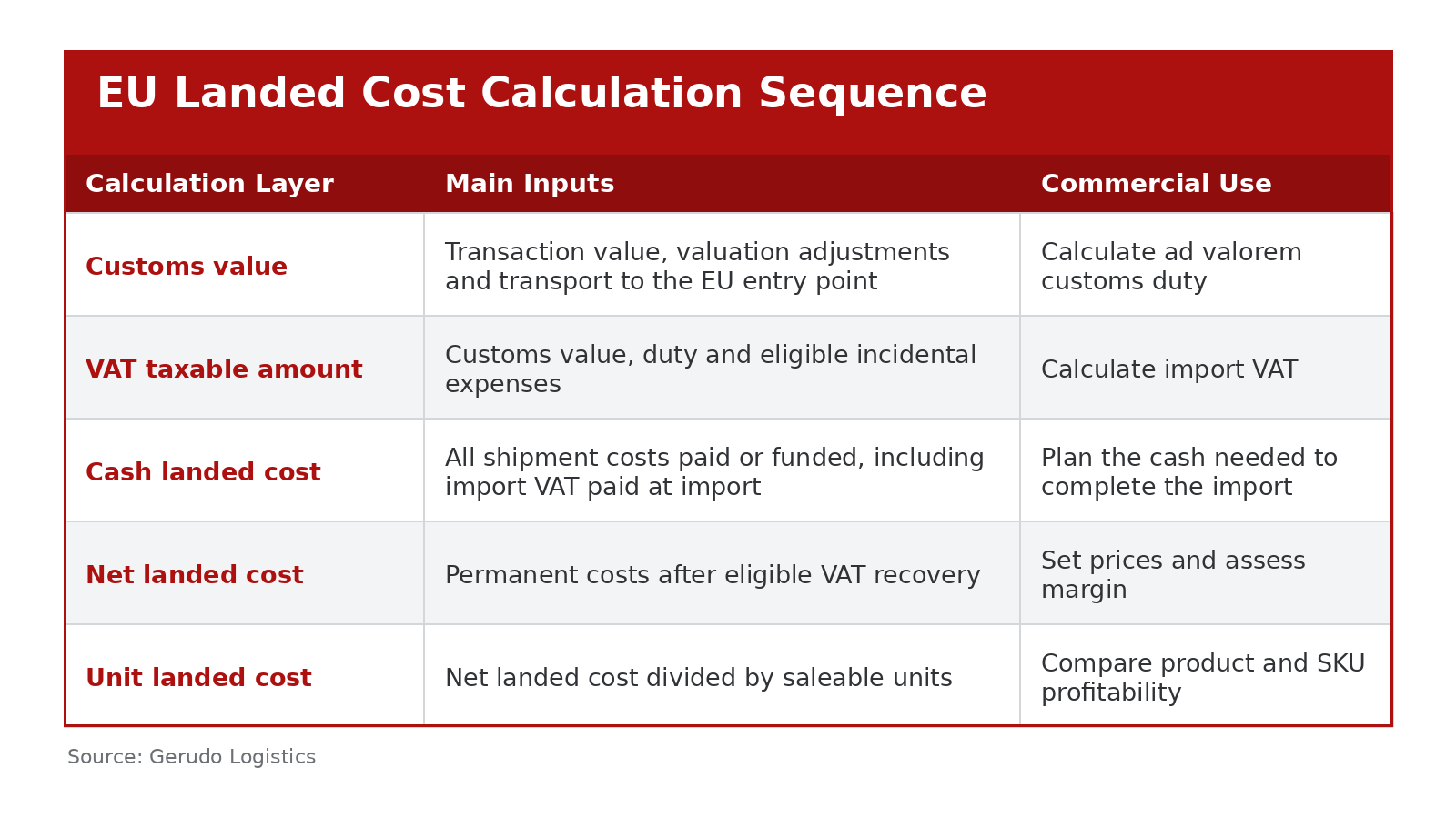
Treat this sequence as a planning framework. The importer or customs representative must confirm the customs value, tariff measures and VAT treatment for the actual declaration.
Costs Included in China to EU Landed Cost
Landed cost should include every cost required to move a saleable product from the supplier to the intended EU destination. The exact lines depend on the Incoterm, route, cargo and import arrangement.
Supplier and origin costs: The goods, supplier packaging, pickup, China customs clearance, loading and origin documents not already included in the quoted price.
International transport and insurance: Ocean, air, rail or multimodal freight, plus cargo insurance where purchased separately.
Import and destination charges: Customs duty, trade defence duties, other applicable import taxes, terminal handling, customs clearance, inspections, storage and final delivery. Add CBAM certificate costs when the goods and importer fall within the mechanism.
Specialist cargo costs: Dangerous goods assessment, compliant packing, carrier surcharges, reefer equipment, temperature monitoring or heavy-lift handling.
Loss allocation: Samples, inspection losses, damage and other unsaleable units. These change landed cost per unit even when the shipment total remains unchanged.
Do not add every quoted amount automatically. First determine whether the supplier, freight forwarder or destination agent has already included it elsewhere. A duplicated freight or handling line will overstate the result as easily as a missing charge will understate it.
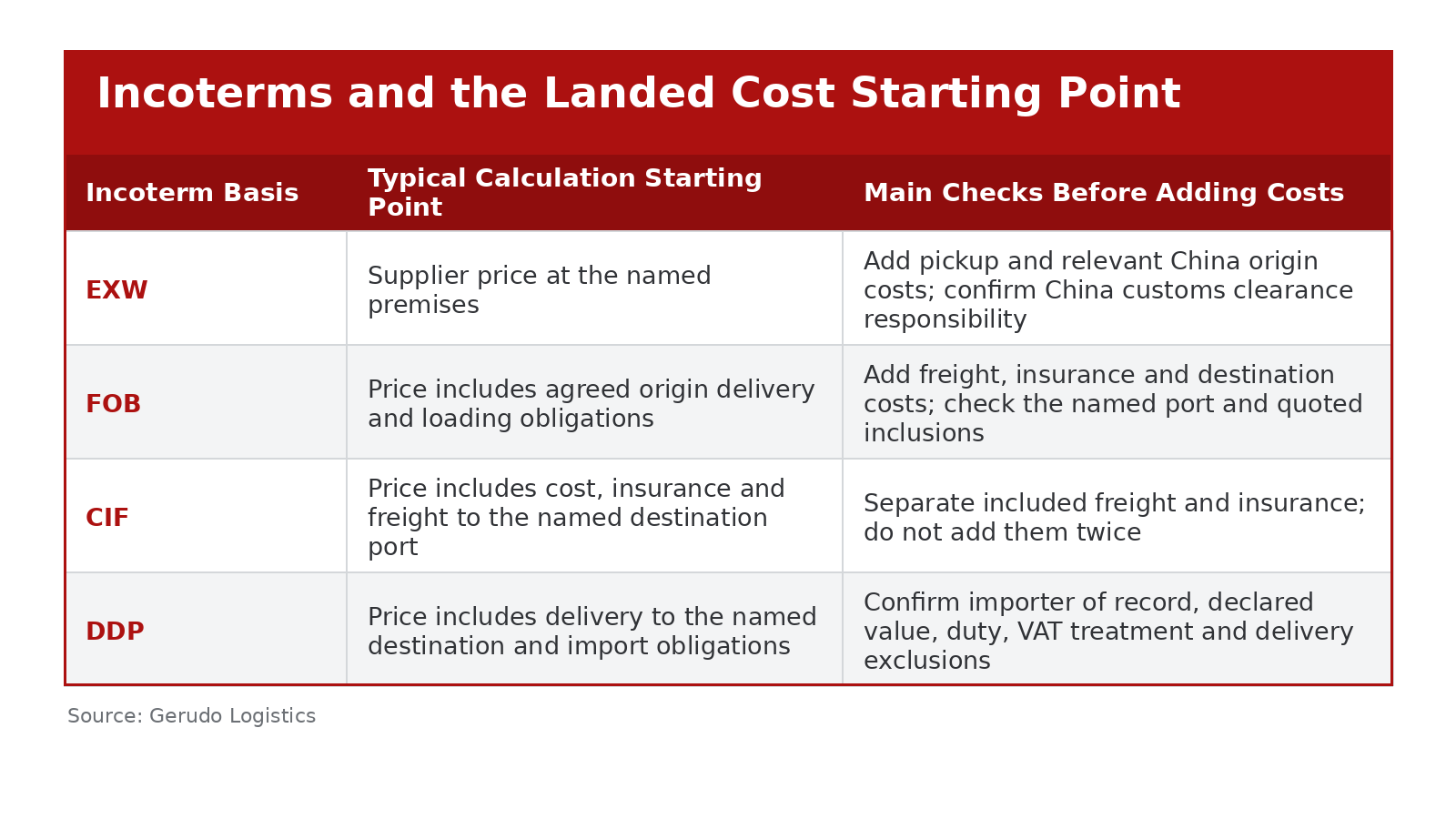
Incoterms and the Landed Cost Starting Point
The agreed Incoterm helps identify which costs the supplier price already includes. It does not determine the customs value or replace EU valuation rules.
EXW and FOB Calculations
An EXW price normally leaves more origin costs outside the supplier invoice. The importer should obtain the pickup address, packed dimensions, weight and China customs arrangement before comparing it with a FOB offer.
A FOB price usually includes more of the movement to the named Chinese port. However, the quotation must still state what it covers. Warehouse handling, China customs documents or cargo-specific charges can remain separate even when the commercial term is FOB.
Compare supplier offers on the same cost boundary. An EXW price can look lower than a FOB price while producing a higher total once pickup and origin handling are included.
CIF Calculations
A CIF price includes cost, insurance and freight to the named port under the Incoterm. The importer still needs the freight and insurance breakdown when calculating customs value and comparing transport offers.
Do not add the full international freight and insurance again if the supplier price already includes them. Destination terminal charges, customs clearance and final delivery also require separate confirmation because CIF does not mean delivered to the importer’s warehouse.
DDP Quote Review
A DDP total can be convenient for budgeting, but the total alone does not show whether the import arrangement supports the buyer’s accounting or VAT position.
Before using a DDP price as the landed cost, confirm:
Importer of record: Identify the party named in the import declaration.
Declared customs value: Check the value and transaction documents used for clearance.
Duty and import VAT: Request a clear breakdown instead of treating both as an unspecified inclusive amount.
VAT evidence: Confirm who holds the import documentation and whether the buyer has a valid basis for any intended recovery.
Delivery scope: Check unloading, appointment delivery, storage and other possible exclusions.
Two DDP offers are not commercially comparable when one uses a transparent import arrangement and the other provides no evidence of how the goods enter the EU.
EU Customs Value for Goods from China
Customs value is the basis for calculating ad valorem customs duty. It is not the same as the final landed cost.
The transaction value is the main EU valuation method. It starts with the total price paid or payable for the imported goods, with the additions and deductions required under customs rules. If the transaction value method cannot apply, five other valuation methods follow in a defined order.
Transaction Value Method
The supplier invoice is an important starting document, but the invoice total is not automatically the final customs value. The importer must examine the sale, the parties and the amounts paid directly or indirectly for the imported goods.
Related-party transactions, indirect payments, free materials supplied to the manufacturer and royalties can require additional review. A customs representative needs commercial evidence that supports both the price and any adjustment.
Additions to the Declared Product Value
Depending on the transaction, customs value can require additions for:
Transport and insurance: Costs up to the point where the goods enter the EU customs territory.
Loading and handling: Related costs incurred up to that entry point.
Assists: Certain materials, components, tools, designs or services supplied by the buyer free of charge or at a reduced cost for producing the imported goods.
Royalties and licence fees: Relevant payments that meet the conditions for inclusion.
Selling commission: Commission paid by the buyer that qualifies for inclusion.
Only add a cost once. If the commercial price already contains freight or another required element, the calculation should identify that included amount rather than duplicate it.
Costs After Entry into the EU
Transport costs after entry into the EU customs territory can be excluded from customs value when they are distinguished from the price paid or payable. The same principle prevents an importer from treating all freight to the final warehouse as dutiable by default.
This boundary does not mean that every post-entry cost disappears from the tax calculation. Transport and other incidental expenses can still enter the import VAT taxable amount under separate VAT rules.
Customs Duty and Import VAT Calculation
Customs duty and import VAT should be calculated in sequence because the duty can form part of the VAT taxable amount.
Customs Duty
For an ad valorem rate:
Customs duty = Customs value × applicable duty rate
The correct rate depends on the product classification, origin and measures in force on the declaration date. TARIC integrates EU tariff measures, quotas, suspensions and trade defence instruments. It does not provide national VAT rates. Importers should check the current EU TARIC database and its applicable measures before finalising the estimate.
Anti-dumping or countervailing duties can materially alter landed cost even where the ordinary third-country duty is low.
For the explanation of EU tariffs, VAT and trade measures, read Import Duties from China to Europe in 2026.
VAT Taxable Amount
The import VAT taxable amount starts with customs value. It also includes customs duty and other taxes or charges due because of the import, excluding the VAT itself.
When not already included in customs value, the base can include commission, packing, transport and insurance to the first destination in the importing Member State. It can also include transport to another EU destination when that destination is known at import.
The European Commission guidance on the import VAT taxable amount defines the first destination by reference to the consignment note or another import document. If the documents do not identify one, the first cargo transfer point in the importing country can become the relevant destination.
Import VAT
Use the rate that applies in the importing Member State and to the imported goods. Do not use a general EU average.
The customs declaration currency conversion and the importer’s internal budget exchange rate can also differ, so the estimate should record which rate and date it uses.
Recoverable Import VAT and Net Landed Cost
Import VAT can affect two different commercial figures:
Cash required at import: The amount that the importer must pay, fund or account for when the goods clear customs.
Permanent product cost: The amount that remains after any import VAT the business is legally entitled to recover.
A VAT-registered business may be able to deduct import VAT when the importer, documentation and business use meet the applicable conditions. VAT registration alone does not guarantee recovery.
Before excluding import VAT from net landed cost, confirm:
the business named as importer;
the import declaration and VAT evidence it holds;
the VAT registration used for the transaction;
the intended taxable business use of the goods;
any restriction on input VAT deduction;
the reporting procedure in the importing Member State.
Postponed accounting or a deferment arrangement can reduce the immediate funding burden. It changes when or how VAT is accounted for. It does not by itself decide whether the VAT is deductible.
For internal reporting, retain both the cash landed cost including any VAT funded at import and the net landed cost after eligible VAT recovery. This preserves the cash-flow requirement without treating recoverable tax as a permanent product cost.
The importer should confirm VAT recovery and reporting with its customs representative or local VAT adviser.
China to EU Landed Cost Calculation Example
The following example demonstrates how ordinary customs duty and anti-dumping duty enter the same landed cost calculation.
Assume an importer buys 2,400 lengths of aluminium alloy profiles from China under FOB Ningbo terms. The goods enter the EU through Rotterdam and move to the importer’s warehouse in Utrecht, which is stated as the first destination in the import documents.
For this illustrative calculation, assume the profiles fall within the product scope of the EU anti-dumping measure on certain aluminium extrusions originating in China. Assume the producer is subject to the 32.1% rate for all other companies.
A real entry requires current verification of the product scope, origin, producer and applicable TARIC measures. The 7.5% ordinary customs duty and all shipment amounts below are assumptions used to demonstrate the calculation.
This example excludes CBAM certificate costs and related compliance expenses. Aluminium products fall within CBAM only when their CN code is covered, and the cost depends on factors such as imported mass, embedded emissions and the applicable certificate price. Add any confirmed CBAM exposure as a separate landed-cost line.
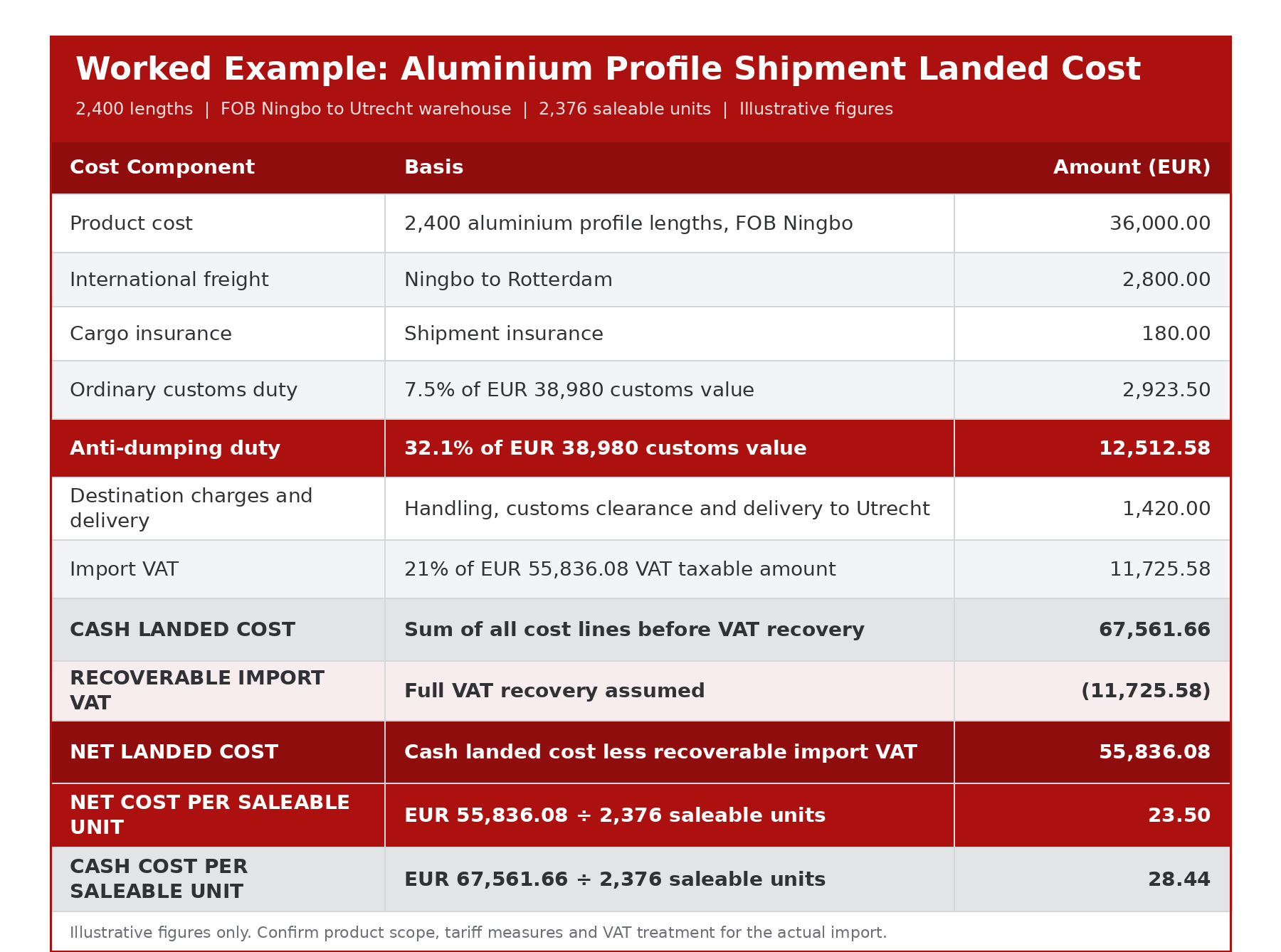
The calculation assumes that no assists, royalties or other customs-value adjustments apply. It also uses the EUR 38,980 customs value as the net free-at-Union-frontier price before duty for the anti-dumping calculation. If the import VAT were not recoverable, the net landed cost would remain EUR 67,561.66.
The anti-dumping duty adds EUR 12,512.58 to the permanent shipment cost in this example. It also increases the VAT taxable amount. Recoverable import VAT does not remain in net landed cost, but the anti-dumping duty does.
Landed Cost Allocation Across Multiple Products
A mixed shipment needs a consistent method for allocating shared costs. Dividing the total equally across all units can distort margins when products have different values, dimensions, weights or duty rates.
Use the cost driver that best explains each charge:
Product cost: Assign the invoice value directly to each SKU.
Customs duty: Calculate by classification and customs value. Do not apply one average duty rate to products with different TARIC measures.
Freight: Allocate by gross weight, volume, chargeable weight or another documented factor that reflects how the carrier priced the shipment.
Insurance: Allocate by insured value unless the policy uses another basis.
Handling and clearance: Allocate by shipment, customs line, pallet, SKU or unit according to how the cost arose.
Specialist cargo charges: Assign directly to the products that caused the requirement where possible.
Losses: Divide final SKU cost by saleable quantity after known damage, samples or inspection losses.
Document the method and apply it consistently. A reasonable allocation method should be explainable to purchasing, finance and customs teams.
Common EU Landed Cost Calculation Errors
Treating every value as the same base: Customs value, the VAT taxable amount and landed cost include different items.
Adding CIF freight twice: Freight and insurance already included in the supplier price must be identified before adding logistics costs.
Using EXW as the full origin cost: Pickup, China customs clearance and cargo-specific origin charges can remain outside the EXW product price.
Including all EU inland transport in customs value: Post-entry transport should be separated where the customs rules permit, although relevant expenses can still affect the VAT base.
Applying one duty rate to every SKU: Each product requires the correct classification and applicable TARIC measures.
Treating recoverable VAT as a permanent cost: This understates the product margin after eligible VAT recovery.
Ignoring import VAT cash flow: Excluding VAT entirely can understate the money needed to complete customs clearance.
Dividing by the ordered quantity: Damaged, sampled or unsaleable units increase the cost of the remaining saleable stock.
Omitting conditional charges: Inspections, storage, demurrage, repacking or failed delivery can change the final result. Keep a separate contingency rather than presenting them as guaranteed fees.
Information Required for an Accurate Landed Cost Estimate
An accurate estimate needs enough information to establish the quotation boundary, customs assumptions and VAT treatment.
Product and classification: Commercial description, material, function, model, available HS/CN/TARIC code and any existing customs ruling.
Commercial basis: Supplier quotation, pro forma invoice, currency, agreed Incoterm and named place.
Cargo and origin: Supplier address, loading location, quantity, package count, dimensions, gross weight and cubic volume.
EU import plan: Entry point, importing Member State, final delivery address, importer of record, customs representative and VAT arrangement.
Transport conditions: Preferred mode, delivery requirement and any dangerous goods, temperature-control or oversized-cargo restrictions.
Cost status: Confirmed charges, amounts already included in the supplier price and destination costs that remain conditional.
A preliminary estimate should label assumptions clearly. Replace them with confirmed values before approving the purchase price, sales margin or shipment budget.
How Gerudo Logistics Supports China to EU Cost Planning
Gerudo Logistics can prepare a transport quotation that separates China origin services, international freight, cargo-specific charges and destination delivery. This breakdown helps importers compare supplier terms and identify which logistics amounts still need to enter the landed cost model.
Duty and VAT estimates depend on the importer’s product classification, valuation information and EU customs arrangement. Gerudo Logistics coordinates the shipping information required for the estimate, while the importer and its EU customs representative confirm the final customs and VAT treatment.
Contact Gerudo Logistics with the supplier term, cargo data and destination to request a shipment-specific quotation.
Frequently Asked Questions
Which Exchange Rate Should Be Used for the Calculation?
Use the exchange rate required by the customs authority for the customs declaration. Keep it separate from the purchasing budget rate and the rate charged by the payment provider so that currency differences remain visible.
How Should a 2026 CBAM Cost Be Recorded Before Certificates Are Purchased?
Record estimated CBAM exposure separately from customs duty and import VAT, then update it when the embedded emissions and certificate price are confirmed. This keeps the shipment’s economic cost visible even when the certificate purchase occurs after the goods enter the EU.
Should Currency Conversion and Supplier Payment Fees Be Included?
Include bank charges, payment platform fees, hedging costs and currency conversion losses when they arise from buying the goods. Keep them separate from customs value unless EU valuation rules require a particular amount to be included.
How Should Demurrage and Storage Be Treated Before the Amount Is Known?
Do not present an uncertain charge as a fixed cost. Record a separate contingency based on the cargo, route and free-time exposure, then replace it with the actual invoice when the shipment is complete.
What Happens When the Final Freight Invoice Differs from the Quote?
Update the landed-cost model with the final freight, surcharge and destination invoices. Keep both the budget and actual versions so purchasing and finance teams can see whether the variance came from freight, customs, delay or currency changes.
Should Financing Costs Be Added When Import VAT Is Recovered Later?
The recoverable VAT itself can be excluded from net landed cost, while the cost of funding it can still be a real commercial expense. Record interest or financing charges separately when the delay between payment and recovery is material.
How Often Should an EU Landed Cost Estimate Be Updated?
Review it before the purchase order, before shipment and after final invoices arrive. Recalculate earlier when freight rates, exchange rates, TARIC measures, the import route or the VAT arrangement changes.
Treat this sequence as a planning framework. The importer or customs representative must confirm the customs value, tariff measures and VAT treatment for the actual declaration.