Shipping Liquid-Cooled BESS from China: Coolant Handling Guide
Sea freight is the main option for complete liquid-cooled battery energy storage systems (BESS). A cabinet can move inside a dry container when its packed size, weight and securing plan fit the equipment limits. A container-type unit can move as a shipper-owned container (SOC) only when its structure, CSC status and handling design support direct container transport. Larger units may require a flat rack, open-top container or project cargo arrangement.
Liquid cooling adds a separate review layer. The importer needs the battery classification records, exact coolant data, approved fill condition and final handling information before accepting a route or quotation. This guide focuses on how the cooling system changes the shipping plan.
At a Glance
How are complete units usually shipped? By sea freight, using FCL, an SOC booking, flat rack equipment or a project cargo arrangement according to the unit design.
Does liquid-cooled BESS require a reefer container? No. Liquid cooling is part of the equipment design and does not mean the cargo needs refrigerated transport.
Must the coolant always be drained? No. Filled, partially filled and drained conditions can all be considered when supported by the manufacturer and accepted for the route.
Is every container-type BESS automatically UN 3536 or an SOC? No. Dangerous goods classification and direct container handling require separate evidence.
Shipping Methods for Liquid-Cooled BESS from China
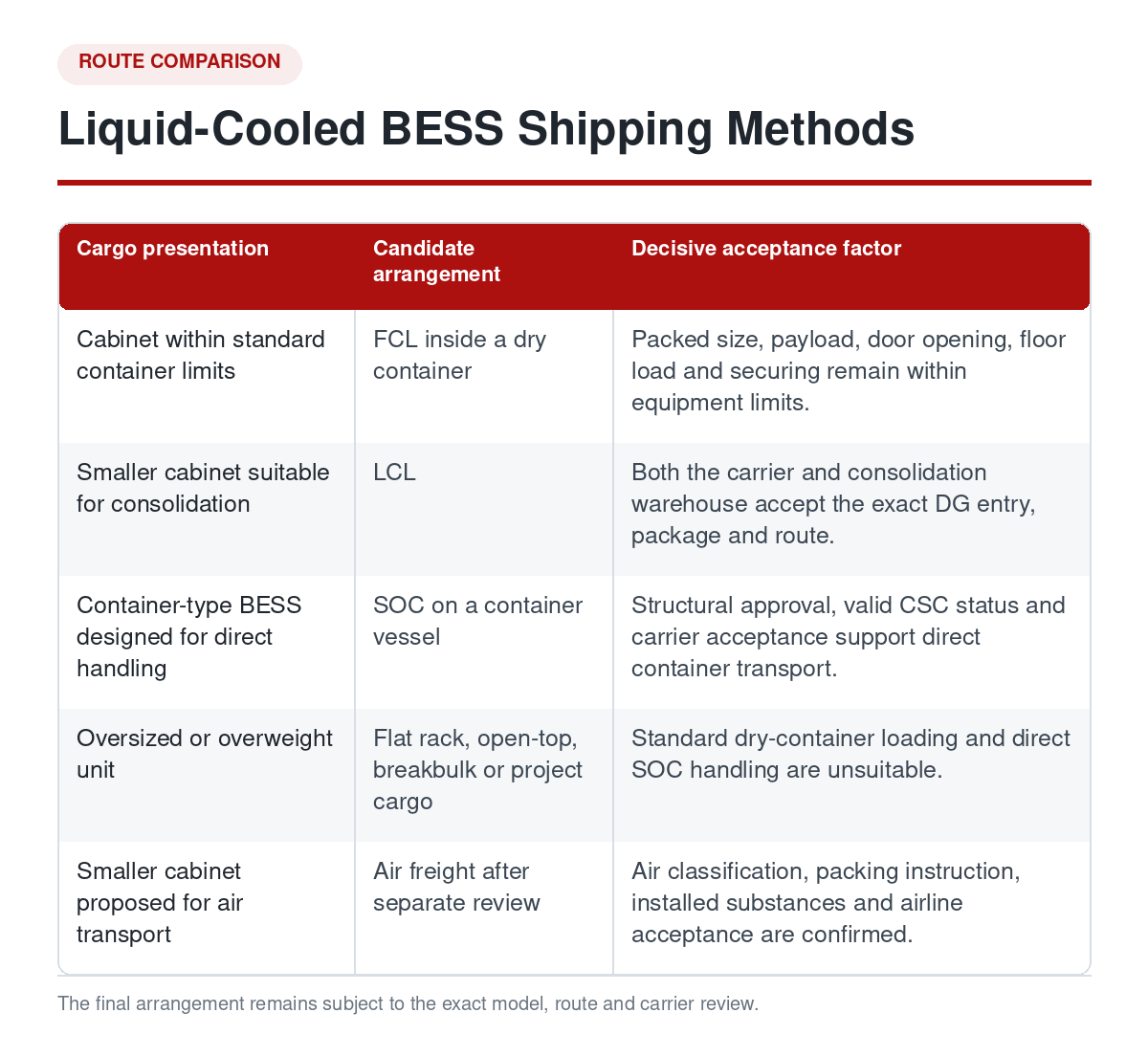
The first route decision is whether the BESS will be loaded inside freight equipment or handled as a container unit itself. Classification, fill condition, dimensions, weight and structural status determine the final arrangement.
FCL and LCL for BESS Cabinets
FCL is usually the first candidate for a cabinet that fits inside a standard dry container. The packing plan must confirm the loaded dimensions, gross weight, floor pressure, restraint points and safe access for loading.
LCL has an additional acceptance point. The ocean carrier and consolidation warehouse must both approve the exact dangerous goods entry and package design for the proposed route. A carrier indication alone does not confirm warehouse acceptance.
SOC Booking for Container-Type BESS
An SOC booking requires structural evidence. Container-style dimensions and corner fittings do not establish that a BESS can be lifted, stacked and carried as a freight container. The owner should provide the CSC plate details, current examination status, approved gross mass and relevant structural records.
The carrier and terminal review the actual model. If they do not accept direct container handling, the freight forwarder should assess flat rack, breakbulk or project cargo alternatives.
Flat Rack and Project Cargo for Oversized Units
Flat rack or open-top equipment can suit units that exceed dry-container door or internal dimensions. Approval depends on gross weight, load distribution, over-width or over-height exposure, securing points and terminal limits.
Project cargo becomes relevant when the unit exceeds container equipment or inland transport limits. The route then needs coordinated lifting, vessel stowage, port discharge, road permits and site delivery planning.
Air Freight for Smaller BESS Cabinets
Air freight requires a separate assessment. It is unsuitable for complete container-type units. A smaller cabinet can be considered after reviewing the applicable battery entry, packing instruction, state of charge, coolant and other installed substances. Airline acceptance remains specific to the cargo and route.
Transport Classification for Liquid-Cooled BESS
The battery configuration determines the main dangerous goods entry. The term liquid-cooled describes the thermal-management design and does not assign a UN number.
UN 3536 for Container-Type Units
UN 3536 is a Class 9 entry for lithium batteries installed in a cargo transport unit and designed only to provide power outside that unit. Under Special Provision 389 in the IMDG Code, the batteries must meet the applicable battery provisions, include overcharge and overdischarge protection, and be securely attached within the cargo transport unit.
The finished unit must meet those conditions. A cabinet cannot use UN 3536 solely because it resembles a 20-foot or 40-foot container. If the conditions are not met, the classification must follow the actual battery chemistry and shipping configuration. UN 3481 can be relevant to lithium-ion batteries contained in equipment.
Effect of Coolant on the Main Entry
The coolant does not replace the battery entry. A non-regulated coolant does not turn a Class 9 BESS into general cargo. A regulated coolant still needs to be assessed as part of the finished configuration.
Special Provision 389 can cover an installed dangerous substance that is necessary for the safe and proper operation of a UN 3536 cargo transport unit. It must be properly secured or installed. The importer still needs evidence of the substance, its function and its installation. Spare liquid carried for later use remains separate cargo.
Shipping Liquid-Cooled BESS with or without Coolant
There is no universal requirement to drain every liquid-cooled BESS. The correct shipping condition depends on the coolant, circuit design, manufacturer instructions, transport configuration and route acceptance.
Identify the Installed Coolant
Request the working-mixture data, including:
Exact product: Product name and manufacturer.
Current SDS: A Safety Data Sheet for the mixture installed during transport.
Concentration: The final dilution or formulation in the circuit.
Installed volume: Total liquid quantity in each unit.
Transport information: The classification stated in Section 14 of the SDS.
A concentrate SDS may be insufficient. The concentrate and working mixture can have different transport properties, so the document must match the product and concentration inside the shipped unit.
Compare Filled, Partially Filled and Drained Conditions
A filled system can reduce refilling and commissioning work at destination. The manufacturer should confirm that the circuit is designed to remain filled during transport. The submission should include any leak-test, isolation or inspection evidence requested for the route.
A partially filled system requires a stated residual quantity and a technical reason for retaining it. The shipping instructions should address liquid movement, expansion space, corrosion protection and the restart process.
A drained system removes most free liquid but does not change the battery declaration. The manufacturer should record the drainage method, expected residue and protection applied to the empty circuit.
The importer should compare the complete cost of each condition. Draining can add origin work and destination recommissioning. Keeping the circuit filled can add weight, testing and leakage-control requirements. The manufacturer should also confirm any effect on seals, warranty and storage limits.
Review Other Installed Substances Separately
The cooling circuit, HVAC system and fire-suppression system are separate. The manufacturer must identify each installed substance and its quantity. Liquid cooling does not prove that the equipment contains R-32 or any other refrigerant.
Class 2 substances require separate attention. An HVAC refrigerant or pressurised fire-suppression agent cannot be treated as coolant data. Configurations containing Class 2 gas cargo are outside the current standard service scope of Gerudo Logistics.
Preparing Liquid-Cooled BESS for Transport
The handling file must match the shipped condition. A drawing prepared for an empty prototype cannot support a filled production unit when the weight, centre of gravity or projections have changed.
Cabinets Loaded Inside a Freight Container
The packing drawing should show cabinet orientation, floor load, restraint points and inspection access. Coolant pipes, valves, manifolds and exposed connections need protection against impact during loading and inland movement.
Leakage controls should follow the manufacturer's risk assessment. Suitable measures can include protected isolation points, inspection access and compatible containment. They must not obstruct required ventilation or create a new hazard around the battery system.
Container-Type Units and CSC Status
Direct container handling requires a CSC review. The owner should provide the safety approval plate, current examination status and structural data for the planned gross mass before an SOC booking is proposed.
CSC approval and dangerous goods classification serve different purposes. CSC evidence supports structural safety for container handling. It does not establish the UN number. A unit without suitable CSC evidence may still be assessed as cargo on a flat rack or project vessel.
Lifting and Securing Data
The manufacturer should issue one consistent handling file containing:
Transport dimensions: Include vents, guards, pipework and temporary covers.
Verified gross weight: State the weight for the selected coolant condition.
Centre of gravity: Give the location in each relevant axis.
Lifting points: Identify approved lifting methods and sling angles.
Securing points: State allowable loads and the restraint arrangement.
Shutdown condition: Confirm electrical isolation and protection against accidental operation.
Final production data should control the booking. Sales drawings and nominal weights are unsuitable for lifting, securing or heavy-haul approval.
Documents Required for Carrier Approval
The core BESS file should identify the exact model, battery chemistry, selected UN entry and shipping configuration. The UN 38.3 test summary must match the installed cell or battery type. The route can also require a battery SDS, transport appraisal, dangerous goods declaration and state-of-charge evidence. See the Gerudo Logistics dangerous goods documentation guide for the purpose of the standard records.
The liquid-cooling file adds evidence that is specific to the shipped system:
Working-mixture SDS: Match the product and concentration in the circuit.
Approved fill condition: Identify whether the system is filled, partially filled or drained.
Installed volume: State the total coolant quantity in each unit.
Leak evidence: Provide the test or inspection record requested for a filled system.
Drainage statement: Record the method and expected residue for a drained system.
Installed-substance list: Identify separate refrigerants, suppression agents and other regulated materials.
Updated handling file: Match the final weight, centre of gravity and lifting arrangement.
Commercial and transport records must remain consistent. The invoice, packing list, classification file and handling drawing should use the same model, quantity and gross weight. A coolant-condition change after submission requires the affected documents and quotation to be updated.
Liquid-Cooled BESS Shipping Costs
A useful quotation separates confirmed charges from conditional charges. Battery capacity alone cannot predict the freight cost because two units with the same MWh rating can use different transport equipment, fill conditions and delivery arrangements.
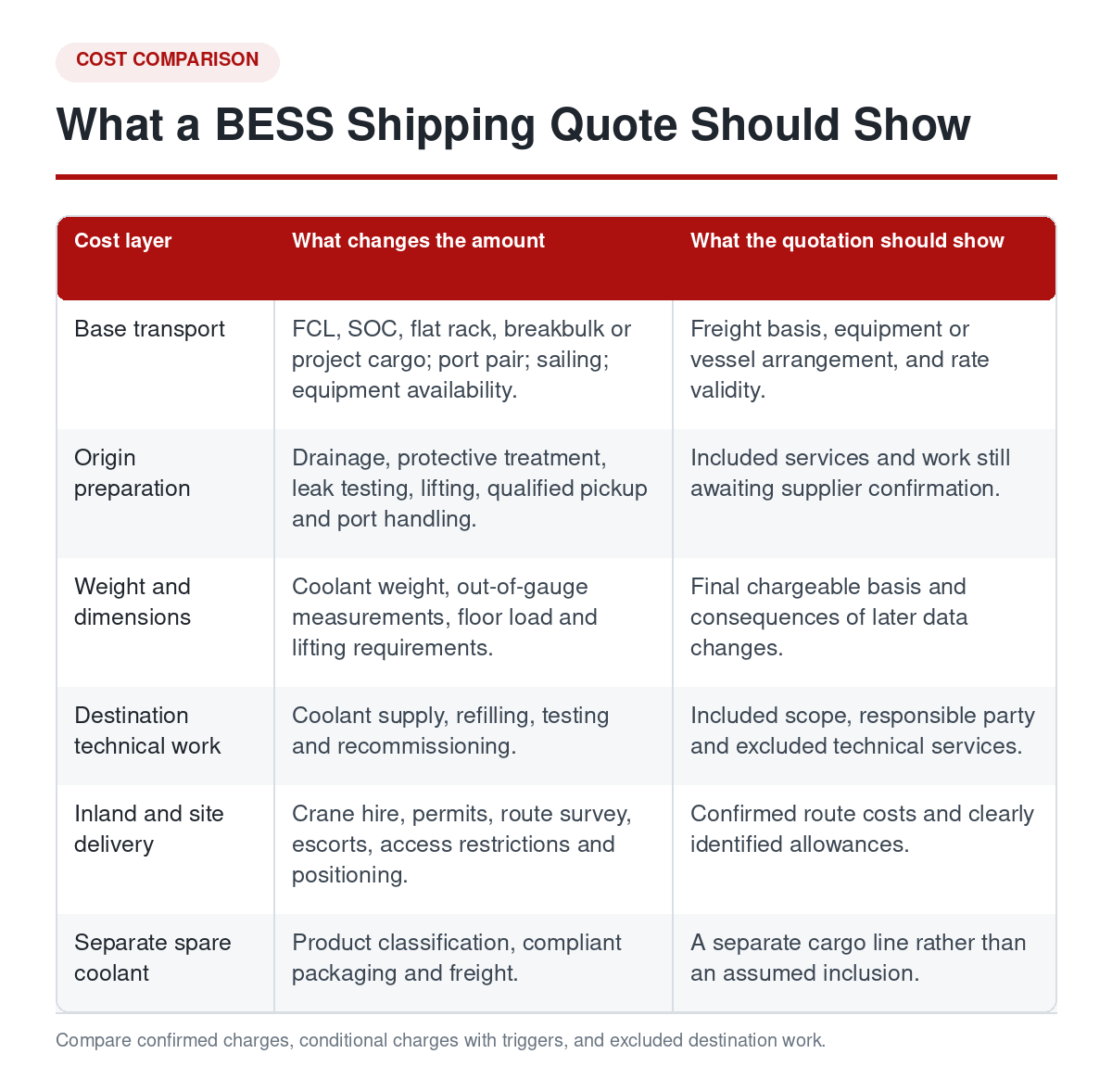
Filled and drained conditions move costs between stages. A filled shipment can increase gross weight and add leakage-control evidence. A drained shipment can add origin treatment, residue records, approved coolant supply and recommissioning at destination.
The importer should request a three-part quotation: confirmed transport charges, conditional charges with stated triggers, and destination work that remains excluded or estimated. This structure makes competing quotations easier to compare and prevents an unresolved crane, test or permit from disappearing inside one freight figure.
US customs costs remain separate from freight. The final duty depends on tariff classification, origin, entry date and applicable Chapter 99 treatment. Importers can use the Gerudo Logistics US landed-cost guide to organise product value, freight, duty, fees and final delivery.
USA Import and Inland Transport Requirements
US-bound shipments need separate transport, customs and project reviews. Ocean carrier approval does not complete the US inland movement or confirm that the equipment can be installed at the destination site.
US Inland Carrier Review
The inland carrier should review the final configuration before the vessel leaves China. The submission should cover the dangerous goods description, installed substances, placarding, gross weight, vehicle or rail requirements and delivery route.
PHMSA Interpretation 24-0082 is configuration-specific. It confirms that the BESS cabinet described in that request met the US definitions of a freight container and cargo transport unit. It does not classify every BESS cabinet automatically. The PHMSA response also explains how Special Provision 389 applies to installed materials needed for safe and proper operation.
Customs and Project Approval
The UN number does not determine the HTSUS classification. The importer of record should provide the complete equipment specification to a licensed customs broker and confirm the tariff number, duty treatment, bond and entry requirements for the entry date.
Transport approval does not authorise installation or energisation. Electrical, fire, building, environmental and utility-interconnection approvals remain project responsibilities. The logistics plan still needs the site's access, unloading and positioning limits.
Information Required for a Liquid-Cooled BESS Shipping Quote
Send one confirmed shipment file containing:
Product identity: Manufacturer, model, quantity and final shipping configuration.
Battery details: Chemistry, classification records, UN 38.3 test summary and planned state of charge.
Installed coolant: Product, working-mixture SDS, concentration, volume and fill condition.
Other installed substances: Details of any refrigerant, fire-suppression agent or other regulated material.
Physical data: Final dimensions, gross weight, centre of gravity, lifting points and securing points.
Container status: Intended handling method, CSC plate details and examination status where relevant.
Route: Pickup address, loading port, discharge port, final destination and Incoterm.
Site conditions: Access limits, crane requirements, road restrictions and unloading responsibility.
US entry data: Importer of record, customs broker and existing tariff assessment for a US-bound shipment.
The quotation should identify unresolved approvals. Manufacturer data, carrier acceptance, terminal handling and inland-route approval should appear as open conditions when they have not been confirmed.
How Gerudo Logistics Supports Liquid-Cooled BESS Shipments
Gerudo Logistics is a dangerous goods specialist freight forwarder based in China. Gerudo Logistics reviews the battery classification file, working-mixture coolant data, installed substances and final handling information before proposing a route for an accepted configuration.
We coordinate the approved shipping plan from supplier pickup and dangerous goods documentation through carrier review, port handling, international transport, customs clearance and final delivery. This support covers accepted dangerous goods cargo across approved packaging and equipment formats, including machinery and containerised units.
Contact Gerudo Logistics with the model specification, fill condition and handling file to request a route review and quotation.
Frequently Asked Questions
Can Spare Coolant Travel in the Same Consignment as the BESS?
Yes, subject to separate review. The spare coolant must be classified, packed and declared for the selected mode, and the carrier must accept it with the BESS. It cannot be placed inside a UN 3536 cargo transport unit solely for later commissioning.
Can a Filled Liquid-Cooled BESS Be Tilted during Loading?
Only within the manufacturer's approved transport limits. The lifting plan should state the permitted orientation and tilt angle for the actual fill condition. The carrier should receive this information before approving the loading method.
Can a Filled BESS Obtain Marine Cargo Insurance?
Yes, subject to the insurer's assessment and policy terms. The insurance submission should disclose the dangerous goods classification, declared value, coolant quantity, fill condition, route and agreed lifting and leakage controls.
Can Carrier Approval Be Reused If the Route or Sailing Changes?
Reuse should never be assumed. A vessel, sailing, port, terminal or inland-route change can trigger a new review. The freight forwarder should reconfirm acceptance before moving the cargo.
Can Different BESS Models Be Included in One Booking?
Yes, when each model is documented and accepted. Classification records, coolant data, weight and handling information must identify every model. The carrier can then decide whether one booking and stowage plan can cover the complete shipment.
Can a Liquid-Cooled BESS Be Shipped to the USA under DDP Terms?
Yes, when the DDP structure is operationally complete. The parties must establish the importer-of-record arrangement, customs bond, broker entry, duty payment and compliant final delivery. The Incoterm does not replace dangerous goods or heavy-haul requirements.