Why Your DG Shipment Misses the Vessel: Cut-off Timelines Every Importer Must Know
Missing a vessel is expensive. For a general cargo shipment, a rolled container means rebooking fees, a one-week delay, and an awkward conversation with your customer. For a dangerous goods (DG) shipment, the consequences compound: rebooking a DG slot is harder, the documentation chain restarts, and some carriers will not accept your cargo on the next available sailing if the approval window has closed.
Most importers assume their freight forwarder is managing this. Many are. But in our experience, the single most common reason DG cargo misses its vessel comes down to a timing misunderstanding, not a process breakdown. The importer, the supplier, and the forwarder are all working from different assumptions about when things need to happen.
This article explains what DG cut-off actually means, why it functions as a chain of four separate deadlines rather than a single date, and what importers sourcing from China need to build into their planning cycles to avoid a rolled shipment.
What Is DG Cut-off? Why It Starts Earlier Than You Think
For standard cargo, cut-off refers to the CY (Container Yard) cut-off - the physical deadline by which your container must arrive at the port terminal. Most importers are familiar with this date. It appears on booking confirmations, and suppliers generally know to work backwards from it.
DG cargo operates on a different timeline entirely. Carriers and port terminals impose additional approval and documentation requirements before a hazardous goods shipment can be accepted. These requirements take time to process - sometimes several working days - and each stage has its own deadline. Miss any one of them and the cargo does not load, regardless of whether the container arrives at the terminal on time.
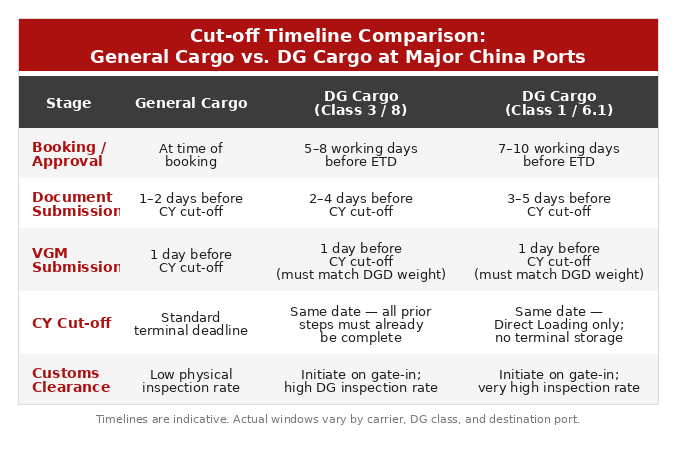
The gap between a general cargo CY cut-off and the earliest DG deadline can be five to ten working days on major China export routes. In practice, this means that if your supplier is working to the same timeline they use for non-DG cargo, they are already late.
The 4 DG Cut-off Deadlines in a China Shipment
DG cut-off is a chain, not a single date. Understanding each component tells you where delays actually originate and which stage requires the earliest action on your end.
1. DG Approval Cut-off - The First and Most Critical Gate
Before a carrier accepts a booking for dangerous goods, they must confirm that the specific cargo is approved for carriage on that vessel and route. This is the DG Approval Cut-off, and it is the earliest deadline in the chain.
The carrier's DG department reviews the cargo's UN number, packing group, quantity, and packaging type against their current acceptance policy.
For sea freight from China specifically, this process also involves MSA (Maritime Safety Administration) approval - the Chinese government authority that must clear the maritime DG declaration before the carrier can confirm acceptance.
This regulatory layer is the underlying reason DG Approval Cut-off sits so far ahead of the vessel departure date. The MSA review timeline is independent of the carrier's own process, and both must complete before the booking is confirmed.
Not all carriers accept all DG classes on all routes. Some restrict Class 1 (explosives) entirely. Others impose quantity limits on Class 3 flammable liquids or apply seasonal restrictions on certain chemical categories. A carrier that accepted your lithium battery shipment last quarter may have updated their policy this quarter.
In our experience, DG Approval Cut-off typically falls five to eight working days before the vessel's estimated departure on major China export routes from Shanghai, Ningbo, and Shenzhen. This timeline varies by carrier, DG class, and destination. The key point for importers: this approval must be initiated before your supplier has finished packing the cargo. If you are waiting for the goods to be ready before starting the approval process, you are already behind.
2. Document Cut-off - Submitting the Compliance Paper Trail
Once the carrier has approved the cargo in principle, the Document Cut-off requires the full DG documentation package to be submitted and verified. This typically includes:
Dangerous Goods Declaration (DGD) - the formal IMDG-compliant maritime declaration, which in China must be signed by a declarant certified under MSA requirements and submitted for MSA approval before the carrier accepts the booking
Material Safety Data Sheet (MSDS/SDS) - matching the exact product formulation being shipped
Dangerous Goods Packaging Certificate - confirming the UN-certified packaging used matches the declaration
Packing Certificate - confirming the container has been packed in accordance with IMDG requirements
Document Cut-off generally falls two to four working days before CY cut-off. The specific window depends on the port and the carrier. What makes this stage problematic is that documentation errors are common, and corrections take time.
A DGD with a mismatched UN number, an expired MSDS, or a packaging certificate that does not correspond to the actual packaging format will be rejected. The document then has to be corrected and resubmitted, which may or may not be possible within the remaining window.
One detail that causes re-submission delays: the gross weight declared on the DGD must be consistent with the final VGM submission. If the two figures differ beyond the tolerance accepted at a given port, the carrier may require the DGD to be reissued before VGM can be confirmed. Get the weight confirmed by your supplier before the DGD is prepared, not after.
Importers should request documentation from their supplier well before this deadline, not at the same time. If your supplier is preparing the MSDS and packaging certificate at the last moment, there is no buffer for corrections.
3. VGM Cut-off - Weight Verification Before Loading
The Verified Gross Mass (VGM) Cut-off is a requirement under the SOLAS Convention. Every packed container must have its gross mass verified and submitted to the carrier and terminal before loading. Without a valid VGM submission, the container will not be loaded regardless of the cargo type.
For DG cargo, the VGM Cut-off typically aligns with or falls slightly before the CY Cut-off. It is worth noting separately because it involves an additional operational step on the shipper's side - physical weighing at a certified facility and submission through the carrier's system. Suppliers who are not experienced with DG exports sometimes overlook VGM as a distinct step, particularly when they are focused on completing the DG documentation at the same time.
4. CY Cut-off - Physical Arrival at the Terminal
The CY (Container Yard) Cut-off is the deadline by which the laden container must physically arrive at the port terminal and clear customs release. For DG cargo, this is the final step in the chain, not the starting point.
Customs clearance should be initiated as soon as the container gates in, to provide a buffer for potential physical inspections. DG cargo is subject to a significantly higher physical inspection rate than general cargo at Chinese ports.
If your container is selected for inspection and the customs release note is not issued before the vessel's documentation deadline, the cargo will be rolled even if every other step was completed on time. This is a risk that general cargo importers rarely factor in, but for DG shipments it is a real and recurring cause of missed vessels.
By the time CY cut-off arrives, all three preceding steps must already be complete. If DG Approval is still pending, the terminal will not accept the container. If documentation has not been verified, the booking remains on hold. Treating the CY cut-off as the primary planning deadline is the most common timing mistake we see from importers new to DG shipping from China.
How Cut-off Timelines Differ Between Ports and DG Classes
Not all Chinese export ports process DG cargo on the same timeline. The main export hubs each have distinct characteristics:
Shanghai (Yangshan) - highest DG volumes, most established carrier DG desks, generally predictable approval turnaround
Ningbo - strong DG processing capacity, particularly for chemical exports from the Zhejiang manufacturing base
Shenzhen (Yantian, Shekou) - primary hub for South China DG cargo, including lithium batteries and flammable liquids from electronics manufacturing
DG class also determines how much lead time is needed at the Approval stage:
Class 9 (lithium batteries, magnetized materials, dry ice) - typically the fastest to clear, though battery shipments above certain watt-hour thresholds attract additional scrutiny
Class 3 (flammable liquids) and Class 8 (corrosives) - require more detailed carrier review, add two to three working days to the approval window
Class 1 (explosives) and Class 6.1 (toxic substances) - most restrictive acceptance conditions, with approval windows reaching ten working days before departure on some routes. Class 1 cargo typically requires Direct Loading - it cannot be stored at the terminal and must transfer directly from vehicle to vessel. This means the cut-off coordination is effectively real-time, and any documentation gap results in immediate rejection with no opportunity to hold the cargo pending correction.
The same product shipped via different ports, or with different carriers, can face materially different cut-off timelines. Selecting the right origin port for your specific DG class is as much a logistics decision as it is a geography decision.
What Happens When DG Cargo Misses a Cut-off
A rolled DG container creates problems that compound quickly. The consequences fall into three areas:
Rebooking delays
The next available vessel may not have DG slots open, particularly for restricted classes
Carrier DG approval is vessel-specific, so a new approval cycle is required for the next sailing - adding five to seven working days before the cargo can even attempt to load
If the DG Approval was tied to a specific vessel and is not transferable, the entire process restarts from scratch
Where the MSDS or packaging certificate has a validity constraint, documents may also need to be reissued
Accumulating storage costs
DG cargo cannot remain in the standard terminal area during a delay. It must be moved to a dedicated hazardous goods warehouse, which operates under separate licensing and attracts significantly higher daily storage rates than general demurrage
A week's delay at a major terminal can add USD 300-600 above normal detention charges, depending on cargo volume and terminal
These fees run regardless of which party caused the delay
Insurance coverage during extended terminal storage also needs to be confirmed with your insurer, as some policies require a specific extension for this period
Downstream commercial impact
Production schedules, sales commitments, and inventory replenishment plans built around the original arrival date all need to be revised
For time-sensitive DG products - industrial chemicals, battery components, pharmaceutical raw materials - the commercial cost of a two-week delay frequently exceeds the freight cost itself
How to Protect Your DG Shipment Timeline from China
The practical adjustments that prevent most DG cut-off failures are not complicated. They require earlier action and clearer communication within the supply chain.
Start DG Approval when you confirm the order, not when goods are ready
If your production lead time is three weeks, the DG Approval window should open in week one
Waiting until goods are packed means the earliest deadline in the chain has likely already passed
Confirm your supplier's documentation status before production completes
Check MSDS validity - many suppliers use outdated versions that carriers will reject
Confirm the packaging certificate covers the exact format and quantity being shipped
Verify that whoever signs the DGD holds current IMDG certification; this is a legal requirement in China
Give your forwarder the target vessel and sailing date as early as possible
DG Approval is vessel-specific - your forwarder cannot submit the request without a confirmed booking
Early submission leaves time to resolve carrier queries or switch to an alternative sailing if the first choice is full or restricted for your DG class
How Gerudo Logistics Manage Your DG Shipment
The DG cut-off chain requires coordination across multiple parties - carrier DG desks, terminal operators, customs, and your supplier - within tight and overlapping timeframes. Gerudo Logistics handles DG Approval submission proactively, initiating the carrier review process as soon as booking details are confirmed rather than waiting for the supplier to signal readiness.
Our DG team operates across Shanghai, Ningbo, Shenzhen, Guangzhou, Qingdao, and Dalian, with established relationships with carrier DG acceptance departments at each port. This coverage means we can advise on which port gives your specific cargo class the best approval timeline and acceptance conditions for a given sailing window. For a Class 3 flammable liquid where Shenzhen carriers are running a backlog, routing via Ningbo may recover three working days in approval turnaround. These are decisions that require current, port-specific knowledge.
When DG Approval queries come back from the carrier - which happens with mixed-class shipments, higher-quantity bookings, and restricted destinations - we manage the response directly. Importers receive updates on status, not requests to chase their supplier for additional documents.
If you are planning a DG shipment from China and want to confirm the approval and documentation timeline for your cargo, contact us today!
Frequently Asked Questions For DG Cut-Off
How early should I start the DG Approval process before my target sailing?
For most DG classes on major China export routes, initiate DG Approval at least seven to ten working days before the vessel's estimated departure. Class 1 and Class 6.1 cargo may require longer. Confirm the specific window with your freight forwarder when booking.
Can I use the same DG documentation for the next sailing if my cargo gets rolled?
It depends on the document type and validity period. The DGD is typically vessel-specific and must be reissued. The MSDS and packaging certificate remain valid if they have not expired, but the carrier may require reconfirmation as part of a new approval cycle.
Do all Chinese ports have the same DG cut-off rules?
No. Each port terminal has its own DG handling procedures, and carrier acceptance policies vary by port. Shanghai and Ningbo generally have more established DG processing capacity, while Shenzhen is the main hub for South China. Your freight forwarder should be advising you on port selection based on your cargo class and timeline.
What is the difference between DG cut-off and the standard cargo cut-off on my booking confirmation?
The cut-off date on a standard booking confirmation refers to the CY cut-off - when the container must physically arrive at the terminal. For DG cargo, this is the last deadline, not the first. DG Approval and Document cut-offs both fall before this date, sometimes by a week or more.
What happens if the carrier rejects my DG Approval?
The carrier will typically specify the reason - quantity limits, restricted route, packaging non-compliance, or documentation gaps. Depending on the reason, the booking may be transferable to another carrier or vessel, or the cargo may need to be repacked or reclassified before resubmission. Your freight forwarder should manage this process and advise on the fastest resolution path.
Is VGM a separate submission from the DG documentation?
Yes. VGM is submitted through the carrier's system as a separate entry, typically via the shipping line's online portal or through your freight forwarder. It must reflect the actual verified weight of the packed container, not an estimate. Missing or incorrect VGM is grounds for the terminal to refuse loading regardless of DG status.
Does DG cut-off apply to air freight as well?
Yes, though the terminology differs. IATA governs air DG shipments, and airlines have their own acceptance review process with cut-off windows before departure. Air DG cut-offs are generally shorter in absolute terms given faster overall transit, but the principle is the same - approval must precede physical tender of cargo.
Conclusion
DG cut-off is a four-stage chain: DG Approval, Document submission, VGM, and CY entry. Each stage has its own deadline, and they run in sequence. An importer who treats the CY cut-off as the primary planning date is working from the wrong starting point.
The practical fix is straightforward: start the DG Approval process when you confirm the order, not when the goods are ready. Confirm documentation status before production completes. Give your freight forwarder enough lead time to submit the approval and manage carrier queries before the window closes.