Shipping Small Construction Equipment from China: Modes, Costs, and Market Requirements
A mini excavator from SANY or XCMG can cost 30-50% less than an equivalent machine from a Japanese or European manufacturer. For compact loaders, road rollers, and skid steers, the gap is similar. The price difference is real. So is the import process that comes with it.
The purchase price is the easy part. A 1.7-ton excavator quoted at $12,000-$18,000 FOB Shanghai looks like an obvious decision - until the machine arrives with a non-compliant engine and gets destroyed at the US port. Or the HS code is misclassified and a duty bill lands that nobody budgeted for. These are not edge cases. They are the predictable result of skipping the logistics planning that should happen before the order is placed.
This guide covers what you need to get right before the cargo leaves China: freight mode selection, compliance requirements by destination market, and the specific logistics considerations for the equipment categories we handle most frequently.
How to Ship Small Construction Equipment from China
LCL Sea Freight: the Standard for Single Units
LCL (Less than Container Load) sea freight is the default mode for importers buying one or two machines. You pay for the cubic meters your equipment occupies, not the full container. For small order volumes, that difference matters.
Key characteristics of LCL for construction equipment:
Practical weight range: single units under 2 tons after disassembly (boom arm removed, tracks folded)
Transit times: 18-22 days to US West Coast; 30-45 days to US East Coast and European ports
Main trade-off: cargo waits at the origin CFS (Container Freight Station) until the consolidator has enough co-loaded volume to fill a container, which can add days to your departure window
When it stops making sense: tight delivery windows, fragile equipment, or orders of three or more units
FCL: the Better Choice for Multiple Units or Sensitive Cargo
FCL (Full Container Load) gives you full control over how the cargo is loaded and secured, which matters for high-value units and equipment sensitive to co-loading handling.
Container options and capacity:
20GP: fits 2-3 mini excavators depending on disassembly configuration
40HQ: standard for multi-unit excavator shipments; accommodates larger compact equipment including skid steers and wheel loaders
Cost crossover: in our experience, three or more units frequently make FCL cheaper per unit than LCL once CFS handling and consolidation fees are included in the comparison
Flat-Rack and Open-Top Containers
Some compact construction equipment cannot be fully disassembled to fit a standard container. It is a detail suppliers often omit when quoting. Equipment types that commonly require flat-rack or open-top containers include:
Ride-on road rollers (drum width and cab height)
Compact cranes
Larger wheel loaders
Flat-rack rates are higher than standard FCL due to specialized securing requirements. Confirm your machine's post-disassembly dimensions with the supplier before requesting a freight quotation.
China-Europe Rail
For European importers, China-Europe rail offers a practical middle-ground option:
Transit time: approximately 18-22 days vs. 30-35 days by sea
Cost: lower than air freight, higher than sea freight
Limitation: less established for oversized or non-standard cargo; routing options are more limited than sea freight
Request a rail quotation alongside your sea freight quote when delivery timeline is a factor.
Air Freight: Narrow Use Case
The volumetric weight formula (L x W x H / 6,000) makes bulky construction equipment prohibitively expensive by air. Air freight is only viable for:
Urgent spare parts
Compact attachments
Time-critical replacement components
Any complete machine above 200kg actual weight will be economically shipped by sea.
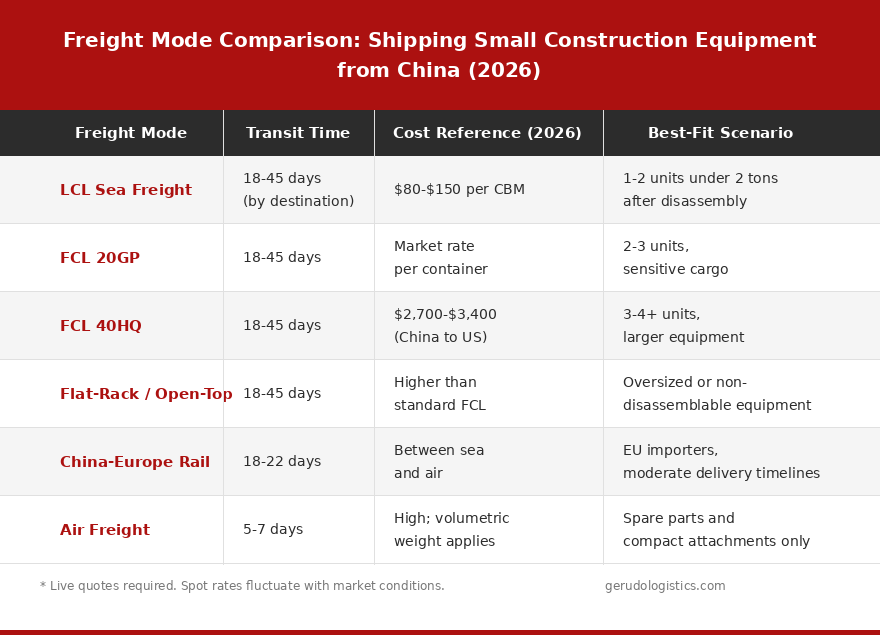
Live quotes are required for accurate rate confirmation; spot rates fluctuate with market conditions.
How Much Does It Cost to Ship Small Construction Equipment from China?
Freight and Origin Charges
Ocean freight (2026 market reference):
40HQ FCL from China to the US: approximately $2,700-$3,400
LCL for machinery: approximately $80-$150 per CBM
These are indicative figures; confirm with a live quotation as rates fluctuate
Origin charges (separate from the ocean freight rate):
Export customs clearance
CFS or container loading fees
Documentation fees
Typical combined range: $200-$500 per shipment depending on port and complexity
Crating and cargo protection:
ISPM 15 compliant wooden crating is required in the US, EU, Australia, and most other markets; wood must be heat-treated and stamped with the IPPC mark
Professional shippers apply a rust-preventative wax coating and use VCI (Vapor Corrosion Inhibitor) film inside crates to protect against salt and humidity during transit
Confirm both crating standard and rust protection are included in your supplier's export preparation before the container is sealed
Import Duties by Major Market
United States:
Standard import duties plus Section 301 surcharges of up to 25% on most Chinese construction machinery
HTS code for hydraulic excavators: 8429.52.10; verify your specific 8-digit code against the USTR exclusion list before pricing (178 exclusions extended to November 10, 2026)
Misclassification between excavator and loader HTS categories is a common error with meaningful duty rate consequences
European Union:
Standard machinery duties: 0-3.7% depending on HS code, plus VAT at destination
CBAM reporting is now active for machinery with embedded steel or aluminum; importers must document embedded carbon intensity
CE certification and Stage V engine compliance are also required (covered in the compliance section below)
Indonesia:
ACFTA (ASEAN-China Free Trade Agreement) preferential rates apply to most Chinese construction machinery; import duties are generally 0-5% depending on HS code, significantly lower than MFN rates
VAT: 11% applied on the customs value at entry
PPh 22 (import income tax): 2.5% for registered importers holding an API (Angka Pengenal Importir) license; 7.5% for non-API importers
LS (Laporan Surveyor): a pre-shipment inspection report from an approved surveyor may be required for certain machinery categories; confirm whether your specific HS code triggers this requirement before shipment
Whether SNI (Standar Nasional Indonesia) certification applies to your specific machine category varies by product classification; verify with a customs broker before placing the order
Other markets:
Duty structures vary by destination; verify with a licensed customs broker before committing to a landed cost estimate
Marine Insurance
All-risk marine cargo insurance is standard for construction equipment given unit values of $12,000-$40,000 FOB:
Typical premium: 1-2% of declared cargo value
Document any damage at the point of delivery before signing the delivery receipt
Claims filed more than 48 hours after delivery become significantly harder to process
Destination Port Compliance Requirements
Engine Emission Standards: EPA Tier 4 (US) and EU Stage V
A non-compliant diesel engine does not get a second chance at the US port. It gets destroyed. That outcome is not rare - it is the standard enforcement response for non-road engines that fail to meet EPA Tier 4 Final requirements. For EU imports, a machine without Stage V compliance cannot legally enter the market at all.
US: EPA Tier 4 Final certification is mandatory for diesel non-road engines; non-compliant machines are subject to seizure and destruction at port
EU: Stage V emission standard applies; non-compliant machines cannot be placed on the market
What this means before you place the order:
Specify export-version engines explicitly - this is not the default configuration for the domestic Chinese market
Kubota, Yanmar, and Perkins engines fitted to export-configured machines typically carry the relevant certification; generic domestic-market engines do not
Verify certification documentation before production begins, not before shipment
CE Certification (EU)
A machine without CE marking will not clear EU customs. The importer carries the disposal or return cost, not the supplier. CE marking is mandatory for all machinery entering the EU, and it needs to be confirmed before the order is placed - suppliers cannot add it retrospectively.
Requirements:
EU Declaration of Conformity from the supplier
Involvement of a Notified Body for certain machine categories
ISPM 15 Wood Packaging
All wood packaging materials must be heat-treated and IPPC-stamped under the ISPM 15 standard. Non-compliance triggers:
Port holds at destination
Mandatory fumigation orders at the importer's cost
This is the supplier's responsibility to execute but the importer's risk to carry. Confirm ISPM 15 compliance explicitly in your purchase order and verify in the shipping documentation before the container is sealed.
DG Classification for Electric Construction Equipment
Electric construction equipment with lithium battery packs is classified as Class 9 Dangerous Goods. Shipping requirements regardless of mode:
UN38.3 test report
Safety Data Sheet (SDS)
Compliant DG declaration and packaging
Sea freight: IMDG Code compliance required
Air freight: IATA DGR 67th Edition (2026) applies; large-format lithium battery packs face significant restrictions that effectively remove air as a viable mode for complete electric machines
Not all freight forwarders are equipped to handle Class 9 machinery shipments. Confirm DG handling capability before booking.
Indonesia: Import Registration and Pre-Shipment Requirements
Indonesia does not apply the same emission certification framework as the US or EU, but has its own import control structure that construction equipment importers must navigate.
Key requirements:
API registration: importers must hold a valid API-U (general importer) or API-P (producer importer) license; shipments from non-registered importers face significantly higher PPh 22 tax rates at clearance
LS (Laporan Surveyor): certain machinery HS codes require a pre-shipment inspection report issued by an approved surveyor (Sucofindo or SGS are commonly accepted); this must be arranged before the cargo is loaded, not after arrival
SNI certification: mandatory SNI applies to selected machinery categories under Indonesian national standards; whether your specific machine type falls under mandatory SNI depends on its HS classification - verify before placing the order
ACFTA documentation: to claim preferential duty rates under ACFTA, the shipment must be accompanied by a valid Form E certificate of origin issued by Chinese authorities; without Form E, standard MFN duty rates apply
Transit time from major Chinese ports to Tanjung Priok (Jakarta) or Tanjung Perak (Surabaya) is approximately 10-16 days by sea, making Indonesia one of the shorter-haul lanes from China for this equipment category.
Voltage and Electrical Standards
Relevant primarily for electric models and battery charger specifications:
China standard: 220V/50Hz
US market: 110V/60Hz
EU market: 230V/50Hz
Most manufacturers can configure at production stage; this cannot be adjusted after manufacturing is complete
Specify destination electrical requirements at the RFQ stage.
Product-Specific Shipping Requirements
Mini Excavators (1-3.5 Ton)
Mini excavators are the highest-volume product in this category. They are also where documentation failures are most expensive. In our experience, "export ready" from a Chinese supplier does not always mean EPA Tier 4 certified - and the difference only becomes clear at the destination port, when it is too late to fix cheaply.
Commonly imported models include the SANY SY16C, XCMG XE15R, Rippa R325, LiuGong 9018F, and Sunward SWE18UF.
Container configuration:
Partial disassembly required: boom arm removed, tracks folded or detached depending on machine width
Single unit under 2 tons after disassembly: LCL via standard 20ft container slot
Wider machines: flat-rack may be required
Multiple units: 20GP (2-3 units) or 40HQ (3-4 units) FCL
US import requirements:
EPA Tier 4 Final certification mandatory for diesel engines
HTS code: 8429.52.10 for hydraulic excavators
Verify Section 301 exclusion status for your specific code before pricing
EU import requirements:
CE marking required
Stage V engine compliance required
Zero-tail-swing models (Sunward SWE18UF, XCMG XE15R) increasingly specified for urban sites where Stage V enforcement is applied at project level
Insurance: all-risk marine coverage is standard given FOB values of $12,000-$35,000 per unit.
Skid Steer Loaders and Compact Wheel Loaders
Models such as the WECAN WT400 and Wolf WL80 fall in the 800kg-2,000kg range. Standard FCL is appropriate for most shipments; LCL works for single units.
Attachment planning:
Buckets, auger drives, and pallet forks are frequently ordered alongside the base machine
Total CBM must include all attachments before the freight quotation is finalized
Some attachment categories with hydraulic lines or residual fuel content may carry additional handling requirements; verify at the booking stage
Electric models:
The Everun EREL05 and similar electric loaders carry full Class 9 DG classification due to lithium battery packs
Complete DG documentation is required regardless of shipment mode
Compact Road Rollers
Ride-on rollers (e.g., Baisway SWW-10, 1-ton class):
Drum width and cab height often require flat-rack or open-top containers
Drum weight distribution creates a shifting risk during transit if the machine is not properly braced; this is not a theoretical risk - unsecured rollers move
Confirm securing specification with your forwarder before loading, not at the origin warehouse
Hand-guided vibratory rollers (e.g., Sinomach GYS08):
More compact; fit standard LCL or FCL without modification
Lower securing complexity than ride-on units
Telescopic and Multi-Function Loaders
Equipment like the Taian DY840 with multiple attachment options requires careful volume planning. Before requesting a freight quotation:
Measure the base machine and every attachment set separately
Include all attachment dimensions in the total CBM calculation
Booking on machine weight alone - without attachment volume - is a common error that results in re-quotes and rebooking at origin
Some attachments with hydraulic cylinders, pneumatic components, or residual fuel content may require a separate compliance review. Raise this with your forwarder at the booking stage.
How Gerudo Logistics Handles Small Construction Equipment Shipments
Shipping construction equipment is not the same as shipping general cargo. Machines get damaged when crating specs are wrong, shipments get held when emission documentation is missing, and electric models get rejected when forwarders are not DG-certified. These are the situations we deal with regularly.
A few things we handle that general forwarders often do not:
Emission documentation checks before the cargo leaves China - EPA Tier 4 and EU Stage V certification gaps are caught at origin, not at the destination port
Class 9 DG handling for electric machinery with lithium battery packs, including UN38.3 review and IMDG-compliant declaration
Container configuration planning for non-standard cargo - flat-rack and open-top bookings for ride-on rollers, oversized loaders, and machines that do not disassemble to standard container dimensions
Form E coordination for Indonesia-bound shipments to secure ACFTA preferential duty rates
Frequently Asked Questions
Q: What is the most cost-effective way to ship a single mini excavator from China?
For a single unit under 3 tons, LCL sea freight is typically the most economical option. If you are buying three or more units, a 20GP FCL becomes more cost-effective per unit and reduces handling risk during transit.
Q: Do Chinese construction machines meet US EPA or EU Stage V emission standards?
Not all models do by default. You must specify export-version engines - Kubota, Yanmar, or Perkins-fitted configurations - that carry EPA Tier 4 Final or EU Stage V certification. Domestic-market engine variants do not meet these standards and face enforcement action at port of entry.
Q: What are the current US tariffs on Chinese construction machinery?
Most Chinese construction machinery faces standard import duties plus Section 301 surcharges of up to 25%. Some HTS exclusions have been extended to November 10, 2026; verify your specific 8-digit HTS code against the USTR exclusion list before finalizing your landed cost estimate.
Q: What is CBAM and does it affect machinery imports into the EU?
CBAM is the EU's Carbon Border Adjustment Mechanism, which requires importers to report the embedded carbon content of steel and aluminum in goods they import. The financial cost is phasing in gradually, but the reporting obligation is active now and applies to construction equipment.
Q: How is construction equipment protected against rust and salt damage during sea transit?
Professional shippers apply rust-preventative wax coatings and use VCI (Vapor Corrosion Inhibitor) film inside ISPM 15 compliant wooden crates. Confirm that your supplier or freight forwarder includes both as part of their standard export preparation.
Q: Can I ship an electric mini excavator or electric loader by sea?
Yes, but the lithium battery pack classifies the machine as Class 9 Dangerous Goods under the IMDG Code. You will need a UN38.3 test report, SDS, and compliant DG declaration. Confirm that your freight forwarder has certified DG handling capability for this cargo type before booking.
Conclusion
The FOB price is not the number that matters. Landed cost is - and it only becomes clear once freight, duties, crating, and destination charges are added in.
Emission certification is where the most expensive mistakes happen. EPA Tier 4 Final for the US, Stage V for the EU - both must be verified before the production order is placed. Once the machine is built with the wrong engine, there is no fix at the port.
For electric models, Class 9 DG classification adds a logistics layer that many forwarders cannot handle. Know this before you book. Mode selection, crating standards, and documentation are not details to sort out after the cargo is ready - they are part of the order itself.