How to Import Drones from China to the USA: A Logistics Guide for 2026
China is the world's dominant drone manufacturing base. Despite tightening US regulations, importers continue to source camera drones, agricultural UAVs, FPV systems, and inspection platforms from Chinese suppliers.
The rules changed significantly in late 2025. Some drone models can no longer enter the US market. Others can, but with a higher compliance burden than two years ago. This guide tells you what to check before you order, what to prepare before you ship, and where most shipments run into trouble.
Can Chinese Drones Still Be Imported into the USA?
The short answer: it depends on the model and the end use.
There are two checks to run before placing any purchase order. Both must pass. If either fails, no amount of logistics planning fixes the problem.
Check 1: Does Your Model Have FCC Authorization?
On December 22, 2025, the US Federal Communications Commission stopped issuing new equipment authorizations for Chinese-made drones. Any model that did not have FCC approval before that date cannot be legally sold in the US market.
What this means in practice:
Before negotiating with any supplier, search the FCC database at fccid.io using the exact model name or FCC ID
If the model has an FCC grant dated before December 22, 2025, you can proceed
If there is no FCC record, or the grant came after that date, do not place the order
Having an FCC ID does not mean CBP will automatically release your shipment. Customs retains authority to detain any consignment on other grounds. FCC authorization is the starting point, not the finish line.
Note on federal projects: Chinese-made drones, regardless of FCC status, are fully prohibited from any project involving US federal funding. This covers government agencies, defense contractors, universities on federal grants, and federally financed infrastructure work. If your buyer operates in any of these categories, the shipment cannot proceed.
Exception worth knowing: If the product appears on the US Department of Defense Blue UAS list, or qualifies under the Buy American Standard (US-made components exceeding 60% of total component cost), it may still be authorized for federal use even if it contains Chinese parts. Confirm this with legal counsel before proceeding.
Check 2: Can Your Supplier Document the Supply Chain?
China's main drone production is concentrated in Shenzhen, Guangzhou, and Hangzhou. When evaluating any supplier, request CE, FCC, and RoHS certifications as a baseline. Suppliers without these documents present compliance risk at US customs.
Ask your supplier before placing any order:
Where are the battery cells sourced, and from which manufacturer?
Where are the camera modules and image sensors made?
Can they provide a full bill of materials with supplier names and factory locations?
Do they hold any third-party supply chain audit certifications?
A supplier that cannot answer these questions, or that provides vague responses without documentation, is a liability. Under US forced labor enforcement, the importer bears the burden of proving a clean supply chain.
Shipping Method: Air Freight vs Sea Freight
Drones contain lithium batteries, classifying them as dangerous goods under IATA (air) and IMDG (sea) regulations. This restricts carrier options and adds documentation requirements regardless of mode.
Air freight suits orders under approximately 500 kg volumetric weight or time-sensitive shipments. Lithium battery restrictions under IATA are strict, particularly for spare batteries shipped separately. Confirm DG acceptance with the airline before booking.
Sea freight by FCL suits bulk commercial orders with adequate lead time. IMDG regulations for batteries in or with equipment are less restrictive than IATA. LCL consolidation adds complexity: not every consolidation warehouse in China is licensed for DG cargo, so confirm acceptance before committing.
Express courier (DHL, FedEx, UPS) is practical for sample orders or small parcels under 30 kg where speed and door-to-door service matter. Cost is higher per unit, but customs clearance is typically included. Check carrier-specific lithium battery acceptance policies before booking.
How Long Does Shipping from China to the USA Take?
Transit times vary by origin port, destination, and season. The figures below reflect standard conditions without customs examination delays.
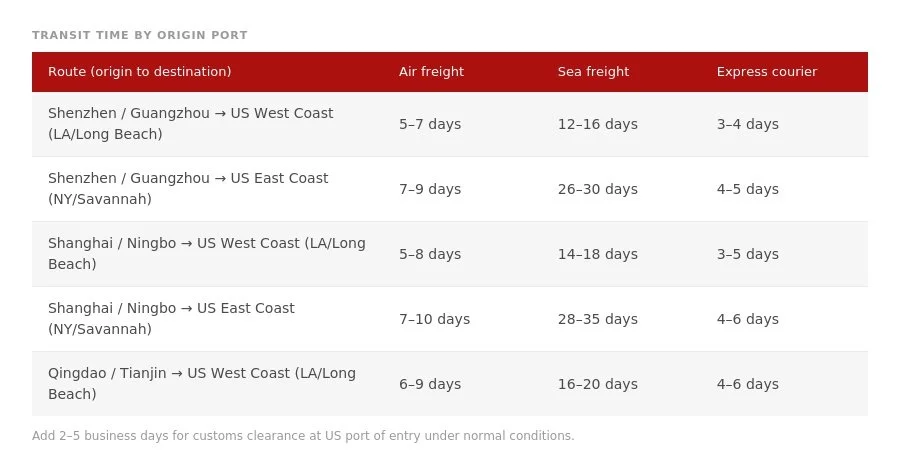
For sea freight, add two to five business days for customs clearance at the port of entry under normal conditions. Drone shipments subject to examination or UFLPA review extend this further. Most drone manufacturers sourcing from DJI, Autel, or XAG suppliers are shipping from South China ports (Shenzhen/Guangzhou).
Drone Shipping Costs from China to the USA
Freight rates fluctuate with market demand, fuel surcharges, and carrier capacity. The figures below are indicative ranges based on 2026 market conditions and should be verified before budgeting.
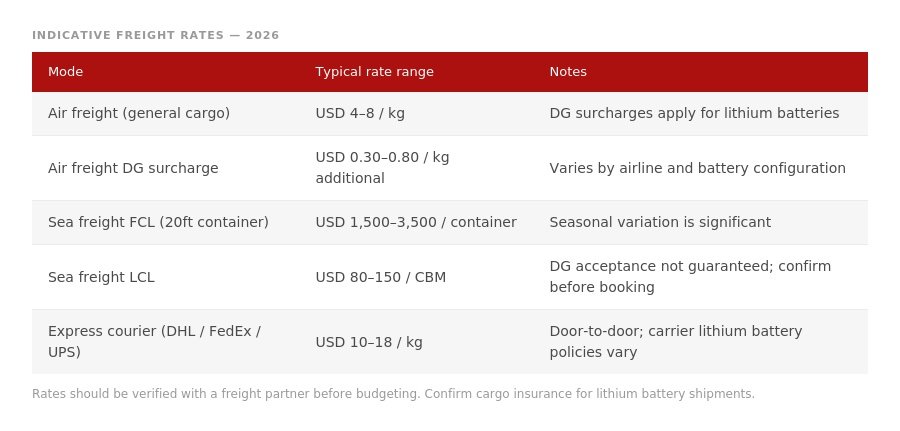
For high-value drone shipments, confirm cargo insurance coverage with your insurer before shipment. Standard marine policies may not cover lithium battery cargo at full value.
Lithium Battery Dangerous Goods Requirements
Drone batteries are classified as dangerous goods under both air and sea regulations. The classification that applies depends on how the battery is configured relative to the drone. Getting this wrong results in carrier rejection at origin.
For a detailed of current Battery compliance, see our dedicated guides:
Shipping Batteries from China: What Exporters Need to Know
Lithium Battery Shipping from China 2026: IMDG Code Compliance
IATA DGR 2026: Battery Shipping Requirements
How Battery Packaging Affects DG Classification
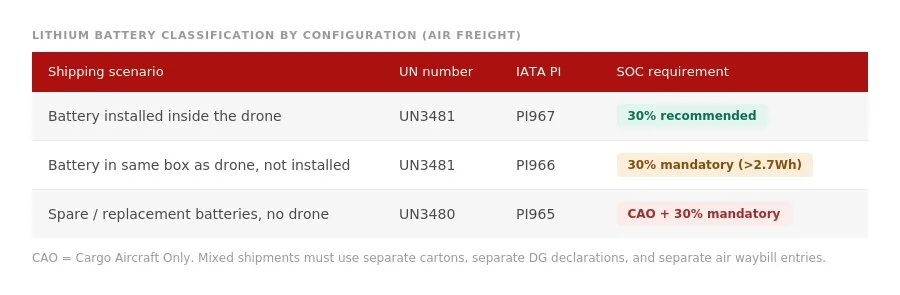
The most common mistake on drone shipments: Spare battery packs and drone units are consolidated into the same shipment without the battery types being declared separately.
These categories require separate outer cartons, separate dangerous goods declarations, and separate listing on the air waybill. Mixing them in the same package or on a single declaration results in carrier rejection at origin.
The full dangerous goods document requirements are covered in the customs clearance section below.
Customs Clearance Documents for Drone Imports
CBP applies additional scrutiny to drone shipments. The documents below are required; gaps in any of them trigger delays or formal examination.
Commercial invoice: Correct HS code (8806.21.00 for most consumer and commercial drones under 7 kg), accurate declared value, buyer and seller details
Packing list: Must include battery watt-hour rating and cell count per unit
FCC grant certificate: The downloaded grant document from the FCC database, not the FCC ID printed on the product
Certificate of origin: Confirms country of manufacture; triggers Section 301 tariff assessment for Chinese-origin goods
Supply chain documentation: Factory-level sourcing records for battery cells and camera modules; required if shipment is referred for UFLPA review
Dangerous goods declaration: Must be completed by someone holding current IATA DG certification; cannot be self-prepared
Material Safety Data Sheet (MSDS): From the battery manufacturer, specifying chemistry, watt-hour rating, and UN classification
Importer Security Filing: Ocean shipments only; must be filed 24 hours before vessel departure from China
Remote ID compliance is an FAA operational requirement, not a CBP clearance condition, and is not checked at the port.
Import Duties and Tariffs on Chinese Drones in 2026
Drone Import Duty Rates from China
The base import duty on drones (HTS 8806.21.00) is 0% to 4.4%. On top of that, Chinese-origin drones carry a 25% Section 301 tariff, in place since 2018.
The Section 122 global surcharge (10% to 15%, introduced February 24, 2026) includes a civil aircraft exemption in its Annex II list. Drones classified under HTS 8806 generally qualify for this exemption.
However, if CBP reclassifies the product as consumer electronics or toys rather than aircraft, the exemption may not hold. Keep the HS code consistent across all shipping documents and have a customs broker confirm the exemption applies before filing.
Sample Tariff Calculation: Drone Ship From China to USA
For a $50,000 CIF shipment of consumer camera drones:
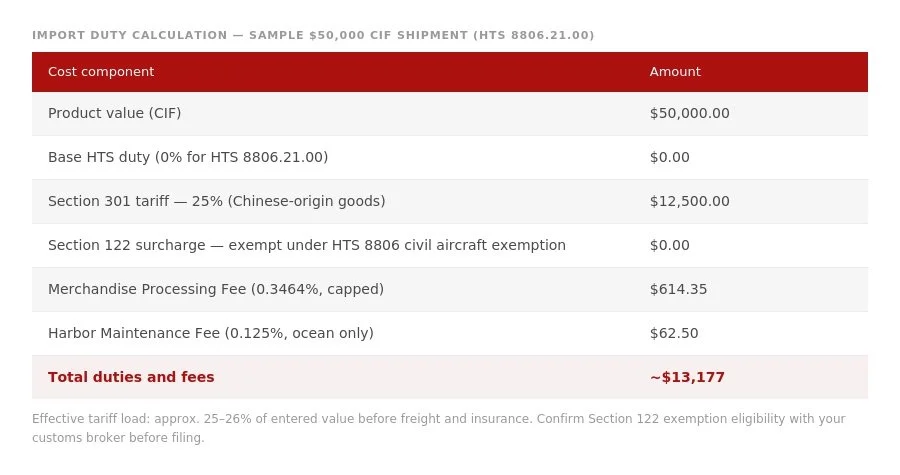
Plan landed cost around a 25% to 26% tariff load before freight and fees. If the margin does not work at that level, it does not improve through logistics.
Top Brands to Source Drones from China
The brands below represent the main options US importers currently work with. For all of them, FCC authorization status must be verified at the model level before ordering. Brand name alone is not sufficient.
DJI covers the widest range of pre-December 2025 FCC-authorized models across consumer and commercial categories (Mavic, Mini, Phantom, Air series). Existing authorized models are importable for non-federal use, though DJI appears on several US government restriction lists that require attention to end-use and buyer category.
Autel Robotics (EVO series) is in the same regulatory position as DJI: existing authorized models only, no new FCC authorizations available. It is often positioned as a DJI alternative but faces the same market access ceiling.
XAG specializes in agricultural drones for crop spraying, seeding, and field mapping. This is a specialist import category with additional regulatory considerations depending on intended use.
Yuneec produces camera and inspection drones, with a portion of its lineup holding valid FCC authorization.
FIMI (a Xiaomi subsidiary) offers consumer-grade models at competitive prices. FCC status varies by model and requires individual verification.
How to Import Drones from China: Step-by-Step
Step 1: Verify Before You Order
Run the FCC database check and supply chain review before any purchase order is issued. These are business eligibility checks, not logistics steps. A shipment that fails at the port of entry costs the product value, the freight, and the examination fees. The check takes one day. Recovering from a seizure takes months.
Step 2: Engage Freight Handling with DG Capability
Not all freight forwarders are equipped for lithium battery shipments. Before booking any shipment, confirm the following in writing:
Current IATA dangerous goods certification
Demonstrated experience with lithium battery shipments in the past six months
DG acceptance confirmed at the origin warehouse or consolidation facility
If these cannot be confirmed, find a different freight partner.
Step 3: Lock Down Documentation Before Cargo Moves
The invoice, packing list, DG declaration, FCC certificate, and supply chain documentation should all be complete and reviewed before the shipment is booked. Problems discovered after cargo departs China are expensive to fix. Problems discovered at a US port of entry can mean detention or seizure.
Step 4: Verify the FCC ID Before Cargo Leaves China
Download the actual FCC grant document from the official database and check it against the FCC ID printed on the physical cartons. Factories sometimes substitute components or rebrand units without notifying the buyer, which results in a different or missing FCC ID on the actual product.
Finding a discrepancy before the vessel departs gives you options. Finding it at Long Beach gives you a detention notice.
Step 5: Ocean Shipments Only: File ISF on Time
The Importer Security Filing must be submitted to CBP 24 hours before the vessel leaves the Chinese port. Late filing triggers automatic penalties. Provide cargo details to the customs broker well in advance, not the night before sailing.
Step 6: Expect Closer Scrutiny at the Port
Drone shipments receive more customs attention than standard electronics, particularly at Los Angeles/Long Beach. CBP will check FCC documentation, review dangerous goods paperwork, and may refer the shipment for UFLPA review if supply chain documentation is incomplete.
Budget for possible examination fees of $300 to $2,000 and build two to five extra days into the delivery timeline for compliant shipments. Shipments flagged under UFLPA review take significantly longer.
Step 7: Post-Clearance Obligations
After cargo is released:
Retain all import documentation for at least five years. CBP can audit past entries.
Register drones over 250g with the FAA before they are operated. This is separate from the import process.
Ensure products meet FAA Remote ID requirements before distribution. Non-compliant products cannot be legally operated in the US, regardless of import status.
Work with a Freight Forwarder That Knows DG Cargo
Drone imports from China are operationally viable in 2026, but the compliance requirements across FCC authorization, supply chain documentation, dangerous goods handling, and customs clearance leave little room for error. A general freight forwarder without dangerous goods experience is not equipped for this cargo type.
Gerudo Logistics is an international freight forwarder based in China, specializing in dangerous goods and temperature-controlled shipments to the United States and global markets. For drone shipments, our team provides:
DG documentation preparation: Shipper's Declaration, MSDS review, and UN-rated packaging coordination for lithium battery cargo under IATA and IMDG requirements
FCC pre-shipment verification: Cross-checking FCC grant records against physical cargo before departure to catch discrepancies before they reach the port of entry
UFLPA supply chain review: Assessing supplier documentation against CBP enforcement priorities to reduce detention risk at the port of entry
Customs clearance coordination: Working with licensed customs brokers to ensure HS code accuracy, duty calculation, and complete documentation filing
Multi-mode coverage: Air freight, FCL/LCL sea freight, and express courier, with DG acceptance confirmed at origin facilities
To discuss a drone shipment from China and get a logistics assessment before committing to a purchase order, contact our team!
Conclusion
Importing drones from China to the United States in 2026 requires more upfront compliance work than two years ago. The December 22, 2025 FCC cutoff, expanded UFLPA enforcement into battery supply chains, and lithium battery dangerous goods requirements under IATA DGR 67th Edition all create checkpoints where a shipment can be stopped before it reaches its destination.
Importers who move through this process without costly delays complete eligibility checks before placing orders, prepare documentation before cargo moves, and work with freight partners that have specific dangerous goods experience. None of these steps are complicated in isolation. The risk comes from treating them as afterthoughts.