How to Ship Dangerous Goods Liquids from China: Drums, IBCs, and ISO Tanks Explained
Choosing the wrong container type for a DG liquid shipment from China does not just delay the cargo. It can mean a carrier rejection at booking, a compliance hold at port, or a disposal cost at destination that never appeared in the original quote.
This guide covers what each container type requires, where each one makes sense, and how to work through the decision before the shipment is booked.
DG Liquid Shipping from China: Three Container Types Explained
Under IMDG, drums, IBCs, and ISO tanks are the three standard container types for exporting dangerous goods liquids from China. Each covers a different volume range and carries different UN certification requirements.
From 200-liter drums suited to low-volume or high-hazard small batches, to ISO tanks moving up to 26,000 liters under a single T-code booking, the format you choose determines your compliance path, your handling costs at both ends, and your total landed cost at destination.
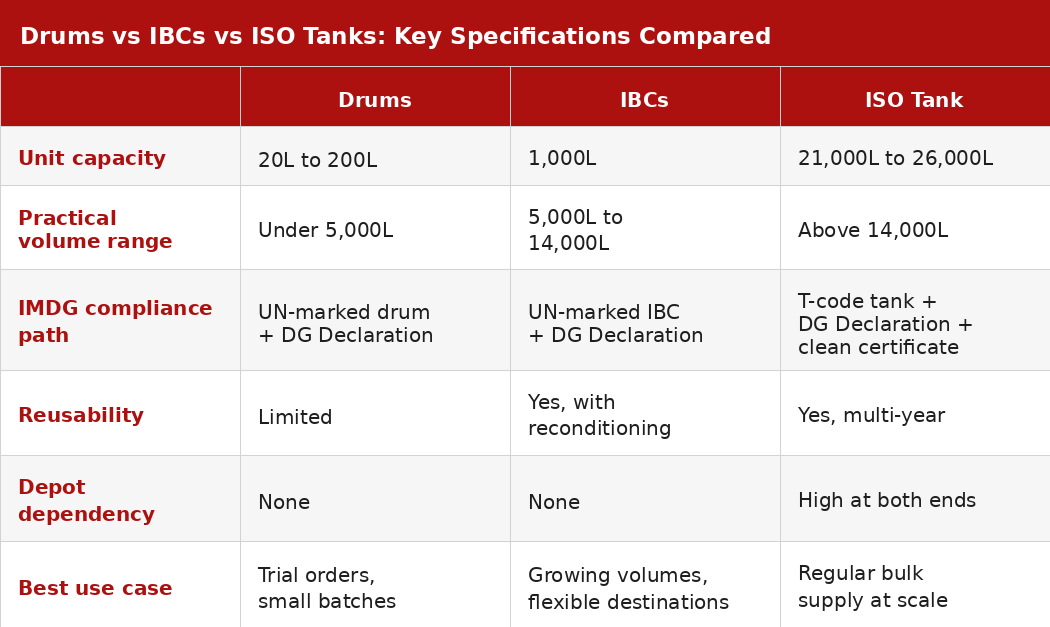
Drums, IBCs, and ISO Tanks for Dangerous Goods: Advantages, Limitations, and Cargo Fit
Drums: Best for Low-Volume and High-Hazard DG Liquids
Drums are the most accessible entry point for DG liquid shipping from China. No depot coordination is required, carrier acceptance is routine for most classifications, and the per-shipment process is straightforward. For a first order or a trial quantity, drums impose the least operational overhead.
Advantages
No depot dependency at origin or destination
Accepted by most ocean carriers for common DG classes without special approval
Flexible for mixed-product shipments or multiple end-buyers in one container
UN-certified drums are widely available from Chinese manufacturers
Simpler customs handling in destinations with limited bulk liquid infrastructure
Disadvantages
Highest cost per liter at scale due to low container payload utilization
High loading and unloading labor at both ends
Drum disposal or return at destination adds cost that rarely appears in initial quotes
Each drum requires individual labeling, marking, and documentation review
Not practical above 5,000 liters per shipment on a regular supply schedule
DG classes commonly shipped in drums from China:
Class 3 (Flammable Liquids): all packing groups
Class 5.1 (Oxidizing Liquids): PG II and PG III
Class 6.1 (Toxic Liquids): all packing groups, including PG I in small volumes
Class 8 (Corrosives): all packing groups
Class 9 (Miscellaneous DG): including liquid forms
IBCs: The Mid-Volume Option for DG Liquid Exports
IBCs consolidate cargo into fewer units, reduce per-liter freight cost, and are accepted by most carriers for common DG classifications without special handling. The compliance path is similar to drums, which makes the transition manageable for growing importers.
Advantages
Better container payload utilization than drums (18,000 to 20,000L per 20-foot container)
Lower per-liter freight cost than drums at equivalent volume
Stackable, reducing warehouse footprint at destination
Stainless steel IBCs available for products requiring higher purity or chemical resistance
No depot dependency — IBCs can be discharged directly at the importer's facility
Disadvantages
Reusable IBCs require cleaning and inspection before refilling; reconditioning infrastructure is limited in many markets
Importers without reconditioning access must treat IBCs as single-use, raising per-shipment cost significantly
Some carriers impose DG surcharges on IBC cargo regardless of hazard class
Above 14,000 liters per booking, cost-per-liter advantage over ISO tank diminishes
Multiple pallets per container means more handling steps and more documentation items than a single ISO tank
DG classes commonly shipped in IBCs from China:
Class 3: standard composite IBCs (plastic inner vessel) are restricted to PG II and PG III; PG I requires specialized stainless steel IBCs meeting specific packaging instructions and carrier approval
Class 6.1: PG II and PG III; PG I requires specific IBC construction approval
Class 8: PG II and PG III corrosives
Class 5.1: oxidizing liquids PG II and PG III
For any PG I classification, confirm IBC construction type and carrier acceptance before booking
ISO Tanks: Bulk DG Liquid Shipping at Scale
ISO tanks are the standard container type once bulk liquid volumes justify the operational setup. They carry the lowest cost per liter at scale, are purpose-built for both hazardous and non-hazardous bulk liquids under IMDG, and are reusable across many years of shipments.
The T-code system under IMDG determines which tank type your cargo requires, based on the product's UN number and packing group. This is a regulatory requirement: a carrier can refuse a booking if the tank type does not match the declared cargo. For a full breakdown of T-codes, documentation requirements, and the step-by-step booking process, see our ISO tank shipping guide.
Advantages
Lowest cost per liter at volumes above 14,000 liters per booking
Reusable over many years; leasing cost per trip is low relative to cargo volume
Single booking, single DG Declaration, single carrier approval per shipment — and critically, no per-unit marking and labelling verification; with drums or IBCs, every individual container must carry consistent UN markings and hazard labels, and any discrepancy across units can trigger a compliance hold at port
Purpose-built IMDG compliance framework for bulk liquid DG cargo
DDP and door-to-door delivery available on most major trade lanes
Disadvantages
Requires depot infrastructure at both origin and destination
Specialized tank types (T14, T75) are held in limited quantities and may require repositioning
Longer booking lead time than standard cargo — minimum 10 to 14 days before vessel cut-off
Destination depot must be confirmed before booking; first-time setups require coordination
Cleaning fee and ongoing rental accrue until the clean certificate is issued after discharge
DG classes commonly shipped in ISO tanks from China:
Class 2 (Gases): certain liquefied gases can be transported in purpose-designed portable tank types — T50 for gases under pressure, T75 for cryogenic gases. Note that gas transport via ISO tank follows a booking and handling process entirely separate from liquid cargo, and MEGCs (Multi-Element Gas Containers) are a distinct format used for some Class 2 shipments. Confirm the correct equipment type with your forwarder before planning any gas shipment.
Class 3: bulk flammable liquids, all packing groups
Class 6.1: toxic liquids in bulk volume
Class 8: corrosives including concentrated acids, requiring T14 lined tank
Class 5.1: oxidizing liquids in appropriate T-code
If your product falls under Class 8 PG I or Class 6.1 PG I, confirm with your forwarder which container types and carrier routings are available before planning your supply schedule. Acceptance varies significantly by trade lane for high-hazard classifications.
The 80/20 Fill Rule
ISO tanks have a fill range, not a fill level. The tank must be loaded to at least 80% capacity — below that, liquid surge during transit generates enough force to stress the valves and fittings.
The upper limit is not a fixed 95%: that figure is a general guideline, and the precise safety ceiling must be calculated based on the product's thermal expansion coefficient and the maximum temperature expected during the voyage. For liquids with high expansion rates, the actual upper limit may be 90% or 92%.
Confirm the correct fill specification with your forwarder before the loading date
The supplier's estimate is not a reliable reference — the correct figure comes from the IMDG requirement for your specific UN number and product properties
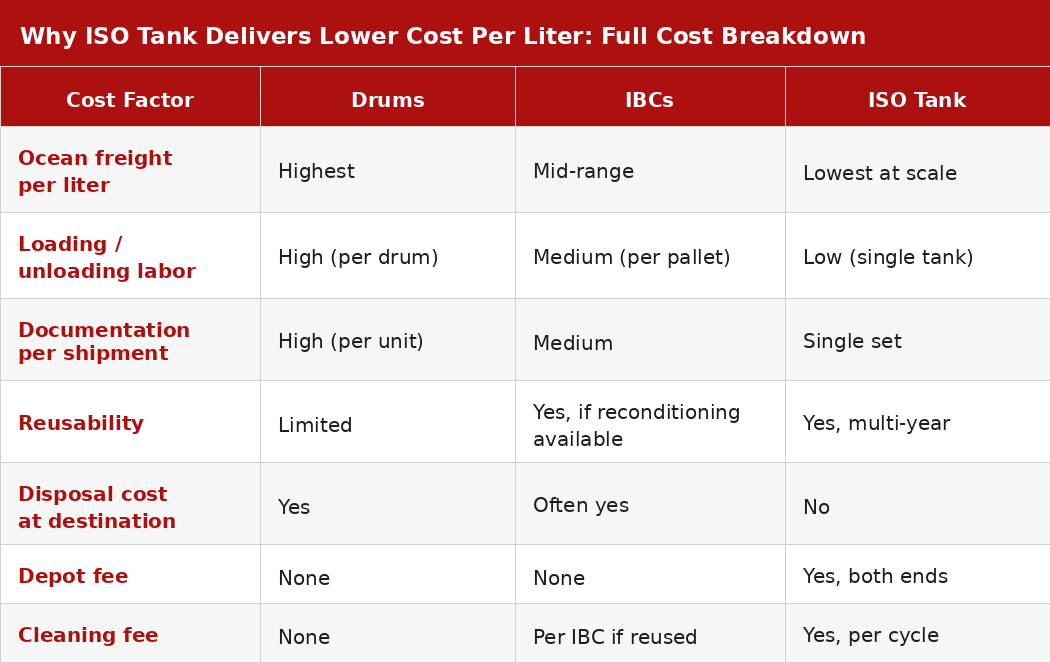
Why ISO Tank Delivers Lower Cost Per Liter for Bulk DG Shipments
From the cost perspective: Drums incur the highest overall costs across most categories, have limited reusability, and require destination disposal fees. IBCs carry mid-range costs with restricted reusability.
While ISO tanks are subject to depot fees at both ends and per-cycle cleaning fees, they deliver the optimal cost per liter, labor, and documentation expenses at scale, offer multi-year reusability, and are a highly cost-effective choice for liquid shipments ranging from small to large volumes.
ISO Tank vs IBC Cost Comparison: A Real Shipping Scenario
Consider an importer shipping 20,000 liters of a Class 8 corrosive liquid from Shanghai to Hamburg on a monthly schedule.
With IBCs, each shipment requires 20 pallets, loading labor for 20 units at origin, 20 sets of per-unit documentation, and either reconditioning or single-use replacement at destination. Where reconditioning is unavailable, those 20 IBCs are disposed of after one use, and the replacement cost is built into every subsequent shipment.
With ISO tank, the same volume moves in a single unit under one booking and one DG Declaration. Depot handling fees and a cleaning charge apply at both ends — costs that IBCs do not carry. On a single shipment, the total cost difference may appear modest.
Over a quarterly supply cycle, the picture shifts. The per-liter cost of ISO tank drops as fixed depot and leasing charges are spread across consistent volume. The IBC cost does not follow the same curve: each shipment carries roughly the same per-unit handling and disposal load regardless of frequency.
For importers shipping above 16,000 liters per month on a regular lane, the quarterly cost differential is typically large enough to justify the initial setup investment — confirming depot access and completing the first ISO tank booking.
DG Shipping Documentation: Requirements by Container Type
Regardless of container type, two documents are non-negotiable for every DG liquid booking: a current MSDS/SDSconsistent with the declared UN number, and a completed DG Declaration. Beyond these, each container type carries specific certification requirements that must be verified before the vessel cut-off.
Drums and IBCs (Packaged DG)
UN Performance Marking: proof that each unit's certification matches the product's packing group
Packing Certificate: confirmation of correct stowage and securing within the container
IBC-specific: a valid inspection or reconditioning certificate is mandatory if the IBC is being reused
ISO Tanks (Bulk DG)
T-code Certification: verification that the tank specification (T11, T14, etc.) aligns with the IMDG portable tank instruction for your specific UN number
Clean Certificate: documentation from the previous cargo cycle confirming the tank was fully cleaned and inspected
CSC Plate: current Container Safety Convention certification confirming the tank's structural integrity
Import Permits: unless your Incoterms specify otherwise (such as DDP), securing destination import permits is the importer's responsibility and must be initiated before the vessel departs China
The most frequent cause of shipment delays is a mismatch between the MSDS and the DG Declaration. Carriers cross-check these documents in detail — ensure your supplier provides an English-language MSDS that aligns with IMDG classification standards, not a domestic Chinese version.
How to Choose Between Drums, IBCs, and ISO Tanks for DG Liquid Shipping
Compliance comes before cost. Once the IMDG boundary is established, volume and destination infrastructure determine which option makes sense. Working through these steps out of sequence — comparing cost before confirming compliance — is how most booking rejections happen.
Step 1: Confirm your cargo's UN number and packing group. Pull the MSDS from your supplier. If there is a UN number, your cargo is classified as dangerous goods under IMDG. The UN number and packing group determine which container types are compliant, and for ISO tank, which T-code is required. Never rely on the supplier's verbal description of hazard level.
Step 2: Match volume to container type.
Under 5,000L: drums are practical; IBCs are possible but underutilized
5,000L to 14,000L: IBCs deliver better efficiency; most carriers accept them for common DG classes
Above 14,000L on a regular schedule: ISO tank delivers the lowest cost per liter
Step 3: Verify destination infrastructure.
ISO tank: is there a receiving depot? Does it handle your required T-code?
IBC: is reconditioning available, or will units be treated as single-use?
Drums: are disposal or return logistics in place at destination?
Step 4: Calculate total landed cost, not just the freight rate. The container type with the lowest ocean freight quote is rarely the one with the lowest total landed cost. Request a full breakdown before approving any booking.
Dangerous Goods Shipping from China with Gerudo Logistics
Gerudo Logistics is a dangerous goods specialist freight forwarder headquartered in Guangzhou, with operations across Shenzhen, Shanghai, Ningbo, Qingdao, and Dalian. WWe handle dangerous goods shipments across all IMDG hazard classes for global importers.
Our scope covers:
DG classification verification and T-code confirmation before booking
Documentation preparation: MSDS review, DG Declaration, clean certificates for ISO tank
Carrier DG acceptance coordination across major trade lanes
Export customs clearance at origin
Door-to-door and DDP delivery to the Middle East, Europe, South East and the United States
To discuss your DG liquid shipment and identify the right container type and routing from China, contact our specialist to protect your margin!
Frequently Asked Questions
Can all three container types carry dangerous goods? Yes, provided each carries the correct UN certification for the product's packing group. Confirm carrier acceptance on your specific trade lane before booking.
What is the minimum volume that makes ISO tank cost-effective? ISO tank typically delivers a meaningful cost-per-liter advantage over IBCs above 14,000 to 16,000 liters per shipment. The crossover depends on trade lane, T-code requirement, and destination depot fees.
Are IBCs accepted by all ocean carriers for DG cargo? Most major carriers accept common DG classes in IBC format, but acceptance varies by UN number and trade lane. Confirm with your forwarder before finalizing the production schedule.
What UN certification do drums need for DG liquids? A UN performance marking on the drum indicating type, material, test pressure, maximum gross weight, and certified packing group. The marking must match the packing group on the MSDS and DG Declaration.
How does packing group affect which container type I can use? PG I is the highest hazard, PG III the lowest. Higher packing groups impose stricter requirements on packaging construction and, for ISO tanks, on the T-code. Verify the packing group on the MSDS before selecting a container type.
What is the cost difference between IBCs and ISO tanks per liter? For regular bulk supply on long-haul lanes such as China to Europe or the US East Coast, ISO tank typically delivers substantially lower per-liter cost once shipment volume exceeds the practical IBC range. A landed-cost comparison on your specific route is the only reliable way to quantify it.
Conclusion
UN classification and shipment volume are the two inputs that determine the right container type for DG liquid shipping from China. Drums handle low-volume and small-batch needs. IBCs bridge the gap for growing volumes. ISO tanks deliver the lowest cost per liter for regular bulk supply once the volume threshold is reached and destination depot access is in place.
Resolve the container type question before requesting a freight quote. A carrier booking for the wrong container type creates delays that are difficult to fix once the production schedule is set.