Shipping Fruit Juice Concentrate from China: Aseptic and Frozen Cargo
Shipping fruit juice concentrate from China involves three linked decisions: temperature-control plan, shipping option and handling plan.
The supplier’s written storage limits determine whether the cargo can move under ambient conditions or needs temperature control. Volume, urgency, packaging, route and handling capability then determine whether ocean FCL, ocean LCL or air freight is practical.
This guide focuses on the logistics choices importers need to settle before booking. It covers aseptically packed concentrate, frozen concentrate and cargo that falls into both categories.
At a glance
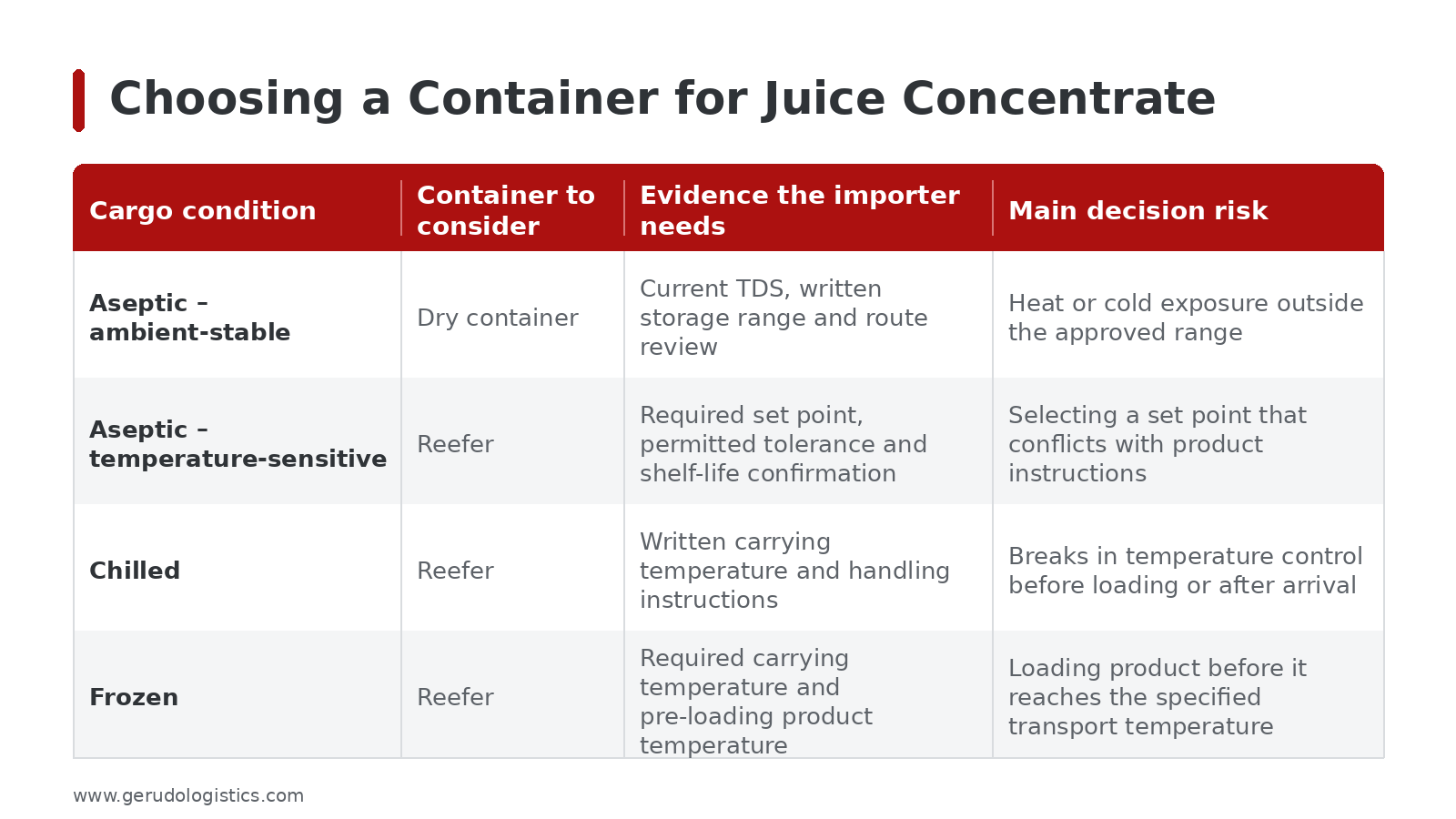
Aseptically packed concentrate: A dry container is possible only when the supplier’s written storage range covers the expected conditions throughout the route.
Cargo requiring frozen carriage: Use a reefer plan with the supplier’s carrying temperature and confirmed cold-chain handovers.
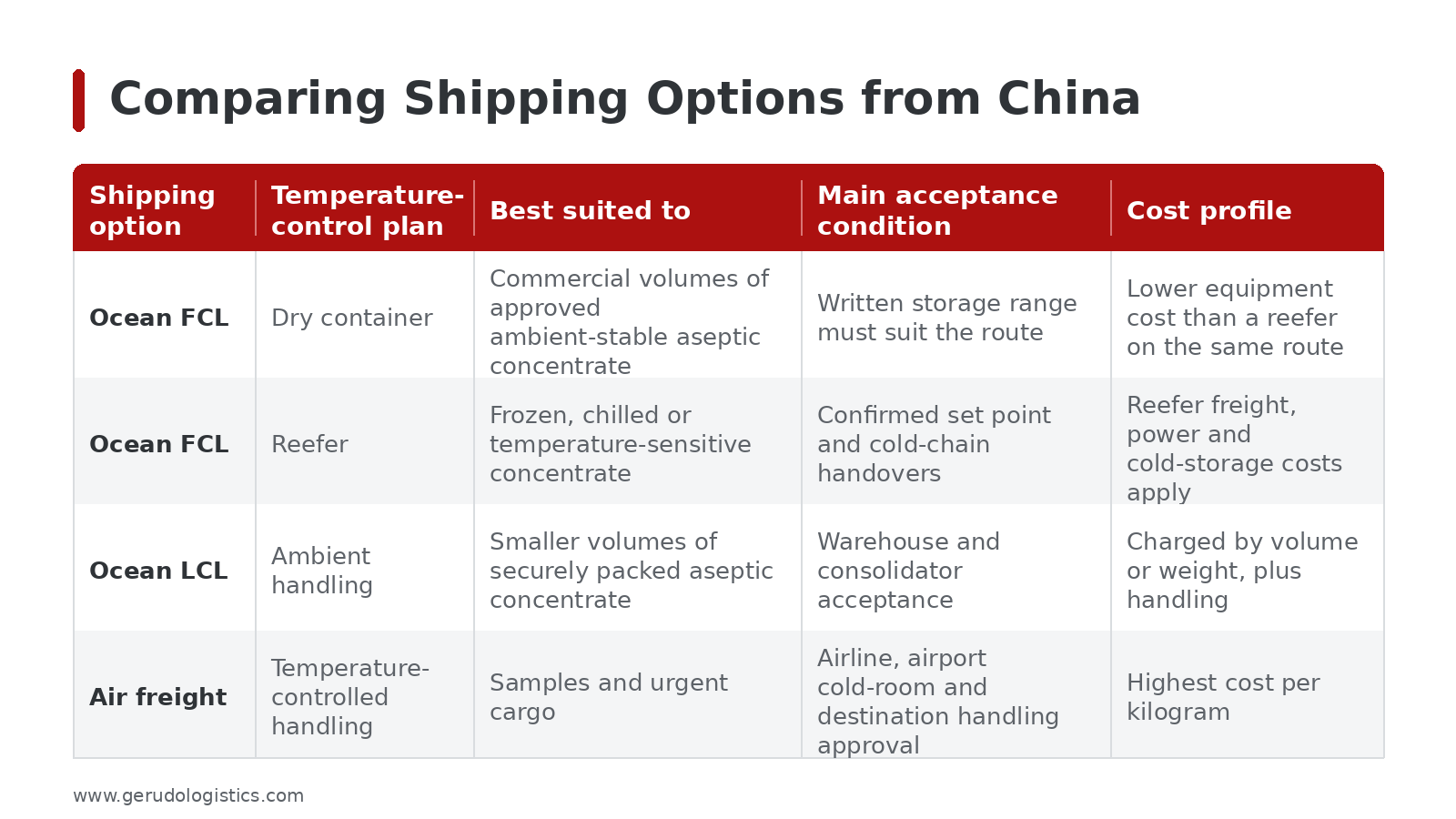
Commercial volumes: Full container load (FCL) is normally more practical than less than container load (LCL).
Samples and urgent cargo: Air freight can work when both airports provide suitable handling.
Container Choice for Juice Concentrate Shipments
Dry Container Conditions
Aseptic concentrate in sealed drums can travel in a dry container when the supplier’s written limits cover every stage of the planned route. The word aseptic describes the processing and packaging condition. It does not establish whether the product can tolerate the journey.
The decision should account for:
Permitted storage range: Check the minimum and maximum temperatures in the current TDS or storage instruction.
Route exposure: Consider the season, origin, transhipment ports, destination and expected transit time.
Time outside controlled storage: Include factory loading, port dwell, transhipment and customs clearance.
Shelf life: Confirm that the remaining shelf life covers transport and a reasonable allowance for delay.
If the expected exposure falls outside the permitted range, the importer should change the route or use active temperature control.
Reefer Conditions
Frozen concentrate normally moves in a refrigerated container at the carrying temperature specified by the supplier. Chilled or heat-sensitive aseptic products may also need a reefer.
The supplier should provide the required set point and any permitted tolerance. The freight forwarder and carrier use this information to check the equipment and route. The importer should not select a generic frozen-food temperature without confirming that it suits the product.
A reefer maintains cargo that has already reached the required transport temperature. It should not be used to freeze warm product after loading. Frozen drums therefore need suitable cold storage and temperature-controlled movement before container loading.
Read our guide to reefer container shipping from China explains the wider equipment and routing considerations.
Comparing Shipping Options from China
Ocean FCL
FCL is normally the first option for commercial volumes of fruit juice concentrate. It reduces cargo handovers and gives the shipper control over the loading plan.
FCL can accommodate the dry-container or reefer plan selected for the product. The booking must reflect the total gross weight, number of drums or intermediate bulk containers (IBCs), pallet plan and container payload.
Dense liquid cargo can reach the container’s weight limit before using all available space. Should check payload and inland road limits before confirming the number of units per container.
Ocean LCL
Importers can consider ambient LCL for smaller volumes of securely packed aseptic concentrate. It remains a route-specific option because the consolidation warehouse must accept liquid food cargo.
The importer obtain confirmation for:
Packaging: The drums or other units must withstand additional handling at the consolidation warehouse.
Leakage control: The warehouse may require pallets, protective material or other measures.
Unit weight: Heavy drums can face warehouse equipment or handling limits.
Stowage: Confirm that the consolidator can stow the cargo safely with other goods.
Transit plan: Extra warehouse and transhipment stages must fit the product’s permitted storage conditions.
Do not plan frozen concentrate as ordinary LCL. A temperature-controlled consolidation service must exist on the specific route, and each warehouse and carrier must accept the arrangement.
Air Freight
Air freight is usually relevant to samples, production trials and urgent replenishment. It shortens transit time but brings higher transport and handling costs.
The airline and airport operator need the package dimensions, gross weight, product condition and temperature requirement before acceptance.
Frozen cargo also needs suitable cold storage at origin and destination. The consignee should arrange prompt customs clearance and collection before departure.
Importers comparing these options can also review the guide on shipping perishable food from China.
Fruit Juice Concentrate Packaging Requirement
Packaging changes the loading, handling and receiving plan.
Aseptic Bags in Steel Drums
An aseptic bag protects the food product, while the outer drum supports handling and transport. Before pickup, the supplier should check the bag seal, drum closure, outer condition and batch label.
Steel drums can move on pallets or under an approved floor-loading plan. The choice affects container capacity, forklift access and unloading at destination.
Importer tips: always ask the receiving warehouse whether it can handle the selected unit weight and loading arrangement.
Frozen Drums
Freezing changes the handling condition of the packed product. The supplier should inspect frozen drums for distortion, leakage or damage before release. A drum that was sound before freezing still requires a final check after the product reaches its shipping condition.
The destination facility also needs a plan for cold storage and controlled thawing or processing.
Importer tips: confirm this plan before dispatch because it affects delivery timing and the equipment needed for unloading.
IBCs and Other Bulk Systems
Food-grade IBCs can reduce the number of handling units, but the receiver needs suitable unloading equipment.
Importer tips: confirm the liner or vessel specification, unit weight, product viscosity, discharge temperature, connection type and pumping equipment.
Flexitanks and bulk tankers are conditional options rather than automatic substitutes for drums or IBCs. Their suitability requires a separate review.
Preparing Juice Concentrate for Shipment in China
Before collection in China, identify the release point and loading arrangement.
Whether the cargo will leave a factory or cold store
Whether the site can load an FCL container
Whether the inland leg needs temperature-controlled equipment.
The supplier must prepare the shipment to match the booking data. The final cargo details should be prepared early enough to identify any change in equipment or collection arrangements.
Shipment Details to Confirm
Product match: Confirm that the TDS and certificate of analysis (COA) apply to the batch being shipped.
Cargo details: Record the number of units, net weight, gross weight, dimensions and pallet configuration.
Product dates: Check the production date, expiry date and remaining shelf life.
Package evidence: Collect clear photos of the drums or IBCs, closures, labels and pallets.
Collection details: Confirm the address, loading hours, site contact and available loading equipment.
Complete these checks before equipment collection. A difference in weight, pallet size or package condition can change the loading plan or delay collection.
Cold-Chain Handover in China
For temperature-controlled cargo, the importer should confirm where responsibility passes from the supplier or cold store to the inland carrier and loading team. The handover plan should identify:
Temperature records: Who records the product temperature at cold-store release and container loading.
Powered movement: Which inland stages require a refrigerated vehicle or reefer genset.
Loading record: Who verifies the booked set point and records the container and seal numbers.
Independent logger: Whether the sales contract or insurance terms require one, and who retrieves its data.
Required Shipping Documents for Fruit Juice Concentrate
The document file must identify the cargo consistently and support both transport and destination clearance. Requirements vary by fruit, ingredients, processing status and importing country.
Shipment and Product Records
A typical file may include:
commercial invoice;
packing list;
bill of lading or air waybill;
product specification or TDS;
COA for the shipped batch;
batch and lot information;
packing specification;
written storage and transport instructions; and
certificate of origin when required.
Fruit juice concentrate and concentrated fruit puree are different products under the Codex General Standard for Fruit Juices and Nectars.
The commercial description should identify the product that the supplier will ship. The product name, quantity, weight, batch information and packaging should also agree across the documents.
Destination Import Requirements
United States
FDA food entry: Foreign facilities covered by the FDA registration rule require active registration and a US agent. FDA Prior Notice is required for each shipment.
Juice HACCP: Juice concentrate sold as juice or used as a beverage ingredient must be processed under 21 CFR Part 120. The US importer must maintain written product specifications, verification procedures and compliance records.
European Union
EU product standard: The product must meet the EU definition and composition requirements for concentrated fruit juice. Juice reconstituted from the concentrate must meet the applicable minimum Brix level.
Bulk product declaration: Concentrate not intended for final consumers must declare the presence and quantity of added lemon juice, lime juice or authorised acidifying agents on the packaging, attached label or accompanying document.
CHED-D, official certificates and laboratory results apply only when the exact product–origin combination appears on the current EU enhanced-control list. They are not standard documents for every fruit juice concentrate shipment.
Read our guide on cold-chain shipment customs clearance.
Fruit Juice Concentrate Packaging and Destination Handling
For temperature-controlled ocean cargo, read the guide to customs clearance for reefer containers for your destination handover.
Fruit Juice Concentrate Shipping Cost Structure
The ocean or air freight rate is only one part of the transport cost. The final amount depends on the cargo condition, route, shipment size and delivery scope.
The cost plan can include:
Origin transport: Factory pickup, cold-chain trucking and any genset requirement for a reefer.
Origin handling: Pallet handling, cold storage, inspection and container loading.
Main freight: Dry-container freight, reefer freight, LCL charges or air-freight chargeable weight.
Temperature-control charges: Reefer power, monitoring services and cold-storage handovers.
Documentation: Export declaration, certificates and inspections that apply to the shipment.
Destination charges: Port or airport handling, customs clearance, storage and final delivery.
Cargo insurance: Cover selected for the product value and relevant temperature risks.
Use the approved transport plan as the quotation baseline. Compare quotations only when they cover the same container type, cold-chain handovers, clearance scope, delivery and insurance assumptions.
How Gerudo Logistics Handles Fruit Juice Concentrate Shipments
Gerudo Logistics is a freight forwarder based in China. Our team reviews the product condition, written temperature requirements, packaging, cargo weight and route before proposing a transport plan.
For temperature-controlled shipments, our team can coordinate the handovers between the supplier, cold store, inland carrier, port or airport and destination service provider. The operating plan will identify the stages that need powered transport or cold storage.
To discuss a shipment, provide the product specification, COA, required transport temperature, packing details, quantity, gross weight, pickup location and destination. Contact us now!
Fruit Juice Concentrate Shipping FAQs
Is fruit juice concentrate classified as dangerous goods?
Ordinary unfermented fruit juice concentrate is generally not classified as dangerous goods for transport. However, added substances, alcohol content or another regulated property could change the classification. Request a classification review when the composition is unusual or unclear.
What HS code applies to fruit juice concentrate?
Fruit and vegetable juices generally fall under HS heading 2009. The full code depends on the fruit, product characteristics and destination tariff schedule. Mixtures may use a different subheading. Give the customs broker the ingredients, Brix value, product specification and intended use before confirming the code.
Can fruit juice concentrate be shipped in a flexitank?
Sometimes. The liner and loading method must suit the product, while both facilities need compatible food-grade connections and pumping equipment. High viscosity or a low discharge temperature can make unloading difficult, so the supplier and receiver must confirm technical suitability before booking.
Can different juice concentrates share one container?
Yes, if the products have compatible temperature and handling requirements. The loading plan must keep each batch identifiable and prevent damage or cross-contamination. The importer should also confirm that the documentation and customs entries will not delay the entire container.
Does juice concentrate need cargo insurance with temperature cover?
Standard cargo insurance may exclude deterioration caused by temperature deviation or delay. Ask the insurer which risks, evidence and temperature limits the policy covers. The sales contract should also define responsibility for product condition and temperature records.
What must a US importer verify under Juice HACCP?
For juice imported from China, the US importer must use written product specifications and affirmative-step procedures to verify compliance with Juice HACCP requirements. The importer must also retain records of these checks. 21 CFR 120.14 sets out the importer requirements.
What must an EU importer check for concentrated fruit juice?
EU importers must confirm that the product name, composition and labelling comply with the current version of Directive 2001/112/EC. General food-labelling, additive and national import requirements may also apply to the specific product.