How to Import Batteries from China to the USA Without Customs Holds
If you are shipping e-bikes, power banks, or other battery-powered devices from China to the USA, you likely have questions about what the process actually involves. The short answer is that it is legal. But it requires compliance on two separate levels.
The first level covers the export from China, including IMDG Code Amendment 42-24 for ocean freight and IATA DGR for air freight. All dangerous goods documents must be in order before cargo arrives at the port.
The second level covers the US import side. This is where most problems occur: incorrect HTS codes, missing CPSC documentation, late ISF filing, and packaging that does not meet 49 CFR requirements for US domestic transport.
This guide focuses entirely on the US import side and how to get your battery products into the USA without delays or holds.
Can You Ship Batteries from China to the USA?
Yes. There is no import ban on batteries from China. But batteries are classified as dangerous goods, and the US import process involves more compliance steps than most other product categories.
Why batteries are classified as dangerous goods
Different battery types carry different risks:
Lithium-ion batteries can enter thermal runaway if damaged, overcharged, or short-circuited. When this happens, heat releases rapidly and can ignite surrounding cargo. This is why ocean carriers require State of Charge limits and UN 38.3 test documentation before accepting lithium battery shipments.
Lead-acid batteries contain sulfuric acid, which is corrosive and requires sealed, upright packaging.
Dry cell batteries carry lower risk but are still subject to dangerous goods rules in bulk quantities due to short-circuit potential.
Why shipping batteries to the USA adds complexity
Most countries apply one regulatory framework to battery imports. The US applies two. IMDG Code Amendment 42-24 governs the ocean freight leg from China. Once cargo arrives in the US, separate domestic rules cover ground transport, consumer product safety, and customs classification — each enforced by a different agency.
Each layer has its own documentation requirements and its own enforcement agency. A shipment that is fully compliant with IMDG can still be held at a US port due to a missing CPSC certificate or an incorrect HTS code. These are not export problems. They are US-side problems that the exporter's freight forwarder cannot resolve alone.
A shipment clears US Customs when three conditions are met: correct classification, complete documentation, and compliant packaging. If any one of these fails, the shipment may be detained, rejected, or fined.
What Battery Products Do US Importers Commonly Source from China?
Different battery products face different US requirements. Here is a breakdown by product type.
Standalone Batteries
Power banks and portable power stations
LiPo battery packs for drones and RC vehicles
Lead-acid batteries for automotive, marine, and solar use
These require full dangerous goods compliance for transport. Under CPSC rules, power banks are treated as finished consumer products. Portable power stations above 100Wh face additional scrutiny at US Customs because they exceed the threshold for certain carrier exemptions.
Consumer Electronics with Built-in Batteries
Wireless earbuds and Bluetooth speakers
Laptops and tablets
Smartwatches
These fall under the "batteries contained in equipment" classification for transport. The HTS classification follows the finished product, not the battery. Importers who file under a battery HTS code instead of the correct electronics code face reclassification and penalties.
Power Tools and Industrial Equipment
Cordless drills and saws
Battery-operated industrial tools
These commonly require UL 62133 or equivalent compliance. The applicable rules differ for professional-grade versus consumer-grade tools, which affects CPSC obligations.
Electric Mobility Products
E-bikes and e-scooters
Hoverboards
For ocean freight, these are classified under UN 3556. CPSC has issued multiple safety alerts and recall notices on battery-powered mobility devices. See the Gerudo guide on shipping electric vehicles from China for full details.
Drones
Drone batteries (LiPo, high-capacity)
Complete drone units
US Customs pays close attention to drone batteries due to dual-use concerns. FCC equipment authorization is also required. IATA Section II lithium content limits apply to air shipments.
Children's Battery-Operated Toys
Any toy marketed for children under 12 must meet CPSC children's product requirements, including third-party safety testing and a Children's Product Certificate. This applies whether the battery is built-in or removable. Specific testing standards vary by product — check cpsc.gov for the applicable requirements.
Shipping Methods and Transit Time: China to USA
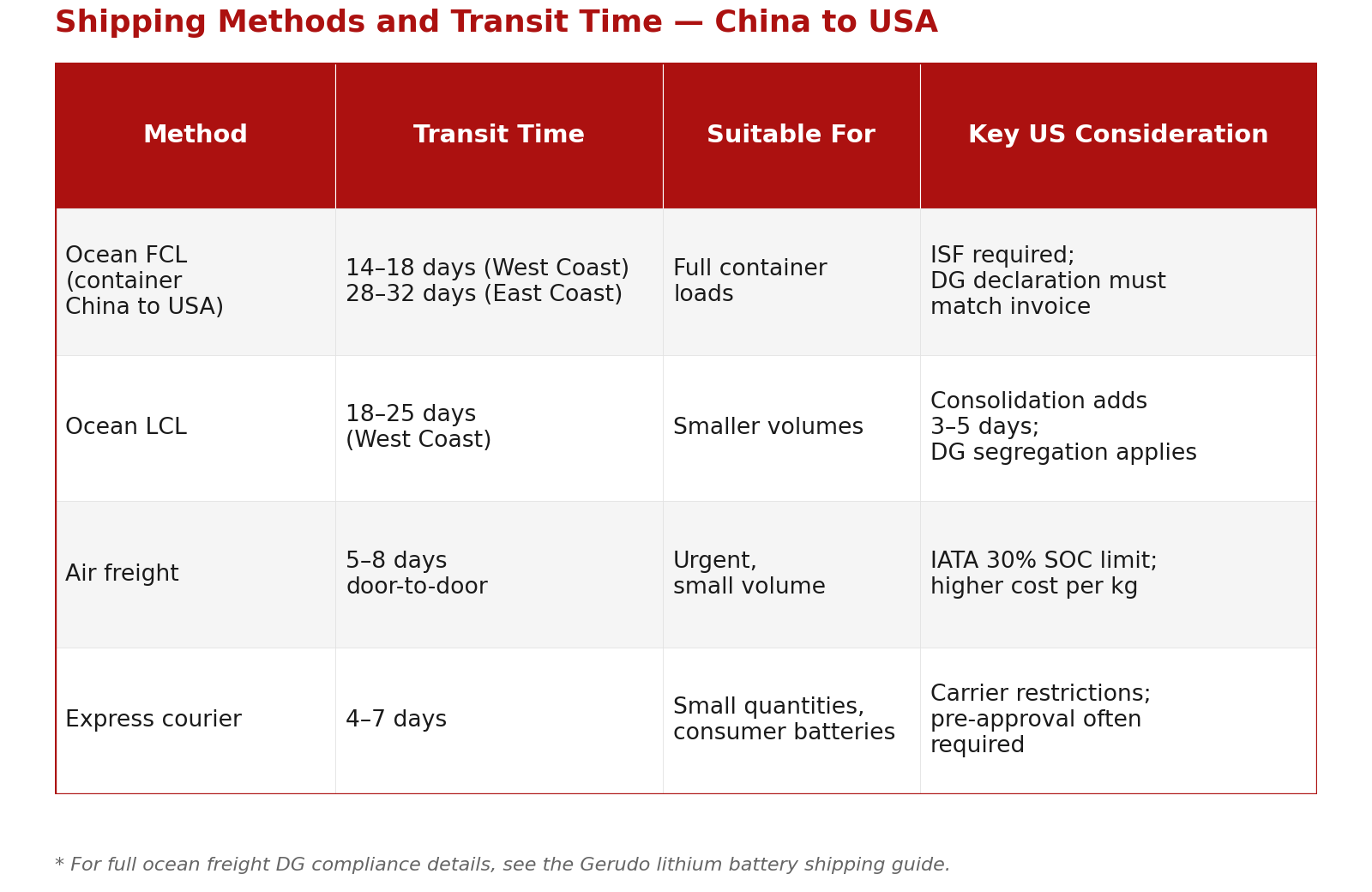
For ocean freight compliance details, see our lithium battery shipping guide.
How Much Does It Cost to Ship Batteries from China to the USA?
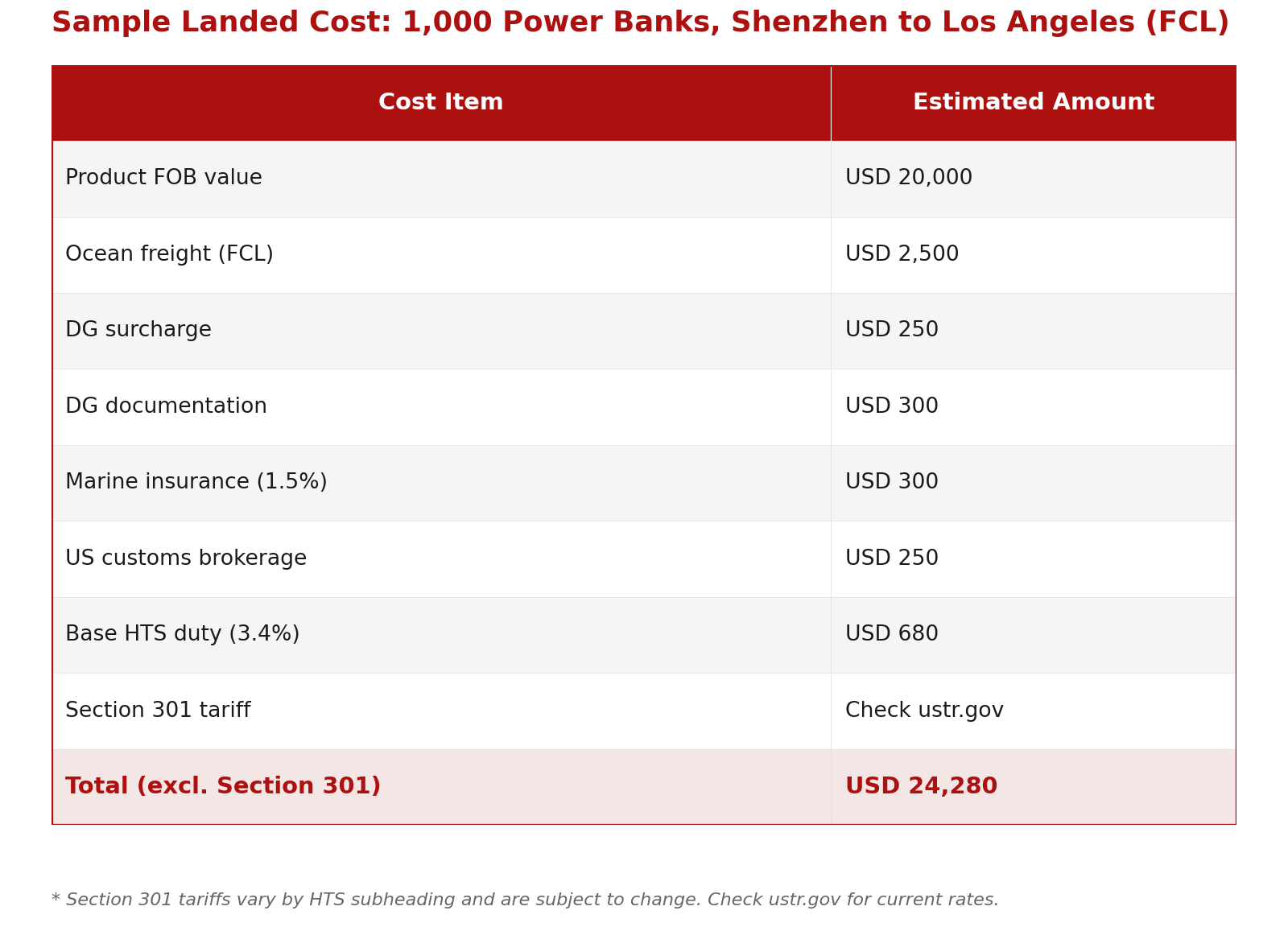
Many importers calculate landed cost based on product price and ocean freight alone. For battery shipments, several additional cost items apply.
Ocean carriers apply DG surcharges of USD 150–400 per container. If your supplier cannot provide compliant DG documentation, a DG-certified freight forwarder will prepare and sign the declarations for USD 200–500 per shipment. Customs brokerage fees typically range from USD 150–350, and a CBP examination adds USD 300–800 plus storage costs. CPSC third-party testing costs USD 500–2,000 per product model. UL certification varies by product category. Both are one-time costs per model, not per shipment.
Sample landed cost for 1,000 lithium-ion power banks, Shenzhen to Los Angeles (FCL):
US Regulations for Shipping Lithium Batteries from China to the USA
49 CFR and PHMSA
Once batteries enter the US, they fall under 49 CFR, the US domestic hazardous materials regulation managed by PHMSA (Pipeline and Hazardous Materials Safety Administration).
49 CFR is separate from IMDG. Labeling formats, shipping paper requirements, and carrier registration rules all differ. Your freight forwarder handles IMDG compliance for the ocean leg. Your US partners (3PL, trucking company) must handle 49 CFR for domestic transport. Clearing Customs does not mean the shipment is ready for US distribution. Verify that your US logistics partners are PHMSA-registered before they move your cargo.
CPSC (Consumer Product Safety Commission)
CPSC regulates consumer products sold in the US. For battery-containing products, the main requirement is the General Certificate of Conformity (GCC). This is a written statement that your product meets all applicable CPSC safety standards. You must issue it before the product enters US commerce. It must be based on testing by a CPSC-accepted laboratory and be available to CBP on request.
UL Certification
UL certification is not a legal requirement for Customs clearance. But it is a practical requirement in several situations:
Major retailers (Home Depot, Best Buy, Walmart) require UL or equivalent for battery products
Amazon requires UL or equivalent for certain battery categories on its US marketplace
Some US states require UL-listed batteries in building systems and emergency equipment
The applicable UL standard depends on your product type. Clarify certification requirements with your US buyers before placing orders in China.
EPA Requirements
Lead-acid batteries fall under EPA regulations (RCRA — Resource Conservation and Recovery Act). US retailers must accept used lead-acid batteries for recycling under the Universal Waste Program. Some states impose additional obligations on importers. This is a post-import issue rather than a clearance issue.
US Customs Clearance — What Battery Importers Need to Know
HTS Codes for Battery Imports
Your HTS code determines your duty rate and whether Section 301 tariffs apply. Battery products fall under Chapter 85 of the HTS.
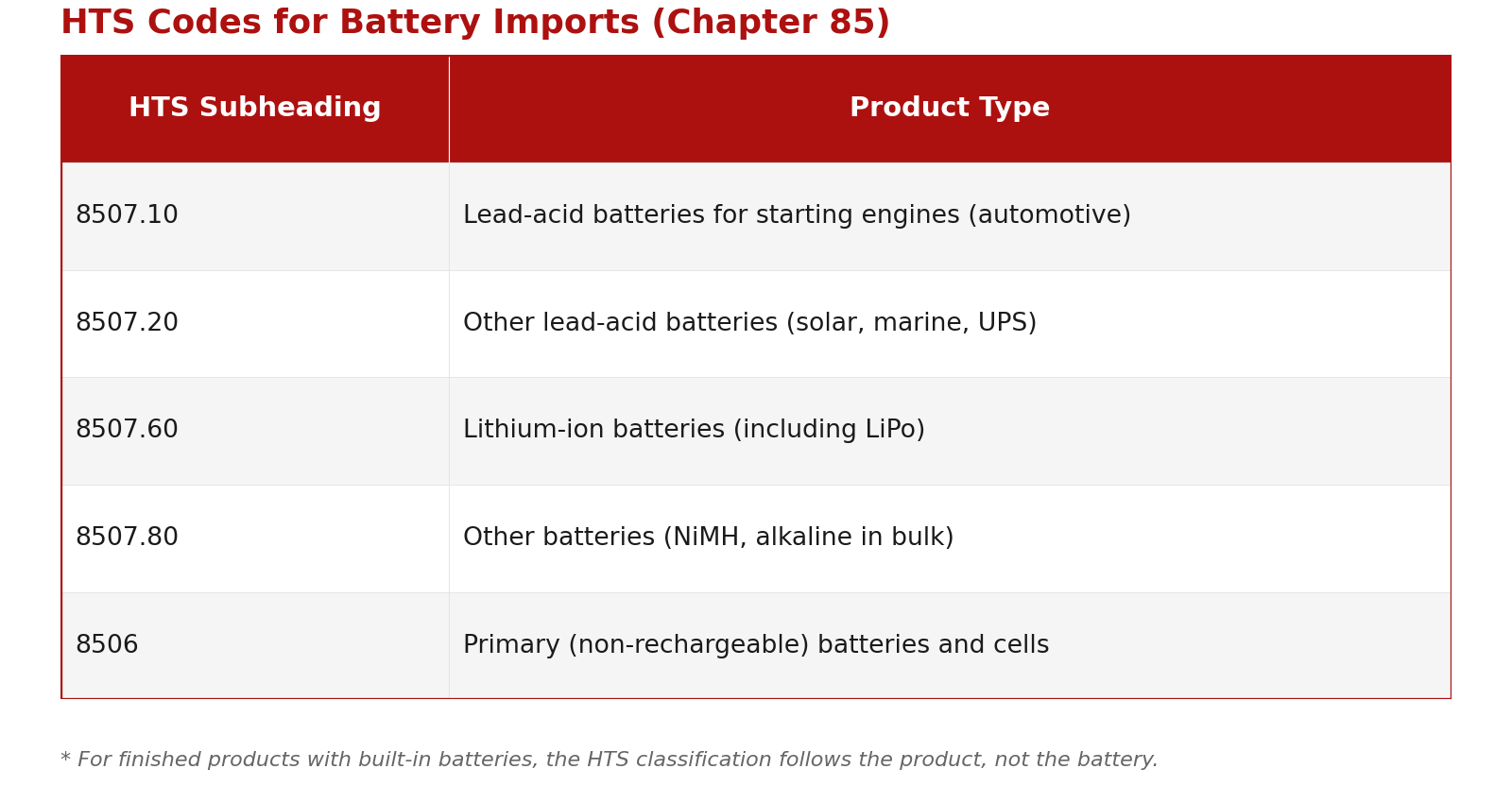
If batteries are built into a finished product, the HTS follows the product, not the battery. A laptop is classified under 8471, not 8507. For high-volume shipments, request a binding ruling from CBP — a formal written decision on your HTS code that protects you from reclassification later.
Section 301 Tariffs
Section 301 tariffs apply to most battery products imported from China. The rate depends on your HTS code and is still subject to adjustment. Check the current rate at ustr.gov or with your US customs broker. Section 301 tariffs are a major landed cost item and must be factored in from the sourcing stage.
ISF (Importer Security Filing)
For ocean freight, you must file an ISF (also called 10+2) with CBP at least 24 hours before the vessel departs the foreign port.
Up to USD 5,000 per violation for late or inaccurate filing
Repeated violations trigger higher exam rates on all future shipments
Any mismatch between the ISF and the Bill of Lading is a red flag for CBP. Once filed, your customs broker can help you track shipping from China and monitor vessel status against the ISF submission.
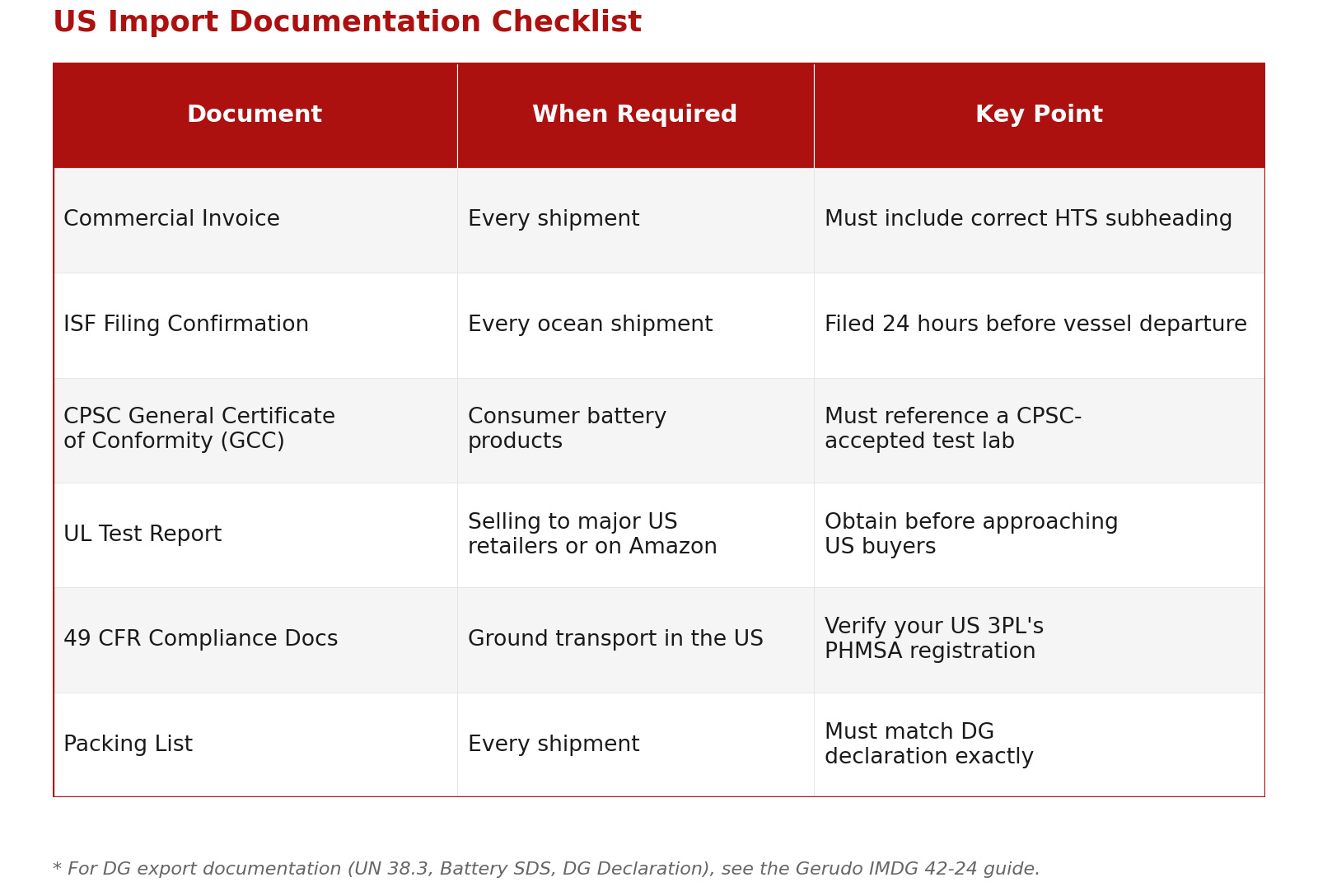
How to Ship Batteries from China to the USA: Your Import Checklist
For DG export documentation (UN 38.3, Battery SDS, DG Declaration), see the IMDG 42-24 guide. For the US import side, you need:
What CBP Looks for — and Common Reasons Battery Shipments Get Held
CBP flags battery shipments based on several risk factors. Understanding these helps you avoid the most common causes of holds and delays.
Wrong HTS code
The most common cause of delays. The wrong subheading changes your duty rate and Section 301 tariff exposure. CBP cross-checks your declared code against product description, unit value, and shipper history.
Late or inaccurate ISF
Any ISF filed after the 24-hour deadline is an automatic flag. So is any ISF that does not match the Bill of Lading. A good customs broker prevents both.
No CPSC documentation
CBP officers routinely request CPSC compliance documents for consumer products. Without a GCC, your shipment faces a hold or refusal of entry.
UN 38.3 mismatch
Your UN 38.3 test summary must match the exact battery model on your commercial invoice. A mismatch triggers examination.
49 CFR labeling issues
IMDG-compliant packaging is not automatically 49 CFR compliant. US domestic carriers may refuse cargo that does not meet 49 CFR marking requirements, even after it has cleared Customs.
Section 301 classification dispute
If CBP believes you have used a lower-duty HTS code to reduce tariff exposure, it will reclassify your goods. Penalties and interest on unpaid duties may apply.
A standard container examination costs USD 300–800, plus storage during the examination period. The importer pays regardless of outcome.
Working with a Shipping Agent: What to Look for in Battery Imports
Shipping batteries from China to the USA requires expertise across the full supply chain. The China export side and the US import side have different rules, different documents, and different risks.
Working with an experienced shipping agent from China to USA makes a significant difference for battery imports. Look for the following:
DG certification: Your agent should have staff certified in IMDG and IATA dangerous goods regulations, not just general freight experience.
China-side operations: Direct presence in major Chinese ports (Shanghai, Shenzhen, Ningbo, Guangzhou) reduces reliance on sub-agents and speeds up issue resolution.
US customs broker network: A good agent coordinates directly with licensed US customs brokers for HTS classification, ISF filing, and CBP examination response.
Documentation audit capability: The agent should review UN 38.3 test summaries, Battery SDS, and DG declarations before booking, not after a carrier rejects the shipment.
At Gerudo Logistics, we manage the China export side directly, covering UN 38.3 verification, DG declaration preparation, and carrier coordination from Shanghai, Shenzhen, Ningbo, and Guangzhou. For US-bound shipments, we work with licensed US customs brokers to ensure HTS classification accuracy, timely ISF filing, and documentation completeness before vessel departure.
Contact our team to discuss your battery product and shipping requirements.
Frequently Asked Questions
Can you ship batteries from China to the USA?
Yes. There is no import ban. Batteries ship via ocean freight, air freight, and express courier. They must comply with dangerous goods rules for transport and US customs requirements for import.
What is the import duty on lithium batteries from China?
The base HTS rate for lithium-ion batteries (8507.60) is 3.4%. Section 301 tariffs add more on top. The exact amount depends on your HTS subheading and current US trade policy. Check the current rate with your customs broker before calculating landed cost.
Do I need UL certification to import batteries from China?
Not for Customs clearance. But most major US retailers and some e-commerce platforms require it. Confirm what your buyers need before finalizing product specs.
What batteries can be shipped by air from China to the USA?
Most types can ship by air. Lithium batteries must be at 30% state of charge or less and are subject to quantity limits. Large quantities require cargo-aircraft-only (CAO) shipment. Some high-capacity LiPo batteries are refused by airlines regardless of documentation.
How long does shipping batteries from China to the USA take?
Ocean freight: 14–18 days to the US West Coast, 28–32 days to the East Coast. Total door-to-door time is typically 4–7 weeks. Add 2–3 weeks during Chinese New Year and the pre-Christmas peak.
What happens if US Customs holds my battery shipment?
CBP issues a hold notice. You have 5–10 business days to provide the missing documentation. If resolved, the shipment is released. If not, options include reclassification, re-exportation, or destruction. You pay examination and storage costs regardless of outcome.
What is an ISF and when must it be filed?
ISF is a mandatory pre-shipment filing to CBP for all ocean freight imports to the US. It must be filed at least 24 hours before the vessel departs the foreign port. Penalties reach up to USD 5,000 per violation.
What is the difference between IMDG and 49 CFR for battery shipments?
IMDG governs ocean transport from China to the US port. 49 CFR governs domestic transport within the US after Customs clearance. The two differ on labeling, shipping paper formats, and carrier registration. IMDG compliance does not satisfy 49 CFR requirements.
Conclusion
Shipping batteries from China to the USA involves more than booking a container. Export compliance, US Customs classification, CPSC documentation, and domestic transport regulations all require attention at different stages of the supply chain.
The most common and costly mistakes come from treating battery shipments as standard freight. Wrong HTS codes, missing GCCs, and ISF errors are all preventable with the right preparation and partners in place before the shipment moves.
Start by verifying your battery classification and HTS code. Confirm your supplier can produce current DG documentation. Work with a freight agent who handles dangerous goods regularly. Getting these elements right before booking avoids the delays, examinations, and penalties that affect importers who address compliance problems after cargo is already at the port.