How to Import Goods from China to Indonesia on a Small Scale
China is Indonesia's largest import source by value, and a growing share of that trade comes from buyers placing orders that are too large for personal shopping but too small to fill a container. The challenge for this segment is not finding products. It is understanding the licensing framework, selecting the right transport mode, and avoiding the compliance gaps that cause shipments to be held or seized at Tanjung Priok.
This guide covers the practical path for small-scale importers: what legal thresholds apply, how to source at low minimum order quantities, how undername import works, and what Indonesia's tax and restricted-goods framework means for your total landed cost.
For a full cost and transit time breakdown on this trade lane, see our comprehensive guide Shipping from China to Indonesia.
What "Small Scale" Means in the China-Indonesia Trade Lane
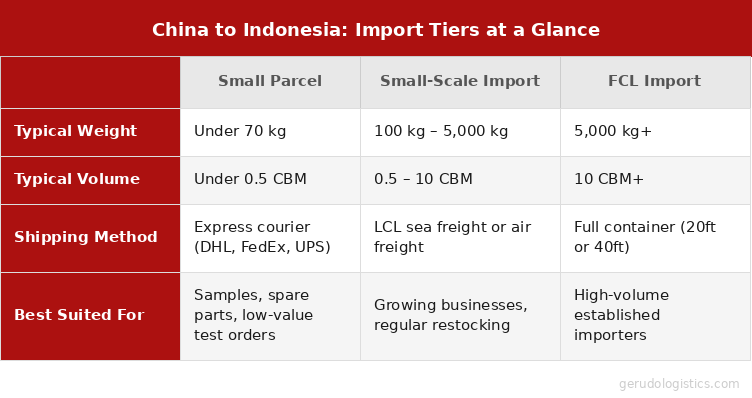
Importers sourcing from China to Indonesia generally fall into one of three tiers. Understanding which tier you sit in determines your shipping method, compliance requirements, and the logistics partner you need.
At the smallest end, small parcel buyers send samples, test orders, or low-value replenishments via express courier - a straightforward process handled entirely by the courier with no formal import declaration.
At the largest end, FCL importers fill a 20ft or 40ft container with established credentials and the volume to absorb per-shipment fixed costs. The middle tier - small-scale formal import via LCL sea freight or air freight - is where most growing businesses operate, and where compliance requirements become more involved.
The legal threshold that matters most within this tier is whether you hold an API (Angka Pengenal Importir) - Indonesia's importer identification number. Without an API, you cannot appear as the formal consignee on an Indonesian customs declaration. This single requirement shapes how most small-scale imports into Indonesia are handled in practice.
Two API types are relevant:
API-U (Angka Pengenal Importir Umum): for businesses importing goods for resale or distribution
API-P (Angka Pengenal Importir Produsen): for manufacturers importing inputs for their own production
To obtain either type, you must first hold a NIB (Nomor Induk Berusaha), Indonesia's unified business registration number. Small buyers who import infrequently, or who have not yet registered a formal business entity, typically cannot obtain an API efficiently. That is the gap that undername import fills.
Sourcing from 1688 and Alibaba at Small Order Quantities
Two platforms handle the majority of China sourcing for small international buyers, and they serve different buyer profiles.
Alibaba is the standard starting point for most importers new to China sourcing. Key characteristics:
Suppliers communicate in English and are accustomed to international inquiries
Trade Assurance provides payment protection and dispute resolution
Supplier verification is more standardized than on domestic platforms
MOQs tend to be calibrated for export-sized orders, so prices for small quantities are often uncompetitive
1688.com is Alibaba Group's domestic Chinese wholesale platform, designed for Chinese buyers purchasing directly from factories and distributors. Key characteristics:
Prices are lower and MOQs are smaller than equivalent Alibaba listings
Product variety is broader, particularly for components and semi-finished goods
The platform operates entirely in Chinese and requires a Chinese Alipay account for payment
Most international buyers access 1688 through a sourcing agent or a freight forwarder who offers purchasing support as part of their service
For practical decision-making: if you already have an agent or forwarder relationship in China, 1688 typically delivers better per-unit pricing even after agent fees. Without that relationship, Alibaba's Trade Assurance gives you more recourse if product quality or delivery does not match expectations.
One step worth taking regardless of platform: request samples before placing a production order. Inconsistency between a sample and the production run is a common problem that causes delays when cargo reaches Indonesian customs and does not match the declared specifications.
The Undername Import Method (Jasa Undername)
Undername import - known in Indonesia as Jasa Undername or Sewa Bendera ("flag rental") - allows a buyer without their own API to import goods by using a licensed freight forwarder or trading company as the formal consignee on the Indonesian customs declaration.
Under this arrangement, the forwarder's API appears on the PIB (Pemberitahuan Impor Barang), Indonesia's import declaration. The forwarder manages customs clearance under their license, and goods are released to the actual buyer after clearance through a door-to-door delivery arrangement. This method is widely used in legitimate commercial operations and is the default solution for small importers who have not yet established their own import credentials.
The tax cost of operating without your own API is significant. PPh Pasal 22 (Article 22 Income Tax) is charged at 7.5% of the import value for consignees without an API, versus 2.5% for API holders. That 5% difference on every shipment is one of the clearest financial arguments for obtaining your own API once your import volume becomes consistent.
Undername cannot be used in all situations. Goods that fall into any of the following categories cannot be cleared under a forwarder's API:
Products requiring a sector-specific BPOM import license tied to the consignee's own registration
Quota-controlled goods where the import allocation is issued to a named importer
Hazardous materials where Indonesian regulations require the buyer to hold their own KLHK environmental permit
Confirm which category your goods fall into with your forwarder before the order is placed, not after the cargo has sailed.
Air Freight vs. Sea Freight LCL: Choosing the Right Method
The decision between air freight and sea LCL depends on three factors: shipment weight, urgency, and product type. For shipments below roughly 100-150 kg, air freight or express courier is often cost-competitive with LCL once you account for LCL handling fees, documentation costs, and the longer transit window. Above that threshold, LCL sea freight typically offers better cost per unit for standard cargo.
For air freight, indicative rates from China to Jakarta run USD 4.50-8.00 per kg on chargeable weight, with transit of 5-10 days and customs clearance of 2-5 days. Cargo arrives at Soekarno-Hatta (CGK). DG cargo such as lithium batteries is accepted on a limited basis under IATA restrictions - certain configurations are prohibited on passenger aircraft entirely.
For sea freight LCL, indicative rates run USD 25-45 per CBM (or per ton, whichever is greater), with port-to-port transit of 14-25 days and customs clearance of 3-7 days at Tanjung Priok. Most consolidators require a minimum of 0.5 CBM or 500 kg. DG cargo is accepted with full IMDG documentation in place.
For express courier (DHL, FedEx, UPS), rates are higher per kg than standard air freight but include door-to-door delivery and simplified customs handling. Express works best for shipments under 50 kg, high-value samples, or time-critical parts.
See our small package and parcel shipping service for express options from China.
What You Actually Pay: Indonesian Import Taxes
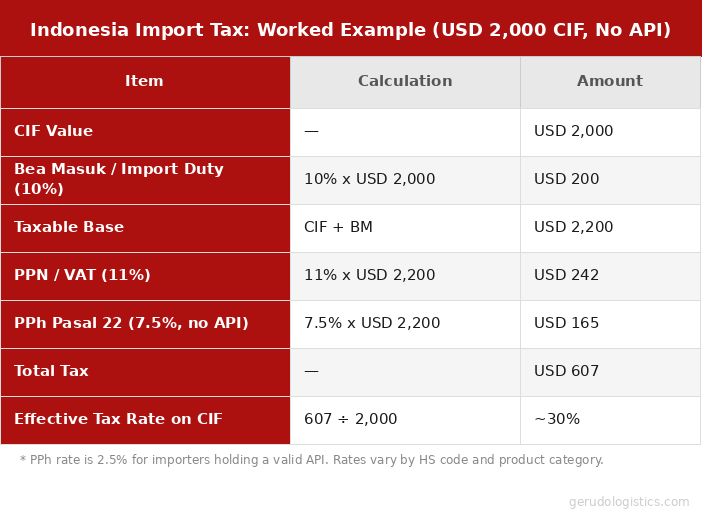
Indonesian import taxation applies three sequential charges, all calculated on the CIF value of your shipment. CIF stands for Cost, Insurance and Freight - the combined total of your goods cost, international shipping fee, and cargo insurance.
Bea Masuk (BM) - Import Duty rates range from 0% to 40% depending on your product's HS code. Consumer electronics typically attract 0-10%, finished apparel and footwear can reach 20-40%, and raw materials often sit at 0-5%. Verifying your HS code and BM rate before ordering is essential - it directly determines your landed cost.
PPN (Pajak Pertambahan Nilai) - VAT is charged at 11% and applied to the sum of CIF value plus import duty. This applies regardless of whether you import under your own API or through undername.
PPh Pasal 22 - Article 22 Income Tax is 2.5% with a valid API, or 7.5% without one, applied to the same CIF + BM base as PPN.
A worked example for a USD 2,000 CIF shipment with a 10% BM rate, imported via undername:
Port handling fees, terminal charges at Tanjung Priok, and customs clearance service fees add a further USD 100-300 per LCL shipment depending on volume. Budget these separately from the tax charges above.
From Chinese Warehouse to Your Door: The Full Import Journey
Step 1 - Place your order and confirm export readiness. After finalizing your order with the Chinese supplier, confirm they can provide a commercial invoice, packing list, and certificate of origin. For products containing lithium batteries, verify that the supplier can provide an MSDS and that packaging meets DG export requirements. Share your freight forwarder's contact details with the supplier at this stage so collection can be coordinated directly.
Step 2 - Cargo pickup and consolidation in China. Your forwarder collects the goods from your supplier's warehouse and brings them to a consolidation point near the departure port. If you are sourcing from multiple suppliers, this is where your forwarder aggregates everything into a single shipment, checks for visible damage, and confirms that cargo weight and dimensions match the packing list.
Step 3 - Export customs clearance in China. Your forwarder files the export declaration with Chinese customs on your behalf. Standard cargo typically clears within one to two working days. DG cargo requires additional documentation before loading is confirmed - your forwarder will specify what is needed based on your product type.
Step 4 - Ocean or air transit. For LCL sea freight, your cargo is loaded into a shared container and departs from the agreed port. Sailing from Guangzhou or Shenzhen to Tanjung Priok takes approximately 12-15 days; from Shanghai, expect 16-20 days. Air freight transits in 5-10 days including handling at both ends. Your forwarder provides a tracking reference so you can monitor the shipment during transit.
Step 5 - Pre-arrival document preparation. While cargo is in transit, your forwarder prepares the Indonesian import declaration (PIB) and confirms all supporting documents are in order. For undername imports, this is processed under the forwarder's API. For LARTAS goods, all required pre-approvals must be confirmed at this stage - not at the port.
Step 6 - Import customs clearance at Tanjung Priok. Once the vessel or aircraft arrives, your forwarder's Indonesian partner files the PIB and manages clearance. Standard LCL cargo typically clears within 3-7 days. Physical inspections can extend this timeline. You will receive a copy of the SPPB (Surat Persetujuan Pengeluaran Barang) - the customs release document - once clearance is complete.
Step 7 - Final delivery to your address. After the SPPB is issued, cargo moves from the port to your warehouse or delivery address. Jakarta deliveries typically take one to two days from port release. Delivery to Surabaya, Medan, or other cities adds one to three days depending on the destination.
Small Electronics and Digital Products: When Your Cargo Is Already DG
Many small importers sourcing digital and consumer electronics from China are carrying dangerous goods without realizing it. If your product contains a lithium battery, it falls under Class 9 (Miscellaneous Dangerous Goods) under both IATA and IMDG regulations - regardless of how small the battery is or how finished the product appears.
Common items in this category that small importers frequently source from 1688 or Alibaba include:
Bluetooth earphones and speakers containing lithium-ion cells
Mobile power banks (UN3481 - lithium-ion batteries contained in equipment)
Wireless keyboards, mice, and small electronics accessories
Electric toys and ride-on products
Smartwatches and fitness trackers
What this means for your shipment. Before your cargo is loaded, the following must be in place:
Your Chinese supplier provides a compliant MSDS and, depending on battery configuration, a UN38.3 test report
Packaging meets the applicable DG standard for your chosen transport mode
For air freight: IATA DGR rules apply, and certain lithium battery configurations are prohibited on passenger aircraft entirely
For sea LCL: IMDG Code requirements govern packing, marking, and labelling
Your forwarder confirms DG handling capability before the booking is made - not all LCL consolidators accept Class 9 cargo
Power banks carry an additional compliance layer in Indonesia. Beyond the DG classification, power banks are subject to SNI (Standar Nasional Indonesia) certification requirements, meaning they fall under both a DG handling requirement and a LARTAS product registration requirement simultaneously. Importing power banks without SNI certification will result in a customs hold regardless of how the DG documentation is handled.
If your product contains a lithium battery and you are unsure whether it qualifies as DG, share the product specifications and MSDS with your forwarder before placing your production order.
See our guide to shipping lithium batteries and Class 9 dangerous goods from China for full compliance detail
LARTAS: Restricted Goods and How to Manage Them
LARTAS (Larangan dan Pembatasan) is Indonesia's framework covering goods that are either prohibited or subject to import restrictions requiring pre-approval before customs clearance can proceed. For small importers, LARTAS is the most common source of port holds and cargo seizures.
Products commonly subject to LARTAS restrictions include:
Food, beverages, and dietary supplements: BPOM import notification (ML number) required before import
Cosmetics and personal care products: BPOM registration required per SKU
Electronics and electrical goods: SNI certification required for many categories including cables, adapters, lighting, and audio equipment
Textiles and apparel: SNI and surveyor verification apply to certain product categories
Agricultural products and plant-based materials: quarantine inspection required from BKIPM or the Ministry of Agriculture
Chemicals and hazardous materials: Ministry of Environment (KLHK) Rekomendasi Impor B3 required
LARTAS compliance must be arranged before your goods are shipped from China, not after they arrive at Tanjung Priok. Cargo arriving without the required approvals will be held at port. In serious cases, goods are destroyed or returned to origin at the importer's expense.
Undername import does not provide a workaround for LARTAS. If your goods require a BPOM ML number or SNI certificate, those approvals must exist regardless of whose API is used for clearance. Check LARTAS status at the sourcing stage, before placing a production order in China.
How Gerudo Logistics Handles Small-Scale Imports from China to Indonesia
Gerudo Logistics is a dangerous goods and reefer-specialist freight forwarder headquartered in Guangzhou, with operations across Shanghai, Ningbo, Shenzhen, Qingdao, and Dalian.
For importers shipping to Indonesia, we handle both standard FCL and LCL cargo. We provide door-to-door DDP service that includes undername customs clearance through our Indonesian partner network, covering Tanjung Priok (Jakarta) as well as Surabaya and other delivery destinations.
For DG cargo, our team confirms documentation requirements - including MSDS, UN38.3 test reports where applicable, and IMDG or IATA-compliant packaging verification - from the Chinese export stage through Indonesian customs release.
Before any booking is confirmed, we check whether your cargo falls under a LARTAS category and identify the required pre-approvals. For lithium battery products, we confirm SNI status so there are no compliance surprises at Tanjung Priok.
Frequently Asked Questions
Can I import from China to Indonesia without a business license? Through the undername (Jasa Undername) method, your freight forwarder uses their own API to clear goods through Indonesian customs on your behalf. You do not need your own API for this arrangement, but your goods must not fall into categories that require the consignee to hold a sector-specific import license.
What is the minimum shipment size for LCL sea freight from China to Indonesia? Most LCL consolidators on this lane require a minimum of 0.5 CBM or 500 kg, whichever is greater. Below that threshold, air freight or express courier is generally more cost-efficient when you factor in LCL handling and documentation fees.
How long does a small shipment take to arrive from China to Jakarta? Sea LCL runs approximately 14-25 days port to port, plus 3-7 days for customs clearance. Air freight takes 5-10 days including clearance. Add one to three days for door-to-door delivery to cities outside Jakarta.
Are there goods I cannot import through undername? Yes. Goods requiring the consignee to hold a sector-specific license - certain BPOM-registered product categories, quota-controlled goods, or hazardous materials requiring the buyer's own KLHK environmental permit - cannot be cleared under a forwarder's API. Confirm this with your forwarder before the order is placed.
What documents do I need to import from China to Indonesia? Standard documents include the commercial invoice, packing list, bill of lading or airway bill, and certificate of origin. DG cargo additionally requires MSDS and DG declarations compliant with IMDG or IATA DGR standards. LARTAS goods require category-specific permits such as BPOM notification, SNI certificate, or KLHK recommendation depending on product type.
Is 1688 reliable for small international orders? 1688 is a legitimate wholesale platform, but it operates without the buyer-protection mechanisms available on Alibaba's international marketplace. Payment disputes are more common when using 1688 without a local agent or forwarder handling the purchasing process. Working with a forwarder who offers purchasing support reduces this risk significantly.
What to Do Before Your First Shipment
Small-scale importing from China to Indonesia is operationally straightforward once you understand where the real compliance checkpoints are. The API and undername question determines your tax structure. The LARTAS check determines whether your goods can enter at all. The DG classification question determines which carriers and consolidators can handle your cargo.
All three questions are worth answering before you place a production order in China, not after the goods are packed and ready to ship. A conversation with your freight forwarder at the sourcing stage - covering your product type, HS code, and intended shipment method - resolves most of them in one step and prevents the delays that typically catch first-time importers off guard.