Importing Building Materials from China: Costs, Containers and Customs (2026)
A 20ft container of porcelain tiles and a 40ft container of kitchen cabinets look like the same type of shipment on paper. They are not.
One hits the weight limit before the floor is full. The other needs internal bracing that the supplier will not arrange unless you specify it. Getting either one wrong costs money that does not show up until the cargo arrives.
This is a guide to getting the decisions right before the container is loaded. It covers cargo categories, container selection, 2026 shipping costs, transit times, sourcing hubs, customs duties, and required documents.
Types of Building Materials You Can Import from China
The most useful way to group building materials is by how they behave in transit and at customs. There are three categories.
Group 1: High-Density Brittle Cargo
This group includes:
Ceramic and porcelain tiles
Sintered stone and quartz slabs
Marble and granite
Sanitary ware
Glass products
These materials are heavy relative to their size. A 20ft container loaded with tiles often hits its weight limit before the floor is full. Adding a 40ft container does not add usable capacity - it adds cost.
The main damage risk is packaging failure. Edge chipping, surface scratching, and cracking under pressure are common when crating is undersized for the voyage.
Group 2: High-Volume Low-Density Cargo
This group includes:
Kitchen cabinets
Aluminum doors and windows
WPC and SPC flooring
Acoustic wall panels
Prefabricated steel sections (C/Z purlins, standard frames)
These products fill container volume before hitting weight limits. The standard container choice is a 40ft High Cube. Internal bracing and loading order determine whether goods arrive in good condition.
Group 3: Compliance-Sensitive Cargo
Some building materials require specific safety or quality certificates before they can be imported. Missing these documents will result in the shipment being held at customs, regardless of how the freight is arranged.
SPC and WPC flooring: must pass a formaldehyde emission test before entering the US or EU market. Formaldehyde is a chemical used in the manufacturing process, and regulators in both markets set limits on how much can be present in the finished product. Ask your supplier for the test certificate and confirm it covers your exact product.
LED lighting, smart toilets, and electrical fixtures: need a safety certification for the market you are importing into. For the US, this is a UL or ETL certificate - these confirm the product meets American electrical safety standards. For the EU, the equivalent is CE marking.
Steel structures: require a China export license (mandatory since January 2026) plus an anti-dumping duty declaration for US and EU buyers. Anti-dumping duties are extra charges applied to certain imported goods to protect local industry - the rate varies by supplier and must be checked before you order.
See our full guide: How to Import Steel Structures from China: 2026 Costs and Logistics Guide.
FCL vs LCL for Shipping Building Materials from China
Full Container Load (FCL) and Less than Container Load (LCL) have different risk and cost profiles. The right choice depends on your cargo type and volume.
When to Use FCL
FCL gives you a dedicated container. No other cargo is handled alongside yours between origin and destination. For tiles, glass, and stone, this is the key advantage - every extra handling point is a breakage risk.
FCL is also the standard for cabinets and large panels. Size accuracy in transit depends on the goods not shifting or being repacked.
When LCL Works - and When It Does Not
LCL shares container space with other shippers. It works well for:
Trial orders under 10 CBM
Non-fragile, standard-sized items
For tiles, glass, and finished surfaces, LCL carries a higher damage risk. Cargo is handled multiple times during consolidation and unpacking. Assigning responsibility for damage is harder.
20GP vs 40HQ: Which Container for Heavy Cargo?
Many importers default to a 40ft container. For high-density cargo like tiles and stone, this can cost more, not less.
A 20GP loaded to its weight limit (approximately 21-23 metric tons net) often gives a lower cost per tonne than a 40ft that cannot be filled to weight capacity. Check this calculation with your freight forwarder before booking.
China Building Materials Shipping Costs in 2026
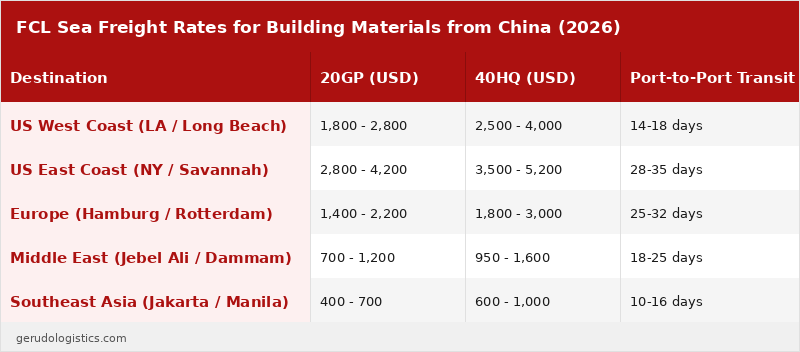
The table below shows FCL rate ranges for early 2026. These are port-to-port estimates only. They exclude destination handling, customs clearance, duties, and inland delivery.
LCL rates typically run USD 35-80 per CBM, before origin and destination handling charges. For orders above 15 CBM, FCL is usually more cost-effective.
Additional costs to include in your budget:
Fuel surcharges: USD 100-300 per container
Destination terminal handling: USD 200-600
Port congestion surcharges: varies by route and season
Dense cargo under-declared on weight is subject to a freight adjustment at origin when the carrier re-weighs. Accurate weight declaration avoids this.
How Long Does It Take to Ship Building Materials from China
Port-to-port transit is only part of the total timeline. Here is a realistic breakdown of each stage.
Stage 1: Production Lead Time
Standard stock items (tiles, flooring, cabinets): 15-30 days
Custom-made items (cabinetry, steel structures, cut stone): 30-60 days from drawing approval
Custom lead times are often underestimated. Plan accordingly before setting a delivery deadline.
Stage 2: Export Clearance in China
Standard processing: 2-3 working days
During Chinese New Year (Jan-Feb) or Golden Week (Oct): add 1-2 weeks
Book freight at least 3-4 weeks ahead during holiday windows.
Stage 3: Destination Customs Clearance
Standard processing with complete documents: 3-7 working days
If physical inspection is triggered: add 5-10 days
Missing or inconsistent documents are the most common reason customs inspections are initiated.
Stage 4: Inland Delivery
Time varies by distance and cargo type. Heavy or oversized goods require specialist trucks and confirmed unloading equipment at the delivery point.
Total Timeline Example
A standard FCL shipment from a Guangdong factory to a US East Coast warehouse typically takes 10-14 weeks door to door, including production, export clearance, ocean transit, US customs, and inland delivery.
Sourcing Building Materials from China
China's building materials production is highly concentrated by region. Knowing where to source reduces both cost and logistics complexity.
Best Cities in China for Sourcing Building Materials
Foshan, Guangdong
Foshan is the most important hub for finished building materials. Key products sourced here include:
Ceramic and porcelain tiles
Sanitary ware
Aluminum windows and doors
LED lighting and fixtures
Furniture hardware
Foshan's proximity to Nansha Port (Guangzhou) and Shekou Port (Shenzhen) makes container consolidation across multiple product categories practical and cost-efficient.
Shanghai and Jiangsu
This region covers:
Engineered wood products
Composite panels
SPC and WPC flooring
Prefabricated structural components
Shanghai's export infrastructure handles complex compliance documentation well, making it a suitable base for products with certification requirements.
Hebei and Shandong
These provinces are China's main production base for structural steel.
Tangshan (Hebei): standard structural profiles at scale
Qingdao (Shandong): export-oriented fabricators with direct port access
For orders combining Foshan finishing materials with Shandong steel, consolidation warehousing at a hub port (Shanghai or Qingdao) avoids separate shipments and reduces total freight cost.
How to Evaluate a Building Materials Supplier
Finding a supplier in the right region is the starting point. Verifying them before placing a deposit is what prevents most problems.
The key distinction is between a direct manufacturer and a trading company. Trading companies resell products from multiple factories. This is not always a problem, but it means less control over production quality, lead times, and compliance documentation - particularly for products that require factory-level certifications such as formaldehyde test reports or steel Mill Test Certificates.
Before committing to any supplier, confirm the following:
Business license and export registration: verify the supplier is registered to export your product category
Relevant certifications: request the actual test certificates, not just confirmation that they exist. For flooring, ask for the CARB Phase 2 report. For electrical products, ask for the UL or CE certificate.
Production capacity: confirm they can complete your order within your timeline without subcontracting to a third party
Export history to your market: ask for references from buyers in your destination country. A supplier with no experience exporting to the US or EU will often have gaps in documentation knowledge.
Sample before bulk production: for tiles, stone, and finished cabinetry, a sample confirms colour, calibre, and finish consistency before you commit to a full container
Platforms such as Alibaba and Made-in-China are useful for initial contact. Filter for verified suppliers with documented export history. For high-value or compliance-sensitive orders, a third-party factory audit before production is a standard precaution.
Customs Duties on Chinese Building Materials (2026)
Tariff rates depend on your product's HTS code, not just the product category. Verify your code before placing any purchase order.
US Tariff Structure for Most Building Materials
Most Chinese building materials imported into the US face a combination of:
20% fentanyl-related tariff (the additional 10% component was cancelled after the October 2025 US-China trade meeting; net rate is now 20%)
Section 301 tariff: 25% on most manufactured building materials
Combined minimum effective rate: approximately 45% for standard building materials.
Steel and Aluminum: Section 232
Steel and aluminum products face an additional Section 232 tariff of 25-50% on top of standard rates. Anti-dumping and countervailing duties on steel vary by mill. Check the USITC database at HTS code level before ordering.
Ceramic and Porcelain Tiles: Anti-Dumping Orders
Active anti-dumping and countervailing duty (AD/CVD) orders apply to Chinese ceramic and porcelain tiles in the US, EU, and India. Key points:
Rates are assessed at the manufacturer level, not the country level
A supplier without an individual rate assigned may face the "all others" rate, which is often higher
Verify your specific supplier's AD/CVD status before committing to volume orders
UFLPA Due Diligence
The Uyghur Forced Labor Prevention Act (UFLPA) is increasingly enforced in 2026. Importers of certain material categories must show supply chain traceability at the input level. Work with your customs broker to confirm whether your specific product falls within current enforcement scope.
Documents Required for Customs Clearance
Incomplete documents are the primary cause of customs holds and inspection delays. The following are required for standard building materials shipments.
Standard Documents (All Shipments)
Commercial Invoice: product description, HTS code, unit price, total value, Incoterm, country of origin. Any inconsistency with the packing list can trigger inspection.
Packing List: carton counts, dimensions, gross and net weights per line item. For tiles and stone, include piece count and surface area.
Bill of Lading: vessel name, port of loading, port of discharge, cargo description consistent with the invoice.
Certificate of Origin: required where preferential duty treatment applies.
ISF (Importer Security Filing): for US ocean freight only. Must be filed by your customs broker 24 hours before vessel departure from China.
Product-Specific Documents
Formaldehyde test report: SPC / WPC flooring and engineered wood (US and EU)
UL / ETL or CE certificate: electrical fixtures, LED systems, smart sanitary ware
Mill Test Certificate: all steel products, stamped by the producing mill
China Export License copy: steel products under HS 7201-7307 (mandatory from January 2026)
Incoterms for Building Material Imports
FOB - Free on Board
FOB is the industry standard for most building material imports. The supplier delivers cargo to the named Chinese port. The importer takes responsibility - and pays - from that point forward. FOB gives you direct control over freight booking and insurance.
DDP - Delivered Duty Paid
Under DDP, your freight forwarder manages everything: pickup in China, export clearance, ocean freight, destination customs clearance, duty payment, and inland delivery. You get one price and one point of contact.
DDP works well for:
First-time importers
Multi-supplier orders needing consolidation
Compliance-sensitive cargo requiring document coordination
EXW - Ex Works
EXW transfers all logistics responsibility to the importer from the factory gate. Without established trucking arrangements inside China, this adds coordination work without a clear cost benefit.
CIF - Cost, Insurance, and Freight
CIF is offered by some suppliers as a convenience option. The drawback: you lose control over insurance terms and carrier selection. Supplier-arranged insurance is often insufficient for the cargo value involved.
Managing Cargo Risk Before Shipment
When to Order a Pre-Shipment Inspection (PSI)
A PSI is most cost-effective in these situations:
First order from a new supplier
First production run of a new product specification
Orders where visual consistency is critical (tiles, stone slabs, finished cabinetry)
Standard PSI fees from firms such as SGS, Intertek, or V-Trust run approximately USD 200-350 per man-day in China.
The financial case for PSI is clear: releasing final payment without a passing inspection report leaves you with no documented basis for a claim if goods arrive non-conforming. Hold final payment until the inspection report is in hand.
What to Check by Cargo Type
Tiles: calibre consistency, surface flatness, shade variation across boxes
Cabinets: hardware function, hinge and drawer alignment, finish consistency, dimensions against purchase order
Steel: piece mark accuracy, surface treatment coverage, dimensions on key structural members
Marine Insurance vs Supplier Disputes
Marine cargo insurance covers damage that occurs in transit. If goods arrive damaged from handling or sea conditions, a claim is well-supported with documented evidence at delivery.
Production defects - wrong colour, wrong size, failed compliance test - are supplier disputes. The outcome depends on your contract terms and the quality records you established before shipment.
Choosing a Reliable Shipping Agent for Building Materials from China
Gerudo Logistics manages building material shipments through our operations in Guangzhou, Shenzhen, Shanghai, Ningbo, and Qingdao.
What we handle for this cargo category:
Weight-limit routing for high-density cargo: we select the optimal container type and loading plan for tiles and stone, avoiding freight adjustments at origin
Multi-supplier consolidation: we coordinate factory pickups and consolidation for importers combining Foshan finishing materials with Shandong structural products
Compliance documentation tracking: we confirm formaldehyde test reports, UL/CE certificates, steel export licenses, and UFLPA documentation before production is complete
DDP execution: full door-to-door delivery including destination customs clearance and inland transport
Contact us for a landed cost estimate on your next building materials shipment.
Frequently Asked Questions for Building Materials Import
Is it still cost-effective to import building materials from China in 2026?
For most product categories, yes. China's manufacturing cost advantage - particularly for tiles, flooring, and cabinets - is large enough to absorb current US tariff rates and still deliver a lower landed cost than local sourcing at volume. The margin is narrower than pre-2018, which makes accurate landed cost calculation before ordering more important.
What container size should I use for tiles from China?
A 20GP is usually more cost-effective than a 40ft for tiles. Tiles hit the weight limit (around 21-23 metric tonnes net) before filling the floor area. A 40ft loaded to weight capacity with tiles will have unused floor space you are paying to move. Confirm the numbers with your freight forwarder using your tile weight per carton.
Are there anti-dumping duties on Chinese ceramic tiles in the US?
Yes. Active anti-dumping and countervailing duty orders apply to Chinese ceramic and porcelain tiles in the US. Rates are set at the manufacturer level. Verify your supplier's AD/CVD status through the USITC before committing to an order.
What certification does SPC flooring need for the US market?
SPC flooring must meet California Air Resources Board (CARB) Phase 2 formaldehyde emission standards. Ask your supplier for the current test certificate and confirm it covers your exact product specification. A certificate issued for a different variant does not cover your shipment.
What is the ISF filing deadline for US ocean freight?
ISF must be filed by your customs broker 24 hours before the vessel leaves the Chinese port. Late filing triggers a penalty and may lead to a customs exam on arrival. Give your broker the shipment details as soon as freight is booked.
How does DDP shipping work for building materials?
Under DDP, your forwarder handles the full journey: China pickup, export clearance, ocean freight, destination customs, duty payment, and final delivery. You receive one all-in price. Gerudo offers DDP to the US, Europe, and the Middle East.
What documents are required for steel building materials from China in 2026?
Beyond the standard invoice, packing list, and bill of lading, steel products under HS codes 7201-7307 require a China Export License copy (mandatory from January 2026 under Announcement No. 79/2025) and a Mill Test Certificate from the producing mill. US importers also need an anti-dumping duty declaration.
Conclusion
Shipping building materials from China in 2026 comes down to planning the right decisions at the right stage. Container type, tariff verification, documentation, and inspection timing all need to be confirmed before cargo is loaded - not after the container arrives at the destination port.
The most common and expensive mistakes are predictable: defaulting to a 40ft container for high-density cargo, skipping HTS-level tariff verification before ordering, and releasing final payment before a passing inspection report. None of these requires specialist expertise to avoid. They require the right questions at the right stage of the process.