Importing Frozen Tilapia from China to USA: The Real Cost Breakdown in 2026
Frozen tilapia from China moves through some of the most competitive trade lanes in global seafood. The trade environment in 2026 looks meaningfully different, and importers who have not updated their cost models or compliance assumptions are running on outdated numbers. For those evaluating Chinese tilapia for the first time, the picture is more nuanced than many freight quotes suggest.
If you are evaluating Chinese tilapia as a sourcing option in 2026, this article gives you the cost structure, compliance checklist, and supplier verification framework to make that decision on accurate numbers.
Why Importers Still Source Frozen Tilapia from China in 2026
China is the world's largest tilapia producer, with output concentrated in Guangdong (Mao Ming), Hainan, and Guangxi. The processing infrastructure, product variety, and cost per unit that Chinese suppliers offer remain difficult to match from any other single origin.
The export environment has nonetheless shifted due to tariff pressure, competition from Vietnamese basa fish, and growing domestic consumption. Importers who have not updated their cost models are working on outdated assumptions. The landed cost calculation for Chinese tilapia today requires a different set of inputs than it did even a few years ago.
Frozen Tilapia Cold Chain: Reefer Container Requirements and Claims Protection
Tilapia fillets must be maintained at -18°C or below throughout the entire logistics chain, from the processing facility in China to your cold storage at destination. Temperature excursions above this threshold accelerate ice crystal growth within the fillet, degrading texture and reducing shelf life, sometimes without producing visible signs of damage at delivery.
Key cold chain requirements for tilapia shipments from China:
FCL in a 40ft High Cube Reefer is the only practical format at commercial volumes. LCL arrangements share temperature-controlled space across multiple consignments, and the liability chain for temperature excursions is harder to enforce.
Require an IoT real-time temperature tracker in your purchase order. A continuous data log from stuffing to destination is not just a quality control measure. Without it, any insurance or carrier liability claim for temperature damage is almost impossible to substantiate. Shipping companies and insurers will not pay without an unbroken evidence chain.
Request a Pre-Trip Inspection (PTI) report confirming the container reached operating temperature before loading began. A PTI report dated before stuffing is the first link in that evidence chain.
For reefer container specifications and documentation requirements, see our full seafood cold chain shipping guide.
Shipping Frozen Tilapia from China to USA
The US is the largest single destination market for internationally traded tilapia. As of March 2026, the combined estimated tariff on frozen tilapia fillets from China is approximately 35%, following successive rounds of Section 301 and Section 122 measures. The Section 301 exemption that briefly applied to HTS 0304.61.0000 expired in August 2020 and has not been reinstated.
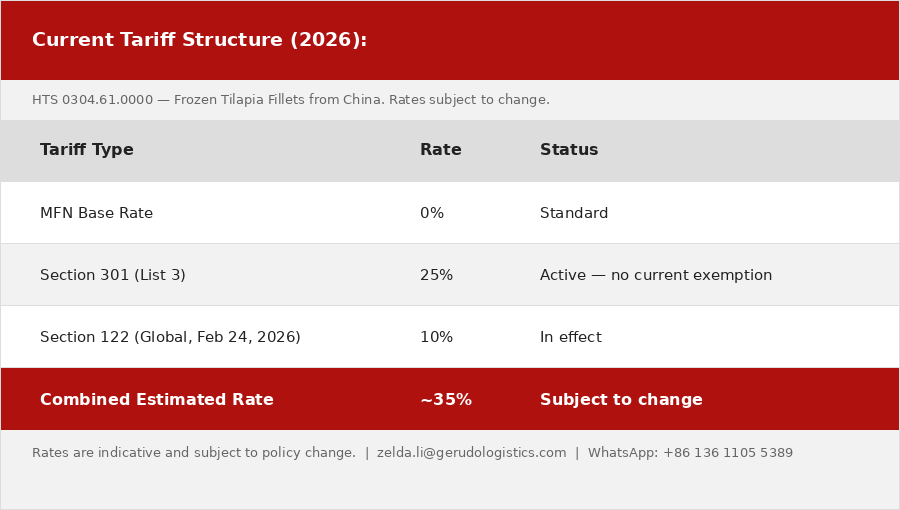
At 35%, the tariff line item typically exceeds the ocean freight cost by a factor of nearly four. For US retail channels, this pushes Chinese tilapia out of competitive range against Indonesian and Latin American supply for most buyers. High-volume commodity food service remains the exception where the FOB price differential can still absorb the duty burden.
Transit times: West Coast (Los Angeles/Long Beach) 18 to 33 days. East Coast (New York/Savannah) 28 to 40 days. Allow 3 to 7 additional days for FDA clearance and port handling.
Landed cost breakdown (US-bound shipment):
Origin handling and inland transport: $300 to $600
Reefer power surcharges: $200 to $400
Ocean freight (40ft HQ Reefer): $3,500 to $5,500
Destination port handling and terminal fees: $400 to $700
Customs brokerage: $150 to $400
FDA Prior Notice and examination fees: $100 to $300
Tariffs (~35% of CIF value): the largest single cost line
Marine cargo insurance: approximately 1% to 1.5% of cargo value
Hidden fees most importers do not budget for:
CES examination fees: If CBP selects your container for a Centralized Examination Station inspection, expect an additional $1,500 to $3,000 in handling, drayage, and inspection charges. Heightened customs scrutiny on Chinese goods in 2026 has made this a more frequent occurrence. This cost is borne entirely by the importer.
Reefer plugging fees: While your container awaits FDA clearance or CBP release, the reefer unit continues drawing power at the terminal. Plugging fees of $75 to $150 per day are standard at major US ports. A five-day clearance delay adds $375 to $750 before the container leaves the terminal.
Invoice structure matters:
US Customs calculates tariffs on CIF value (cost + insurance + freight). If your supplier bundles freight into the FOB value on the commercial invoice, you pay 35% on the freight component as well.
Ensure your invoice clearly separates FOB cargo value from international freight and insurance. On a $50,000 FOB shipment with $5,000 freight and $500 insurance, the tariff on the CIF value of $55,500 is approximately $19,425. A bundled invoice inflates that figure unnecessarily.
Customs Clearance and Documentation for Frozen Tilapia Imports
What customs and your end buyer will both ask for are more connected than they appear. The documents required to clear a tilapia shipment and the certifications required to sell into a particular retail channel often overlap, and gaps in either direction create delays or lost contracts.
Customs clearance documents for each shipment:
FDA importer registration (one-time)
Prior Notice submitted before vessel arrival
Commercial invoice with FOB value and freight listed separately
HACCP documentation from the Chinese processing facility
GACC registration of the processing plant. A plant not listed in the GACC approved exporters database cannot legally export food products from China
Labeling compliance: common name, "Product of China," net weight, "Farm-Raised," and CO treatment disclosure if applicable
Certificate of Admissibility (COA) if your supplier's HTS subheading overlaps with a listed MMPA-prohibited wild fishery. Confirm with your customs broker before the first shipment
Buyer certification requirements by market:
BAP (Best Aquaculture Practices), administered by the Global Seafood Alliance, is the standard required by major US retail chains. For supermarket or club store supply programs, BAP 4-star certification is frequently non-negotiable. Verify against the Global Seafood Alliance's public directory.
ASC (Aquaculture Stewardship Council) carries more weight in EU markets and with sustainability-focused premium buyers. A larger share of Indonesian export volume carries ASC certification than Chinese volume, which is partly why some EU buyers default to Indonesian supply for sustainability-critical programs.
BAP and ASC are not interchangeable. A supplier holding only BAP certification cannot supply an EU retailer whose procurement policy requires ASC. Confirm your end customer's specific certification requirements before shortlisting suppliers, not after.
Other key markets
Mexico: the second-largest tilapia importer globally, with a more favorable trade environment for Chinese product than the US. Required documents include a GACC health certificate, commercial invoice, packing list, and NOM (Norma Oficial Mexicana) compliant labeling. Transit times to Manzanillo or Lázaro Cárdenas typically run 22 to 30 days.
Middle East: requires a halal certificate issued by a GACC-recognised halal certification body in addition to standard seafood documents.
EU: product must be non-CO-treated. ASC certification is required for sustainability-mandated retail programs, and BAP alone is not sufficient for most major EU supermarket chains.
What to Watch Out for When Shipping Frozen Tilapia from China
Ice glaze and net weight pricing
Ice glaze is applied after the IQF freeze cycle to protect fillets from dehydration during transit. Glaze percentages of 5% to 10% of gross weight are standard, meaning a 10 kg carton with 10% glaze contains 9 kg of fish. Some suppliers quote pricing on gross weight, which means you are effectively paying for ice at the per-kilo fish price.
In our experience, this is one of the most common sources of landed cost miscalculation on tilapia imports. Specify "100% net weight pricing" in your purchase order and confirm the glaze percentage in writing before accepting any quote.
Chinese New Year disruption
Processing and shipping schedules from Guangdong and Hainan are heavily affected by the Spring Festival shutdown, typically spanning four to six weeks including pre-holiday slowdowns and post-holiday ramp-up.
Factories in tilapia-producing provinces often begin winding down earlier than coastal manufacturing hubs. For time-sensitive orders, place bookings at least eight weeks before the holiday window and confirm your supplier's exact closure and restart dates in writing.
Port selection and reefer free time
Not all Chinese ports offer the same free time for reefer containers before power charges begin. Shenzhen's Shekou terminal and Guangzhou Nansha are the most practical origin ports for Guangdong and Hainan tilapia, with established reefer handling infrastructure.
Confirm free plug-in time with your freight forwarder at origin before booking, as this directly affects whether holding costs accumulate before the vessel departs.
Additive disclosure
Some Chinese processors use additives such as STPP (sodium tripolyphosphate) to retain moisture. Confirm with your supplier what additives are used and at what concentration, and ensure this is documented in the product specification sheet before shipment.
Chinese Tilapia Supplier Selection: Specs, Certifications, and What to Verify
Selecting product specifications and selecting a supplier are not two separate decisions. If your purchase order specifies IQF, deep-skinned, PBO fillets with no CO treatment, but the factory lacks the equipment or certification to deliver consistently, those spec requirements are unenforceable in practice.
The negotiation that produces your contract and the due diligence that validates your supplier need to happen in parallel.
Define your product specifications first
The format variables that determine your HTS classification, labeling obligations, cold chain risk profile, and margin need to be fixed before you approach suppliers:
IQF (Individually Quick Frozen) fillets: the standard for Western retail and food service. Each fillet is frozen separately, allowing end users to thaw individual portions. Typically packed in 10 kg bulk cartons or in IVP (individually vacuum packed) format for premium applications. IVP adds cost but reduces freezer burn risk over long transit times from China.
Block frozen: cheaper, suited to high-volume processing operations that thaw an entire block in one run. Uncommon in US and European retail. If your customer base is US food service or supermarket chains, block frozen is generally not the right format.
Skinning and trimming: deep-skinned fillets remove the dark fatty tissue beneath the skin, producing a whiter fillet that US retail buyers expect. Shallow-skinned fillets come at a lower price but are harder to place in premium channels. Boneless PBO (Pin Bone Out) is the baseline requirement for most retail markets.
Carbon monoxide (CO) treatment: widely used in Chinese processing to maintain fillet color over time. Permitted in the US and must be disclosed on packaging. Prohibited in the EU. Confirm treatment status in writing before booking the container.
Vet the Right China Supplier
Four checks to run before placing an order:
GACC registration: verify the plant's registration number against the official GACC database. If it is not listed, the conversation ends there.
Certification status: confirm the supplier holds the certification your target market requires (BAP or ASC) and that it is current. A factory without BAP 4-star certification cannot reliably supply major US retail chains regardless of what the spec sheet says.
CO and STPP disclosure: ask directly whether fillets are CO-treated and whether STPP (sodium tripolyphosphate) is used. Excess STPP increases water weight and produces a soft texture. A supplier unwilling to answer these questions clearly is not one to trust with your cold chain.
Pre-shipment inspection: for the first container, commission an independent inspection at origin. It confirms temperature at stuffing, product specification compliance, and packing integrity before the box is sealed. The cost is modest relative to the risk of a non-conforming load arriving 30 days later.
How Gerudo Logistics Handles Frozen Tilapia Shipments
Gerudo Logistics is headquartered in Guangzhou with operations across Shenzhen, Shanghai, Ningbo, Qingdao, and Dalian. We manage reefer shipments for frozen seafood including tilapia from processing facilities in Guangdong and Hainan to major markets including the US, Mexico, and the Middle East.
Our cold chain support for tilapia shipments covers:
Reefer container booking and pre-trip inspection coordination at origin ports
Temperature log monitoring from stuffing to destination port handover
Documentation support: GACC health certificate coordination, HTS classification, and FDA Prior Notice filing for US-bound shipments
DDP service for importers who prefer a single point of accountability from Chinese processing facility to final destination
Customs clearance coordination in both China and destination markets
Contact our team to discuss your frozen tilapia routing and request a freight estimate.
Frequently Asked Questions
Q: What is the correct HTS code for frozen tilapia fillets entering the US? A: The standard 10-digit code is 0304.61.0000. It carries a 0% MFN base rate, but Chinese-origin product is currently subject to 25% Section 301 and 10% Section 122, bringing the combined estimated rate to approximately 35%.
Q: Is there still a Section 301 tariff exemption for Chinese tilapia? A: No. The exemption granted in March 2020 expired on August 7, 2020 and has not been reinstated. Current USTR extensions active through November 2026 do not include HTS 0304.61.0000.
Q: Does the MMPA import ban affect Chinese farm-raised tilapia? A: Generally no. The MMPA ban targets wild-caught species with marine mammal bycatch risk. Farm-raised tilapia is typically exempt, but confirm with your customs broker whether a Certificate of Admissibility (COA) is required based on your supplier's specific HTS classification.
Q: What is CO-treated tilapia and must it be disclosed? A: Carbon monoxide treatment maintains fillet color during frozen storage. Permitted in the US with mandatory packaging disclosure. Prohibited in the EU. Always confirm treatment status with your supplier in writing.
Q: Can I use LCL shipping for frozen tilapia? A: Not recommended. LCL shares temperature-controlled space across multiple consignments, creating temperature excursion risk during consolidation and deconsolidation. FCL in a 40ft High Cube Reefer is the standard.
Q: What documents does the FDA require for Chinese tilapia imports? A: FDA importer registration, Prior Notice for each shipment, HACCP documentation from the processing facility, and GACC registration of the Chinese plant.
Q: How do I calculate real landed cost per kilo, accounting for ice glaze? A: Divide the total purchase price by net weight, not gross weight. On a 1,000 kg shipment with 10% glaze, you have 900 kg of fish. Always specify net weight pricing in your purchase order and confirm the glaze percentage in writing.
Conclusion
Chinese tilapia remains a viable sourcing option in 2026, but the cost structure and compliance landscape are meaningfully different .
The decisions that determine outcome are product specification, supplier verification, and a landed cost calculation that accounts for the full tariff stack. Get those three right, and the logistics execution is manageable.