Limited Quantity Exemption for Shipping DG from China: Air and Sea Freight Guide
An importer contacted us after their fragrance oil shipment was held at a Guangzhou consolidation hub. They had been moving the same SKUs by air for over two years without any DG flag. This time, the carrier reviewed the SDS during acceptance, flagged the cargo as a Class 3 flammable liquid, and the shipment was hit with retroactive DG surcharges and a documentation demand before it could move.
The importer's first question was whether this was avoidable. In most cases like this, it is, but not by arguing with the carrier.
The correct route is to determine at the booking stage whether the shipment qualifies for the Limited Quantity (LQ) or Excepted Quantity (EQ) exemption under the applicable DG regulations. Had LQ been assessed and applied from the start, the surcharge, the declaration, and the delay would not have occurred.
This article explains how LQ and EQ work under both air and sea freight, when a shipment qualifies, and what the practical difference is for cost and compliance when importing small-quantity DG cargo from China.
Which Products Are Flagged as Dangerous Goods When Shipping from China
The starting point for most DG flags is the safety data sheet. When a carrier or forwarder reviews an SDS, flashpoint values, vapor pressure, pH, and reactivity data are checked against the applicable DG classification thresholds. Air freight applies stricter hazard criteria than sea freight under IMDG -- a product that ships by sea without DG treatment can still be flagged as DG when the same consignment moves by air.
SDS review triggers the majority of flags we see at origin, regardless of transport mode. A product with a flashpoint of 45°C is a Class 3 flammable liquid under both IATA and IMDG, regardless of what the supplier's commercial description says.
The following product categories generate the most DG flags from China in our experience:
Fragrance oils and essential oils (flashpoint below 60°C, Class 3)
Cosmetic aerosols (pressurized, Class 2.1)
Nail products including gel and adhesives (flammable, Class 3)
Household and industrial cleaning agents (corrosive or flammable, Class 8 or Class 3)
Lithium battery-powered devices (Class 9)
Paint and ink products (flammable liquid, Class 3)
Product description language adds a secondary layer of risk. Descriptions referencing "flammable," "combustible," or indirect language tied to heat or burning have prompted DG reviews at consolidation hubs. In our experience, mistranslated or vague product descriptions generate as many DG flags as the chemistry itself does.
The practical consequence is disproportionate cost for low-hazard shipments. Full DG treatment by either mode means:
Carrier DG handling surcharges on top of base freight
A formal DG declaration document, prepared by a certified DG professional
UN-specification outer packaging with UN packaging certification, which a standard export carton does not meet
Additional segregation, documentation, and handling requirements
For a small commercial shipment of fragrance oil or cosmetic aerosols, this overhead bears no reasonable relationship to the actual transport risk involved.
This is the gap LQ and EQ provisions address.
What Is the Limited Quantity (LQ) Exemption?
When a product gets flagged as DG but each individual bottle, tube, or container holds a small amount, it may not need to ship under full DG treatment at all.
LQ applies when the inner packaging quantity is small enough. Both IATA DGR 67th Edition (air) and the IMDG Code (sea) include LQ provisions, each with their own quantity limits per inner container by substance and packing group. If each inner bottle or packet stays within the applicable limit, the shipment qualifies as Limited Quantity. The limits differ between air and sea -- IMDG generally permits larger quantities per inner container than IATA.
What changes under LQ -- for both air and sea:
No UN packaging certification required for outer packaging. This is one of the most significant practical benefits. Full DG shipments require the outer packaging to carry UN certification, which involves testing, documentation, and cost. Under LQ, a standard export carton is acceptable.
No formal DG declaration document required. For air freight, this means no Shipper's Declaration for Dangerous Goods (DGD). For sea freight, no Multimodal Dangerous Goods Form is needed.
No DG hazard labels on the outer carton. The only marking required is the LQ mark: a black diamond shape applied to the outside of the carton.
Simpler carrier acceptance. Fewer handling restrictions, fewer booking complications, and no advance DG notification required in most cases.
What the LQ shipment still requires:
Inner packaging must be chemically compatible with the product and properly sealed -- no UN packaging certification on the outer box, but the inner containers must still be fit for purpose
The outer carton must display the LQ mark in the correct size and position
For sea freight, the bill of lading must note the goods as "Limited Quantity" -- this is mandatory and must not be omitted
The SDS must remain available throughout transit for inspection purposes
Quantities per inner container must stay within the applicable regulatory limit
One misconception to flag: some importers assume they can apply the LQ mark to any small shipment and avoid DG treatment. The mark does not create the exemption -- the actual inner quantity does. If the bottles are overfilled relative to the applicable limit, the carrier will catch it during SDS review and the shipment will be reclassified on the spot.
What Is the Excepted Quantity (EQ) Exemption?
For importers sending product samples to an overseas buyer, or shipping a small reference quantity for lab testing before placing a commercial order, EQ is the relevant provision.
EQ is designed for very small quantities -- sample level, not commercial volume. Both IATA DGR 67th Edition and the IMDG Code include EQ provisions. The limits per inner container are significantly tighter than LQ under both modes. Each dangerous goods substance carries an E-code:
E0 means the substance cannot use EQ at all
E1 through E5 allow progressively larger quantities per inner container, but even the most generous E-codes permit only a few milliliters or grams per inner receptacle
What EQ means for packaging and paperwork:
No formal DG declaration required under either air or sea freight
No UN packaging certification required for outer packaging
The supplier must use a three-layer packaging structure: inner receptacle, an intermediate layer with absorbent material for liquids, and an outer carton
The outer carton must carry the EQ mark, a diamond shape with the shipper's and consignee's company names written in the opposing triangles
For sea freight, the bill of lading must note the goods as "Excepted Quantity"
When EQ stops being useful:
EQ is practical in a narrow set of situations:
Sending samples ahead of a commercial order
Shipping small reference quantities for laboratory testing or formulation approval
Forwarding a single unit for regulatory documentation purposes
For importers managing regular small-volume DG shipments from China, small package shipping options may also be worth reviewing alongside LQ compliance.
For regular commercial import volumes, EQ quantity limits are too restrictive to be workable. The decision rule is straightforward: check LQ first.
If inner quantities fit within the applicable limits, use LQ.
If they exceed LQ limits, EQ will not help either -- full DG declaration is then the only compliant route.
LQ vs EQ vs Full DG Declaration: Required Documents and Packaging
Using LQ or EQ does not mean no declaration at all. Both provisions still require specific documentation and marking -- the difference is that the requirements are significantly lighter than full DG treatment. The table below shows what is actually required under each pathway.
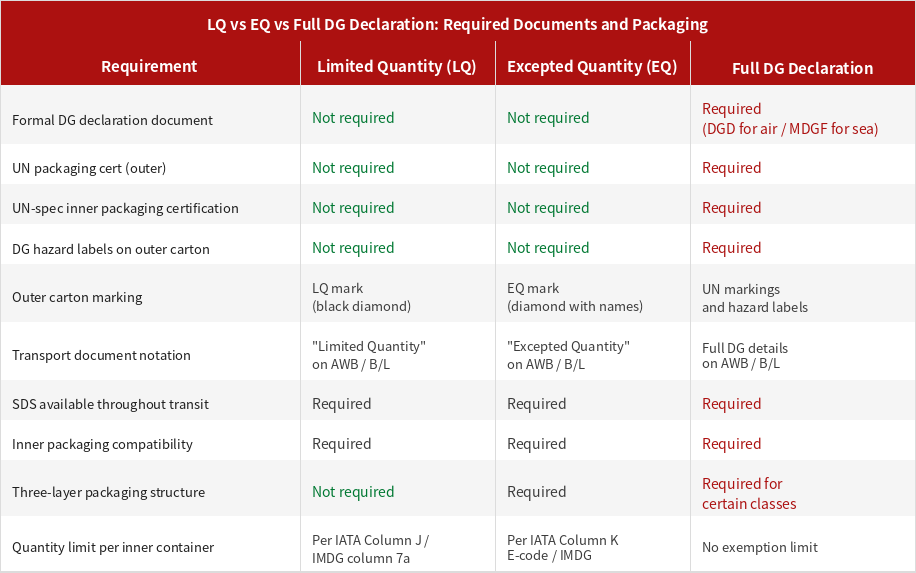
For most importers sourcing cosmetics, fragrances, cleaning products, or adhesives from China in small commercial quantities, LQ is the first provision to evaluate. Full DG declaration should be confirmed as necessary rather than assumed by default.
How to Check Limited Quantity Eligibility for DG Shipping from China
The starting point is the product's UN number. Every dangerous goods substance has one, and it is listed in the SDS. Once the UN number and packing group are confirmed, the applicable DG regulations provide the maximum quantity per inner container allowed under LQ:
For air freight: IATA DGR 67th Edition Dangerous Goods List, Column J for LQ limits and Column K for EQ E-codes
For sea freight: IMDG Code Dangerous Goods List, column 7a for LQ limits; EQ E-codes are also listed per substance
If the actual quantity in each inner bottle or container is at or below the applicable limit, the shipment qualifies.
If the limit shows zero, LQ is not available for that substance regardless of quantity. Note that IMDG limits are generally more generous than IATA limits for the same substance; a shipment that does not qualify for air LQ may still qualify for sea LQ.
Packing group is where most errors occur. The same substance can have a different limit under Packing Group II versus Packing Group III. In our experience, packing group misidentification is the most common source of LQ errors when the check is done without current DG qualification.
How Limited Quantity Exemptions Reduce DG Shipping Costs
Shipping under LQ or EQ reduces cost in four practical ways:
1. No UN packaging certification on outer packaging Full DG shipments require the outer packaging to be UN-certified, which involves formal testing, documentation from a certified lab, and recurring renewal. Under LQ or EQ, a standard export carton is accepted. For importers shipping DG products regularly, removing this requirement from every shipment produces significant cost and time savings.
2. No DG declaration document Full DG treatment requires a formal declaration prepared by a DG-certified professional -- a Shipper's Declaration for Dangerous Goods by air, or a Multimodal Dangerous Goods Form by sea. Under LQ or EQ, neither document is required. This removes one of the most operationally demanding steps in DG compliance.
3. Reduced or eliminated carrier DG surcharges Carriers apply DG handling surcharges to fully declared dangerous goods shipments, covering additional storage, segregation, and specialized handling. Under LQ or EQ, the shipment does not enter the full DG handling stream. This typically means either a substantially lower surcharge or no DG surcharge at all, depending on the carrier and route.
4. Simpler booking and faster acceptance Fully declared DG shipments require advance DG notification, acceptance checks, and in the case of air freight, quantity limits per aircraft type. LQ and EQ shipments are handled closer to general cargo, which means:
More routing options from Chinese ports
Faster carrier acceptance at origin
Fewer booking refusals on routes where DG capacity is limited
The aggregate saving across packaging certification, documentation fees, and surcharges is meaningful for importers who ship small-quantity DG products with any regularity.
For a broader view of cost reduction options across DG shipments from China, see our guide on reducing dangerous goods shipping costs.
Common LQ Mistakes That Lead to Carrier Rejection
The four most common reasons LQ shipments are rejected at carrier acceptance:
Exceeding inner quantity limits. Suppliers pack to volume or weight convenience without checking the applicable limit. A single inner packaging that exceeds the limit invalidates the LQ exemption for the entire outer package, regardless of how other inner units are packed.
Missing or non-compliant LQ mark. The diamond mark must meet the size and contrast requirements of the applicable regulations. A mark that is too small, placed on a non-visible face, or printed with insufficient contrast will fail the carrier's DG acceptance check.
Wrong packing group assessment. Suppliers who default to the less restrictive packing group without confirming flashpoint data produce LQ assessments based on the wrong row. The error is not always caught until the carrier reviews the SDS at origin or at the transit hub.
Missing transport document notation. For sea freight, "Limited Quantity" must appear on the bill of lading. Omitting this notation is treated as undeclared DG cargo. For air freight, the LQ status must similarly be reflected in the air waybill handling information. A forwarder unfamiliar with these requirements creates a compliance gap that may only surface at destination.
How Gerudo Logistics Supports DG Shipping from China
Gerudo Logistics is a China-based freight forwarder specializing in dangerous goods and temperature-controlled cargo, with IATA DGR-certified operations across Guangzhou, Shenzhen, Shanghai, Ningbo, Qingdao, and Dalian.
When an importer brings us a product that may carry DG classification, we assess the applicable compliance pathway -- full DG declaration, LQ, or EQ -- before confirming the booking.
In our experience, many importers of cosmetics, fragrances, cleaning products, adhesives, and similar goods are paying full DG rates on shipments that would qualify for LQ treatment. The issue is rarely the product itself. It is that the compliance check was either skipped or performed by a forwarder without current DGR qualification.
For a DG assessment on an upcoming shipment from China, contact us!
Frequently Asked Questions For Small Packages DG Cargo
Do LQ and EQ apply to all dangerous goods classes? Most classes qualify, including Class 3, 4, 5, 6.1, 8, and 9. Broadly excluded are Class 1 (explosives), Class 6.2 (infectious substances), and Class 7 (radioactive materials). Within eligible classes, individual substances may still be excluded if the applicable LQ column shows zero.
Can small quantities of dangerous goods be declared as non-DG cargo? No. Declaring DG substances as general cargo is mis-declaration under both IATA and IMDG, regardless of quantity. LQ and EQ are the compliant route for reducing requirements -- not reclassifying the cargo type.
Does LQ apply to sea freight as well as air freight? Yes, under both IATA DGR (air) and the IMDG Code (sea). IMDG generally permits larger quantities per inner container than IATA for the same substance, so a shipment that does not qualify for air LQ may still qualify under sea LQ.
If a product cleared customs without a DG flag, does it still require LQ treatment? Yes. Customs clearance and carrier DG acceptance are separate processes with separate criteria. A shipment can clear customs without a DG flag and still be rejected or surcharged by the carrier at acceptance or a transit hub.
Can a Chinese supplier handle the LQ mark and inner packaging independently? Only with detailed written instructions. Most Chinese suppliers are unfamiliar with LQ marking requirements, and without written specification this is a reliable source of compliance errors.
What happens if a shipment is accepted as LQ but later found to be non-compliant? The carrier reclassifies the cargo as full DG, applies retroactive surcharges, and holds the shipment pending correct documentation. Repeated violations can result in account-level consequences with that carrier.
Is EQ practical for regular import volumes? Rarely. EQ limits are designed for sample-level quantities. For commercial volumes, assess LQ first. If quantities exceed both LQ and EQ limits, full DG declaration is the only compliant option.
Do LQ quantity limits change between regulatory editions? Yes. IATA updates the DGR annually and IMDG is updated on a two-year cycle. Always verify eligibility against the current edition before booking -- for 2026 air freight, that is IATA DGR 67th Edition.
Conclusion
LQ and EQ are not workarounds. They are provisions built into both IATA DGR and the IMDG Code for shipments where genuinely small quantities reduce the actual transport risk. Used correctly, they eliminate the UN packaging certification requirement on outer packaging, remove the need for a formal DG declaration, and reduce or eliminate carrier DG surcharges. The compliance still needs to be built correctly at origin -- inner quantities, packaging, transport document notation, and marking all count. A qualified DG forwarder in China is the most reliable way to get that right before the shipment reaches the carrier.