How to Calculate Landed Cost When Importing from China to the USA
When you import from China, the price on your supplier's invoice is the easiest number to see and the least useful one to plan around. The figure that determines whether a shipment is profitable is the landed cost: everything you pay to move goods from the supplier to your US warehouse.
A supplier quote of $18 per unit can reach $28 or more once freight, duties, fees, and delivery are added. An importer who prices from the $18 figure is building in a loss.
This guide explains what landed cost includes, how to calculate it, and how to use the per-unit figure for pricing decisions. The worked example covers a lithium battery shipment, where several cost lines are easy to miss.
China-USA Shipping Cost Calculator
Landed cost is the total cost of getting goods from a supplier in China to your final address in the United States. It covers the product price plus every freight, customs, and handling charge along the way.
The formula is:
Landed Cost = Product Cost + Freight + Insurance + Customs Duties and Fees + Origin and Destination Charges + Final Delivery
To get a per-unit figure, divide by quantity:
Landed Cost Per Unit = Total Landed Cost ÷ Number of Units
The per-unit figure is what determines your margin. A total landed cost of $28,700 for 1,000 units means each unit costs $28.70 to reach your shelf, regardless of the $18 supplier price.
What Goes Into the Landed Cost of a Shipment from China to the USA
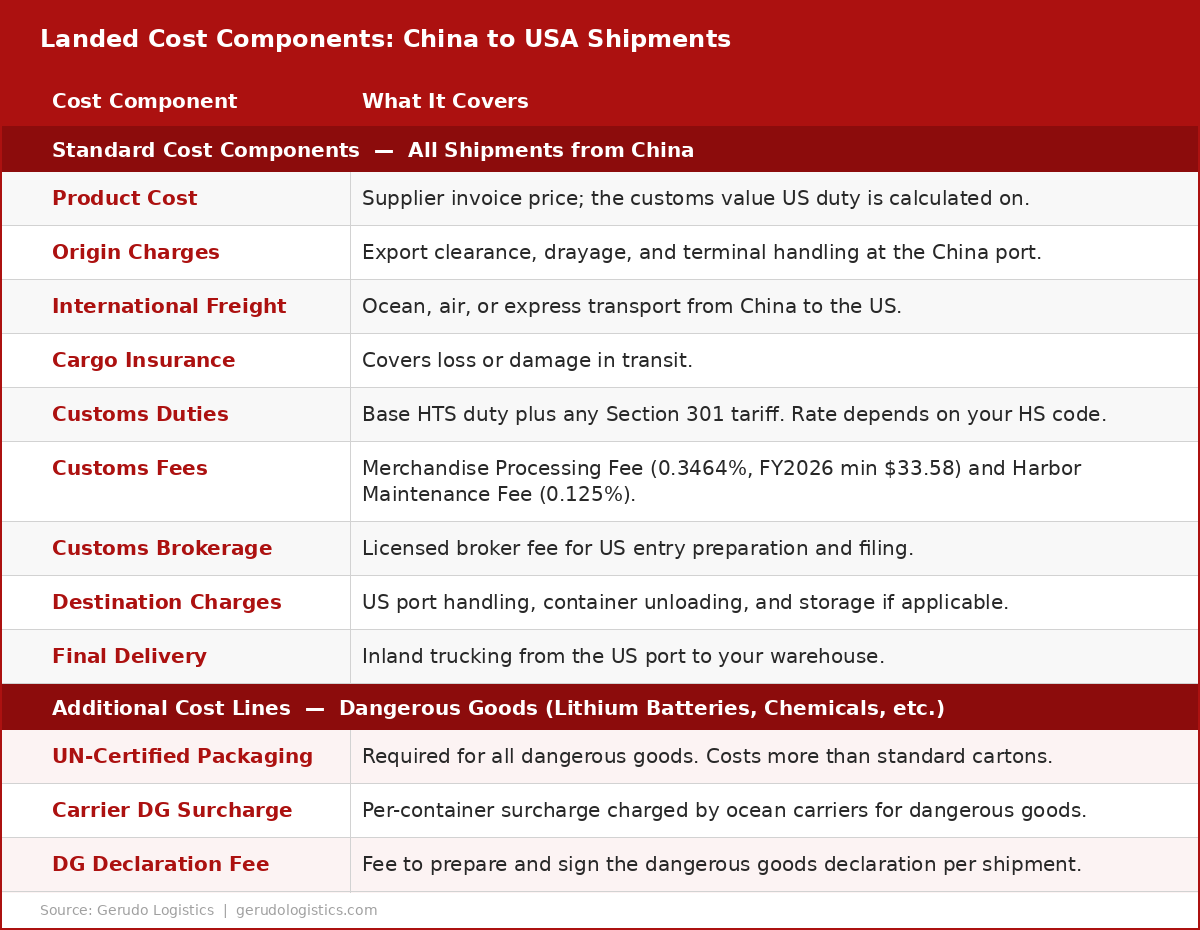
The landed cost framework applies to any destination, but the specific duties and fees depend on the import country. The components below cover a shipment entering the United States, where US Customs and Border Protection calculates duty on the FOB value of goods.
Product Cost
The price your supplier charges for the goods. It appears on the proforma or commercial invoice. US Customs treats this as the customs value from which duty is calculated.
Origin Charges
Costs to move goods from the factory to the China port. They include export clearance, documentation, factory drayage, and terminal handling. Under FOB terms, your supplier covers most of these. Under EXW, they fall to you.
International Freight
The cost of transporting goods from China to the United States by ocean, air, or express. Ocean freight is standard for full containers. Rates vary by route, season, and available carrier space. See our guide to shipping from China to the US for route and rate detail.
Cargo Insurance
Covers loss or damage while goods are in transit. It costs a small percentage of the cargo value. High-value cargo such as batteries and electronics should always carry it.
Customs Duties
US duty comes in two layers. The base rate is set by your product's HTS code. Many goods from China also carry a Section 301 tariff on top. That second layer can change your effective rate significantly. Confirm both against our current China tariffs guide before placing an order.
Customs Fees
Two government fees apply to most US ocean entries. The Merchandise Processing Fee is 0.3464% of the customs value, with a FY2026 minimum of $33.58 and maximum of $651.50. The Harbor Maintenance Fee is 0.125% of cargo value and applies to ocean shipments only.
Customs Brokerage
A licensed customs broker prepares and files your entry with US Customs. The service is charged as a flat or value-based fee. This is separate from the government fees listed above.
Destination Charges
Port and terminal handling fees at the US arrival port. They cover container unloading, terminal handling, and storage if you do not collect within the free period. These vary by port and carrier.
Final Delivery
The cost of trucking goods from the US port to your warehouse or fulfillment center. It is usually quoted separately from the ocean freight. The amount rises with distance from the port.
Dangerous goods shipments, including lithium batteries and chemicals, carry three additional cost lines that do not appear on a standard cargo invoice.
UN-Certified Packaging
Dangerous goods must travel in packaging tested and certified to UN standards. This costs more than standard cartons or pallets. The exact uplift depends on the product class and the applicable packing instruction.
Carrier Dangerous Goods Surcharge
Ocean carriers charge a surcharge to accept dangerous goods on board. It is applied per container and varies by carrier and trade lane. Most importers of batteries and chemicals are charged this on every shipment.
Dangerous Goods Declaration Fee
A qualified person must prepare and sign the dangerous goods declaration for each shipment. This service carries its own fee. Most online landed cost calculators have no field for it, which is why battery and chemical importers routinely underestimate their true cost.
How Incoterms Change Which Costs Fall on the Buyer
Before calculating landed cost, confirm which costs your supplier already covers. That depends on the Incoterm in your contract.
Under EXW, you cover nearly everything from the factory gate, including export clearance and all freight.
Under FOB, your supplier delivers to the China port and handles export clearance. Your calculation starts from there.
Under CIF, the supplier also pays main freight and insurance to the US port. You handle US duties, fees, and final delivery.
Under DDP, the seller arranges duty-paid delivery to your US address. Most of the landed cost is bundled into one figure.
The risk is comparing two supplier quotes under different terms. A lower EXW price can end up more expensive than a FOB quote once origin charges are added. Compare suppliers on the same Incoterm basis.
Calculating Landed Cost Step by Step
Work through the calculation in a fixed order to avoid missing a line.
Step 1. Gather shipment details
Collect the product description, quantity, unit price, gross weight, volume in CBM, carton count, supplier location, and US delivery address. An estimate without these inputs is guesswork.
Step 2. Confirm the Incoterm
Establish which costs the supplier covers so you do not double-count or miss a line. This one check prevents most of the comparison errors importers make between suppliers.
Step 3. Calculate product cost
Multiply unit price by quantity. For 1,000 units at $18, the product cost is $18,000. This is the starting point, not the landing point.
Step 4. Add freight and handling
Include ocean or air freight, origin charges, and US destination charges. Confirm whether your freight quote is port-to-port or door-to-door. The gap between the two can reach several hundred dollars.
Step 5. Add duties and customs fees
Apply your duty rate to the customs value, then add the MPF and HMF. Duty rates depend on your HS code and current trade measures.
Check them against our current China tariffs guide and the USITC tariff schedule before committing to an order.
Step 6. Add insurance and final delivery, then divide
Sum every line, add cargo insurance and inland trucking, then divide by units. The result is your landed cost per unit.
A Worked Landed Cost Example for a Lithium Battery Shipment
The lines most importers miss are easiest to see in a specific cargo type. This example covers a shipment of lithium-ion battery packs from Shenzhen to a US warehouse.
Battery packs travel as Class 9 dangerous goods under UN3480. That classification adds cost lines that a standard cargo shipment does not carry.
The compliance process for these shipments is covered in our guide to shipping lithium batteries from China under the 2026 IMDG Code.
The shipment: 1,000 lithium-ion battery packs at $18.00 per pack, FOB Shenzhen, moving as one 40ft container to a US warehouse. All figures below are representative and used for illustration only. They are not a quote.
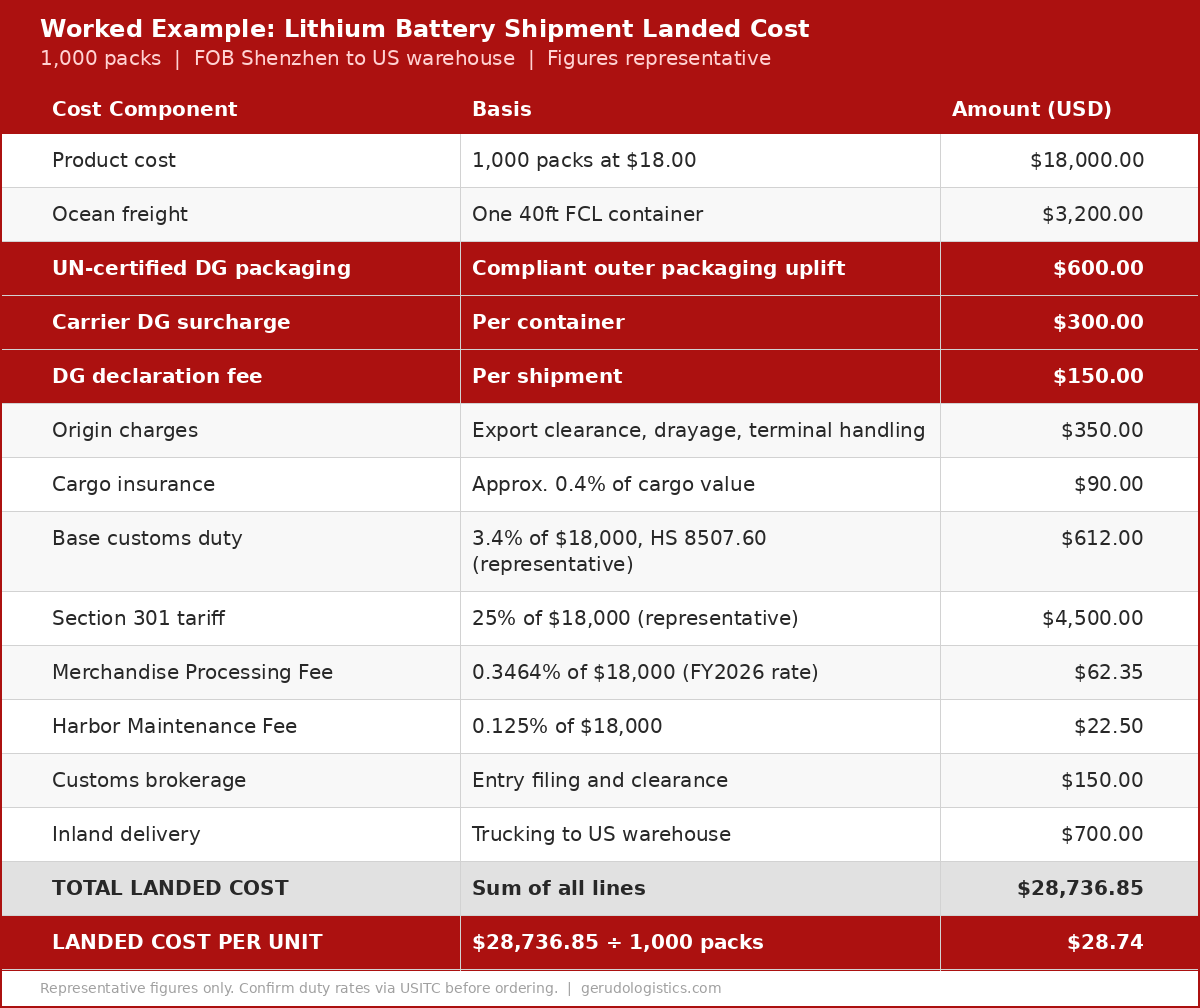
The supplier price is $18.00 per pack. The landed cost per unit is $28.74, nearly 60% above the invoice price. An importer pricing from the supplier figure would lose margin on every unit.
The MPF here is calculated at the standard rate. On this shipment the result ($62.35) exceeds the FY2026 minimum of $33.58, so the percentage applies. On smaller shipments, the minimum takes over.
Three lines in this example do not appear in a standard calculation. The UN-certified packaging, carrier DG surcharge, and declaration fee together add $1,050. For utility-scale containerized systems, the extra lines are larger still.
We cover that in our guide to shipping battery energy storage systems from China.
Reefer cargo carries its own additions, including the container premium and monitoring charges.
Common Mistakes That Distort Landed Cost
Most landed cost errors are omissions, not math errors. These are the gaps we see most often on shipments from China.
Calculating Only Product Cost and Freight
This is the most common starting error. It leaves out the entire duty and customs layer. On a standard China shipment, that layer alone can add 30% or more to the total.
Leaving Out Dangerous Goods Charges
For batteries and chemicals, the UN-certified packaging uplift and the carrier DG surcharge are easy to skip. Generic calculators have no field for either line. In our experience, this is the most frequent gap on battery shipments.
Filing Under the Wrong HS Code
The HS code used for the estimate must match what the customs broker files. A mismatch changes the duty rate and produces a figure that does not reflect what you actually pay.
Missing the MPF Minimum on Small Shipments
The Merchandise Processing Fee is 0.3464% of customs value. On small shipments, that percentage falls below the FY2026 minimum of $33.58. The minimum applies in those cases, not the formula result.
Treating a Port-to-Port Quote as Door-to-Door
A port-to-port freight quote does not cover US destination handling or inland trucking. Treating it as a door-to-door cost leaves several hundred dollars per shipment unaccounted for.
Converting Currency at the Headline Rate
The exchange rate shown on financial websites is not the rate your bank applies. Banks add a margin that typically adds 1-3% to the product cost. Use your bank's actual transaction rate in the calculation.
Dropping Insurance to Reduce the Estimate
Removing insurance saves a small percentage on paper. It also removes the only financial protection if cargo is lost or damaged in transit. The risk is highest on high-value battery cargo.
Reusing an Estimate Without Checking Current Rates
Ocean freight and duty rates can shift sharply within a quarter. An estimate built on last season's figures may be significantly off. The Drewry World Container Index and the Freightos Baltic Index give a directional freight reference between firm quotes.
How Gerudo Logistics Helps You Plan Landed Cost for Specialist Cargo
Gerudo Logistics is China-based freight forwarder headquartered in Guangzhou, with operations across Shenzhen, Shanghai, Ningbo, Qingdao, and Dalian. We handle specialist cargo from China to global markets: lithium batteries, energy storage systems, chemicals, and temperature-controlled freight, in drums, IBCs, ISO tanks, and full containers.
For importers, the value of a specialist forwarder shows up directly in the cost estimate. The DG surcharges, packaging requirements, and documentation fees that a general-purpose provider omits are lines we account for from the first quote. The figure you plan against is the figure you pay.
We handle classification, compliant packing, customs clearance, and door-to-door delivery under DDP terms, giving you a single landed cost figure for the full movement.
To work through the cost of a specific shipment, contact our team.
Frequently Asked Questions to USA
What is landed cost?
Landed cost is the total cost of bringing goods from a supplier in China to your final address in the United States. It covers the product price, freight, insurance, customs duties and fees, and final delivery. Use this figure, not the supplier price, to set selling prices and assess margin.
Does landed cost include customs duties and Section 301 tariffs?
Yes. Landed cost includes the base HTS duty, any Section 301 tariff, the Merchandise Processing Fee, and the Harbor Maintenance Fee. Duty rates depend on your HS code. Confirm the current rate before calculating.
What is the difference between product cost and landed cost?
Product cost is what you pay the supplier for the goods alone. Landed cost adds freight, duties, customs fees, and delivery. The gap is often 40% or more, and higher for dangerous goods.
How do I calculate landed cost per unit?
Sum every cost line for the shipment to get the total landed cost. Divide by the number of units shipped. A shipment of 1,000 units with a total landed cost of $28,700 produces a per-unit cost of $28.70. That figure determines your margin.
Are landed costs higher for dangerous goods like lithium batteries?
Generally yes. Dangerous goods carry extra cost lines: UN-certified packaging, carrier DG surcharges, and declaration fees. A standard estimate that omits these will understate the real landed cost.
Is US landed cost based on FOB or CIF value?
US Customs calculates import duty on the FOB value, meaning the supplier price without freight or insurance. Other elements of landed cost are added separately. Some other countries assess duty on the CIF value, so the method differs by destination.
Can an online landed cost calculator give me an accurate number?
A calculator is a useful starting point. It works from standard inputs and cannot capture specialist cost lines such as DG surcharges. Use it for early planning, then confirm with your freight forwarder before committing to an order.
Conclusion
The supplier invoice is where the calculation begins. It is not where the cost ends. A landed cost breakdown taken to the per-unit level is what tells you whether an import holds its margin.
Work through every line before placing a large order. Confirm the Incoterm, apply the right duty rate, and include the specialist cargo charges that generic tools leave off.