How to Find a Reliable Dangerous Goods and Chemical Freight Forwarder in China
Many freight forwarders or shipping agents in China say they can handle dangerous goods (DG) and chemical cargo. The difference usually becomes clear when they review the shipment, check the proposed route, and explain what still requires carrier or warehouse approval.
For an overseas importer, the main risk is choosing a company that provides a quick quotation but cannot complete the shipment under the stated conditions. Problems may appear after collection through warehouse rejection, repacking, route changes, storage charges, or delayed delivery.
This guide explains how to build a shortlist, compare candidates, verify the Chinese company, and decide whether a freight forwarder is ready to handle your dangerous goods or chemical shipment.
What Should You Look for in a Dangerous Goods and Chemical Freight Forwarder?
A reliable freight forwarder should provide clear evidence before asking you to release the cargo. The company should understand the product, explain the proposed route, identify pending approvals, and provide a clear quotation and responsibility structure.
Check these eight areas:
Company identity: Confirm who will sign the contract, issue the invoice, and receive payment.
Relevant experience: Look for experience with similar products, packaging formats, transport modes, and destinations.
Cargo review: The forwarder should request the current Safety Data Sheet (SDS) and enough shipment information before confirming the route.
China-side execution: Check who will coordinate the supplier, collection, packing, warehouse delivery, and customs declaration.
Carrier and warehouse status: Ask what has been accepted and what remains under review.
Destination coverage: Confirm who will handle customs clearance, delivery, and local problems after arrival.
Complete pricing: Compare included services, conditional costs, and charges that may arise if the plan changes.
Problem handling: Identify who will manage rejection, damage, leakage, delay, repacking, or return transport.
These checks are more useful than relying only on company age, a low rate, or a general claim of dangerous goods experience.
For background information on classification, documents, and transport requirements, read the dangerous goods shipping guide.
Where to Find Specialist Freight Forwarders in China
The first step is building a shortlist. Search results, industry contacts, and forwarding networks can help you find candidates, but they cannot prove that a company can handle your specific shipment.
Useful sources include:
Google search: Look for companies with dedicated dangerous goods and chemical logistics services.
Specialist company websites: Review whether the company explains its actual cargo scope, China locations, routes, and handling services.
Freight forwarding networks: Use directories to identify companies in the required China gateway or destination market.
Supplier referrals: Ask whether the supplier has worked with the recommended forwarder on similar cargo.
Customs broker referrals: A broker may know companies with relevant origin or destination experience.
Industry contacts: Importers in the same product sector may provide more relevant recommendations than general online reviews.
A referral should include context. A forwarder recommended for general cargo, textiles, or consumer products may have limited experience with chemicals, batteries, liquids, powders, or regulated machinery.
Create a shortlist of two or three companies. This gives you enough options to compare without creating an unmanageable approval process.
Compare DG and Chemical Freight Quotes
A quotation is only comparable when every company receives the same information. Different cargo descriptions, packaging details, or delivery requirements will produce different prices and route assumptions.
Send each candidate:
Current SDS: Use the latest available version from the manufacturer or supplier.
Product information: Include the product name, intended use, and model where relevant.
Known transport status: State whether the cargo is known as dangerous goods, confirmed as non-DG chemical cargo, or still awaiting assessment.
Packaging information: Provide the packaging type, package count, gross weight, and dimensions.
Supplier location: Include the pickup address and packing location in China.
Destination details: Give the destination country, delivery address, and required service scope.
Timing: State the target shipping date and any firm delivery deadline.
Available supporting documents: Include any test report, transport appraisal, UN 38.3 test summary for lithium batteries where applicable, or packaging document already available.
You do not need to complete the technical assessment yourself. The forwarder should explain what additional information is required and which details still need confirmation.
A chemical shipment may be confirmed as dangerous goods, confirmed as non-DG based on the available documents, or require further transport assessment. The forwarder should clarify which status applies before presenting the shipment plan as confirmed.
For a broader document overview, see the Gerudo Logistics dangerous goods shipping documents guide.
Verify the Chinese Company and Payment Details
Before signing a contract or making payment, confirm the legal company behind the quotation. A professional-looking website or email signature does not establish who is responsible for the shipment.
Ask for:
Chinese registered company name: The legal name should appear on the business licence.
Unified Social Credit Code: This can be used to search the company record.
Business licence: Check that the company remains active.
Contracting entity: Confirm which company will sign the service agreement.
Invoice issuer: Identify which entity will issue the invoice or receipt.
Bank beneficiary: Confirm that the payment account has a clear relationship with the contracting company.
Chinese company records can be checked through the National Enterprise Credit Information Publicity System. Search by the Chinese registered name or Unified Social Credit Code.
Different entities may be involved for legitimate reasons, such as a group company, overseas office, or authorised payment company. The relationship should be explained in writing before payment.
A company-domain email, stable contact details, and an established online presence can support your checks. They should not replace legal company and payment verification.
Check What the Forwarder Reviews Before Confirming the Quote
The quality of the cargo review is one of the strongest signs of capability. A reliable forwarder should ask enough questions to understand the shipment before presenting the route and price as confirmed.
Look for these behaviours:
Requests the SDS: The company should review the product information before confirming how the cargo will move.
Checks the packaging: The forwarder should ask whether the cargo is packed in drums, Intermediate Bulk Containers (IBCs), bags, cartons, machinery, or another format.
Confirms the China origin: Supplier location and packing location can affect pickup, inspection, warehouse, and gateway options.
Checks the destination: The destination country and final delivery scope can affect carrier choice and customs planning.
Identifies missing information: A capable forwarder should point out gaps or inconsistencies instead of ignoring them.
Explains pending approval: The company should identify what still requires carrier, airline, shipping line, or warehouse review.
An indicative estimate before the full review can be reasonable. It should be clearly described as an estimate.
A final route and confirmed price require more caution when the forwarder has not reviewed the SDS, packaging, origin, and destination. Collection before the required approvals creates a higher operational risk.
Ask About Similar Cargo and Routes
Experience should be relevant to your shipment. A large general shipment volume does not prove that the company can handle your chemical or dangerous goods cargo.
Ask whether the forwarder has handled:
Similar products: The same chemical category, battery type, liquid, powder, equipment, or other related cargo.
Similar packaging: Drums, IBCs, bags, cartons, machinery, or ISO tanks, which are tank containers used for bulk liquid transport.
The required transport mode: Air freight, Full Container Load (FCL), Less than Container Load (LCL), tank transport, or multimodal service.
The proposed China gateway: The same or a comparable port or airport.
The destination market: The same country or a market with similar customs and delivery requirements.
A useful answer should explain the normal approval process, common causes of rejection, and the parts of the plan that usually require the most coordination.
Confirm the Carrier and Cargo Acceptance Status
A quotation does not always mean that the cargo has been accepted. Importers should ask the forwarder to separate the proposed route from the current approval status.
Confirm:
Proposed carrier: Ask which airline, shipping line, or transport provider is being considered.
China gateway: Confirm the proposed port, airport, or cross-border route.
Current review status: Ask whether the cargo information has been reviewed by the forwarder, carrier, and warehouse.
Pending requirements: Identify documents, packing work, photos, tests, or other conditions still outstanding.
Cargo delivery status: Ask whether the supplier can deliver the cargo to the warehouse now.
Validity period: Confirm how long the rate, routing, and approval remain valid.
The acceptance checks differ by transport mode:
Air freight: Ask whether the airline and origin handling facility have reviewed the cargo.
FCL sea freight: Ask whether the shipping line and origin terminal or port acceptance conditions have been confirmed.
LCL sea freight: Ask whether both the shipping line and consolidation warehouse accept the cargo.
These questions help the importer determine whether the proposed service has been checked against the actual transport mode. A general statement that the cargo can ship does not explain which operating parties have reviewed it.
A booking number may confirm space while other cargo conditions remain pending. Ask the forwarder to explain what the booking number means for your shipment.
For LCL dangerous goods, the shipping line and consolidation warehouse may make separate acceptance decisions. The warehouse controls the other cargo loaded in the shared container and may apply additional restrictions.
Non-DG chemical cargo may also require warehouse or carrier approval. Liquids, powders, products with strong odours, unclear descriptions, or leakage concerns may face restrictions even when they are not regulated as dangerous goods.
For more information on how Chinese gateways differ in dangerous goods acceptance and port procedures, read the Gerudo Logistics China dangerous goods port guide.
Check China-Side Handling and Destination Coverage
A reliable freight forwarder should be able to coordinate more than the main transport booking. Dangerous goods and chemical shipments often depend on communication between the importer, Chinese supplier, warehouse, carrier, customs broker, and destination delivery partner.
Check whether the proposed service covers:
Supplier communication: The forwarder should be able to explain packing, document, and handover requirements to the supplier.
Pickup in China: Confirm who will physically collect the cargo and whether the actual road carrier is qualified and equipped for the shipment. When China’s road dangerous goods transport requirements apply, ask whether the carrier and the relevant driver and escort personnel hold the required qualifications.
Packing coordination: Ask whether the company can arrange inspection, repacking, overpacking, or labelling support where required.
Warehouse delivery: Confirm the warehouse address, booking reference, delivery conditions, and cut-off.
China customs declaration: Identify who will prepare and submit the origin customs declaration.
International transport: Confirm who controls the main freight booking and carrier communication.
Destination customs clearance: Ask whether this is included or handled by a separate destination broker.
Final delivery: Confirm whether the quotation covers delivery to the importer or only arrival at the destination terminal.
The freight forwarder does not necessarily need to hold the road dangerous goods transport permit itself. It may coordinate collection through a qualified subcontracted road carrier. The important question is who will physically collect the cargo and whether that company is authorised and properly equipped for the shipment.
A dangerous goods vehicle is not automatically required for every chemical shipment. The requirement depends on the cargo’s transport status, quantity, packaging, and the rules applicable to the proposed domestic movement in China.
The service scope should match your actual requirement. Port-to-port service may be adequate for an importer with a trusted destination broker, while another importer may need coordinated door-to-door delivery.
Compare the Complete Freight Quote
The lowest total is useful only when the quotations cover the same work. Compare the route, service scope, approval status, validity period, and expected departure before comparing price.
The quotation may include:
China pickup: Supplier collection and inland transport.
Packing services: Inspection, repacking, overpacking, palletising, or other preparation where required.
Document handling: Dangerous goods or chemical document review and declaration support.
Warehouse charges: Receiving, handling, storage, and special cargo fees.
Terminal charges: Origin port or airport handling.
Main freight: Air, ocean, road, rail, or multimodal transport.
Carrier surcharges: Dangerous goods, special handling, or route-specific charges.
Destination clearance: Customs brokerage and related destination handling where included.
Final delivery: Transport from the destination terminal to the agreed address.
Also ask which situations create additional costs:
Repacking: Required after a document, packaging, or warehouse review.
Storage: Charged while waiting for documents, approval, inspection, or another booking.
Booking changes: Applied when the route, carrier, or sailing changes.
Failed warehouse delivery: Charged when cargo arrives before acceptance or with incorrect documents.
Return transport: Required when the cargo cannot remain at the warehouse.
Cancellation: Applied after space, handling, or special services have been arranged.
Damage or leakage: May require overpacking, isolation, repacking, or disposal support.
Duties and taxes should only be compared where they are included in the quoted service scope.
A lower quotation may use a slower route, later departure, transshipment service, or less certain space. Compare the expected review time, earliest realistic departure, space confirmation status, and estimated transit time before deciding.
A low quotation can reflect a genuine rate advantage. It can also cover fewer services or rely on conditions that have not been confirmed. Ask the forwarder to itemise the scope before deciding.
Check Communication and Problem Handling
Reliable forwarding depends on how problems are managed. Dangerous goods and chemical shipments can face document rejection, carrier refusal, damaged packaging, leakage, inspection, missed cut-offs, or destination clearance delays.
Before booking, identify:
Daily contact: Know who will provide routine shipment updates.
Operational contact: Confirm who will handle warehouse, carrier, or customs problems.
Supplier coordination: Ask who will communicate corrective requirements to the Chinese supplier.
Repacking responsibility: Confirm who can arrange repacking or overpacking in China.
Route-change process: Ask who proposes and approves an alternative route.
Cost approval: Confirm how additional charges will be reported and approved.
Destination escalation: Identify who will manage clearance or delivery problems after arrival.
A reliable answer should name the responsible team or contact and explain the next step. A general promise to handle everything does not provide enough information.
Get Written Confirmation Before Cargo Collection
The final checkpoint comes before the supplier releases the cargo. Ask for a formal email, quotation, or service agreement confirming the key conditions.
The written record should cover:
Cargo description: The product and packaging used for the booking.
Route and carrier: The proposed gateway, main carrier, and destination.
Approval status: What has been accepted and what remains pending.
Commercial scope: Included services and conditional costs.
Outstanding requirements: Documents, packing work, approvals, and cut-off dates.
Do not rely only on a short chat message saying that the cargo can ship. The written record should make the current status understandable to the importer and supplier.
If the route, packaging, quantity, or product information changes, ask whether a new review is required before delivery to the warehouse.
Red Flags When Choosing a Dangerous Goods and Chemical Freight Forwarder
Some warning signs create a much higher risk than slow replies or limited online reviews.
No request for the SDS or basic cargo information: The route and price may rely on an incomplete cargo description.
All chemicals are treated as general cargo: Non-DG status should be supported by suitable product and transport information.
Acceptance is guaranteed before review: Carrier and warehouse decisions may still be pending.
The route or approval status remains unclear: The forwarder cannot explain which carrier or warehouse is involved.
Cargo delivery is requested before required approval: The shipment may enter a warehouse without a confirmed onward plan.
The contract or payment entity is unexplained: The importer cannot identify who is legally and financially responsible.
Misdeclaration is suggested: Hiding the cargo identity or declaring dangerous goods as general cargo creates serious operational and legal exposure.
Read the Gerudo Logistics guide to dangerous goods misdeclaration risks before accepting any proposal to change or conceal the cargo description.
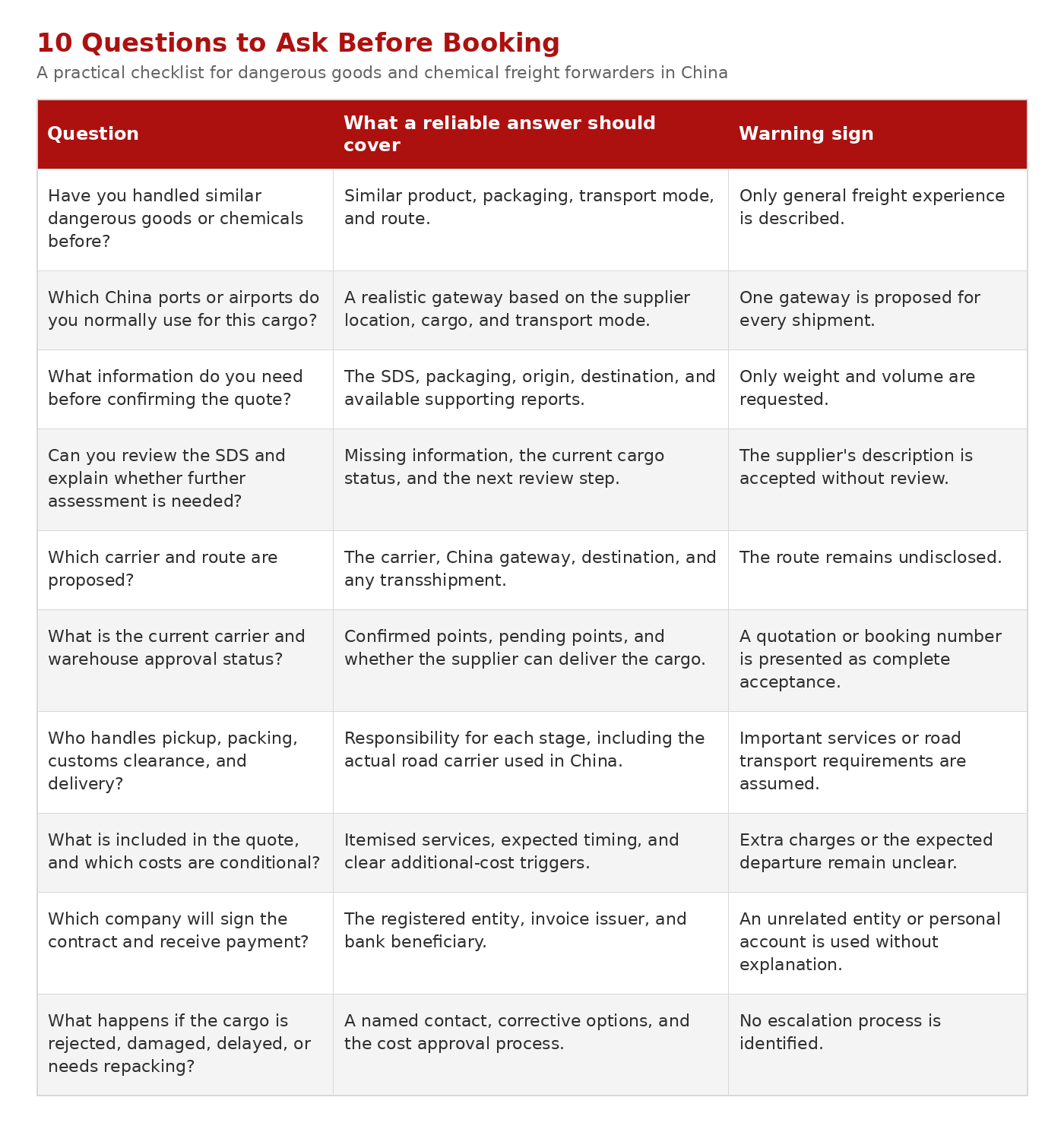
10 Questions to Ask a Dangerous Goods and Chemical Freight Forwarder in China
How Gerudo Logistics Handles Dangerous Goods and Chemical Shipments from China
Gerudo Logistics is a dangerous goods and chemical freight forwarder headquartered in Guangzhou, with operations across Shenzhen, Shanghai, Ningbo, Qingdao, and Dalian. Gerudo Logistics supports approved dangerous goods and chemical shipments from China to global destinations.
Gerudo Logistics reviews the SDS, cargo details, packaging format, supplier location, destination, and required service before confirming the shipment plan. The review determines what information is available, what still requires clarification, and which carrier or warehouse conditions need to be checked.
We can coordinate supplier pickup, packing support, carrier and warehouse approval, China customs clearance, international transport, destination clearance, and final delivery where available. The service can cover drums, IBCs, bags, ISO tanks, machinery, and other approved cargo formats.
The purpose is to give the importer a clear route, approval status, service scope, and responsibility structure before the cargo is collected. Contact us to review a dangerous goods or chemical shipment from China.
Frequently Asked Questions
Can I Use the Freight Forwarder Recommended by My Chinese Supplier?
A supplier recommendation can be useful when the forwarder has handled similar cargo and can provide the required service scope. Verify the company, quotation, approval status, and payment details independently before booking.
Is Every Chemical Shipment Classified as Dangerous Goods?
No. Chemical cargo may be dangerous goods, confirmed non-DG chemical cargo, or cargo requiring further transport assessment. The forwarder should review the available product information and explain whether further evidence is needed.
Can a Forwarder Give an Estimate Before Reviewing the SDS?
Yes. An indicative estimate can help with early planning when it is clearly described as provisional. The final route, service scope, and confirmed price should follow an adequate cargo and carrier review.
Should the Supplier Deliver Cargo While Approval Is Pending?
Delivery should wait when the carrier or warehouse requires approval before receiving the cargo. Ask the forwarder to confirm in writing whether the supplier can deliver and which conditions remain outstanding.
Can the Same Forwarder Handle Both DG and Non-DG Chemicals?
Yes, when the company has suitable carrier options, warehouse arrangements, and destination coverage for both categories. The forwarder should still review each product because non-DG classification does not guarantee acceptance by every carrier or warehouse.
What Should I Do if the Forwarder Changes the Route After Collection?
Ask why the original route failed and request the new carrier, approval status, cost impact, and expected delay in writing. Do not approve additional charges until the revised service scope and responsibility are clear.
Conclusion
A reliable dangerous goods and chemical freight forwarder should make the shipment easier to evaluate before the cargo moves. The importer should know which company is responsible, whether the forwarder has relevant experience, what has been reviewed, which route is proposed, and what remains pending.
Build a shortlist, send every candidate the same cargo information, verify the Chinese company, compare the complete service scope, and request written confirmation before collection. The strongest candidate is the one that gives clear, shipment-specific answers and remains transparent about conditions that have not yet been confirmed.