Shipping Small Kitchen Appliances from China: Methods, Costs and Import Requirements
Small kitchen appliances may belong to the same retail category, yet their shipping profiles differ considerably. A plug-in kettle normally moves as general cargo, a stand mixer is dense, an air fryer occupies more carton space, and a portable blender may contain a regulated lithium battery.
This guide explains how to classify small kitchen appliances, select a transport method, prepare the cargo and documents, manage packaging, estimate costs, and meet European Union and United States import requirements.
Which Small Kitchen Appliances Need Different Shipping Plans?
Small kitchen appliances shipped from China fall into three practical freight groups: mains-powered heating appliances, mains-powered motor appliances and battery-powered portable appliances.
Mains-Powered Heating Appliances
This group includes air fryers, electric kettles, rice cookers, toasters, sandwich makers, electric grills, bread makers and induction cooktops.
Most models use mains electricity without an internal battery and can move as general cargo. Their construction may combine heating elements, thermostats, electronic controls, cooking vessels, coated surfaces and glass panels.
Air fryers and food dehydrators usually occupy more carton space relative to their weight. Induction cooktops have a flatter product structure, while kettles and rice cookers include removable food-contact components.
Mains-Powered Motor Appliances
This group includes countertop blenders, food processors, juicers, stand mixers, hand mixers and electric coffee grinders.
The motor base usually accounts for most of the weight, while jars, bowls, blades and attachments define the product configuration.
Multifunction appliances require a more precise description. A heated blender or cooking food processor combines motor and heating functions, which can affect customs classification and product compliance.
Battery-Powered Portable Appliances
Portable blenders, cordless mixers, rechargeable milk frothers and portable coffee grinders may contain lithium-ion batteries.
Three battery configurations are possible:
Contained in equipment: The battery is installed inside the appliance.
Packed with equipment: The battery and appliance share the same shipment, but the battery is not installed.
Shipped separately: The battery moves without the appliance as a separate battery consignment.
Lithium-ion batteries installed in or packed with equipment generally fall under UN 3481, while lithium-ion batteries shipped alone generally fall under UN 3480. The final transport treatment depends on the battery capacity, configuration and selected service.
Detailed battery rules are covered in our guide toshipping batteries and battery-powered products from China.
Best Shipping Methods for Small Kitchen Appliances
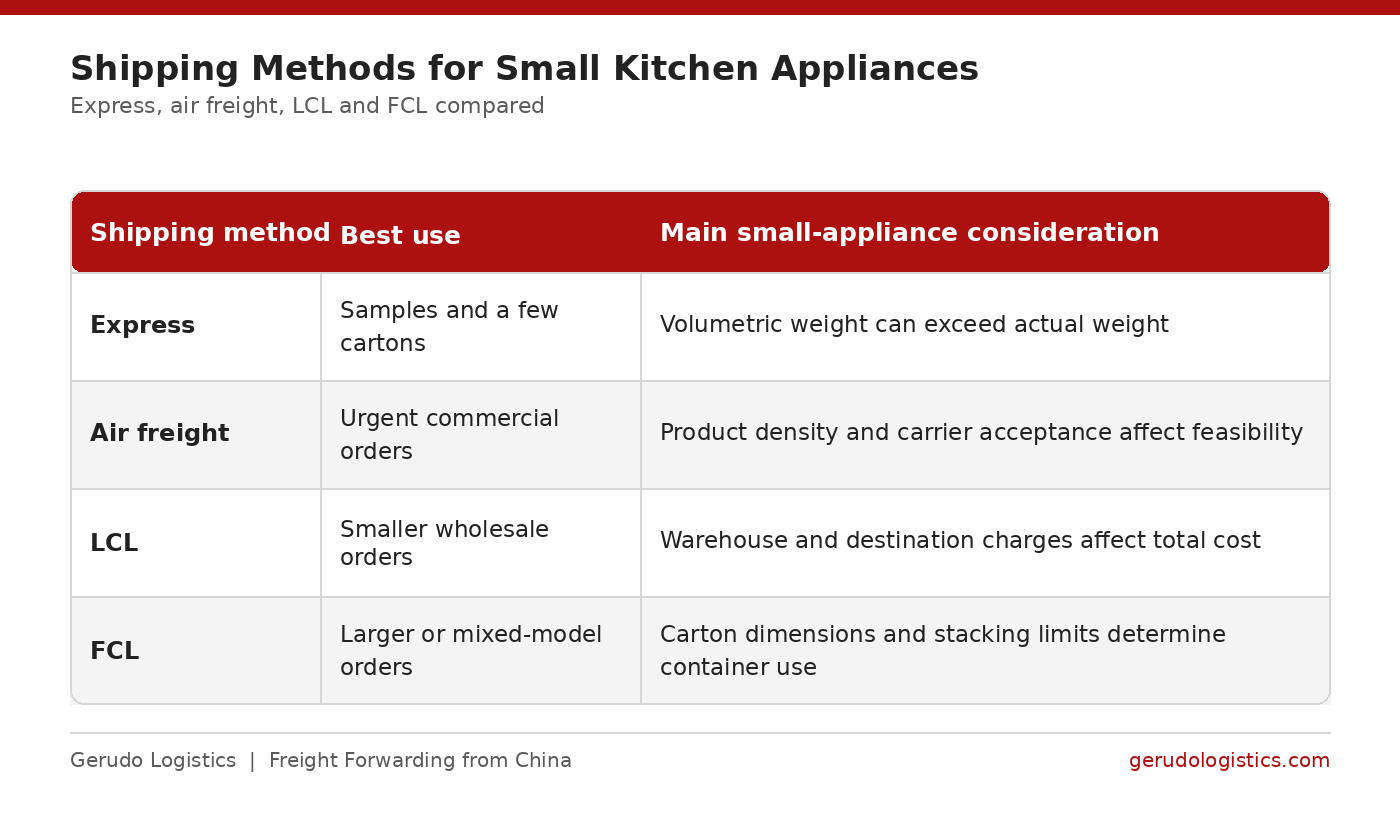
The best transport method depends on the packed volume, product density, order size and delivery deadline. Bulky appliances often become expensive by air, while compact and dense products remain more suitable for urgent services.
Express Shipping for Samples and Small Orders
Express shipping suits samples, replacement units and small trial orders.
The service normally combines collection, international transport, express customs processing and final delivery under one tracking system.
Express carriers calculate charges from the higher of actual weight and volumetric weight. A light air fryer in a large retail box can therefore cost more than a smaller appliance with the same actual weight.
Battery-powered appliances remain subject to carrier acceptance.
Air Freight from Mainland China or Hong Kong
Air freight from Guangzhou, Shenzhen or Shanghai suits urgent commercial orders that exceed practical express volumes. Mains-powered appliances usually have wider airline availability, while battery-powered models depend on the selected carrier, route and battery configuration.
Hong Kong becomes relevant when the required direct service, airline capacity or battery-cargo acceptance is unavailable from the practical mainland airport. The route adds cross-border trucking and origin handling, and it remains subject to dangerous goods documentation and airline approval. Hong Kong airlines carrying dangerous goods require the relevant permission from the Civil Aviation Department.
LCL for Smaller Commercial Orders
Less than Container Load (LCL) shipping suits wholesale orders that exceed practical air freight volumes but do not fill a container.
The cartons move through an origin consolidation warehouse and a destination deconsolidation warehouse. LCL quotations therefore include warehouse, documentation and delivery charges in addition to the ocean freight line.
This method works well for stable cartonised orders where the destination charges are confirmed before booking.
FCL for Larger or Mixed Orders
Full Container Load (FCL) shipping becomes practical when bulky retail cartons, higher order volumes or mixed appliance ranges require controlled container loading.
Confirmed carton dimensions and stacking limits determine the container plan. Air fryers and food dehydrators may fill the available cubic capacity quickly, while stand mixers and coffee machines place more weight on each carton layer.
Mixed loads require a deliberate loading sequence. Heavier cartons remain in stable lower positions, while lighter cartons can use upper space without excessive compression.
What to Confirm Before Shipping Kitchen Appliances
A workable kitchen appliance freight quote requires the exact production model, destination-market electrical version and final packed cargo data.
Product and Market Specifications
Exact product identity: The quotation requires the product name, model number, principal function and intended household use.
Electrical version: Voltage, frequency, rated power, plug type and power cable identify the market version.
Product configuration: Heating functions, motors, batteries and major accessories require separate identification where models differ.
Market presentation: Labels, warnings, manuals and importer information need to correspond with the destination country.
Carton Dimensions and Cargo Volume
Master-carton quantity: The packing data records total cartons and units per carton for every model.
External dimensions: Length, width and height are measured after the final retail boxes and inserts are packed.
Gross and net weight: Both values are recorded by model and for the complete shipment.
Total cubic volume: LCL and container calculations use the external master-carton measurements.
Pallet data: Pallet dimensions, loaded height, quantity and gross weight are included where pallets form part of the shipment.
Final measurements require confirmation before booking because repeated differences across multiple cartons can change the chargeable weight or container requirement.
Battery Information for Portable Models
Battery chemistry and model: The technical data identifies the exact battery fitted to the production appliance.
Watt-hour rating: The review uses the printed Watt-hour value or a calculation based on voltage and ampere-hour capacity.
Packing configuration: The cargo description states whether the battery is installed, packed with the appliance or shipped separately.
Battery quantity: The shipment data records batteries per appliance, per carton and across the full consignment.
Spare batteries: Replacement batteries are declared separately because they create a different transport configuration.
Shipping Documents and HS Code Classification for Home Kitchen Appliances
An electric kettle, countertop blender and rechargeable portable mixer cannot be declared under one generic product description. Each model requires accurate commercial records and a product-specific Harmonized System (HS) classification.
Documents Required for Freight and Customs Clearance
Commercial invoice: Each model requires a clear description, quantity, unit value, total value, currency, country of origin and applicable International Commercial Terms (Incoterms) rule.
Packing list: The document records carton count, units per carton, dimensions, net weight, gross weight and total volume by model.
Transport document: The carrier or forwarder issues an air waybill or bill of lading after booking.
Product compliance records: Test reports, declarations, technical files and food-contact records apply according to the destination market and product design.
Battery records: Battery-powered appliances may require a UN 38.3 test summary, battery specification, Safety Data Sheet and carrier-specific declarations. UN 38.3 refers to subsection 38.3 of the United Nations Manual of Tests and Criteria.
Certificate of origin: This document may support a destination requirement or preferential tariff claim.
The model number and product description need to remain consistent across the invoice, packing list, product label and supporting files.
HS Code Classification for Different Appliances
Small kitchen appliances do not share one HS code. Classification follows the appliance’s principal function, technical construction and destination-country tariff schedule.
Motor-driven appliances: Blenders, food processors, juicers and electric grinders may fall under heading 8509 when a self-contained electric motor performs the principal function.
Electrothermic appliances: Electric kettles, toasters, air fryers, rice cookers and sandwich makers may fall under heading 8516 when electricity is primarily used to generate heat.
Multifunction appliances: Heated blenders, cooking food processors and combined coffee systems require a product-specific review based on the function that gives the appliance its essential character.
Battery-powered appliances: A built-in battery changes the transport treatment without automatically changing the customs heading, since the appliance function remains central to classification.
The United States Harmonized Tariff Schedule places specified domestic electromechanical food appliances within heading 8509 and electrothermic domestic appliances within heading 8516. These headings provide classification direction rather than a final tariff code.
Mixed shipments require a separate description, value and tariff code for each materially different appliance model.
Packaging Small Kitchen Appliances for International Shipping
Packaging needs to follow the weakest component in each appliance. A blender jar requires movement control, a ceramic cooker pot requires rim protection, and an induction cooktop requires protection across the glass surface.
Protecting Appliances and Fragile Components
Blenders and juicers: Glass or plastic jars require fitted upper and lower supports, while the blade assembly and motor base remain separated to prevent movement at the coupling and jar wall.
Rice cookers and slow cookers: Ceramic or coated inner pots require support around the rim and base so the pot cannot strike the heating plate or outer casing.
Air fryers: The basket and removable tray require fixed positions inside the appliance to protect the coating, handle and control assembly.
Induction cooktops: Glass panels require full-surface protection and reinforced corners, with cables and accessories isolated from the panel.
Stand mixers and food processors: Metal bowls, blades and mixing attachments require dedicated compartments away from painted or plastic housings.
Coffee makers: Glass carafes require independent supports, while water tanks, filter holders and drip trays need fixed positions inside the retail box.
Master Cartons, Pallets and Moisture Protection
Master cartons require sufficient compression strength for the packed appliance weight and planned stacking height.
Pallets can improve handling stability for heavy or retail-ready cartons when the load remains within the pallet footprint.
Moisture control starts with dry cartons, dry pallets and a clean loading environment. Desiccants or liners depend on the packaging materials, season and expected ocean transit conditions.
Reducing Cargo Volume Without Weakening Protection
Packaging efficiency matters most for appliances with large housings or accessory cavities.
Accessories can sometimes be nested inside appliance cavities when the arrangement prevents contact and movement. Removable handles and stackable trays can also reduce retail-box dimensions.
Reducing foam thickness or carton clearance requires physical testing. Glass, ceramic and electronic panels still need adequate impact protection after the adjustment.
What Determines Kitchen Appliance Shipping Costs?
Small kitchen appliance shipping costs depend on product density, packed volume, order composition and service scope.
Product density and packed volume: Air fryers, bread makers and food dehydrators occupy considerable space relative to their weight, while stand mixers and metal-body grinders are denser and more affected by actual weight.
Order composition: Mixed orders containing kettles, blenders and rice cookers may use container space less efficiently because carton dimensions and stacking limits vary.
Freight method: Express works for a few samples, commercial air freight suits larger urgent orders, and ocean freight becomes more economical as packed volume grows.
Origin route: Supplier location affects domestic transport and the available port or airport. A Hong Kong air departure also includes cross-border origin handling.
Battery status: Rechargeable appliances can involve document review, carrier approval and dangerous goods handling charges.
Protective packing: Fragile components requiring custom inserts, reinforced cartons or pallets increase gross weight or cubic volume.
Destination costs: Customs clearance, import duty, value-added tax, terminal handling, LCL warehouse charges and final delivery remain separate from the basic international freight rate.
Market conditions: Flight capacity, vessel space and peak seasons affect rate levels and quotation validity.
A usable quotation requires the supplier city, destination postcode, appliance model, carton count, dimensions, gross weight, total cubic volume and delivery scope.
EU and US Import Requirements
Small kitchen appliances entering the European Union or United States require product-specific compliance evidence in addition to freight documents.
Exact-model coverage: Test reports and declarations need to cover the final production model, electrical configuration and supplied materials.
Food-contact scope: Jars, bowls, seals, blades, coatings and water tanks require evidence for their actual materials and intended food-contact conditions.
Market-version consistency: Labels, warnings, manuals and compliance records need to refer to the same destination-market version.
EU Electrical and Food-Contact Requirements
CE marking and electrical conformity: CE marking, derived from the French term Conformité Européenne, links the finished appliance to the applicable conformity assessment and technical documentation. Mains-powered products may fall under the Low Voltage Directive (LVD) and Electromagnetic Compatibility Directive (EMC), depending on voltage and electronic design.
Restricted substances and electrical waste: The Restriction of Hazardous Substances Directive (RoHS) limits specified substances in electrical and electronic equipment, while the Waste Electrical and Electronic Equipment Directive (WEEE) creates collection, registration, reporting and waste-management obligations.
General product safety: The General Product Safety Regulation (GPSR) covers safety, traceability, economic-operator information and importer responsibilities for consumer products within its scope.
Food-contact materials: Regulation (EC) No 1935/2004 provides the general European Union safety and inertness framework for materials intended to contact food, including jars, bowls, seals, blades, coatings and water tanks.
US Safety and Food-Contact Requirements
Consumer product safety: The United States Consumer Product Safety Commission (CPSC) applies product-specific rules rather than one certification requirement for every kitchen appliance. A General Certificate of Conformity (GCC) applies where the exact general-use product is subject to a CPSC rule requiring certification.
CPSC electronic filing: Since 8 July 2026, importers of regulated consumer products subject to CPSC certification generally need to file the applicable certificate data electronically through the CPSC eFiling system. The filing requirement does not create a certification obligation where no underlying CPSC rule applies.
Food-contact substances: The United States Food and Drug Administration (FDA) regulates food-contact substances according to the materials used and their intended conditions of use. This can include components used in cookware, preparation surfaces and food-processing equipment.
Electrical safety listings: A Nationally Recognized Testing Laboratory (NRTL) is recognised by the Occupational Safety and Health Administration (OSHA) to certify products within an approved scope.
Importers purchasing through an online sourcing platform can also review our guide toshipping from Alibaba to the USA.
Why Dangerous Goods Expertise Matters for Battery-Powered Appliances
Gerudo Logistics specialises in dangerous goods and lithium battery shipping from China. For battery-powered appliances, our team reviews the declared battery configuration and supporting records, then confirms suitable carrier and routing options before booking.
We arrange air and sea freight from major China logistics hubs, with customs clearance and delivery available where included in the agreed route and service scope. Feel free to contact us with the product, battery and packing details for a shipment assessment.
Frequently Asked Questions
Can a portable kitchen appliance ship with its battery installed?
Yes. A battery installed inside the appliance can ship as contained in equipment when it meets the applicable carrier and transport conditions.
Is removing the battery always better for air freight?
No. A battery shipped separately can face stricter air transport conditions than a battery correctly installed in the appliance.
Can several kitchen appliance models share one shipment?
Yes. Each materially different model needs its own description, value, carton data and HS code on the commercial documents.
Can retail packaging be used as the international shipping carton?
Retail packaging alone may lack the stacking strength required for international freight. A separate master carton is often necessary for commercial shipments.
Can one test report cover several appliance models?
Only when the report clearly covers the relevant models, components and technical differences. A visually similar product does not automatically share the same compliance evidence.
Does a built-in battery change the appliance HS code?
A built-in battery changes the transport review, but customs classification normally remains based on the appliance’s principal function.
Conclusion
Shipping small kitchen appliances from China begins with the exact product configuration. Mains-powered heating products, motor-driven appliances and battery-powered portable models require different cargo data and transport decisions.
The final carton profile determines whether express, air freight, LCL or FCL provides the best balance of cost and transit time. Documents, HS classification, packaging and destination compliance then need to match the specific production model.