Shipping from Alibaba to the USA: A Practical Freight Guide for Importers
Alibaba connects international buyers with Chinese manufacturers at competitive prices. But getting those products to your US warehouse is a separate challenge.
For standard dry goods, most freight forwarders can handle the job. For battery-powered products, chemical-based goods, and heavy machinery - which make up a large share of Alibaba's most popular listings - the requirements are stricter, and the wrong forwarder will get your shipment rejected.
This guide covers how shipping from Alibaba to the USA works in practice: what Alibaba is, how it compares to 1688, which freight options are available, and which product types need specialist handling.
What Is Alibaba and How It Works for International Importers
Alibaba.com is a global marketplace that connects international buyers with Chinese manufacturers and trading companies. It was founded in 1999 and is the most widely used sourcing platform for importers buying from China.
Key features of the platform:
Suppliers list products in English and accept international payments
Gold Supplier status means the business profile has been verified
Trade Assurance protects orders where goods do not meet agreed specs or are not shipped on time
Product categories include electronics, machinery, chemicals, consumer goods, and more
One thing to keep in mind: verification status does not mean freight compliance. A verified supplier can still be completely unprepared to handle export logistics for dangerous goods or heavy machinery. That responsibility sits with you and your freight forwarder.
Alibaba vs 1688 - What the Difference Means for Your Freight
You might also encounter 1688.com as a lower-cost alternative to Alibaba. For sourcing, the price difference is real. For freight, the two platforms work very differently.
1688.com is Alibaba Group's domestic wholesale platform, built for Chinese businesses buying within mainland China. Most 1688 suppliers currently do not handle international shipping directly. While the platform has been piloting international buyer access in recent years, this operates through intermediary services rather than direct cross-border dispatch.
Goods bought on 1688 must be received by a freight forwarder inside China first, consolidated if needed, and then exported. This adds a step that requires a China-based logistics partner.
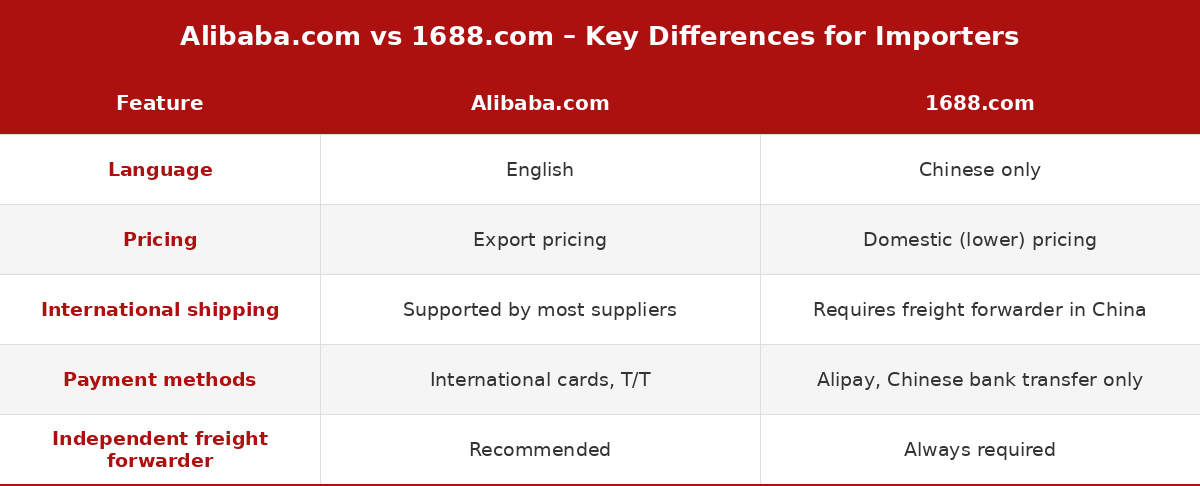
For importers sourcing from Alibaba for the first time, the platform's English interface and supplier-side export support reduce the logistics coordination required on the China side compared to 1688
Alibaba Products That Require Specialist Freight Handling
A significant number of Alibaba's high-volume product categories require specialist freight handling - proper DG classification, compliant documentation, or UN-certified packaging. Many general freight forwarders lack the in-house capability to identify these requirements at booking, which means problems tend to surface at the port or on arrival in the USA rather than before departure.
Lithium Battery-Powered Products
Products in this category include:
Power tools
E-bikes and electric scooters
Power banks and portable chargers
Battery packs shipped separately
All lithium battery shipments are classified as Class 9 dangerous goods under IATA (air) and IMDG (ocean) rules. To get carrier acceptance, you need:
UN38.3 test certification for the battery cells
Inner and outer packaging marked to UN standards
A compliant dangerous goods declaration before departure
Air carriers check these requirements at the point of booking. Ocean carriers have separate IMDG rules depending on whether batteries are in equipment or shipped loose. Sourcing a lithium battery product on Alibaba is easy.
Getting it onto a vessel or aircraft without the correct documentation is a different process.
Products Containing Flammable or Chemical Components
Many common Alibaba categories contain chemical compounds that trigger dangerous goods rules - even when the listing does not say so. Examples include:
Paint and coatings- Class 3 flammable liquid
Adhesives and solvents- Class 3
Industrial cleaning agents- Class 8 corrosive
Aerosol sprays - Class 2.1
Fragrance and perfume products- Class 3
Request the product's Safety Data Sheet (SDS) from your supplier before booking freight. If the SDS shows a flash point below 60 degrees Celsius, or flags the product as corrosive, oxidizing, or toxic, it needs DG handling and compliant packaging.
Suppliers rarely flag this on their own, and most general forwarders will not catch it at booking.
Heavy Machinery and Industrial Equipment
Lawn mowers, mini excavators, generators, and industrial equipment are popular on Alibaba and can offer strong value compared to US pricing. The freight side is more involved than standard cargo. Typical requirements include:
Out-of-gauge or overweight declarations for large units
Partial disassembly and specialist crating for container loading
EPA or CARB compliance certificates for engine-powered equipment
ISF pre-filing with correct machinery classification
These are standard requirements for this product type. Engage a forwarder experienced in machinery shipments before placing your order - not after production is complete. See our heavy machinery and equipment shipping guide.
Set Your Incoterms Before You Pay
The Incoterm in your purchase agreement defines who handles freight and who carries risk at each point in the journey. Get this agreed in writing before you pay.
EXW (Ex Works)
Supplier's job ends at the factory gate
You arrange everything: domestic trucking, export clearance, international freight, US import, and inland delivery
Gives maximum control, but requires a forwarder who can manage pickup from the factory
FOB (Free on Board)
Supplier delivers to the named Chinese port and handles export clearance
You control freight booking, insurance, and US import from that point
The standard choice for most importers
Lets you choose your own forwarder independently of the supplier
DDP (Delivered Duty Paid)
The seller or their logistics partner handles everything: pickup, freight, US duties, and final delivery
Simplest arrangement, but typically costs more
For DG or machinery, only works if the party arranging DDP has verified compliance capability
For DG cargo, heavy machinery, or any large-volume shipment where you need full visibility over the logistics process, avoid using your Alibaba supplier's nominated freight forwarder. Supplier-nominated forwarders have a primary relationship with the seller. Resolving documentation gaps or compliance issues mid-shipment without a direct line to the forwarder is difficult.
Shipping Methods from Alibaba to the USA
Can Alibaba Suppliers Ship Directly to the USA?
Some suppliers offer logistics coordination as part of their service. For standard dry goods, this can work. The supplier nominates a forwarder, arranges pickup, and provides a tracking number once booked.
For dangerous goods, heavy machinery, or large FCL shipments, this approach carries risk. The nominated forwarder works for the supplier, not for you. Documentation gaps or classification errors are harder to resolve when you have no direct relationship with the freight provider.
A simple guide:
Standard goods, small orders - supplier logistics can be acceptable
DG products, batteries, machinery, large volumes - use your own forwarder
Available Shipping Modes to Ship Products from Alibaba to USA
Express courier (DHL, FedEx, UPS)
Best for shipments under 70 kg
Transit: 3 to 7 days
High per-kg cost
Most carriers will not accept DG or lithium batteries under standard terms
Air freight
Best for 100 kg to 500 kg
Transit: 8 to 14 days door-to-door
Can handle some DG categories under IATA rules, but requires classification, UN packaging, and a carrier-accepted DG declaration first
Sea freight LCL (Less than Container Load)
Best for shipments under 15 CBM
Your cargo shares a container with other shippers
Transit: 20 to 35 days door-to-door
Cost-effective for mid-volume orders
Sea freight FCL (Full Container Load)
Best for larger volumes
20-foot container: 25 to 28 CBM; 40-foot: 55 to 60 CBM
You control the container's loading with no dependency on other shippers
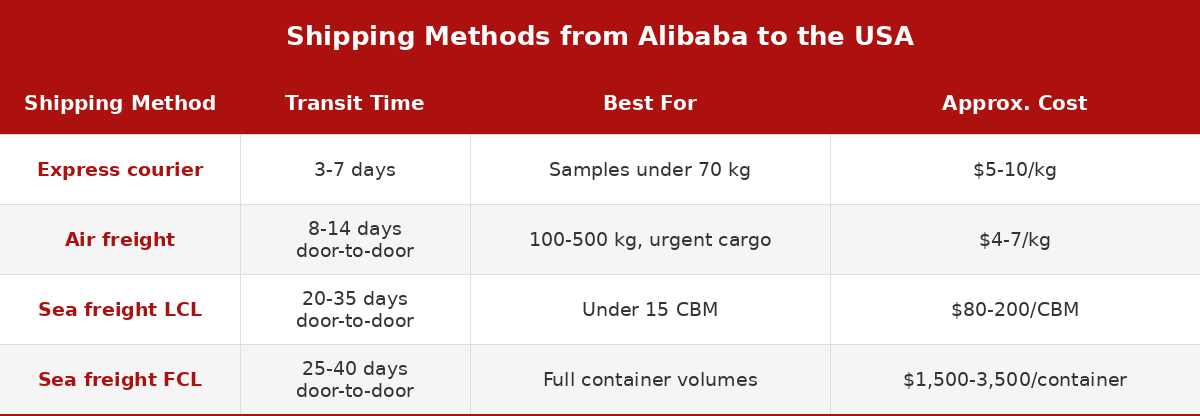
Rates change with fuel surcharges, carrier capacity, and seasonal demand. The figures above are indicative ranges. Your forwarder will quote based on your specific cargo and shipment date.
Working with a Freight Forwarder for Your Alibaba Shipments
A freight forwarder manages the logistics between your Alibaba supplier and your US address. Their standard scope of work includes:
Booking cargo space with carriers
Reviewing and preparing export documentation
Coordinating supplier pickup
Handling Chinese export customs clearance
Arranging cargo insurance
Filing the Importer Security Filing (ISF) before vessel departure
Managing US import clearance on arrival
For standard dry cargo, most freight forwarders handle this well. For Alibaba shipments involving dangerous goods or heavy machinery, the forwarder's specific capabilities matter far more than price.
What specialist DG handling requires:
Staff holding active IATA or IMDG certification
Carrier relationships that include DG-accepted lanes for your specific route
In-house classification expertise to review your product before booking
A gap in any of these areas creates compliance risk that falls on you as the importer.
The clearest guidance: engage your freight forwarder before finalizing the purchase order. They can confirm whether your product needs DG documentation, which packaging standards apply, and which shipping modes a carrier will accept for your cargo type.
How Gerudo Logistics Help with Your Alibaba Shipment
Gerudo Logistics is a dangerous goods and cold chain specialist freight forwarder headquartered in Guangzhou, with port operations across Shenzhen, Shanghai, Ningbo, Qingdao, and Dalian.
For importers sourcing from Alibaba in categories that include lithium batteries, chemical compounds, flammable materials, temperature-controlled cargo, or industrial machinery, we manages compliant handling under IATA, IMDG, and ADR standards from cargo classification through to US delivery.
Documentation review, carrier acceptance, customs clearance, and freight execution are handled as part of a single end-to-end service. To discuss your shipment, contact our team.
US Customs Clearance for Alibaba Imports
Every commercial shipment entering the USA must clear US Customs and Border Protection (CBP). For shipments above $2,500 in value, a formal customs entry is required. This means filing entry documents, paying applicable duties, and working with a licensed customs broker. For a full breakdown of import requirements for China shipments, see our Shipping from China to USA guide.
Importer Security Filing (ISF)
For ocean shipments, ISF must be submitted at least 24 hours before the vessel leaves the Chinese port. Missing this deadline carries a $5,000 penalty per violation. Your freight forwarder or customs broker handles ISF filing as part of the standard ocean freight service.
Documents required for US customs clearance:
Commercial invoice - accurate product description, quantity, and declared value
Packing list - weights and dimensions per package
Bill of lading (ocean) or air waybill (air)
Dangerous goods declaration and SDS - where applicable
EPA or CARB compliance certificate - for engine-powered machinery
Importer's EIN or Tax ID number
HTS code classification
Every product is assigned a Harmonized Tariff Schedule (HTS) code, which determines the duty rate applied. Misclassification is one of the most common and costly customs errors. For chemical products and machinery, correct classification is often non-obvious. Getting HTS codes reviewed before the shipment departs is far less expensive than correcting a misclassification after cargo arrives.
Step-by-Step Process for Shipping from Alibaba to the USA
Step 1 - Check your product classification before ordering
Request the SDS and full product specifications from the supplier. Share these with your freight forwarder to confirm whether DG documentation is required before you commit to the purchase.
Step 2 - Agree on Incoterms in writing
FOB is the practical standard for most importers. Make sure the Incoterm, named port, and responsibility scope are written into the purchase agreement before payment.
Step 3 - Engage your freight forwarder before confirming the order
Provide product details, origin city, destination, target shipment date, and approximate weight and volume. For DG or machinery, confirm carrier acceptance terms before production starts.
Step 4 - Prepare export documentation
The supplier provides the commercial invoice and packing list. Your forwarder handles freight booking, export customs clearance, and ISF filing for ocean shipments. For DG cargo, the forwarder prepares or reviews the dangerous goods declaration before the carrier accepts the booking.
Step 5 - Track the shipment in transit
Your forwarder provides the vessel name, voyage number, and estimated arrival at the US port. For DG cargo, confirm that carrier acceptance documentation is complete and on file before the vessel departs.
Step 6 - Clear customs and arrange delivery
Your customs broker files the entry, pays applicable duties, and coordinates cargo release. For heavy machinery or out-of-gauge equipment, arrange specialist trucking from the port before the vessel arrives.
Frequently Asked Questions
Do I need a freight forwarder to ship from Alibaba to the USA?
For shipments above $2,500 in value, a formal customs entry is required, and most importers use a licensed customs broker or freight forwarder to manage this. For cargo involving dangerous goods, lithium batteries, or heavy machinery, a specialist forwarder is a practical necessity - these shipments require carrier-specific documentation and classification that general logistics providers are not equipped to handle.
Which Alibaba products are classified as dangerous goods?
Common categories include power tools and e-bikes with lithium batteries (Class 9), paints and adhesives with flash points below 60 degrees Celsius (Class 3), industrial cleaning agents and corrosive chemicals (Class 8), and aerosol products (Class 2). Request the product Safety Data Sheet from your supplier before booking freight if you are unsure about your product's classification.
How long does shipping from Alibaba to the USA take?
Express courier takes 3 to 7 days. Air freight door-to-door runs 8 to 14 days. Sea freight to the US West Coast is 20 to 30 days port-to-port, with East Coast ports adding 8 to 12 days. Add 3 to 5 business days for US customs clearance on top of the transit time.
What is the difference between FOB and DDP when buying on Alibaba?
Under FOB, the supplier delivers to the named Chinese port and handles export clearance - you control everything from that point. Under DDP, the seller handles the entire journey including US duties and final delivery. FOB gives you more control over forwarder selection and usually lower total cost when you work with a specialist forwarder independently.
Can I ship heavy machinery purchased on Alibaba to the USA?
Yes. Lawn mowers, mini excavators, generators, and industrial equipment move from China to the USA regularly. These shipments require out-of-gauge or overweight declarations where applicable, specialist crating, and EPA compliance documentation for engine-powered equipment. A freight forwarder without machinery experience will not be prepared to handle these requirements without issues.
What documents do I need to import an Alibaba shipment into the USA?
The standard set includes a commercial invoice, packing list, and bill of lading or air waybill. DG shipments additionally require a dangerous goods declaration and Safety Data Sheet. Engine-powered machinery requires EPA or CARB compliance certificates. Your freight forwarder will confirm any product-specific document requirements before the shipment is booked.
Conclusion
Alibaba gives importers access to a wide product range at competitive prices. The freight side becomes complicated when your cargo falls into categories that need specialist handling - and more popular Alibaba product categories carry those requirements than most first-time importers expect.
Three things determine whether a shipment clears smoothly:
Confirming product classification before booking freight
Choosing a forwarder with the right compliance capability for your cargo type
Having complete documentation ready before the goods reach the port
For standard dry goods, most freight forwarders will serve you well. For dangerous goods, battery-powered equipment, or heavy machinery, the forwarder's specialist credentials are the factor that matters.