Shipping Air Compressors from China: Costs, Customs & Delivery Guide
Shipping air compressors from China starts with confirmed packing data, equipment configuration and destination access. Catalog dimensions become inaccurate once a skid, crate or separate receiver changes the cargo size and lifting points. A compact electric compressor and a towable diesel unit therefore need different freight plans.
This guide includes freight arrangement plan for industrial air compressors, air receivers, refrigerated air dryers and related parts.
At a Glance
Main shipping method: Sea freight suits most complete units and multi-machine orders.
Container choice: LCL suits one compact unit within warehouse handling limits; FCL gives better control over larger shipments.
Main cost factors: Packed volume, gross weight, container type, handling requirements, route and final delivery scope affect the freight cost.
Dangerous goods status: Diesel fuel, regulated batteries, refrigerant, regulated oil and residual pressure determine whether the shipment follows a general cargo or dangerous goods route.
Shipping Methods for Air Compressors from China
LCL and FCL Sea Freight
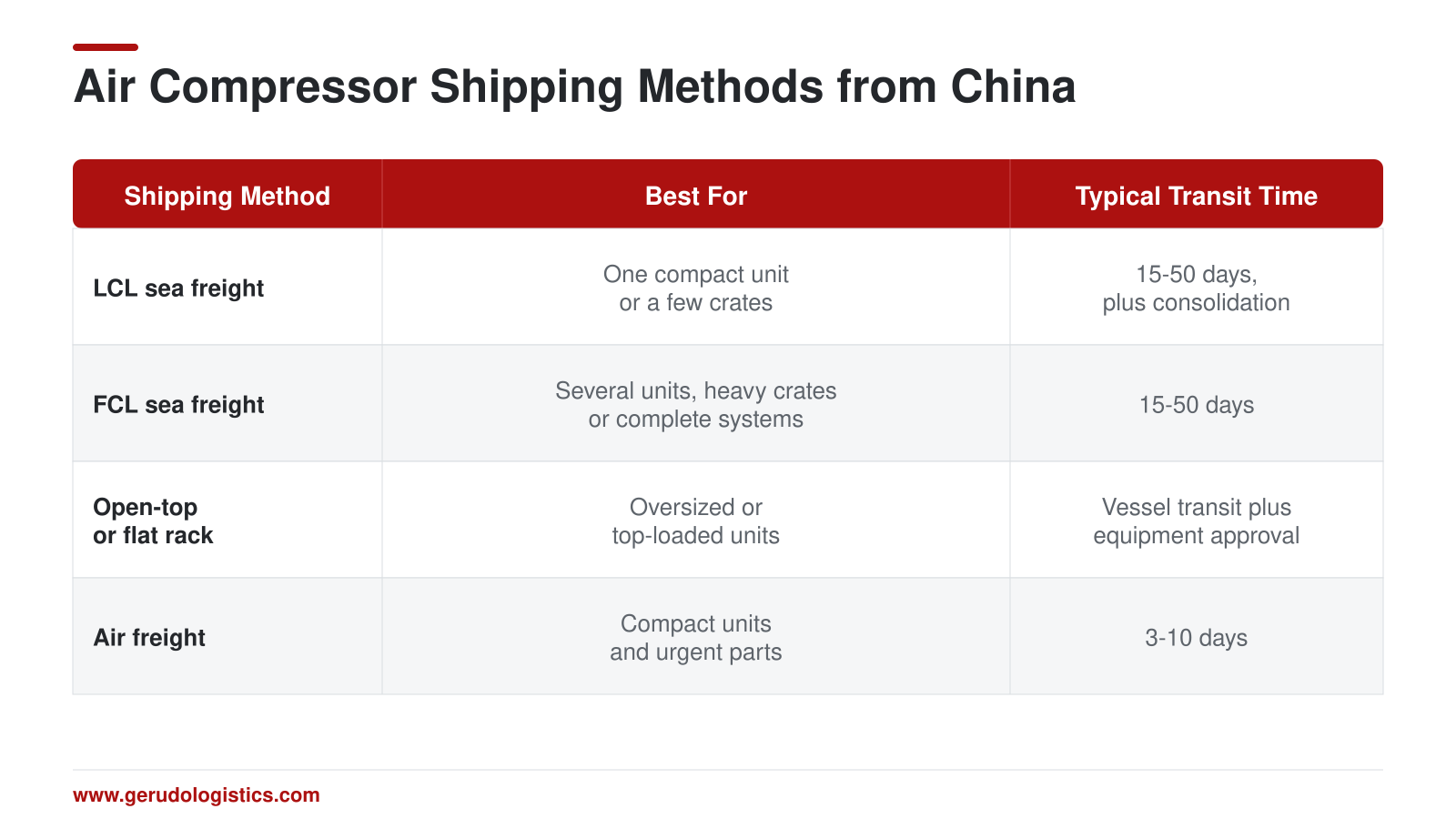
Less than container load (LCL) shipping suits one compact compressor that fits the warehouse and container-handling limits. It passes through consolidation facilities and shares space with other cargo, so the machine needs a rigid base, protected controls and clear lifting points.
Full container load (FCL) gives the loading team direct control over crate positioning and securing. It suits several compressors, heavy stationary machines and complete systems.
Choose between a 20GP and 40HQ from the final packing list. Check that every crate passes through the container door. Then place the crates on an internal floor plan, reserve securing space and compare the combined weight with the container payload and floor-loading limit.
Open-Top and Flat-Rack Shipping for Oversized Air Compressors
Use an open-top container when a compressor requires top loading or exceeds the normal door height. Use a flat rack when the packed machine is too wide, too high or unsuitable for an enclosed container.
Send the final dimensions and weight to the carrier for out-of-gauge equipment approval. The loading team must work from approved lifting points and secure the machine around its center of gravity. Include weather protection and destination unloading in the freight plan, with site access and crane availability confirmed at destination.
Air Freight for Small Air Compressors
Air freight suits compact oil-free compressors, samples, control panels and urgent replacement parts. It is rarely economical for large units because crating raises the chargeable weight.
Submit the packed dimensions, actual weight and details of every battery, oil, fuel, refrigerant or pressurized component. Approval for one courier package does not cover the complete machine.
Consolidating a Complete Compressor System
A consolidation warehouse can combine packages from several Chinese suppliers into one international shipment.
Give the warehouse an item list, model reference, dimensions, weight and photos for every package. This exposes missing accessories, duplicate package numbers and stacking conflicts. Record the dryer, receiver and separate oils as individual items in the cargo file.
Importers sourcing HVAC products can read our separate guide to importing air conditioners from China to Europe.
Air Compressor Shipping Time from China
Record the supplier’s production lead time separately from freight transit.
FCL follows the selected vessel schedule. LCL adds time for consolidation at origin and unpacking the shared container at destination.
Door-to-door shipping time = cargo preparation + carrier acceptance + main transit + customs clearance + final delivery
Start with the confirmed cargo-ready date and flight or vessel schedule. Out-of-gauge approval and dangerous goods acceptance add time before handover. Destination clearance, truck availability, site access and lifting arrangements set the final delivery date.
What Affects Air Compressor Shipping Costs from China?
Calculate air compressor shipping costs from the final packed dimensions, gross weight, collection address, destination, transport method and delivery scope.
LCL and FCL Cost Factors
LCL quotations use chargeable volume or weight, with separate collection, warehouse, terminal, deconsolidation and delivery charges. Heavy crates add special-handling charges when the warehouse needs lifting equipment or reinforced support.
FCL quotations are built from the container type, loading port, destination, sailing and local service scope. Poor crate layout wastes space and sometimes forces the order into a larger container, so multi-machine orders need a packing plan.
Air Freight Chargeable Weight
Air freight is charged on the greater of actual and volumetric weight. The general calculation is:
Volumetric weight in kg = packed length × width × height in cm ÷ 6,000
Use 6,000 for a preliminary standard air-cargo calculation. Express courier services commonly use 5,000, so apply the divisor stated in the quotation. Crating increases both dimensions and gross weight, and the quotation must use packed data.
Special Handling and Destination Costs
A complete quotation separates the international freight from the following cost items:
Packing: Crating, moisture protection or reinforced skids.
Special equipment: Open-top containers, flat racks and cargo securing.
Dangerous goods charges: Classification, documentation, carrier surcharges and specialist handling for regulated components.
Destination services: Port charges, clearance, storage, truck delivery and unloading.
Compare quotations on the same delivery scope. A low ocean rate still results in a high delivered cost when a crane, specialist truck or long inland movement is required.
Cost Example for an Air Compressor with a Pressurized Component
This example uses assumed charges to show how dangerous goods status can change the shipping cost.
A buyer ordered one 22 kW electric screw compressor, a matching air receiver and maintenance filters. The three crates measured 5.2 CBM and weighed 950 kg for shipment from Shenzhen to Rotterdam. The supplier had not provided proof that the receiver was fully depressurized.
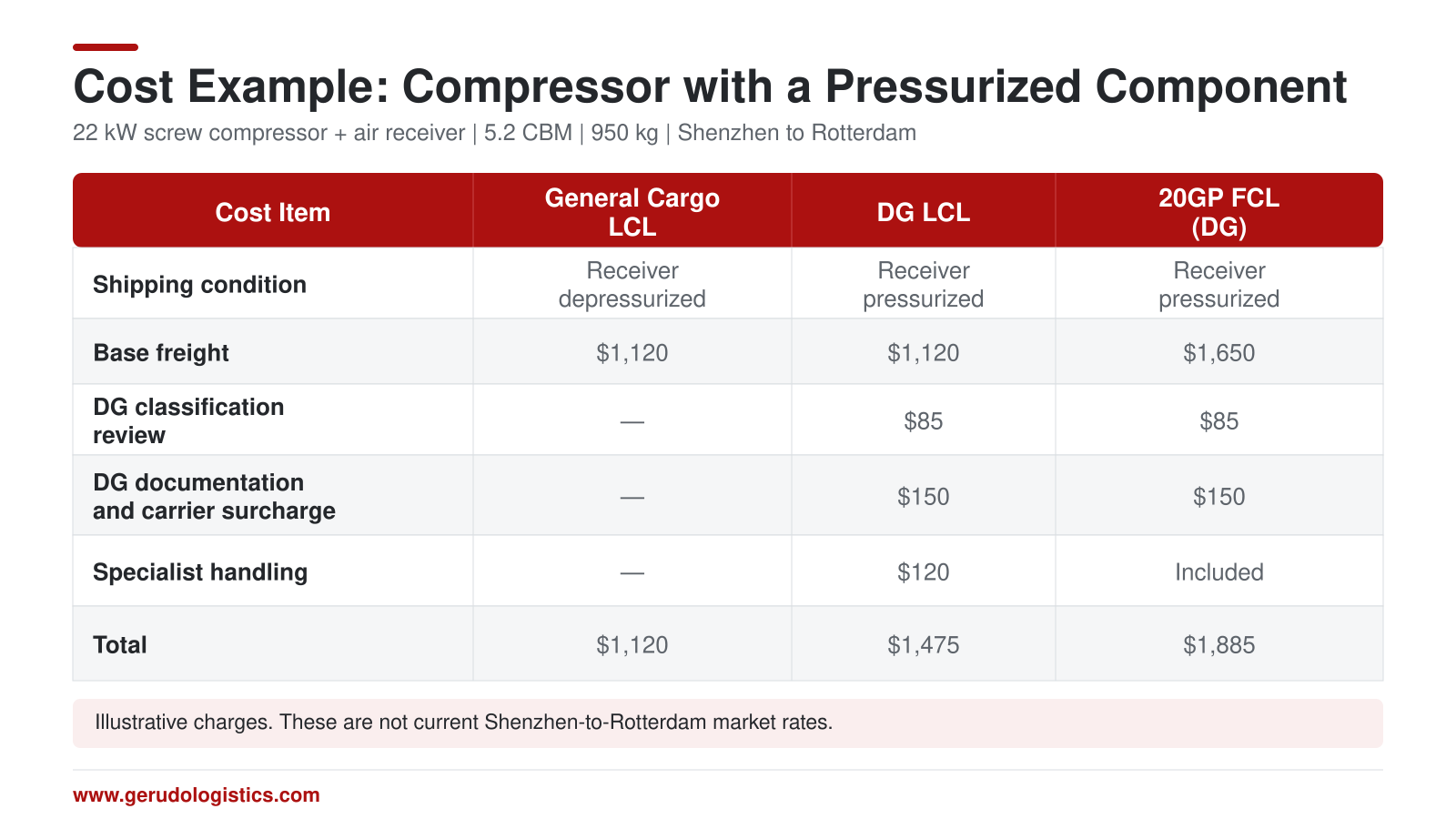
Result: Documented depressurization reduces the quoted cost by $355 compared with DG LCL and $765 compared with DG FCL. If the LCL warehouse does not accept the pressurized receiver, FCL becomes the available option.
All amounts are illustrative rather than current Shenzhen-to-Rotterdam market rates.
How Incoterms Change Air Compressor Shipping Costs
Incoterms identify which transport costs are included in the supplier’s price and who arranges each stage:
EXW (Ex Works): The importer arranges pickup from the factory, origin handling, international freight and destination services.
FOB (Free on Board): The supplier delivers the cleared cargo to the named Chinese port. The importer controls the main freight and destination arrangements.
CIF (Cost, Insurance and Freight): The supplier pays freight and insurance to the named destination port. The importer handles destination charges, customs clearance, import duties and inland delivery.
DDP (Delivered Duty Paid): The seller quotes delivery to the named destination with duties paid. The quotation must identify the importer of record, unloading scope and any cargo-specific charges.
Compare supplier quotations using the same Incoterm and named place. Our Incoterms 2020 guide explains cost allocation, risk transfer and the responsibilities assigned to each party.
How to Pack an Air Compressor for Shipping
Air Compressor Crating
Crate base: Support the manufacturer-approved mounting points and provide forklift access for the packed weight.
Machine restraint: Use bolts or brackets without loading weak panels, pipes or the motor assembly.
Component protection: Protect controls, gauges, valves and exposed pipes. Place loose accessories in marked cartons or fixed compartments.
Crate markings: Show the gross weight, center of gravity, lifting points and upright direction.
Wood packaging: Use heat-treated, ISPM 15-marked solid wood. Plywood and other processed wood fall outside the raw-wood scope.
Moisture Protection for Sea Freight
Moisture barrier: Use a suitable barrier layer, desiccant and manufacturer-approved corrosion protection.
Openings and controls: Cap openings and keep control cabinets closed.
Oil record: Record the type and quantity of any oil drained for transport.
Condition photos: Photograph the machine before wrapping, after fixing it to the base and after closing the crate.
Container Loading and Securing
Floor position: Place heavy crates on a suitable floor area without relying on neighboring cargo for stability.
Blocking and lashing: Control movement without pulling against weak panels or unsupported pipework.
Weight distribution: Separate multiple crates and balance their weight across the container floor.
Loading photos: Record crate positions, restraints, container number and seal. For flat-rack and open-top shipments, also photograph weather protection and external securing.
Are Air Compressors Dangerous Goods?
A standard electric air compressor ships as general cargo when it contains no fuel, regulated battery or regulated refrigerant circuit, its receiver is fully vented, and its oil is not regulated for transport. The shipped configuration, rather than the product name, determines the result.
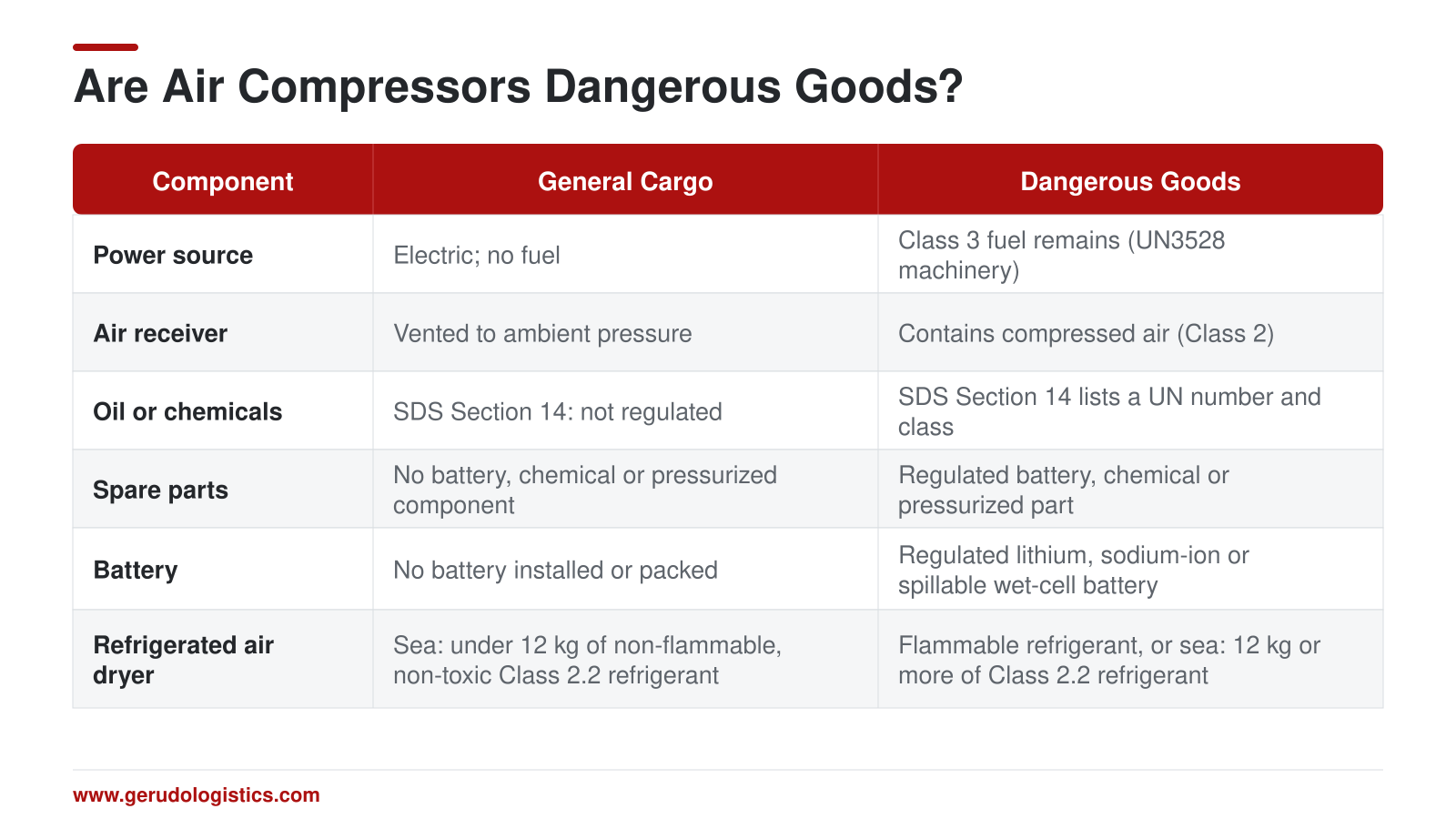
Refrigerant exemption note: Under IMDG Special Provision 119, a refrigerating machine containing less than 12 kg of non-flammable, non-toxic Class 2.2 gas falls outside the relevant sea-freight requirements. Air freight uses the separate ICAO/IATA refrigerating-machine provisions.
One regulated component makes the booking dangerous goods. Remove or fully neutralize that component, or document the exemption, and the remaining shipment returns to general cargo.
Shipping Diesel-Powered Air Compressors
A diesel-powered compressor with Class 3 fuel remaining in the tank or fuel system follows the UN3528 Class 3 machinery entry. A completely drained and cleaned fuel system moves as general cargo when no other regulated component remains.
Fuel record: State the fuel type, tank capacity and condition at handover. A drained statement must cover the tank, lines and filters.
Starter battery: Record the battery chemistry and rating, then photograph its installation and short-circuit protection.
Shipping Refrigerated Air Dryers with Refrigerant
Record the refrigerant name, charge per unit and whether the circuit is factory sealed. Our guide to shipping equipment containing gas from China explains the relevant entries and exemptions. Separate refrigerant cylinders or service gas ship under their own classification. For shipments to the USA, see our refrigerant shipping guide.
Air Receiver Tanks and Residual Pressure
For general cargo, provide a pressure statement identifying the receiver model or serial number, plus photos of the zero gauge, open valve and nameplate. Without this evidence, quote the receiver as dangerous goods.
Documents Needed to Ship Air Compressors from China
Prepare a shipping file that matches the final machine configuration and packing condition.
Core shipping documents
Commercial invoice: State the product name, model, quantity, value, currency and agreed Incoterm.
Packing list: Record the package count, crate dimensions, net and gross weights, and contents of each package.
Product records: Include the specification sheet and clear nameplate photos for equipment identification.
Packing evidence: Photograph the machine and closed crate. For a container shipment, also photograph the loading position, restraints, container number and seal.
Transport document: Check that the bill of lading, sea waybill or air waybill matches the cargo description, package count and weight.
Additional records for specific configurations
Diesel-powered compressor: Fuel statement and starter battery details.
Refrigerated air dryer: Refrigerant name, charge per unit and confirmation that the cooling circuit is factory sealed.
Air receiver: Statement and photographs showing its pressure condition at handover.
Separate oil or chemicals: Safety Data Sheet and classification evidence required for the selected transport mode.
Destination clearance: Importer tax or customs registration number and the destination broker's entry instructions.
The model, quantity, package count, gross weight and description should agree across all records. If the factory adds an accessory after issuing the documents, update the invoice, packing list and cargo review to match the final shipment.
Customs Clearance and Import Duties for Air Compressors
Customs uses the product description, HS classification, declared value, origin and national tariff measures to process the entry.
Air Compressor HS Codes
Harmonized System (HS) heading 8414 covers air and gas compressors. The full national code follows the machine design and destination tariff. The heading distinguishes towable air compressors mounted on a wheeled chassis from other types. Parts use another subheading when classified separately.
The customs broker classifies the air receiver, dryer, control cabinet and maintenance kit as parts of one complete system or as separate products, based on their presentation and the destination tariff rules.
The final national tariff code and origin set the base import duty rate. The broker then checks taxes, preferential treatment and additional trade measures.
Customs Declaration for Complete Compressor Systems
The invoice should identify the equipment and components by product name, model, quantity and value. A description such as “machine with accessories” is too vague. The packing list should follow the same item structure and connect each product to its crate number.
For a multi-supplier shipment, declare each component on a separate invoice line with its model, value and crate number.
Air Compressor Delivery and Unloading at Destination
Site Access for Air Compressor Delivery
Delivery details: Provide the complete address, receiving hours, site contact and delivery restrictions.
Vehicle access: Confirm road conditions, gate width, turning space and unloading-area clearance.
Crane position: Check whether the truck or crane can reach the planned unloading point.
Indoor placement: Treat movement inside a building as a separate service from delivery to the unloading area.
Unloading Heavy Air Compressors
Lifting capacity: Match the forklift or crane capacity to the packed weight and center of gravity.
Forklift setup: Confirm the required fork length and entry direction from the crate design.
Labor and equipment: State in the delivery quotation who provides the lifting equipment and unloading team.
Delivery scope: Confirm whether the service ends with the closed crate, unpacking or final positioning.
Inspecting an Air Compressor After Delivery
Crate condition: Check for holes, broken boards, water marks, leaning crates and damaged restraints before signing the delivery receipt.
Damage record: Add visible damage to the delivery receipt and take clear photographs.
Equipment inspection: After unpacking, photograph the compressor, controls, gauges, pipework and accessories.
Claim evidence: Keep the packaging and report damage within the contract and cargo insurance deadlines.
Shipping Air Compressors with Gerudo Logistics
Gerudo Logistics is a China freight forwarder specializing in dangerous goods and chemical cargo.
For air compressor shipments, Gerudo Logistics checks packing data, compares freight options, consolidates cargo from multiple suppliers and arranges international transport and destination delivery. The cargo review identifies fuel, batteries, refrigerant, regulated oil and residual pressure before the shipping method is selected.
For a shipment proposal, contact Gerudo Logistics with the supplier location, model, final packing data, equipment configuration and delivery address.
FAQs About Shipping Air Compressors from China
Can Used Air Compressors Be Shipped from China?
Yes, used air compressors can be shipped from China when the destination permits used machinery. Provide photos, serial information and a statement covering the oil, fuel and pressure condition.
Can an Air Compressor Be Transported on Its Side?
Only with manufacturer approval and instructions for oil, refrigerant, mounts and internal components. Keep the machine upright when no model-specific instruction supports another orientation.
Can Air Compressor Spare Parts Ship by Express Courier?
Dry mechanical spare parts without batteries, oil, chemicals or pressure move by courier within package limits. Parts containing regulated items use a dangerous goods service.
Is Cargo Insurance Necessary for an Air Compressor Shipment?
Buy cargo insurance separately when it is absent from the freight contract. For high-value machinery, confirm the insured value, exclusions, deductible and claim evidence.
Does Compressor Oil Need to Be Drained for Shipping?
Installed compressor oil can remain when SDS Section 14 states that it is not regulated and the sump is leak-tight. Drain it when the oil is regulated or the selected carrier requires an empty sump.