Importing Air Conditioners from China to Europe: Shipping Methods, Costs and Import Checklist
The summer of 2026 made air conditioners a more urgent purchasing category for many European buyers. Repeated heatwaves increased demand for residential cooling, portable units, split systems and project HVAC equipment.
For European importers, the central question is operational: can these products be shipped from China to Europe safely, at a controlled cost and with the right documents for customs release?
The answer is yes. However, air conditioners require more planning than ordinary small appliances. They are bulky, sensitive to handling damage and often linked to refrigerant documentation. When refrigerant is involved, the shipment must be checked from a dangerous goods perspective before booking.
This guide explains how air conditioners are shipped from China to Europe, what affects the freight cost, which product types need extra handling attention, what documents are required for EU entry, and what importers should check before confirming freight.
Can Air Conditioners Be Shipped from China to Europe Easily?
Yes. Air conditioners can be shipped from China to Europe without major difficulty when the order is prepared correctly.
Three points decide whether the shipment moves smoothly:
The first issue is volume. Air conditioner shipments often fill container space before reaching the container weight limit. A supplier may describe the order as moderate in weight, while the carton volume still makes the shipment expensive or unsuitable for LCL handling.
The second issue is cargo protection. Outdoor units, portable units and floor standing models can be damaged by pressure, tilting, warehouse handling or weak cartons. Dented panels, broken grilles, crushed packaging and unstable compressors are common loss points when packing is not designed for international movement.
The third issue is refrigerant DG status. Many AC units contain refrigerants such as R32, R410A or R290. For ocean freight, equipment containing refrigerant should be reviewed before booking. The SDS/MSDS and transport classification support the assessment of the UN entry, hazard class, any applicable exemption, carrier acceptance and port declaration requirements.
If the order includes separate refrigerant cylinders, spare gas or service gas, the cargo should be handled as DG gas cargo. Gerudo Logistics explains this process in its guide to shipping refrigerants from China.
Best Shipping Methods for Air Conditioners from China to Europe
The best shipping method depends on order volume, delivery deadline, destination country and service scope.
FCL sea freight is usually the best choice for large AC orders. It gives the importer better control over loading, reduces cargo mixing risk and works well for seasonal stock. For split air conditioners, the forwarder should check how indoor unit cartons and outdoor unit cartons are matched inside the container.
LCL sea freight can work for trial orders or small batches, but the packaging must be stronger. LCL cargo passes through consolidation warehouses and destination handling points, which increases the risk for loose cartons. For high-value models, palletizing is often the safer option.
Rail freight is useful when the importer needs faster delivery to inland Europe, especially for Germany, Poland, Czech Republic, Hungary and nearby markets. It can support urgent seasonal replenishment, provided the rail terminal, customs plan and final trucking arrangement are confirmed before shipment.
Air freight should be limited to samples, remote controls, PCB boards, compressors, small parts and urgent after-sales components. Full AC units are expensive by air because they are both heavy and bulky. If the sample contains refrigerant, airline acceptance must be checked before booking.
How Much Does It Cost to Ship Air Conditioners from China to Europe?
The cost of shipping air conditioners from China to Europe depends on shipment size, loading city, destination port, DG status and delivery scope.
The example below shows a typical cost breakdown for a 40HQ container of wall-mounted split air conditioners from Shanghai to Rotterdam, booked as DG cargo because the units contain refrigerant.
Real Example: Cost of Shipping Air Conditioners from Shanghai to Rotterdam
Cost example: one 40HQ container of wall-mounted split air conditioners from Shanghai to Rotterdam, booked as DG cargo because the units contain refrigerant.
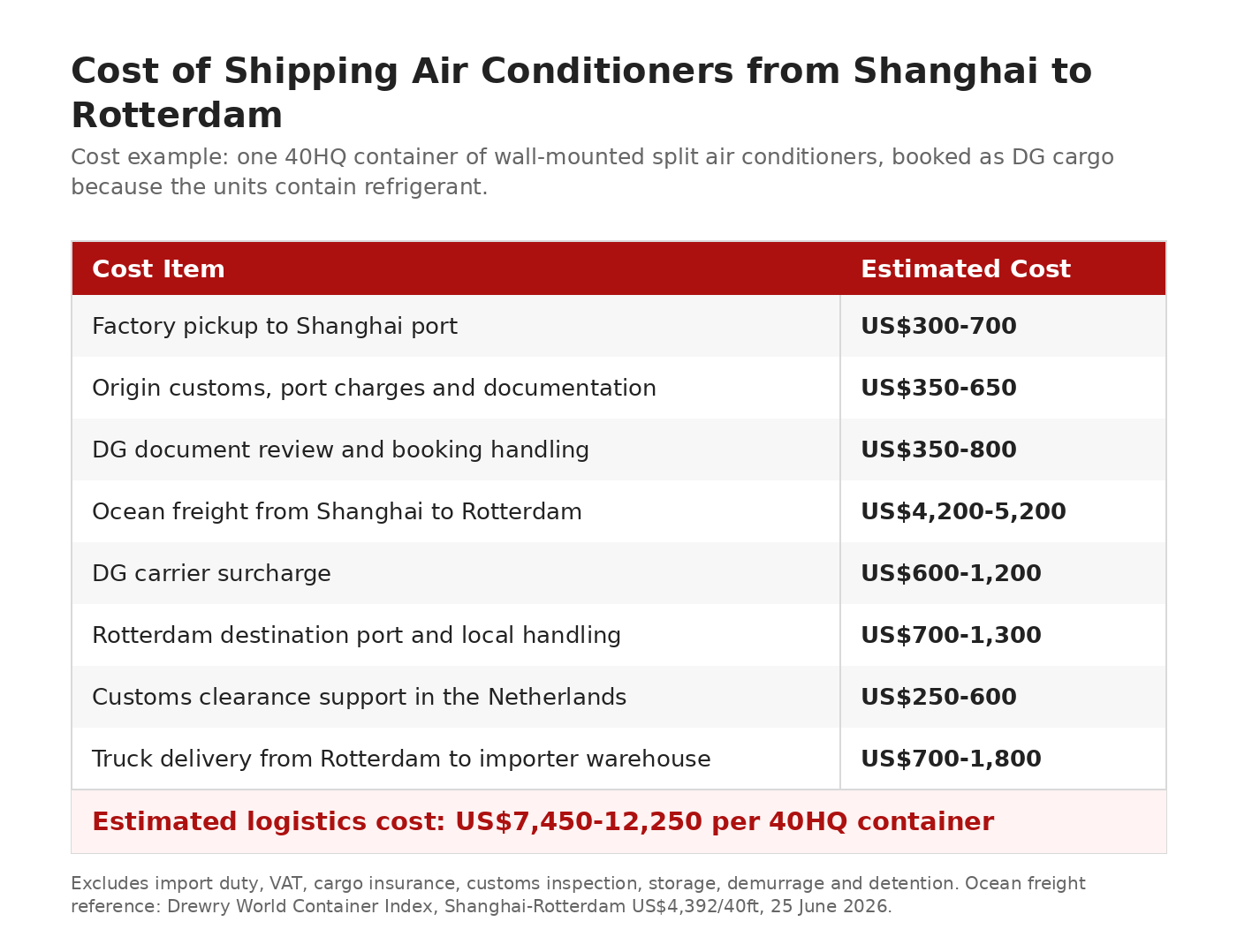
Estimated logistics cost: US$7,450-12,250 per 40HQ container, excluding import duty, VAT, cargo insurance, customs inspection, storage, demurrage and detention.
For this route, the importer should pay close attention to DG booking cost. When air conditioners contain refrigerant, the shipment should be reviewed before booking so that SDS/MSDS, transport classification, carrier acceptance and DG surcharges are handled before the cargo reaches the port.
Types of Air Conditioners Imported from China
Different air conditioner types create different logistics risks. The product category affects carton size, loading method, damage risk, document review and DG handling. Importers should tell the forwarder exactly what type of AC units are being shipped before asking for a quotation.
Single-Split and Wall-Mounted Air Conditioners
Wall-mounted split air conditioners, often sold as single-split air conditioners when one indoor unit is paired with one outdoor unit, are common in European residential and light commercial markets. The transport difficulty is that indoor and outdoor cartons must be counted, matched and loaded correctly.
The main risks are outdoor unit damage, missing accessories and unclear carton marks. The packing list should make the indoor and outdoor unit relationship clear by model, especially when several capacities are loaded in the same container.
Portable and Mobile Air Conditioners
Portable air conditioners are common in retail and e-commerce channels because they are sold as ready-to-use consumer products. Each unit is usually packed in one retail carton with an exhaust hose, window kit and remote control.
The main issue is large carton volume. Portable AC cartons can fill container space quickly and face more handling risk in LCL shipping. Retail packaging should be checked carefully if the shipment will move through consolidation warehouses or last-mile delivery networks.
Window Type Air Conditioners
Window type air conditioners are complete units packed in one carton. They are less common than split systems in many European markets, but they still have demand in selected channels and replacement markets.
The main shipping risk is heavy single-carton handling. Weak cartons can lead to casing damage, grille damage or front panel deformation during stacking. Importers should pay attention to carton strength, upright marks and stacking limits.
Multi-Split and VRF Systems
Multi-split and VRF systems are used for apartments, offices, hotels, shops and other project cargo. A shipment may include outdoor units, indoor units, branch pipes, controllers and technical accessories.
The main issue is model accuracy. One missing or mismatched item can delay the entire installation project. These shipments often have higher cargo value and more refrigerant-related technical data, which makes packing list control and DG review important before booking.
Floor Standing Air Conditioners
Floor standing air conditioners are larger units used in restaurants, halls, offices and large rooms. Their cartons are taller, and visible damage can become a customer complaint after delivery.
The main risks are tilting, carton deformation and surface damage. Palletizing is useful for LCL shipments, while FCL loading should prevent heavy cargo from pressing against the outer panels. The loading plan should keep tall cartons stable and avoid pressure against front panels or exposed casing.
Major Chinese Air Conditioner Brands Commonly Sourced for Europe
Many European importers consider Chinese air conditioner brands because they offer broad product ranges, large production capacity and competitive pricing. Brand choice is a sourcing decision, but it also affects logistics because mature suppliers usually provide clearer packing data, better carton standards and more complete documents.
Midea is widely known in home appliances and HVAC products. Importers often consider Midea for split units, portable AC units, heat pumps and commercial systems. Before placing an order, the buyer should confirm that the selected model is intended for the European market.
Gree is another major Chinese air conditioner manufacturer. It is commonly considered for split systems, inverter models and larger cooling products. For shipping, buyers should ask for exact carton size and loading quantity by model.
Haier has strong home appliance and HVAC product lines. Importers should check whether the supplier can provide the correct energy label, technical file and market documents for Europe.
Hisense is also seen in European appliance channels. For importers, the main point is to verify model availability, after-sales parts, product documents and packaging strength before shipment.
TCL and AUX are often considered by buyers looking for OEM options, retail product lines or price-sensitive markets. The final decision should depend on product compliance, carton quality, delivery schedule and document readiness rather than brand name alone.
EU Customs Clearance Requirements for Air Conditioners Shipped from China
Standard Customs Documents
The basic customs file should be consistent across the invoice, packing list and transport document. A product description such as “wall-mounted split air conditioner, model XXX, cooling capacity XXX” is stronger than “air conditioner” or “electrical appliance.”
Importers usually need:
Commercial invoice: Buyer, seller, product name, model, quantity, unit value, total value, currency and trade term.
Packing list: Carton quantity, gross weight, net weight, CBM, pallet details and model breakdown.
Bill of lading or sea waybill: Shipper, consignee, notify party, vessel details and cargo description.
HS or TARIC code: Confirmed by the destination customs broker before entry.
EORI and VAT details: Provided by the European importer.
Value support: Sales contract, payment record or purchase order if customs requests proof of declared value.
The invoice, packing list and shipping document should describe the same cargo in the same way. If the invoice separates split units by model, the packing list should follow the same model structure.
European Market Documents
Customs clearance and market compliance are separate processes, but they often meet at the border. If the importer cannot provide product files for the EU market, the shipment may face document requests, inspection or later market surveillance action.
For most AC imports, the supplier should provide CE declaration, RoHS documents, EU energy label, product information sheet, user manual and technical specification sheet. For air conditioners covered by EU energy labelling rules, the importer should confirm whether the model must be registered in EPREL, the European Product Registry for Energy Labelling, before it is placed on the EU market.
This review need take place before balance payment. Your forwarder can check whether the shipping file is complete, while product compliance remains the importer’s responsibility.
Pre-charged air conditioners containing HFC refrigerants such as R32 also require an EU F-gas check. The EU importer must have a valid F-gas Portal registration before import and confirm whether HFC quota authorization and a Declaration of Conformity apply to the annual quantity placed on the EU market.
R32 and Other Refrigerant Shipping Documents
Pre-charged air conditioners can be shipped with factory-installed refrigerant, but the refrigerant type and charge per unit must be confirmed before transport classification and carrier acceptance are reviewed. The DG file should confirm whether the shipment can be accepted by the carrier, declared to the port and loaded on the planned vessel.
For refrigerant-containing AC shipments, the key documents are:
SDS/MSDS: Provided by the supplier or refrigerant manufacturer. Section 14 identifies transport classification, including UN number, proper shipping name and hazard class.
Transport classification report: Arranged by the supplier through a qualified testing agency in China. It supports DG pre-check and carrier acceptance.
DG declaration: Prepared after classification is confirmed. It is used for carrier booking, port declaration and vessel acceptance.
Product specification sheet: Confirms the AC model, refrigerant type and refrigerant quantity.
Product label photos: Verify the model number, refrigerant marking and safety information.
Separate refrigerant cylinder documents: Required when refrigerant cylinders, spare gas or service gas are shipped with the order.
Importers should obtain these files from the supplier and send them to the DG forwarder before submitting the booking request. Gerudo Logistics can review the SDS/MSDS, classification report, product labels and packing list before confirming the DG route with the carrier.
What Importers Should Check Before Booking Freight
Before booking freight, the importer should turn the supplier’s product information into a clear shipping file.
Use this checklist before confirming the shipment:
Confirm the shipment size: Ask the supplier for the final packing list, including carton quantity, gross weight, net weight, total CBM and pallet details.
Check the loading plan: Confirm whether the cargo will move as loose cartons or palletized cargo, and ask for carton marks and loading photos before departure.
Verify the AC type: Make sure the packing list clearly separates wall-mounted split units, portable units, window units, VRF systems or floor standing units.
Match indoor and outdoor units: For split systems and VRF cargo, confirm that indoor units, outdoor units and accessories are matched correctly by model.
Confirm refrigerant documents: Ask for refrigerant type, quantity, SDS/MSDS, transport classification report and DG declaration documents where required.
Flag separate refrigerant cargo: If the order includes refrigerant cylinders, spare gas or service gas, tell the forwarder before booking.
Prepare EU product files: Collect CE, RoHS, EU energy label, product information sheet, user manual and technical specification files from the supplier.
Confirm the customs code: Ask the destination customs broker to check the HS code or TARIC code before shipment.
Choose the shipping scope: Decide whether the shipment should move under EXW, FOB, CIF, DAP or DDP terms.
Confirm the delivery address: For door delivery, provide the full warehouse address, unloading condition, appointment rules and contact person.
Check the delivery deadline: Tell the forwarder if the cargo is linked to a summer sales window, project installation date or retail launch.
Decide on cargo insurance: For high-value AC shipments, confirm insurance before the goods are picked up.
How Gerudo Logistics Helps Importers Ship Air Conditioners from China to Europe
Gerudo Logistics is a China-based freight forwarder specializing in dangerous goods, temperature-controlled cargo and door-to-door international logistics. Headquartered in Guangzhou, with operations across Shenzhen, Shanghai, Ningbo, Qingdao and Dalian, we supports importers who need controlled shipping execution from Chinese suppliers to overseas destinations.
For air conditioner shipments, we provides early document review, route planning, carrier coordination, China-side handling, international freight and destination delivery support.
Our DG capability is especially relevant when AC orders involve refrigerant-containing units, separate refrigerant cylinders, spare gas or service gas, where SDS/MSDS review, transport classification and carrier acceptance need to be checked before booking.
To discuss a shipment plan for air conditioners from China to Europe, importers cancontact us with the supplier address, packing list, product type, refrigerant documents and destination delivery address.
FAQs About Importing and Shipping Air Conditioners from China to Europe
Are air conditioners difficult to ship from China to Europe?
Air conditioners are manageable by sea freight, rail freight or door-to-door service when the order information is complete. The main risks are carton volume, handling damage, unclear refrigerant information and missing European product documents.
What is the best shipping method for wholesale air conditioners?
FCL sea freight is usually the best option for wholesale air conditioner orders because it gives better container control and lower unit freight cost for bulk cargo. LCL can work for small orders, but the packaging must be stronger because the cargo is handled more often.
Can I ship air conditioners from China to Europe by DDP?
DDP may be possible for some air conditioner shipments, depending on the destination country, product documents, cargo value, tax arrangement and final delivery address. Importers should still confirm product compliance because DDP service does not replace EU market requirements.
Are refrigerant-containing air conditioners treated as DG cargo?
When air conditioners contain refrigerant, the shipment should be checked from a DG perspective before booking. The forwarder will review the SDS/MSDS, transport classification, product labels and carrier acceptance requirements.
What HS code is used for air conditioners?
Air conditioners usually fall under HS heading 8415, but the exact EU TARIC code depends on product type and configuration. The importer should confirm the final code with the customs broker before shipment.
What documents should I ask from my Chinese supplier?
You should ask for the commercial invoice, packing list, product specification, carton dimensions, CE documents, RoHS documents, energy label files, product information sheet and refrigerant DG file where applicable.
Is rail freight better than sea freight for air conditioners?
Rail freight can be better when the importer needs faster delivery to inland Europe and the cost still makes sense. For regular wholesale shipments, sea freight is usually more cost-effective.
Can I mix air conditioners with other products in one container?
Mixed loading is possible, but the forwarder should review weight distribution, carton strength, product compatibility and whether any cargo in the container is regulated. Heavy goods should not be loaded in a way that crushes air conditioner cartons.
Conclusion
Importing air conditioners from China to Europe is practical when the shipment is planned around real product and packing details. The most suitable method is usually FCL sea freight for bulk orders, while LCL, rail freight, air freight and DDP can be considered for smaller, faster or more managed shipments.
The key is to confirm product type, carton volume, refrigerant documents, EU product files, customs code and delivery requirements before booking. When these details are clear, the logistics process becomes easier to control from the Chinese supplier to the European destination.