Shipping Equipment Containing Gas from China: DG Classification, Exemptions and Degassing
A gas spring, pressure accumulator, cooling circuit, or fire suppression component can change the shipping status of an otherwise ordinary machine. Importers often discover the issue after booking, when the carrier asks for the gas name, charge, pressure, and transport classification, while the supplier has described the product as general cargo.
Equipment containing gas can usually be shipped from China. The correct shipping condition depends on the gas, quantity, pressure, equipment design, applicable UN entry, and planned transport method.
The equipment may qualify for a specific exemption, require dangerous goods handling, or need to be degassed before shipment. This guide explains how overseas importers can identify the correct route, verify a supplier’s exemption claim, and avoid cargo rejection after the equipment leaves the factory.
Can Equipment Containing Gas Be Shipped from China?
Yes. The main question is which shipping condition applies to the exact equipment model.
A shipment normally follows one of three routes:
General cargo under a valid exemption: The equipment meets every condition of an applicable provision, and the supporting evidence covers the shipped model and configuration.
Dangerous goods transport: The equipment falls under a regulated entry and remains subject to declaration, documentation, packing, and carrier approval requirements.
Transport after degassing or component removal: The supplier changes the equipment condition and provides evidence showing what was removed and what remains installed.
A supplier statement such as contains only nitrogen, low-pressure component, or small refrigerant charge does not establish the correct shipping condition. The statement must be supported by technical information for the actual model.
The classification should be resolved before the equipment leaves the supplier. Once the machine reaches an airport terminal, port warehouse, or LCL facility, inspection, repacking, return transport, and storage costs can increase quickly.
Is Equipment Containing Gas Classified as Dangerous Goods?
Equipment containing gas is not automatically classified as dangerous goods. The result depends on the finished equipment, internal gas, pressure-containing component, and available exemption.
The main factors are:
Gas identity and hazard: Flammable, toxic, oxidising, and non-flammable non-toxic gases follow different classifications and transport restrictions.
Gas quantity, pressure, and capacity: The charge, internal pressure, chamber capacity, and pressure-volume value may determine whether a specific provision applies.
Installed or removable component: A permanently installed gas spring may follow a different classification route from a removable cylinder, cartridge, or accumulator.
Specific UN entry: A named equipment entry should be checked before a broader articles-containing-gas description is considered.
Transport method: Air and sea freight may require different assessments, documents, and carrier approvals.
Carrier policy creates an additional level of review. An equipment model may satisfy a regulatory provision while a particular airline, shipping line, terminal, transit point, or LCL warehouse still declines it.
Where no applicable exemption covers the actual model and shipped configuration, the equipment normally requires dangerous goods classification and carrier approval. The importer must then use an accepted dangerous goods route or ask the supplier to change the equipment condition.
Common Equipment That May Contain Gas
The pressure component may be hidden inside the finished product. Importers should review technical drawings, component lists, and model specifications before accepting a general cargo description from the supplier.
Gas Springs and Shock Absorbers
Gas springs, struts, and shock absorbers commonly contain compressed nitrogen for lifting, support, damping, or impact absorption.
Typical products include office chair gas lifts, automotive shock absorbers, furniture lift supports, industrial buffers, door struts, and energy-absorbing safety devices.
Some products may fall under UN 3164, ARTICLES, PRESSURIZED, PNEUMATIC or HYDRAULIC, containing non-flammable gas. Certain shock absorbers and pneumatic springs may qualify for a specific exemption when their pressure, capacity, construction, and testing meet the applicable conditions.
Before accepting the supplier’s classification, the importer should request the gas-space capacity, charge pressure, component model, and supporting test evidence for the exact product.
Pneumatic and Hydraulic Equipment
Pressure accumulators and pneumatic components may be installed in hydraulic power units, lifting systems, production machinery, construction equipment, and industrial control systems.
The supplier should identify the component manufacturer, model, gas, chamber capacity, charge pressure, test pressure, and installation method. Whether the component can be removed also affects the assessment.
A loose accumulator packed beside a machine remains a separate pressure-containing article. Packing it in the same crate does not turn it into an integrated machine component.
Where the accumulator is removable, the importer should ask whether the equipment can ship without it and whether the component can be sourced, installed, or charged after arrival.
Refrigerating and Air-Conditioning Equipment
Pre-charged cooling equipment includes air conditioners, heat pumps, refrigerated cabinets, water chillers, laboratory cooling units, and industrial refrigeration machines.
The critical information is the refrigerant name, hazard classification, charge per finished unit, and whether the system is factory sealed. The manufacturer should also confirm whether the shipment consists of a complete refrigerating machine or a separately charged component.
Non-flammable refrigerating machines may fall under UN 2857. Equipment containing a flammable refrigerant may use another entry and follow different conditions.
The importer should confirm the exact refrigerant and charge before choosing air or sea freight. A description such as pre-charged air conditioner does not provide enough information for carrier review.
Transport classification and destination-market restrictions require separate checks. A refrigerant may be acceptable for transport while facing environmental, product, or market-access controls in the destination country.
Importers sourcing HVAC units for the European market can also read our guide to importing air conditioners from China to Europe
Other Gas-Containing Equipment
Other equipment categories may include installed fire suppression systems, gas-driven release devices, medical analysers, laboratory instruments, calibration systems, and machinery that uses gas for cooling or pressure control.
These products vary too widely for a single general classification. The assessment should begin with the complete component list and the purpose of the gas inside the equipment.
An SDS helps identify the gas hazard. It does not determine the transport classification of the complete machine without supporting equipment data.
Exemptions for Equipment Containing Gas
An exemption applies to the actual finished article and shipped configuration.
A small gas charge, non-flammable gas, or familiar equipment name does not create an exemption by itself. The equipment must meet the technical conditions of the relevant provision, and the supplier must provide evidence covering the exact model.
UN 3164 and Special Provision 283
IMDG Special Provision 283 covers certain gas-containing articles designed to function as shock absorbers, including pneumatic springs and impact-energy-absorbing devices.
Under the current conditions, the gas-space capacity must not exceed 1.6 litres. The charge pressure at 20 degrees Celsius must not exceed 280 bar, and the gas-space capacity in litres multiplied by the charge pressure in bar must remain within 80.
The supplier must also hold evidence covering burst strength, construction, production quality, and safe pressure release in a fire. A catalogue or general statement about nitrogen content provides insufficient support.
For the importer, the practical question is whether the evidence matches the exact model being purchased. A report for another size, pressure rating, or component design may not support the shipment.
Where the technical evidence is unavailable or does not match the product, the equipment requires another accepted route or a change to its shipped condition.
UN 2857 Refrigerating Machine Provision
IMDG Special Provision 119 covers refrigerating machines and components designed to keep products cold in an internal compartment. Air-conditioning units are also included within its stated scope.
Equipment assigned to UN 2857 Refrigerating machines may fall outside the IMDG Code when it contains less than 12 kg of Class 2.2 gas or less than 12 litres of ammonia solution assigned to UN 2672.
This threshold applies to qualifying refrigerating equipment. It does not extend to gas springs, accumulators, extinguishing systems, pressure vessels, or unrelated machinery.
Before relying on the provision, the importer should confirm:
Exact refrigerant: The commercial name must identify the correct substance and hazard classification.
Charge per finished unit: The quantity should be confirmed for each machine or qualifying component.
Equipment purpose: The product must fit the refrigerating or air-conditioning description.
Installed configuration: The reported charge and component arrangement must match the shipped condition.
A machine containing flammable, non-toxic liquefied gas may fall under UN 3358 and associated provisions. It requires a separate assessment from equipment containing a Class 2.2 refrigerant.
Where the supplier cannot confirm the refrigerant or charge per unit, the importer should pause the shipment assessment until the missing data is available.
When refrigerant is shipped separately in cylinders rather than installed inside the equipment, see our guide to shipping refrigerants from China
What If No Specific UN Entry Applies?
Some equipment does not fit a dedicated entry such as UN 3164, UN 2857, or UN 3358. A broader articles-containing-gas entry may then need to be considered based on the gas and equipment design.
UN 3537 covers articles containing flammable gas, while UN 3538 covers articles containing non-flammable, non-toxic gas. These remain regulated dangerous goods entries and require the applicable classification, documents, and carrier approval.
The importer should avoid using a broad article entry until the equipment-specific possibilities have been checked.
Can Equipment Containing Gas Use Limited Quantity?
Limited Quantity may apply when the equipment has been assigned a regulated UN entry, that entry permits Limited Quantity transport, and the quantity and packaging meet the stated conditions.
The amount of gas alone does not establish LQ eligibility. A gas spring covered by Special Provision 283 may qualify for an article-specific exemption, while another UN 3164 article may remain regulated and use Limited Quantity where permitted.
The importer should confirm the UN entry, permitted LQ limit, packaging condition, and carrier acceptance before using this route.
For further detail, see Limited Quantity Dangerous Goods Shipping from China.
Does the Gas Need to Be Removed Before Shipping?
Degassing may be the most practical option when the charged equipment cannot use an exemption or when the available carrier will not accept it in its current condition.
The importer should discuss this with the supplier while the product can still be modified at the factory.
When Degassing Is Required
Gas removal may be appropriate when:
The equipment exceeds an exemption limit: Its pressure, capacity, gas quantity, or construction falls outside the relevant provision.
The supplier lacks technical evidence: Required drawings, calculations, test records, or production information are unavailable.
The planned route refuses the charged item: The airline, shipping line, terminal, warehouse, or transit point will not accept the equipment.
The pressure component is removable: A cylinder, cartridge, or accumulator can be removed without changing the main machine.
An uncharged version is available: The equipment can be charged, commissioned, or fitted with the component after arrival.
The installed gas creates destination issues: The importer prefers to source or charge the gas locally.
Degassing should be completed by the manufacturer or another technically competent party. An informal statement that the gas has been released is unlikely to satisfy carrier review.
Proof Required After Degassing
There is no single worldwide certificate that automatically changes every degassed product into general cargo. The evidence must describe the specific equipment and final shipping condition.
A manufacturer’s degassing statement should identify:
Equipment details: Model, serial number, batch, or production reference.
Original contents: Gas or refrigerant previously installed.
Removal method: Recovery, controlled discharge, or complete component removal.
Residual pressure: Final pressure and measurement method.
Component condition: Whether the chamber, accumulator, cylinder, valve, or cartridge remains installed.
Completion record: Date of the work and responsible department or technician.
Supporting photographs: Nameplate, pressure gauge where relevant, valve condition, and removed component.
Where hazardous residues may remain, the carrier may request cleaning evidence. A new transport assessment may still be necessary when the equipment retains a closed chamber or pressure component.
Degassing changes the cargo condition. The final classification and carrier acceptance should still be confirmed before collection.
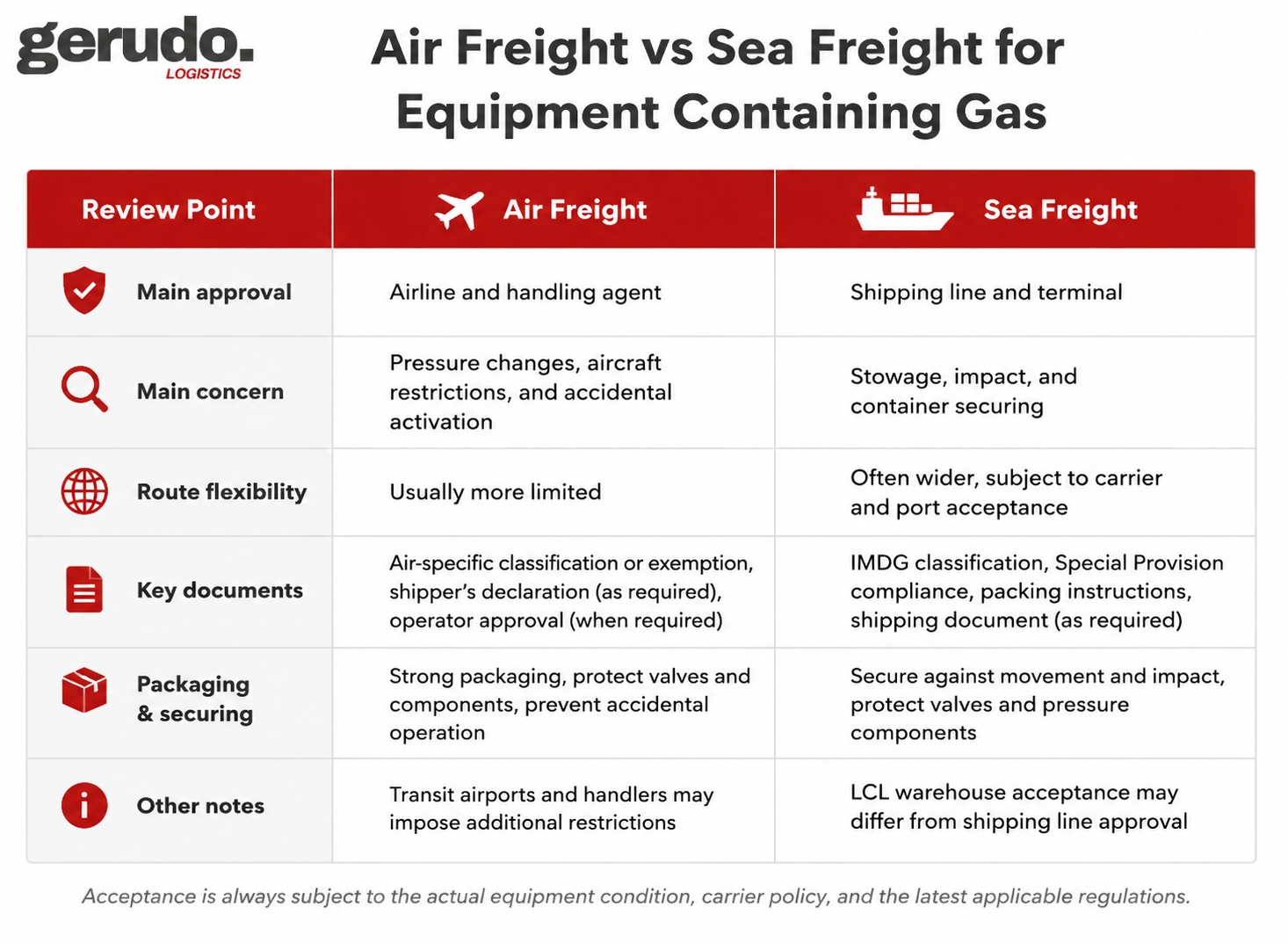
Air Freight vs Sea Freight for Equipment Containing Gas
Air and sea freight may produce different acceptance results for the same equipment. A classification or exemption document prepared for one method should not automatically be used for the other.
Air Freight for Equipment Containing Gas
Air freight places greater attention on pressure variation, temperature change, accidental activation, and aircraft restrictions.
The airline may request an air-specific transport assessment, additional technical evidence, or prior dangerous goods approval. Transit airports and handling agents can also impose restrictions after the origin station has reviewed the cargo.
Valves, switches, release devices, and control systems should be protected against accidental operation. Other regulated components inside the equipment, including batteries, require their own assessment.
Importers should request an air-specific conclusion before selecting air freight, even where the supplier already holds a sea transport report.
Sea Freight for Equipment Containing Gas
Sea freight uses the IMDG framework for classification, Special Provisions, packing, documentation, stowage, and segregation.
A shipping line may accept the equipment in a full container while an LCL warehouse refuses it. This often reflects warehouse capability, consolidation restrictions, and compatibility with other cargo.
The machine must be secured against movement and impact. Valves and exposed pressure components should remain protected throughout loading and transport.
FCL may offer more routing flexibility, but it does not change the cargo classification or remove dangerous goods declaration requirements. For LCL shipments, shipping line approval must also be followed by acceptance from the consolidation warehouse.
Documents Required to Ship Equipment Containing Gas
The supplier should provide enough information for a model-specific transport review.
Required Technical Information
The core file normally includes:
Product information: Exact model, function, dimensions, weight, photographs, and technical drawings.
Gas information: Gas or refrigerant name, composition, SDS, hazard classification, and quantity per unit.
Pressure and capacity data: Charge pressure, working pressure, test pressure, chamber capacity, and maximum permitted pressure.
Component information: Manufacturer, model, location, purpose, and removability of the pressure component.
Test evidence: Burst, leakage, fire, construction, or quality-control evidence required by the claimed provision.
Transport assessment: A mode-specific conclusion identifying the UN entry and any exemption basis.
Degassing evidence: Removal method, residual pressure, component condition, and supporting photographs.
Each document serves a different purpose. The gas file supports hazard identification, pressure and capacity data help assess an exemption, and the transport assessment supports the proposed shipping condition for the exact model.
SDS is the current term for Safety Data Sheet, although some suppliers still use MSDS. Either document describes the substance hazard. The finished equipment still requires a wider transport assessment.
How to Verify an Exemption Claim
Match the documents to the equipment. Confirm that the transport assessment, test evidence, and exemption statement cover the exact model, gas component, and final shipping configuration.
Compare the technical figures. Check that the gas, quantity, pressure, chamber capacity, and component details are consistent across the supplier’s documents.
Confirm the cited provision. Verify that the UN entry or Special Provision applies to the equipment’s function, gas, and design.
Check the transport method. Confirm that the assessment supports the planned air or sea route.
Obtain carrier approval before collection. Submit the complete file while the equipment remains at the factory and retain the written acceptance.
Keep the approved configuration unchanged. A different gas charge, pressure component, refrigerant, or equipment model may require a new assessment.
Common Reasons for Carrier Rejection
Carrier rejection often results from a small number of recurring problems:
Incomplete gas data: The exact gas, quantity, pressure, or chamber capacity is missing.
Incorrect exemption: A provision has been applied to the wrong equipment type.
Model mismatch: The report or test evidence covers another model.
Configuration mismatch: A removable component remains installed or the cargo differs from the reviewed design.
Wrong transport method: A sea freight conclusion is submitted for an air shipment.
Unverified degassing: The residual pressure or final component condition cannot be confirmed.
These issues are easier to resolve while the equipment remains at the factory. A late review can turn a document problem into a warehouse, storage, repacking, and return-transport problem.
How Professional Shipping Agent Handles Dangerous Goods Shipments from China
Gerudo Logistics is a dangerous goods specialist freight forwarder in China. Gerudo Logistics supports classification review, documentation, packing coordination, carrier communication, customs clearance, and international transport for dangerous goods in drums, IBCs, ISO tanks, machinery, and other approved cargo formats.
For equipment containing gas, Gerudo Logistics reviews the product specification, gas information, transport assessment, and proposed shipping condition before arranging the shipment. Once the cargo status and route are confirmed, our team can coordinate supplier pickup, multimodal transport, customs procedures, and final delivery.
Importers can contact Gerudo Logistics with the available technical documents for an initial review.
Frequently Asked Questions
Can equipment containing gas be shipped as general cargo?
Yes, when the exact equipment qualifies for an applicable exemption or has been properly degassed and accepted in that condition. A supplier’s general cargo statement alone is insufficient.
Can equipment containing gas be shipped by air from China?
Yes, some equipment containing gas can be shipped by air. The airline will usually require the exact gas, quantity, pressure, equipment design, and an air-specific classification or exemption basis.
Does equipment containing nitrogen need a dangerous goods declaration?
Nitrogen is generally a non-flammable, non-toxic Class 2.2 gas, but the classification of the finished equipment depends on the pressure component and applicable provision. A declaration may be unnecessary where the exact article satisfies a valid exemption.
Can gas springs and shock absorbers ship as general cargo?
Some products may qualify for an applicable exemption when the model meets the required pressure, capacity, construction, testing, and production conditions. The supplier must provide evidence covering the actual item being shipped.
Can an empty pressure component remain installed in the equipment?
Possibly, provided the supplier can prove that the component has been depressurised and no relevant hazardous residue remains. The carrier may request a degassing statement, photographs, pressure readings, or an updated transport assessment.
Can an air conditioner ship with refrigerant installed?
Yes, many factory-charged air conditioners can be shipped after the refrigerant, quantity, applicable UN entry, exemption status, and carrier acceptance have been confirmed. Equipment containing flammable refrigerant requires a different assessment from equipment containing Class 2.2 refrigerant.
Conclusion
Equipment containing gas should be assessed before the freight route is selected. The central question is whether the actual model falls under a regulated transport entry, satisfies an article-specific exemption, or needs to be degassed before shipment.
Where an exemption cannot be supported, the practical alternatives include dangerous goods transport, documented degassing, removal of the pressure component, or purchase of an uncharged version.
Early review reduces the risk of carrier rejection, warehouse delays, document amendments, and additional handling costs.