China to Middle East Shipping Costs in 2026: The Impact of the US-Iran Conflict
A container we shipped to the Gulf earlier this month came back with $3,000 in surcharges on top of the agreed freight rate — after the booking was confirmed and the cargo was already at port.
That figure has since moved higher. With Jebel Ali in the middle of its pre-Eid restocking rush and Gulf ports running reduced shifts through the Ramadan period, carriers handling last-minute bookings in March 2026 are quoting war risk charges approaching $4,000 per 40HQ. Shippers who locked their rates two weeks ago are in a materially different position from those still booking today.
Since the escalation of US-Iran tensions and the effective closure of the Strait of Hormuz to commercial traffic in early 2026, surcharges on China-to-Middle East lanes have become a standard line item — not an exception. The base rate your supplier quotes you is no longer what you will actually pay.
This article breaks down every surcharge category you may encounter, explains how each one is calculated, and gives you a realistic picture of total freight costs on this trade lane as of early 2026. Rates and conditions cited here reflect the current situation, which remains fluid.
Why China to Middle East Shipping Surcharges Spiked in 2026
The Strait of Hormuz is one of the most strategically critical shipping passages in the world. Approximately 20% of global oil trade and a significant share of container traffic to Gulf ports passes through it. When access becomes uncertain, the entire routing logic for Asia-to-Middle East shipping breaks down quickly.
Carriers responded to the 2026 disruption with a combination of:
Rerouting via the Cape of Good Hope, adding 20-25 days for Gulf-bound vessels that must circumnavigate the entire African continent before heading north through the Indian Ocean
Blank sailings on affected services, reducing available capacity
Carrier-imposed surcharges to cover increased operating costs and risk exposure
Tighter restrictions on DG and reefer acceptance on rerouted services
The result is a surcharge stack that, for some shipments, now exceeds the base ocean freight rate itself. Understanding what each component is — and why it exists — is the starting point for managing it.
China to Middle East Shipping Surcharges: What Each Line Item Means
Carriers do not absorb geopolitical risk. They price it, quickly, and pass it on. Most shippers are surprised to learn that carriers are fully entitled to do this under the terms they already agreed to.
The Liberty Clause (also called the Deviation Clause), standard in virtually every bill of lading, grants carriers the right to alter routes and delivery arrangements when the original routing becomes impractical or unsafe.
Most carriers have also invoked Force Majeure provisions citing the Strait of Hormuz situation, which releases them from standard service obligations. Together, these clauses mean a surcharge notice can arrive legally and legitimately after your container is already loaded.
Below are the main surcharge categories currently appearing on China-to-Middle East invoices.
War Risk Surcharge (WRS)
The War Risk Surcharge is applied when vessels are required to transit zones formally designated as conflict areas. The Lloyd's Joint War Committee (JWC) maintains a list of such zones; when a region is added, carriers immediately revise their surcharge schedules.
While WRS remains the most commonly used term, check your invoice carefully. As of late February 2026, major carriers including Maersk and MSC have begun issuing charges under alternative labels: CAC (Contingency Adjustment Charge) and TAD (Transit Additional — Destination). These umbrella terms bundle war risk premiums together with routing overhead costs into a single line item, which can make it harder to identify what you are actually paying for. If you see CAC or TAD on an invoice where you expected WRS, they are effectively the same charge under a different name.
Key points:
Quoted as a flat fee per TEU or FEU, or occasionally as a percentage of cargo value
Set independently by each carrier — rates vary and are not standardized
Applied regardless of whether your specific vessel actually transits the risk zone
On our recent Gulf shipment, the entire additional charge was WRS — no other surcharge category contributed to that figure
This surcharge moves fast. In active conflict scenarios, carriers have revised WRS rates within 24-48 hours of a JWC zone designation update.
Bunker Adjustment Factor (BAF)
The Bunker Adjustment Factor compensates carriers for fuel cost volatility. Under normal routing, a China-to-Gulf voyage covers approximately 6,000 nautical miles. The Cape of Good Hope alternative — circumnavigating Africa and crossing the full Indian Ocean — more than doubles that distance, which is why BAF has risen sharply alongside rerouting.
Key points:
Quoted per TEU, varies by carrier and trade lane
Increases proportionally when rerouting extends voyage distance
Some carriers split this into a base BAF plus a separate "rerouting fuel surcharge" — check your invoice carefully
BAF does not require a conflict zone designation to be applied. As long as rerouting is in effect, elevated BAF charges will appear.
Peak Season Surcharge (PSS)
The Peak Season Surcharge is a demand-driven fee. Carriers apply it when booking volumes on a trade lane exceed available capacity — which is exactly what happens when blank sailings reduce supply while demand holds steady.
Key points:
Not universally applied; varies by carrier and service
Compounds with WRS and BAF when applied simultaneously
Worth checking whether your preferred carrier has PSS active before booking
PSS is one of the more negotiable surcharges for shippers with regular volume commitments, though not during the acute phase of a disruption.
Emergency / Rerouting Surcharge
This appears under different names across carrier invoices: Emergency Bunker Surcharge (EBS), Emergency Risk Surcharge (ERS), or simply Rerouting Surcharge. It is distinct from BAF in most cases.
Key points:
Covers operational costs beyond fuel — port change fees, schedule disruption costs, additional handling at alternate ports
Not always clearly itemized; sometimes bundled into a generic "emergency surcharge" line
Ask your freight forwarder to identify each line item separately — vague surcharge bundling is common during disruptions
Port Congestion Surcharge
As traffic reroutes away from Hormuz-dependent ports, alternate hubs absorb increased volume. Ports including Jebel Ali (UAE), Salalah (Oman), and Sohar (Oman) have seen congestion build since the disruption began.
The situation is further complicated by the Ramadan-to-Eid transition in March 2026, where reduced port operating hours are clashing with a backlog of rerouted cargo. Pre-Eid restocking demand typically drives a surge in inbound volumes at Gulf ports; this year that surge is arriving on top of already-congested facilities operating at reduced shift capacity during the fasting period.
Key points:
Applied by carriers at affected ports, typically per container
Duration is unpredictable — can last weeks or months depending on how long rerouting remains in place
May also apply at origin ports in China if vessel scheduling is disrupted
Middle East Freight Surcharge Rates at a Glance
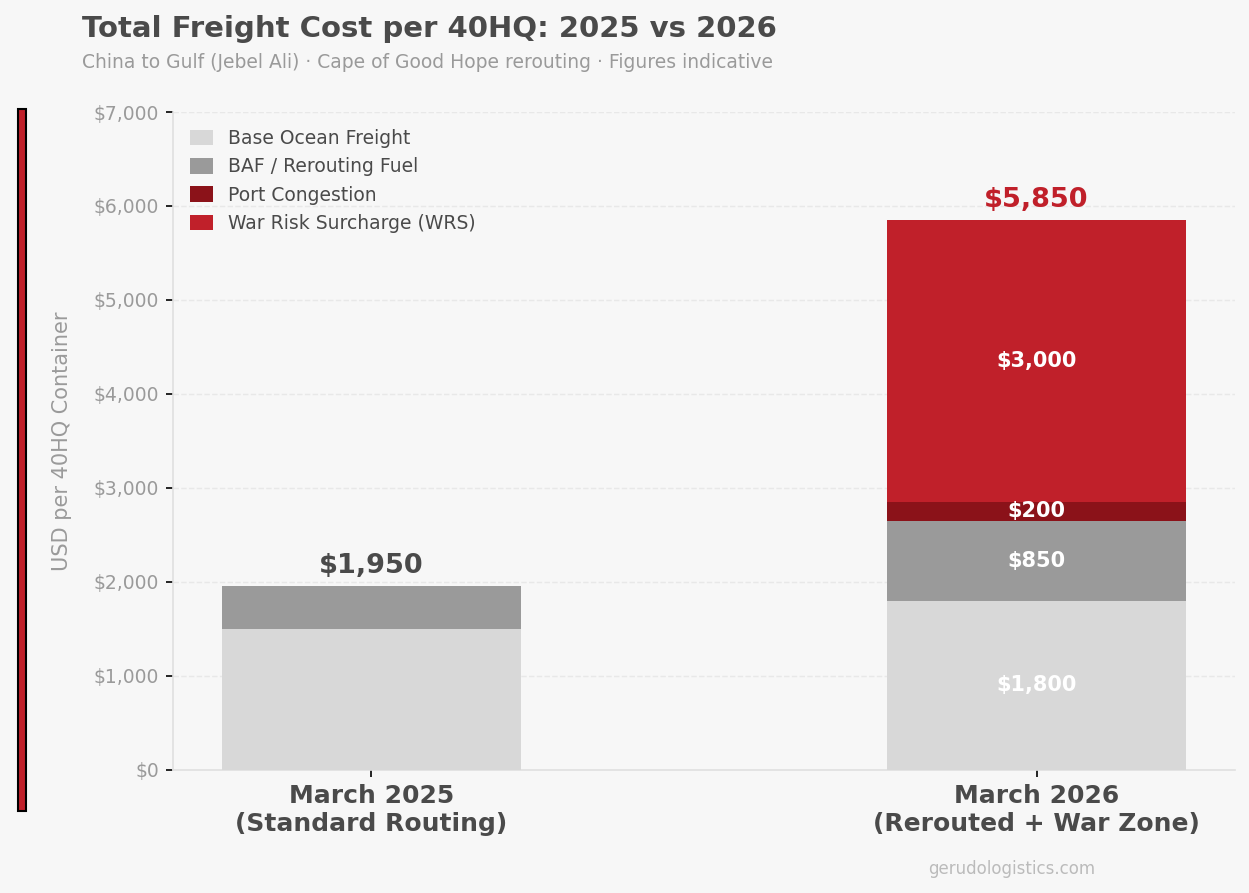
Ranges are indicative as of early 2026 and subject to change. Confirm current rates with your freight forwarder before booking.
Total Freight Cost Breakdown: China to Middle East in 2026
The table below illustrates the scale of the shift on a standard 40HQ container, using representative figures for a China-to-Gulf booking.
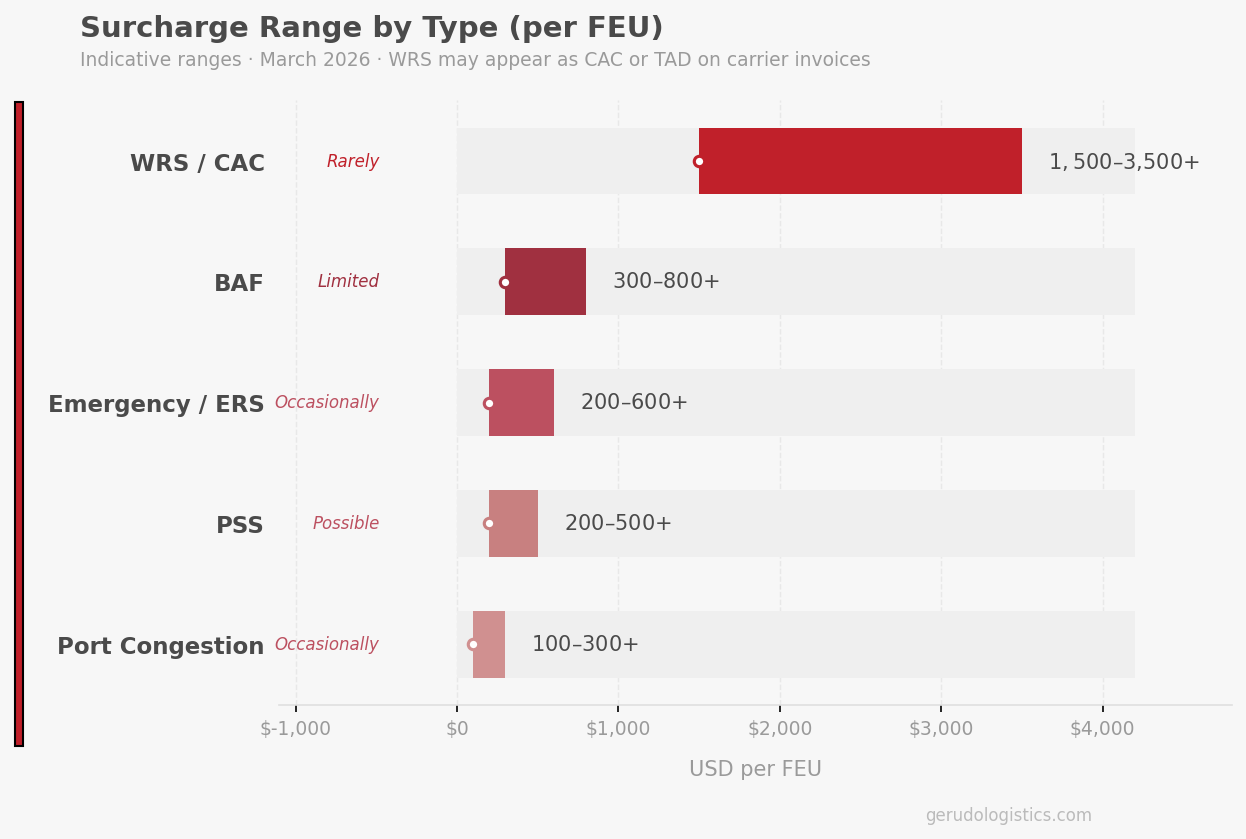
Figures are illustrative, based on current market ranges. Actual rates vary by carrier, port pair, and cargo type.
To put this in context: on a $30,000 cargo value, total freight as a percentage of goods value has shifted from roughly 6% to nearly 20%. For importers operating on thin margins, that difference is not an inconvenience — it directly affects landed cost calculations, pricing decisions, and contract viability.
A shipment that previously cost $1,500 to move could now land between $4,000 and $7,000 or more in total freight, before local delivery, customs, and insurance.
LCL shippers are often hit proportionally harder. Surcharges are frequently calculated per shipment or per container regardless of volume, meaning a 2 CBM LCL booking can absorb the same WRS as a full container.
DG and Reefer Cargo: Higher Surcharge Exposure on Rerouted Services
Standard dry cargo and specialist cargo do not face identical surcharge structures. If you are moving Dangerous Goods or temperature-controlled shipments to the Gulf, the numbers in the previous section understate your actual exposure.
Dangerous Goods:
WRS for DG cargo is not applied at the same rate as dry cargo. During active conflict periods, carriers apply a tiered surcharge structure — DG shipments attract a premium on top of the standard WRS due to higher insurance liability in conflict-adjacent zones. In practice, this can mean the WRS for a DG container approaches double the figure quoted for equivalent dry cargo
Some carriers have suspended DG acceptance on rerouted services entirely, concentrating remaining demand onto fewer carriers and removing competitive pressure on pricing
In our experience, carrier selectivity on DG increases significantly during high-risk periods — shippers without relationships across multiple DG-approved carriers find their options narrow quickly at the worst possible moment
Confirm DG acceptance and the full surcharge breakdown with your forwarder before booking, not after
The rerouting adds significantly more sea time for Gulf-bound vessels than most shippers expect. The direct cost impact includes higher power consumption for refrigerated containers — but this is only part of the picture
The less-discussed cost is working capital: 14 additional days in transit means 14 additional days before the goods clear customs, reach the buyer, and trigger payment. For importers running on letters of credit or with inventory financing in place, that extension has a measurable cost of its own
Extended transit also raises the probability of temperature excursion, which needs to be assessed against the specific product's tolerance window before confirming a booking
Reefer surcharges are already higher than dry cargo under normal conditions; the current environment adds further pressure on top of that baseline
The surcharge table earlier in this article reflects standard dry cargo ranges. DG and reefer shippers should treat those figures as a floor, not a ceiling, and verify current rates on a per-shipment basis.
Can You Negotiate Middle East Shipping Surcharges?
The honest answer: most surcharges are non-negotiable during the acute phase of a disruption. WRS in particular reflects carrier insurance costs, which are externally determined. Asking a carrier to waive WRS during an active conflict zone designation is not a productive conversation.
What may be negotiable or manageable:
Timing: If your cargo is not time-sensitive, waiting for surcharge levels to stabilize may reduce costs. Rates fluctuated significantly week-to-week in early 2026.
Contract rates vs. spot rates: Shippers with existing volume contracts may have some surcharge caps built in. Review your contract terms.
Carrier selection: WRS and BAF vary between carriers on the same trade lane. Getting quotes from three or more carriers often reveals a $500-$1,000 spread on the same surcharge categories.
Booking lead time: Surcharge rates are typically locked at time of booking, not at time of shipment or BL issuance. Confirm which date applies with your forwarder.
Air freight as an alternative: For high-value, compact cargo, current air freight rates to the Middle East may be competitive when compared against sea freight plus the full surcharge stack. This is worth calculating, not assuming.
Rail via Central Asia: Some shippers in 2026 have begun exploring China-Central Asia rail connections into Iran and Iraq as a way to bypass sea freight surcharges entirely. Capacity on these corridors is limited and transit reliability varies, but it is a viable option worth assessing for certain cargo types and destinations — particularly for non-hazardous dry cargo with flexible lead times.
What to ask your freight forwarder specifically:
Are surcharges locked at booking or at BL date?
Which carriers currently accept DG or reefer on rerouted Middle East services?
Is there a validity window on the quoted surcharge rates?
Can I see the surcharge itemized by type, not bundled?
How Gerudo Logistics Handles Shipments During Geopolitical Disruptions
On a recent Gulf shipment, the WRS appeared after booking was confirmed. The client was notified before the container was loaded — not after the fact.
Our approach during active disruptions:
Surcharge transparency: We itemize every surcharge by type and provide the carrier's surcharge notice as documentation
Multi-carrier access: We check rates and acceptance conditions across multiple carriers before recommending a booking, which is particularly important for DG and reefer cargo where not all carriers are currently accepting
Routing assessment: For reefer shipments, we assess whether Cape of Good Hope transit times are within the acceptable window for the specific product before confirming the booking
Proactive updates: When surcharge schedules are revised mid-shipment, we notify clients immediately with the revised cost projection
We handle DG and temperature-controlled cargo to the Middle East from Guangzhou, Shenzhen, Shanghai, Ningbo, Qingdao, and Dalian. If you are working through the cost impact of current surcharges on your shipments, contact our logistics specialist for a current landed-cost breakdown.
Frequently Asked Questions About Middle East Shipping Surcharges
What is a War Risk Surcharge in shipping?
A fee applied by carriers when vessels operate near zones designated as conflict areas by the Lloyd's Joint War Committee. Quoted as a flat fee per TEU or FEU, set independently by each carrier, and can be revised within 24-48 hours of a zone update. Also appearing on invoices as CAC or TAD in 2026.
Why has shipping from China to the Middle East become more expensive in 2026?
The Strait of Hormuz disruption forced carriers to reroute via Cape of Good Hope, more than doubling voyage distance and pushing up fuel costs. Combined with war risk surcharges and blank sailings reducing available capacity, total freight on this trade lane has roughly tripled versus pre-disruption levels.
How long will these surcharges remain in place?
Difficult to predict. Carriers tend to be slow to remove surcharges even after conditions improve. Planning for elevated costs through mid-2026 is prudent, though the situation could shift in either direction as the geopolitical environment develops.
Are DG shipments affected differently by current Middle East surcharges?
Yes. DG cargo attracts a higher WRS tier due to carrier liability exposure, which can approach double the rate for equivalent dry cargo. Some carriers have also suspended DG acceptance on rerouted services entirely, reducing your booking options and removing competitive pressure on pricing.
Can I get a fixed rate that includes all surcharges?
Some forwarders can lock a total rate inclusive of surcharges at booking, but this is not universally available during active disruptions. Ask specifically whether the quoted rate covers all current surcharges and confirm the validity window — surcharge levels on this lane have moved week to week.
Conclusion
A war risk surcharge exceeding $3,000 per container is not an extreme case on this trade lane right now.
The key takeaways:
Get surcharges itemized before confirming any booking, not after
LCL shippers should calculate per-CBM surcharge impact carefully — the numbers can be disproportionate
DG and reefer cargo require additional carrier vetting given current acceptance restrictions
Booking lead time affects which surcharge rate applies — confirm the lock date with your forwarder
Conditions may ease if the geopolitical situation stabilizes, but consult and book early rather than waiting for rates that may not materialize
For a current landed-cost breakdown on your specific cargo, contact Gerudo Logistics directly.