EU Battery Regulation 2026: China Shipping Compliance Guide
A battery shipment can be refused before it leaves China - over a missing document, an incorrect UN number, or a carrier that won't accept your battery type. It can also be stopped at EU entry after three weeks at sea, over a label that does not meet the August 18 requirements.
In 2026, both scenarios are more likely than they were 18 months ago. New EU requirements are already active, two more deadlines arrive before year-end, and a major structural change is nine months out.
This article covers the four most common failure points for battery cargo on the China-Europe trade lane, what each one costs you when it hits, and the specific steps that prevent it.
Current Challenges Battery Shipments from China
The challenges below are not theoretical risks. They are the most common reasons battery shipments from China stall - either at the Chinese port before the vessel sails, or at EU entry after weeks in transit.
1. Incomplete or incorrect documents get cargo refused at loading
Battery cargo has always required a full DG document set. From early 2026, that set is longer. Industrial batteries above 2 kWh - ESS units, BESS systems, and large battery modules - now need a verified carbon footprint declaration included as a physical document in the shipment. This is not filed separately at customs.
It goes in the same package as the DG declaration, UN38.3 test summary, Safety Data Sheet, packing certificate, and IMDG manifest.
If the carbon footprint declaration is missing at the Chinese export port, Class 9 DG cargo is refused loading. The carrier will not hold the vessel while the document is retrieved.
The same applies to UN classification errors. An ESS unit wrongly declared as UN 3481 instead of UN 3480 - or a vehicle battery under the wrong UN number - gives the carrier grounds to reject the consignment before it sails.
How to handle it:
Run a document audit before placing the booking - not at packing time, not at port
Confirm the carbon footprint declaration is ready and will be physically included in the shipment package
Confirm the UN number against the actual product spec on each booking - watt-hour ratings and packaging configurations can change the applicable transport rules
2. Carrier acceptance for battery cargo is not automatic
Booking freight space and getting confirmed carrier acceptance are two different things for Class 9 battery cargo. Each carrier sets its own limits on battery watt-hour capacity, stowage position, and chemistry type - and those limits can change between sailings without warning.
For ESS units, EV battery packs, and high-capacity eBike batteries, a last-minute refusal at a Chinese port means the importer absorbs demurrage, rerouting costs, and a delayed shipment.
A verbal confirmation from a carrier representative is not enough - acceptance rules can differ between vessels operated by the same line, and battery cargo acceptance has become one of the areas where carriers exercise the most discretion.
How to handle it:
Before goods move from factory to port, get written carrier acceptance that states the vessel, stowage category, watt-hour limits, and any conditions specific to your cargo
Do this at every booking, not just with new carriers - criteria shift between shipments
Work with a freight forwarder that has active carrier relationships for large-format lithium battery cargo on the China-Europe route and can confirm acceptance in writing before goods move
3. Non-compliant labels and no EU legal structure block market entry
From August 18, 2026, all batteries placed on the EU market must carry expanded labels showing: battery chemistry, weight, capacity, manufacturer name, manufacturing date, and hazardous substances above 0.1% by weight.
These labels must be on the battery and on any packaging before goods leave China. There is no way to relabel at a European port. Cargo arriving after August 18 without compliant labels may be detained, ordered off the market, or returned.
Beyond labeling, every Chinese manufacturer placing batteries on the EU market needs an EU Authorized Representative - a legal entity in the EU that holds the compliance documentation and takes on legal liability.
For importers selling into the EU under their own brand, this obligation falls on them directly. Without a proper AR in place, there is no legal anchor in the EU when authorities raise a query. A customs broker cannot fix this.
How to handle it:
Run a label audit at least six weeks before the loading date - request a physical sample from your supplier and check it field by field against the August 18 requirements
Six weeks gives time to revise, reprint, and approve; checking at packing stage does not
Appoint an EU AR as part of standard market entry for any battery product line - not as a reactive step after a compliance query arrives
4. The Digital Battery Passport window is closing
From February 18, 2027, EV batteries, LMT batteries (eBikes, e-scooters), and industrial batteries above 2 kWh must each carry a Digital Battery Passport accessible via QR code.
The passport covers around 90 data points: battery chemistry, carbon footprint per factory, recycled material percentages, performance test results, and full supply chain origin data. Building the system to generate and manage this typically takes 12 to 18 months.
For importers whose orders run into 2027, that window has already started. A shipment that clears EU entry in December 2026 may face refusal at the same border point in March 2027 if the passport infrastructure is not running.
How to handle it:
Map which of the required data points your supply chain can already provide - and where the gaps are
Talk to your Chinese suppliers now about data availability: carbon footprint per factory, material origin records, and recycled content verification all take time to gather and verify
Select a data platform and begin integration with your supply chain - most companies building this for the first time report 12 to 18 months to get it working reliably
If your forward orders run into Q1 2027, the build needs to start immediately
Pre-Shipment Checklist for Lithium Battery to Europe
Each problem above has a fixed point in the shipping timeline where it can be caught and resolved. Miss that point and it becomes a port hold or a market access problem at destination. The three stages below map the right action to the right time.
Most of the issues that cause delays are visible and fixable at Stage 1 or Stage 2 - they only become expensive at Stage 3 or after.
Applies to battery shipments from China to Europe from mid-2026 onwards.
Six Weeks Before Loading - Label and Compliance Audit
Label audit completed: chemistry, weight, capacity, manufacturer, manufacturing date, hazardous substance disclosures
Revised label sample reviewed and approved by supplier
EU Authorized Representative confirmed in place and holding current technical file
EPR registration confirmed in each destination EU member state
For industrial batteries above 2 kWh: carbon footprint declaration confirmed available, EU-methodology compliant, and facility-specific
Before Booking - Documents and Carrier Confirmation
Battery category and UN number confirmed against actual product specification
Written carrier acceptance obtained: vessel, stowage category, watt-hour limits, and any cargo conditions confirmed
UN38.3 test summary current and on file
Safety Data Sheet accurate and up to date
DG declaration prepared with correct UN number, proper shipping name, and packing group
At Loading - Document Package and SOC
State of charge reduced to transport-safe level (typically 30% or below for large-format batteries; confirm the exact threshold with the carrier)
Physical document package complete: DG declaration, UN38.3, Safety Data Sheet, IMDG manifest, packing certificate, and carbon footprint declaration where required
Bill of Lading and packing list verified against the DG declaration
Container sealed with document package inside
To have your document set reviewed before the next consignment departs, contact Gerudo Logistics team.
EU Battery Regulation 2026: Compliance Deadlines by Battery Type
EU rules apply differently depending on the battery type. The category your product falls into determines which documents you need, which deadlines apply, and how much time you have to prepare.
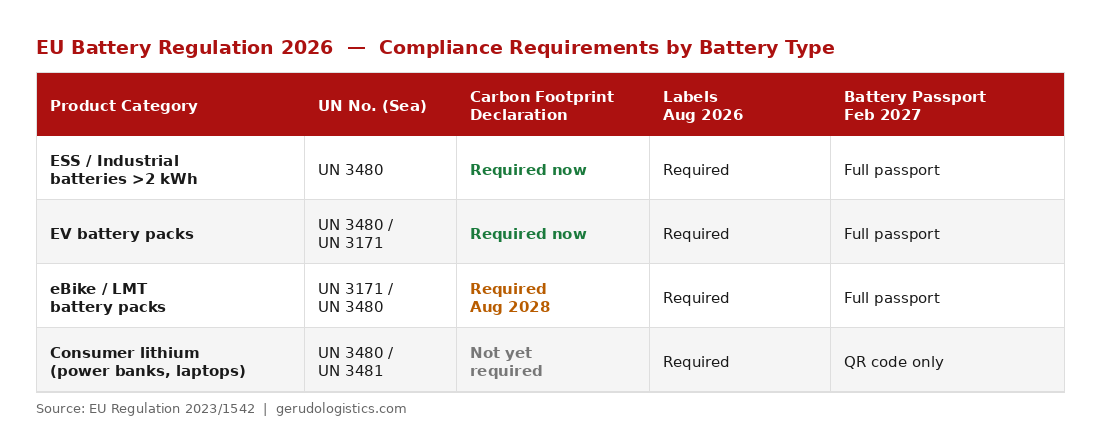
ESS and BESS units face the most demanding combination. They require the carbon footprint declaration to travel with each shipment now, on top of the existing DG document set.
Sea freight rules for large-format lithium batteries also limit which carriers will accept them and under what conditions - some apply stricter watt-hour limits to stationary storage units than to EV battery packs.
An ESS consignment without both the full DG set and the carbon footprint declaration faces rejection at two separate stages.
eBike and LMT battery packs do not need the carbon footprint declaration until August 2028, but the August 2026 labeling deadline applies in full.
Also confirm whether batteries are shipping as standalone units (UN 3480) or already installed in vehicles (UN 3171) - this changes the carrier acceptance rules, stowage requirements, and the documents required.
Getting this wrong is one of the more common classification errors on eBike shipments, and it creates the same outcome as any other UN mismatch: refusal at loading or customs examination at destination.
Consumer lithium batteries have a lighter compliance load for now. The full Digital Battery Passport does not apply - only a QR code from February 2027. Even so, UN38.3 test documentation, correct UN classification, and IMDG compliance are mandatory on every shipment.
The August 2026 labeling requirements also apply in full - chemistry, weight, capacity, manufacturer, manufacturing date, and hazardous substance disclosures must all be present.
For importers treating consumer lithium as lower risk than industrial categories, the August 18 labeling deadline is the point where that assumption needs to be checked.
Shipping Batteries from China to Europe with a DG Specialist
Every decision point that determines whether a battery shipment clears China and enters Europe cleanly - document completeness, carrier acceptance, label compliance, SOC, UN classification - happens before loading. A freight forwarder that gets involved only after a booking is confirmed is already past the point where most problems can be caught.
At Gerudo Logistics, we handle battery cargo across all product categories - consumer electronics and power banks, eBike and LMT battery packs, ESS and BESS units, and new energy vehicle components - through our China-side operations in Shenzhen, Shanghai, Ningbo, Qingdao, Guangzhou, and Dalian.
This covers both the DG transport requirements and the pre-shipment compliance steps that have become essential for battery cargo moving to Europe.
In our experience, the shipments that end up held at European ports follow a consistent pattern: the documentation or label problem was present well before the vessel sailed and was not caught before loading. Pre-shipment document checks, written carrier acceptance confirmation, and label verification are how we handle battery cargo as a standard part of the service.
Frequently Asked Questions About Shipping Batteries to Europe
Does the carbon footprint declaration apply to all the batteries I ship from China?
As of mid-2026, it applies to industrial batteries above 2 kWh and EV batteries. eBike packs and consumer batteries are not yet in scope. Check your category against the table above.
My carrier says they accept lithium batteries. Does that cover ESS units?
General lithium battery acceptance often excludes large-format industrial batteries due to watt-hour limits. For ESS units, get written confirmation against the specific watt-hour rating, stowage category, and vessel name - not as a general cargo type.
What UN number applies to ESS units shipped by sea?
Most ESS products ship as UN 3480 (lithium-ion batteries, Class 9). Batteries inside equipment may classify as UN 3481. Large-format batteries may also trigger extra sea freight rules that change stowage and carrier acceptance. Confirm against your actual product spec before booking.
Do eBike battery packs need the August 2026 labels?
Yes - the August 18, 2026 labeling requirements apply to all battery categories, including LMT. The carbon footprint declaration for eBike batteries does not start until August 2028, but correct labeling is required now.
If cargo is held at a European port due to a label error, can Gerudo assist?
Once cargo is held for a labeling issue, the options are limited - relabeling in a bonded warehouse, return to origin, or seizure. All are costly. In our experience, catching label issues before loading is where the real value is. [Contact our team] to talk through pre-departure checks.
Is the Digital Battery Passport required for power banks?
No - portable batteries need only a QR code linking to product data from February 2027, not a full passport. The full passport applies to EV batteries, LMT batteries, and industrial batteries above 2 kWh.
Conclusion
The China-to-Europe battery trade lane is busier than ever - and more compliance-intensive than it was 18 months ago.
The carbon footprint declaration is now active for industrial batteries.
The August labeling deadline is three months out.
The Digital Battery Passport arrives in February 2027 and the infrastructure to support it needs to be running before then.
None of these are future planning items for importers managing active shipments.
The problems that stop battery cargo - document gaps, label issues, carrier mismatches - are all catchable before loading. They are much harder to fix after the vessel sails. A DG specialist freight forwarder that manages pre-shipment compliance as part of the service is the practical way to keep shipments moving.