Ship Battery-Powered Products from China via Hong Kong: Step-by-Step Guide
We recently handled a toy shipment from China to the USA that had been booked as general cargo. During the final cargo check, the importer discovered that several toy models contained lithium batteries. The original mainland air route required additional transport identification documents, and there was no time to obtain them before the planned departure.
The shipment moved through Hong Kong after a new document review confirmed that the products, batteries, packing, and selected flight could be accepted. Hong Kong provided a workable alternative route because its cargo acceptance process differed from the original mainland booking. All applicable battery safety and air transport requirements still applied.
This guide follows the complete shipment process from the mainland supplier to the Hong Kong warehouse, airline departure, destination customs clearance, and final delivery. It also explains how to track each stage.
Shipping Battery-Powered Products via Hong Kong at a Glance
Shipping via Hong Kong can help when a mainland air route cannot accept the cargo within the required schedule. The exact battery configuration and carrier acceptance must be confirmed first.
Best use case: A time-sensitive shipment is delayed by a document or carrier acceptance issue on the planned mainland route.
Typical route: Supplier pickup in mainland China, cross-border transport, Hong Kong warehouse review, departure from Hong Kong International Airport, destination clearance, and final delivery.
Main requirement: The product, battery, packing, and available safety records must be reviewed before pickup.
Tracking references: The pickup reference, house air waybill, master air waybill, and destination delivery number cover different parts of the journey.
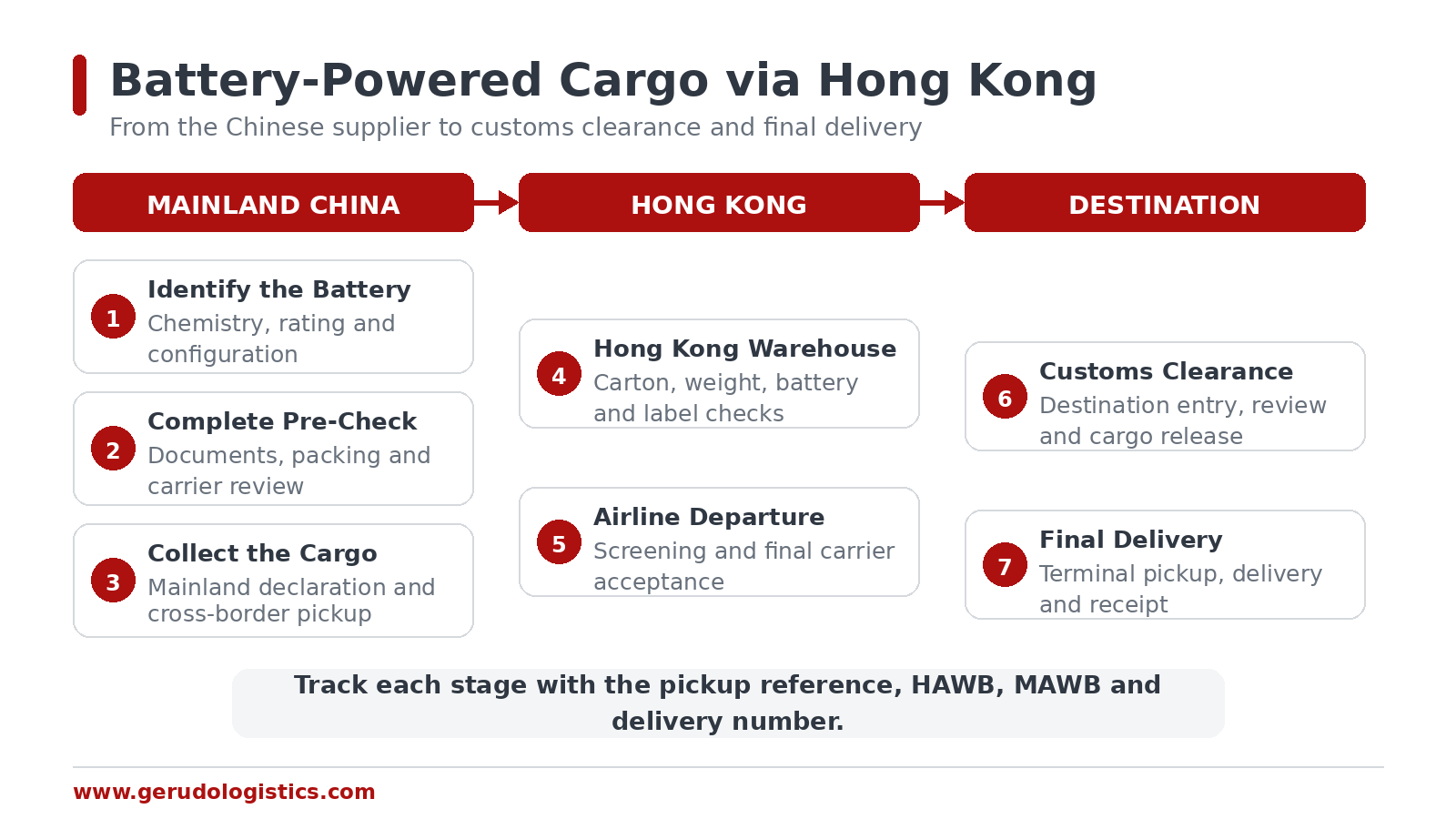
Step 1: Identify Every Product That Contains a Battery
Start with the product list rather than the booking form. One battery-powered SKU can change the treatment of the whole consignment, even when most cartons contain ordinary toys, electronics, or household products.
Collect the following battery details for every model:
Battery chemistry: Lithium ion, lithium metal, sodium ion, nickel-metal hydride, alkaline, lead acid, or another type.
Shipping configuration: Battery installed in equipment, packed in the same box with equipment, or shipped separately.
Battery rating: Watt-hour rating for rechargeable lithium batteries or lithium content for lithium metal batteries.
Quantity: Number of cells or batteries in each product, package, and shipment.
Battery identity: Manufacturer, model number, and any specification reference shown on the battery.
Safety status: Confirmation that the batteries are undamaged, free from swelling, and outside any safety recall.
Available evidence: UN38.3 test summary for lithium batteries, product specification, and other records requested for the route.
Include clear cargo photos of the product, battery, inner packing, closed carton, and applied marks. A description such as “electronic toy” provides too little information for an assessment.
Battery chemistry and configuration determine the transport entry and packing instruction. The existing guide to shipping batteries from China by product type explains these differences in more detail.
Stop if the battery cannot be identified or reliable specifications are unavailable. A Hong Kong route cannot correct an unknown battery classification.
Step 2: Submit the Shipment Details for Hong Kong Pre-Checking
Send the shipment file before the cargo leaves the factory. Pre-checking establishes whether a specific Hong Kong air cargo channel can review the shipment, which documents are missing, and whether the schedule is realistic.
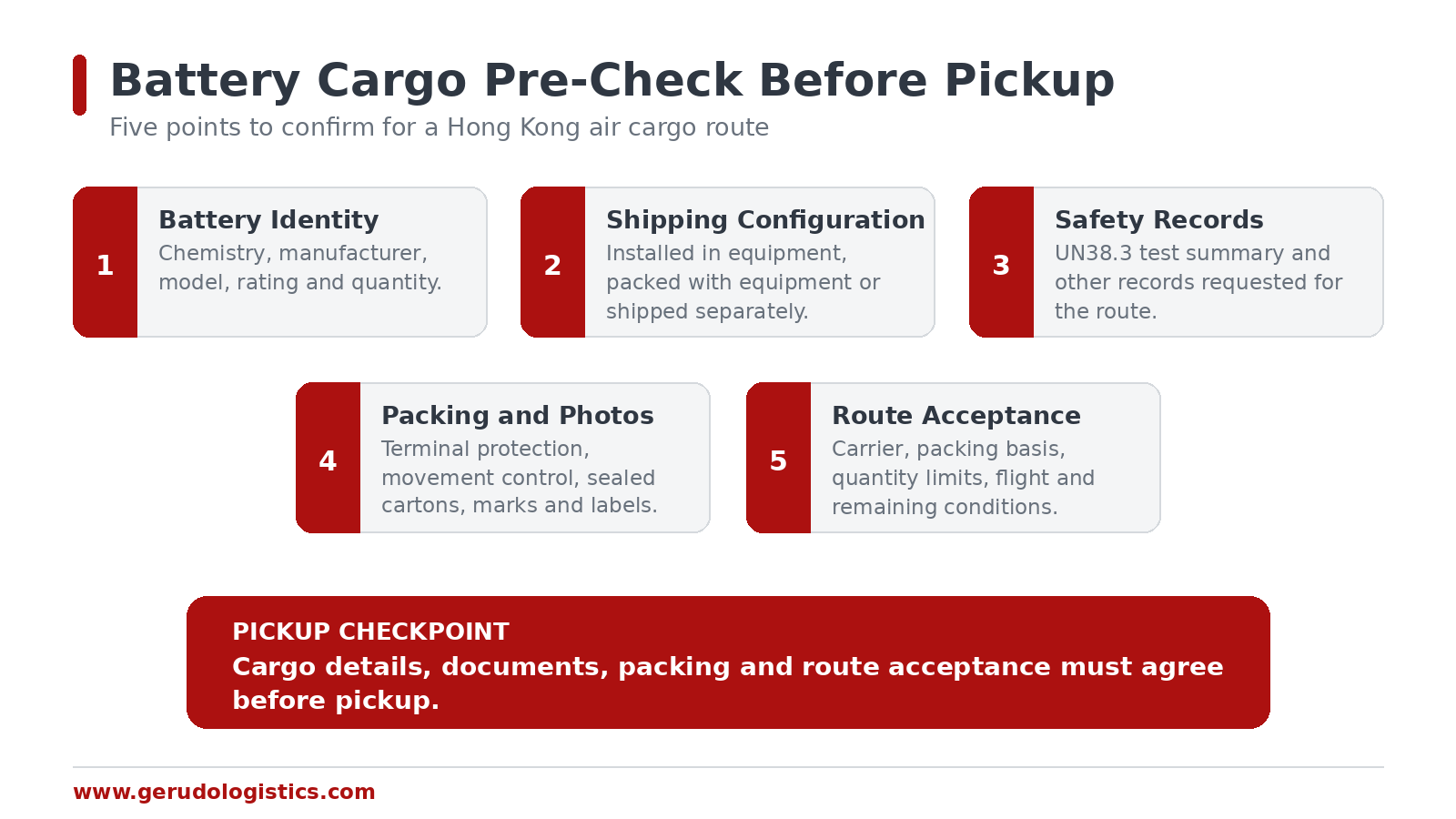
Documents to Send for Pre-Checking
The first submission normally includes:
Commercial invoice draft: Product descriptions, quantities, values, seller, and buyer details.
Packing list draft: Carton count, gross weight, net weight, dimensions, and total volume.
Battery information: Chemistry, configuration, rating, quantity, manufacturer, and model.
UN38.3 test summary: The test summary that corresponds to the lithium cell or battery model in the goods.
Product specification: Technical sheet or manual connecting the finished product to the stated battery.
Cargo photos: Product, battery, internal protection, outer carton, and existing marks or labels.
Earlier classification records: Any transport identification report, SDS, or carrier assessment already obtained.
Route information: Supplier address, cargo-ready date, destination airport, and required delivery date.
An accurate SDS can support the review. Other evidence depends on the battery type, rating, configuration, and carrier.
What the Pre-Check Must Confirm
The pre-check result must identify the accepted cargo description and battery configuration. A general reply stating that battery cargo can move from Hong Kong provides no protection against rejection after pickup.
Confirm the following points:
Proposed transport entry: The battery description and applicable UN number where the goods are regulated.
Packing basis: The packaging, terminal protection, movement control, and activation protection expected for the product.
Marks and labels: The marks or labels required for the packed configuration and selected air service.
Document status: Which records are accepted, which need correction, and which remain outstanding.
Carrier acceptance: Whether the review applies to a named airline or handling channel and the proposed route.
Remaining conditions: Quantity limits, aircraft restrictions, transshipment limitations, or destination conditions.
Hong Kong air cargo channels follow dangerous goods requirements and their own acceptance procedures. In our experience, some channels can assess battery-powered products without the same locally issued transport identification document used by the original mainland route. The exact requirement depends on the cargo and carrier.
Final acceptance still depends on the physical cargo, final paperwork, and inspection in Hong Kong.
Checkpoint: The route-specific document requirements and all remaining acceptance conditions are clear.
Step 3: Confirm the Route, Acceptance Basis, and Full Quote
Choose the route only after the pre-check result is clear. A freight quotation has limited value without a confirmed battery acceptance basis, because a low air rate cannot move cargo that the airline later refuses.
The quotation needs to cover the complete movement:
Mainland pickup: Collection from the supplier and any waiting or loading charge.
Cross-border transport: Movement from mainland China to the nominated Hong Kong warehouse.
Warehouse handling: Receiving, weighing, measuring, inspection, and any approved repacking or relabeling.
Air cargo charges: Chargeable weight, airport fees, security screening, and applicable dangerous goods handling.
Documentation charges: Review, declaration, or processing services included in the route.
Destination charges: Customs brokerage, terminal handling, storage, and final delivery where included.
Exclusions: Duties, taxes, inspections, demurrage, storage, and other charges outside the quoted scope.
The confirmed routing details must include the airline or service type, transit points, and expected flight window. A description such as “Hong Kong to USA” is too broad for a time-sensitive booking.
The Hong Kong option adds cross-border transport and another warehouse handover. Compare this added time with the mainland wait, using the required arrival date as the decision point.
Separate regulatory requirements from airline policy when reviewing the proposed route. The guide to choosing a dangerous goods freight forwarder in China provides the acceptance questions to use before confirming a provider.
Step 4: Prepare the Cargo and Final Shipping Documents
Finalize the packing instructions only after the route has been reviewed. The finished cartons must match the information submitted during pre-checking, including the product model, battery quantity, package count, and gross weight.
Complete the following packing checks:
Terminal protection: Exposed battery terminals are covered or otherwise protected from short circuit.
Movement control: The product and any separately packed battery cannot move freely inside the carton.
Activation protection: Switches, buttons, or controls cannot turn the device on during handling.
Damage prevention: The inner and outer packing protect the battery from crushing, impact, and puncture.
Carton condition: Each outer package is dry, rigid, and free from damage.
Marks and labels: Required marks and labels are correct, visible, and placed on a suitable surface.
Damaged, defective, swollen, or recalled batteries require a separate route assessment because their acceptance conditions differ from ordinary production batteries.
The commercial invoice and packing list must describe the actual goods. Keep product names, model numbers, carton quantities, weights, and consignee information consistent across the invoice, packing list, air waybill instructions, and battery records.
Prepare a final photo set before pickup. It needs to show the product, battery identification, inner protection, each side of the sealed carton, and every visible mark or label.
Checkpoint: The physical cargo, final documents, and approved pre-check information match each other.
Step 5: Move the Cargo from Mainland China to Hong Kong
Arrange pickup after the Hong Kong route and final packing have been accepted for movement. Sending the truck too early transfers the problem to a warehouse and can create waiting, return, or storage charges.
The mainland customs declaration and cross-border submission must use accurate cargo data. The truck schedule, declaration references, and Hong Kong receiving appointment must align.
Since May 1, 2026, Hong Kong’s Trade Single Window has handled the road cargo advance information service previously provided through ROCARS. Correct cargo data must be available before submission.
Routing Chinese-made goods through Hong Kong does not by itself change their country of origin. The invoice, customs entry, and product marking must continue to use the origin determined by the applicable destination rules.
Tracking at this stage normally comes from the pickup or cross-border reference. An airline tracking page will show no useful movement before the shipment enters the Hong Kong air cargo process.
Step 6: Complete the Hong Kong Warehouse and Airline Acceptance
At the Hong Kong warehouse, the cargo is checked against the pre-approved information. Weight, packing, or labeling differences can stop the planned flight.
The Hong Kong warehouse review normally covers:
Piece count: The received carton quantity matches the packing list.
Weight and dimensions: Actual measurements remain within the booked cargo details.
Packing condition: Cartons, inner protection, and battery restraint remain intact.
Battery condition: There is no visible swelling, leakage, damage, or sign of a recall issue.
Marks and labels: Required information is present, legible, and consistent with the approved configuration.
Document consistency: Product descriptions, battery data, quantities, and shipment references agree.
Report any difference before terminal delivery. A label correction can require another review, while a different battery model can change the acceptance decision.
After the warehouse review, the shipment proceeds to security screening and airline acceptance. The master air waybill becomes the main reference once the cargo enters the carrier’s system.
Checkpoint: The cargo has passed the required Hong Kong checks and the accepted flight movement is confirmed.
Step 7: Track the Shipment from Hong Kong to the Final Destination
To track shipping from China via Hong Kong, use the reference connected to the current transport stage. One number rarely covers supplier pickup, the airline movement, customs clearance, and final delivery.
Which Tracking Number to Use
Each tracking reference becomes active at a different stage.
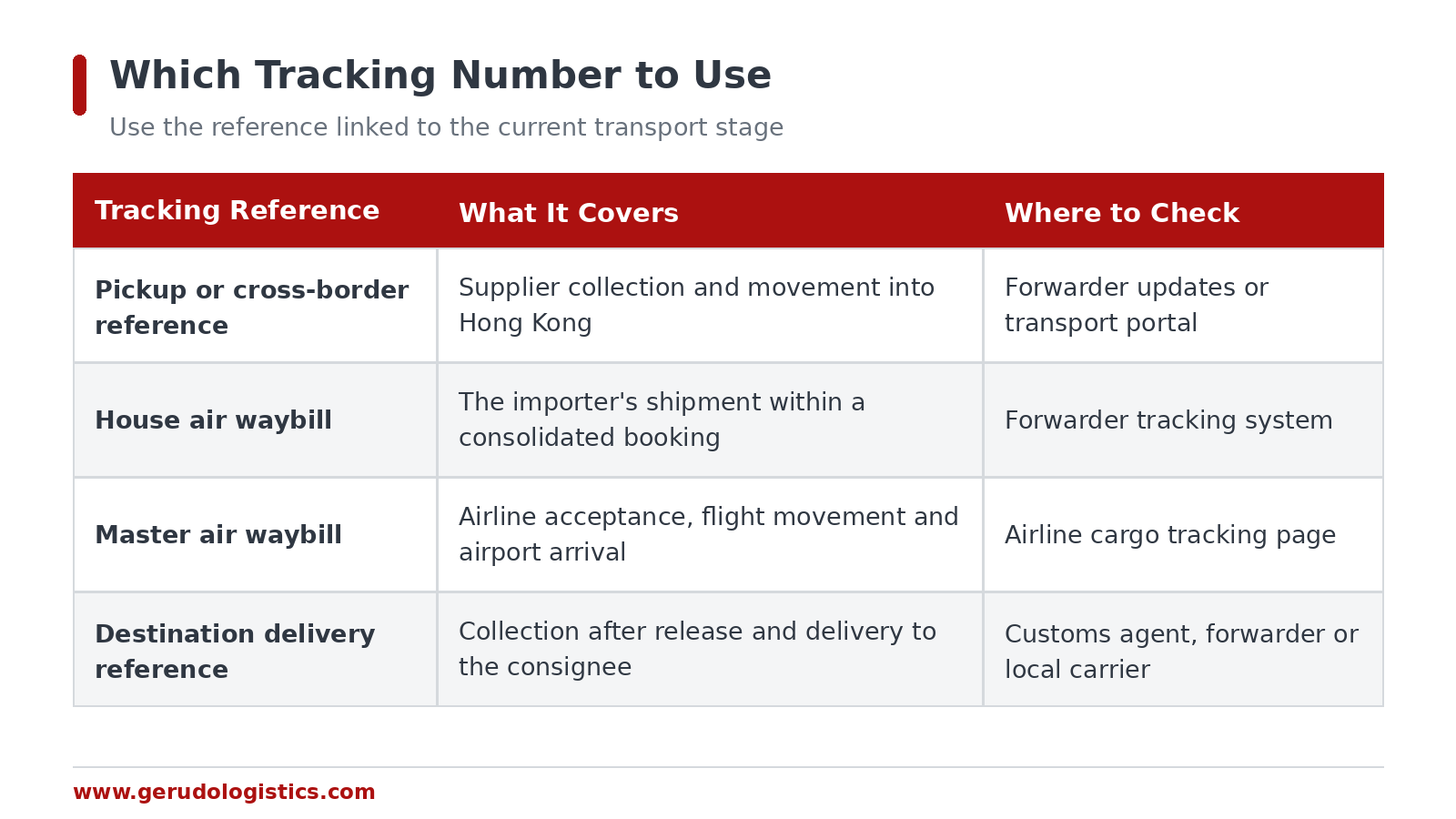
The airline normally recognizes the master air waybill. A house air waybill usually works in the shipment management system because it identifies one consignment inside a larger airline booking.
How to Read Each Tracking Status
Tracking messages describe milestones rather than continuous GPS location. Read each status against the shipment stage and the next action required.
Common milestones include:
Picked up: The cargo has left the supplier and can still be in mainland China.
Received in Hong Kong: The warehouse has recorded the cargo, but airline acceptance can still be pending.
Accepted or received from shipper: The terminal or airline handling system has received the shipment.
Manifested or booked: The cargo is assigned to a planned movement. This is different from confirmed departure.
Departed: The airline record shows the flight movement from Hong Kong or a transit airport.
Arrived: The aircraft or cargo has reached the destination airport. Customs release remains a separate stage.
Customs hold: Additional information, review, inspection, or payment is required before release.
Released: Customs processing is complete, although terminal pickup and delivery still need to occur.
Out for delivery: The destination carrier has collected the shipment for the final leg.
If the shipment misses a flight, confirm whether it remains accepted for the next movement or requires rebooking. For a customs hold, check with the destination broker because the airline tracker rarely explains an entry problem.
Checkpoint: The latest confirmed milestone and next expected update are clear.
Step 8: Prepare Destination Customs Clearance Before Arrival
Before the battery-powered shipment leaves Hong Kong, complete the destination broker appointment and pre-arrival document review. Waiting for the arrival notice can add avoidable airport storage.
Prepare the following clearance file:
Commercial invoice: Accurate product description, value, currency, Incoterm, and country of origin.
Packing list: Package count, weights, dimensions, and packing format.
Air waybill: House and master references where both apply.
Tariff classification: The proposed HS or destination tariff code for each product type.
Importer details: Legal name, address, tax or importer number, and broker authorization.
Product records: Any market-specific safety, conformity, registration, or agency documents required for the finished goods.
Battery records: Supporting information requested for transport or onward domestic movement.
Battery transport acceptance and product import compliance answer different questions. A toy can pass the airline review and still face a customs or product-safety problem.
For shipments to the USA, confirm the eligible Importer of Record, customs bond, tariff classification, country-of-origin marking, and any product agency requirements before departure. The Importer of Record guide for shipments from China to the USA explains who carries the entry responsibility.
When tracking shows arrived, check whether the entry has been filed and whether an authority needs more information. Arrival, customs release, and cargo availability are separate milestones.
Checkpoint: The final clearance documents are ready and all pending release items are clear.
Step 9: Arrange Final Delivery and Close the Shipment Record
After customs release, confirm cargo availability and arrange terminal collection. Final delivery is complete when the correct cargo has been received and its condition recorded.
Before delivery, confirm the delivery release details:
Release status: Customs and terminal release requirements are complete.
Local charges: Handling, storage, duties, taxes, and delivery charges have been settled according to the agreed terms.
Delivery details: Address, receiving hours, contact person, and any vehicle or appointment restrictions are correct.
Piece count: The delivery order matches the number of cartons released by the terminal.
Proof of delivery: The signed delivery record identifies the date, time, and receiving party.
Inspect the outer cartons at delivery. Record shortages, crushing, punctures, wet cartons, or other visible damage on the delivery document and take photos before unpacking.
Keep a complete shipment file with the commercial documents, air waybills, battery records, customs entry, and proof of delivery. For repeat orders, create an approved SKU list and require the supplier to report battery or packing changes before booking.
How Gerudo Logistics Supports Hong Kong Battery Cargo Routes
Gerudo Logistics is a China-based dangerous goods specialist freight forwarder. For battery-powered products, our team reviews the cargo configuration and available records, then confirms an appropriate mainland or Hong Kong routing option before pickup.
When a Hong Kong route is selected, Gerudo Logistics can coordinate the movement from the Chinese supplier through cross-border transport, Hong Kong cargo acceptance, international freight, and destination delivery. The service scope is confirmed for each shipment according to the battery, packing, destination, and carrier acceptance.
For a route review, contact us with the product list, battery specifications, cargo photos, supplier location, destination, and required delivery date.
Frequently Asked Questions
Is the Hong Kong Route Limited to Suppliers in Shenzhen or Guangdong?
No. Cargo can move from other parts of China, but the extra domestic transport can reduce the time and cost advantage. Compare the complete route before confirming it.
What Happens if the Supplier Changes the Battery After Pre-Checking?
Submit the new battery model, rating, and configuration for review before pickup. The changed product requires a new acceptance decision.
Can the Supplier Remove the Batteries and Ship the Products as General Cargo?
Sometimes, provided the product can travel safely without the battery and every document describes the actual packed condition. Any batteries shipped separately need their own classification, packing, and carrier acceptance.
What Happens if the Cargo Waits at the Hong Kong Warehouse?
Warehouse storage and flight rebooking charges can arise while documents, packing, or carrier approval are corrected. Identify the unresolved item and next available flight before approving further work.
Can an Active Tracking Device Travel Inside the Shipment?
Only when the device, battery, and operating mode are accepted for the selected air route. Submit the tracker details during pre-checking instead of placing an undeclared device inside a carton.
Does Shipping via Hong Kong Change the Incoterm or Importer Responsibilities?
No. The Hong Kong route changes the physical and carrier process, while the agreed Incoterm and customs arrangement continue to define each party’s responsibilities.