Door-to-Door Small Parcel Shipping from China to the UK
A small shipment does not always belong in a standard courier network. A box of clothing samples may move as an ordinary parcel. A similar-sized box containing batteries or adhesive may need a restricted-goods channel. Temperature-sensitive material requires a separate review of its packaging and transit time. The shipping plan also changes according to the declared value, delivery postcode and the way UK import VAT will be handled.
This guide explains how importers can choose a door-to-door parcel service from China to the UK, compare express and economy options, prepare for UK customs clearance and determine whether a sensitive product is eligible for the planned channel.
Which Shipments Fit a China-to-UK Door-to-Door Parcel Service?
Door-to-door parcel shipping is generally designed for shipments that can move as individual cartons through a courier or consolidated parcel network. Typical examples include commercial samples, replacement parts, trial orders and small e-commerce replenishment orders.
There is no single weight limit that separates a parcel from a freight shipment. Each service has its own limits for weight, dimensions, carton count and accepted commodities. A large but lightweight carton can also become expensive because the carrier may charge by volumetric weight rather than actual weight.
The general door-to-door shipping service from China can cover supplier pickup, consolidation and final delivery across different destinations. A UK shipment also requires the correct UK VAT treatment, customs data and local delivery plan.
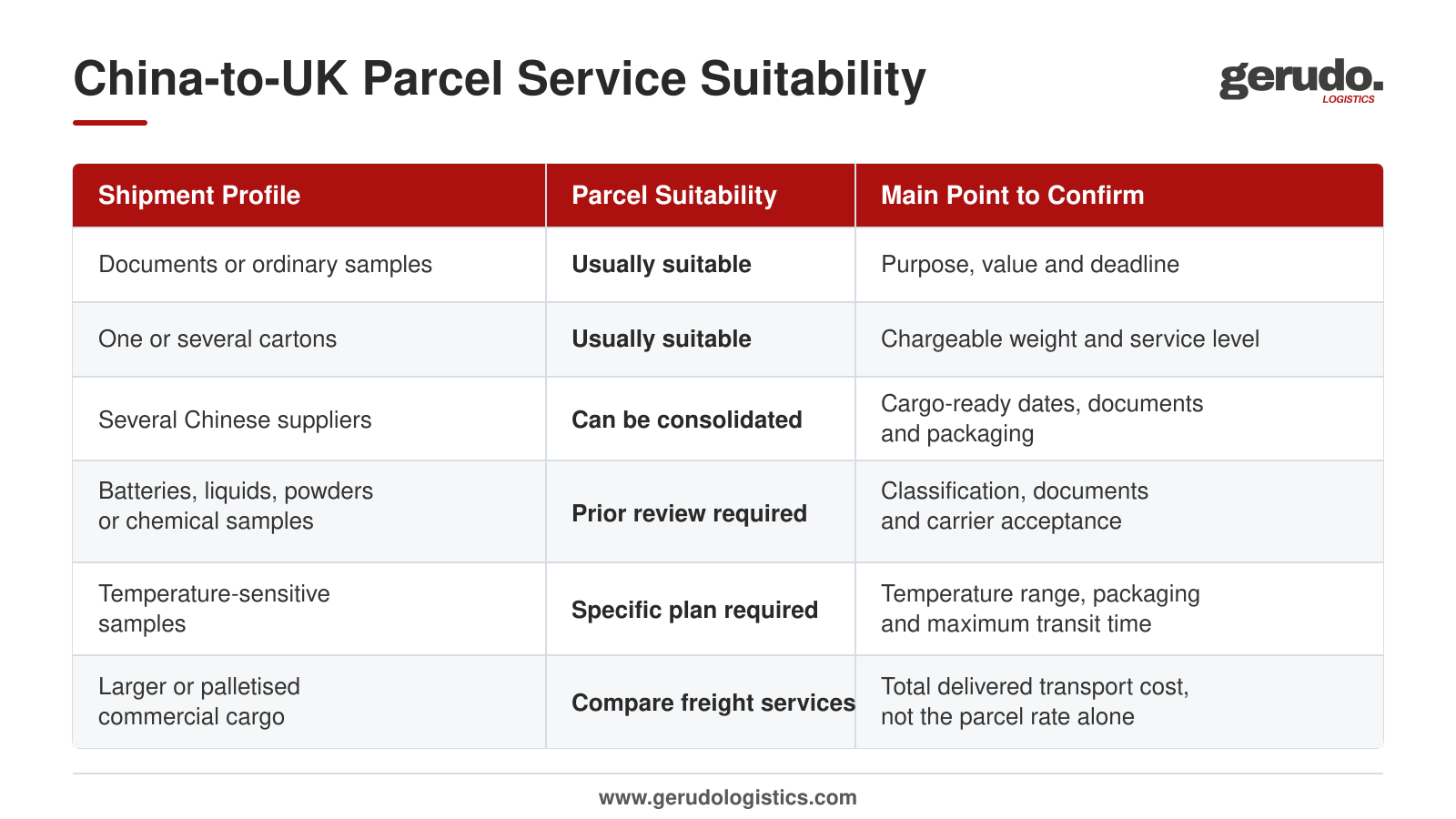
Very light orders may also qualify for postal or lightweight channels. The choice still depends on the product and service requirements, as explained in the guide to shipping parcels under 2 kg from China.
Door-to-Door Parcel and Courier Options from China to the UK
The two main small-shipment choices are express courier and a consolidated or economy parcel service. Both can include collection in China and delivery to a UK address, but the transport network, delivery speed, pricing structure and cargo restrictions are different.
Express Courier
International express couriers connect collection, customs processing and final delivery under one tracking number. They suit urgent samples, replacement parts and small orders, but charge the higher of actual or volumetric weight. Oversized cartons, remote postcodes and special handling can increase the price.
Express availability also depends on the product. Batteries, perfumes, aerosols and adhesives must fit the courier's service conditions, and restricted goods may require an approved account or specialised channel.
Consolidated or Economy Parcel Service
An economy service groups shipments at a China warehouse before moving them through a shared international network. It can cost less than express when timing is flexible or several parcels are ready together, although the additional handling usually extends the journey.
Some quotations include UK customs clearance and duties, while others leave import charges to the recipient. Tracking may also change after handover to the UK delivery company. These details must be confirmed before comparing prices.
Online sellers also need to align the transport channel with their e-commerce parcel fulfilment and packaging requirements.
How China-to-UK Door-to-Door Parcel Shipping and Customs Clearance Work
A door-to-door parcel shipment from China to the UK follows one connected process, although different companies may handle individual stages.
Collection in China: The warehouse receives the cargo and checks the product, quantity, value, packed weight and dimensions. Goods from several suppliers require coordinated cargo-ready dates and documents.
International movement and UK customs clearance: After the required China procedures, the shipment enters the selected network. The UK declaration must show an accurate description, value, commodity code, origin and importer or recipient details. Customs can request further evidence when the data is incomplete or inconsistent.
Final delivery: After release, a UK parcel network delivers the goods to the stated address. Incorrect postcodes, inaccessible premises and failed delivery attempts can create delays or extra charges.
Door-to-door describes the physical movement from the Chinese collection point to the UK delivery address. It does not, by itself, determine who is responsible for import clearance, VAT or customs duty. That responsibility must be established through the agreed commercial term and shipping arrangement.
DAP or DDP for Door-to-Door Parcels from China to the UK
DAP and DDP can both end with delivery to the recipient's address. The difference is the party responsible for UK import formalities and charges. The Incoterm used for a small parcel therefore needs to match the sales agreement and the actual customs arrangement.
DAP for China-to-UK Parcel Shipments
Under Delivered at Place (DAP), the seller arranges transport to the named UK destination. The buyer normally handles import clearance and pays import VAT, customs duty and clearance-related charges.
The carrier may contact the recipient before release to request payment or importer information. A DAP quotation should therefore identify the separately payable charges, the courier's customs role and the information required from the buyer.
DDP for China-to-UK Parcel Shipments
Under Delivered Duty Paid (DDP), the seller takes responsibility for import clearance, applicable duties and taxes, and delivery to the named destination. This can give the buyer a more predictable delivered cost.
The label DDP is not enough to define the whole service. Before dispatch, the parties should confirm:
Importer and declarant: Identify the party named in the customs process and the representative acting on its behalf.
EORI and VAT details: Confirm which registration details the declaration will use and whether they match the agreed transaction.
Included charges: State whether the price covers import VAT, customs duty, clearance fees, disbursement charges—which are courier fees for advancing duty or import VAT during clearance—and delivery to the exact postcode.
Import records: Confirm which customs or tax records can be provided after clearance.
Exceptions: Define who pays for inspection, storage, reassessment or charges caused by inaccurate supplier information.
DDP must also fit the product. A carrier may accept an ordinary parcel under a duty-paid service but reject a battery or chemical product from the same channel. Cargo eligibility and customs responsibility are separate checks.
A business importing into Great Britain may need a GB Economic Operators Registration and Identification (EORI) number. This depends on who makes the declaration and how the customs representative is appointed.
Northern Ireland requires a separate check. Its declaration and VAT arrangements can differ from Great Britain. An XI EORI may be required, so the final destination must be known before the customs arrangement is confirmed.
How the £135 UK VAT Rule Applies to Small Parcels
The £135 threshold is important for goods sold from outside the UK to customers in Great Britain. It changes how VAT is normally collected, but it is not a universal tax exemption for every parcel.
A consignment is the complete group of goods imported together under one shipment. The £135 threshold applies to the total intrinsic value of that consignment, not to each item. Transport and insurance costs are excluded when shown separately rather than included in the selling price.
Goods Valued at £135 or Less
For direct sales to customers in England, Scotland or Wales, UK supply VAT is generally charged at the point of sale. This normally applies when the consignment is worth £135 or less. An online marketplace may instead be responsible for collecting the VAT.
For a B2B sale, the customer must first provide a valid UK VAT number. The overseas seller does not normally charge VAT at the point of sale under this procedure. Instead, the UK business records the VAT through the reverse-charge process on its own VAT return. The invoice and sales records must support this treatment.
The £135 rule applies to sales. A commercial sample, returned item, gift or excise product can follow different valuation or tax provisions. Marking a commercial order as a sample does not change its customs status.
Goods Valued Above £135
Normal import VAT and customs procedures apply when the consignment value is above £135. Customs duty may also apply according to the commodity code, origin, customs value and any available relief.
A description such as “parts”, “accessories” or “samples” can be too vague to support the commodity code. The invoice should identify the goods, their material and commercial function where relevant.
What Affects the Cost and Delivery Time of a China-to-UK Parcel Shipment?
The cheapest rate per kilogram does not necessarily produce the lowest delivered cost. The quote must reflect the parcel dimensions, service speed, cargo type, customs arrangement and final postcode.
Chargeable Weight
Parcel pricing normally uses three related figures:
Actual weight: The gross weight recorded on the scale.
Volumetric weight: The billing weight calculated from the space occupied by the parcel.
Chargeable weight: The higher of the actual and volumetric figures.
Volumetric weight = length × width × height ÷ service divisor
The divisor and measurement unit vary by service, so the quotation must state the applicable calculation.
The supplier should provide the packed dimensions of every carton. Repacking can reduce empty space, but extra cartons may create per-piece or handling charges.
Express Versus Economy Transit
Express service: Uses a more integrated network with fewer waiting stages.
Economy service: Allows additional time for consolidation and transfer to the UK delivery partner.
Quoted transit time: Must identify whether the period starts at supplier collection or international departure and whether customs clearance and final delivery are included.
Customs processing has no guaranteed duration. An unclear description, valuation question or missing importer detail can stop the parcel until the issue is resolved.
Additional Parcel Charges
Delivery surcharges: Remote postcodes, islands, address corrections and repeated delivery attempts can increase the final cost.
Special-cargo charges: Dangerous-goods documents, approved packaging, dry-ice handling and additional warehouse checks can create separate charges.
For a comparable quotation, every provider should receive the same packed dimensions, cargo description, value, postcode and requested tax arrangement. Otherwise, the lowest quote may simply be based on less complete information.
Shipping Small Dangerous Goods and Chemical Parcels from China to the UK
A small quantity does not automatically make dangerous goods eligible for an ordinary parcel service. The transport classification, packaging, documents and current carrier acceptance must be checked before collection. The same classification and preparation principles used for dangerous goods shipping from China still apply when the cargo moves to the UK as a parcel.
Batteries and Battery-Powered Products
Battery acceptance begins with the shipment configuration. A lithium battery packed by itself, packed with equipment or installed in equipment follows different transport conditions.
The shipment review should confirm:
Battery data: Identify the chemistry and record the Wh rating of rechargeable lithium-ion batteries.
Packing configuration: State whether the batteries are standalone, packed with equipment or contained in equipment.
Quantity: Confirm the number of cells or batteries per package and shipment.
Test information: Provide the applicable UN 38.3 test summary and documents requested for the service.
Protection: Prevent short circuits, unintended activation and movement inside the package.
Standalone lithium batteries face stricter air transport restrictions than many batteries contained in equipment. Power banks are treated as batteries rather than as ordinary consumer electronics. These differences are particularly important when shipping batteries from China or arranging power bank shipments.
The carrier must review the battery data, packing method, quantity and current service conditions before pickup.
Chemical Samples, Liquids and Powders
Chemical parcel eligibility depends on composition and transport classification, not the word “sample”. A small bottle can still be a regulated dangerous good.
The supplier should provide a current Safety Data Sheet (SDS) that matches the product. The review may also require its flash point, concentration, physical form, UN number, hazard class and packing group. An SDS supports classification but does not prove carrier acceptance.
Liquid inner containers need secure closures, cushioning and leakage protection. Powders need sealed packaging that prevents release. Products sharing an outer carton must also meet compatibility and carrier packing conditions.
Products such as industrial adhesives and perfume can require different transport classifications even when the retail packaging appears similar. The selected China-to-UK parcel channel must be confirmed for the exact formulation, quantity and packaging.
Transport acceptance does not replace UK product compliance. A business importing chemicals into Great Britain can also have responsibilities under UK REACH and GB classification, labelling and packaging requirements. These depend on the substance, use and supply arrangement.
Shipping Temperature-Sensitive Samples from China to the UK
Some temperature-sensitive samples can be shipped from China to the UK through an approved courier or small-parcel channel. Validated packaging must maintain the required range through collection, customs processing and final delivery.
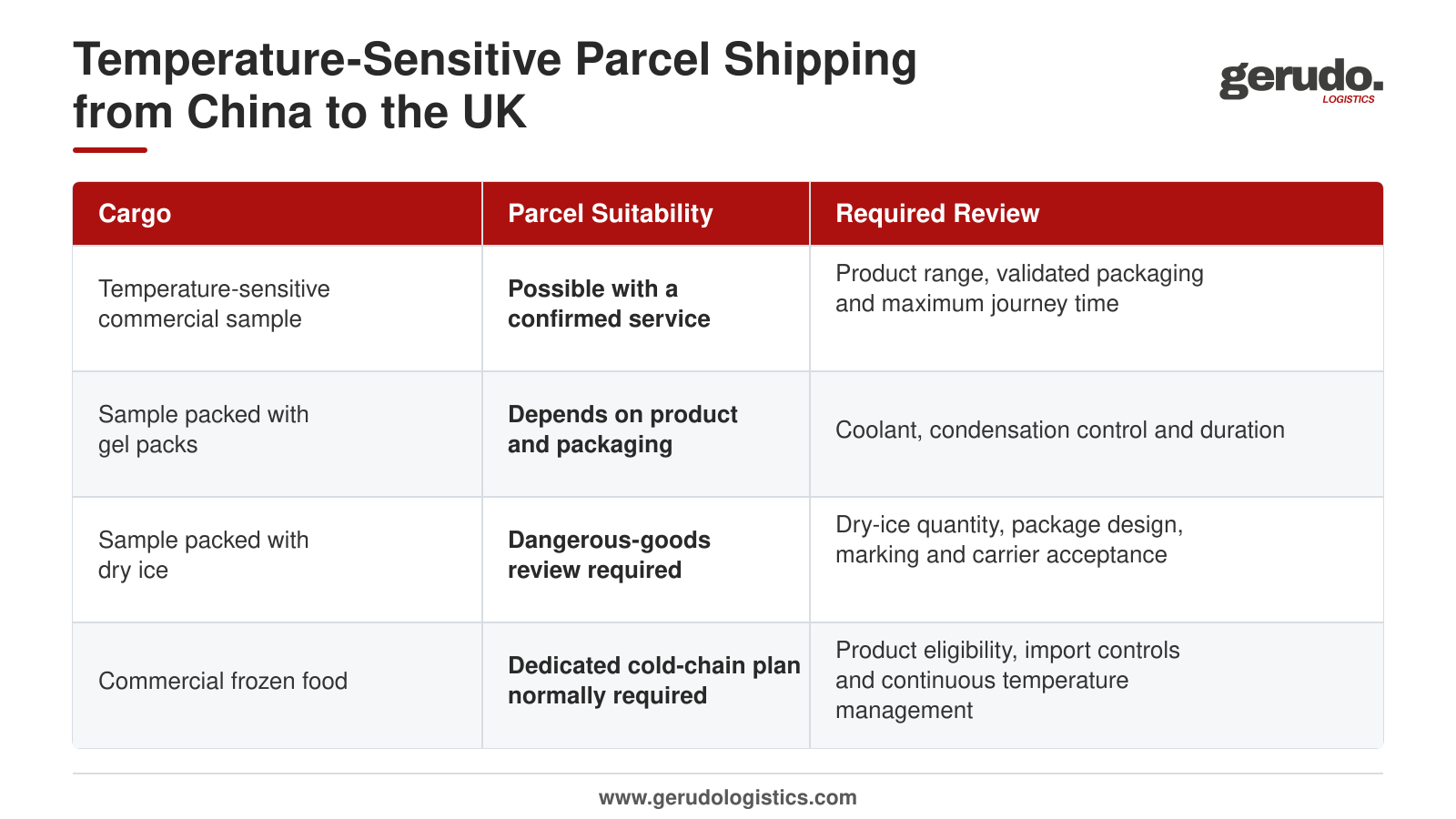
Dry ice is regulated for air transport because it releases carbon dioxide gas. A parcel shipped with dry ice from China must use packaging that allows gas release, and the package information must state the dry-ice quantity.
A commercial frozen food shipment that depends on an uninterrupted frozen chain normally needs a cold-chain shipping plan. UK import controls can also depend on the ingredients, origin, approved establishment and product risk category.
Parcel, Air Freight or LCL: Choosing the Right Option for China-to-UK Shipments
Parcel service is generally the first option for samples and a small number of cartons. Standard air freight becomes relevant when the order grows, needs palletisation or becomes uneconomical under courier chargeable-weight pricing. Less-than-container-load (LCL) shipping is worth comparing when the cargo is larger, less urgent and suitable for warehouse consolidation.
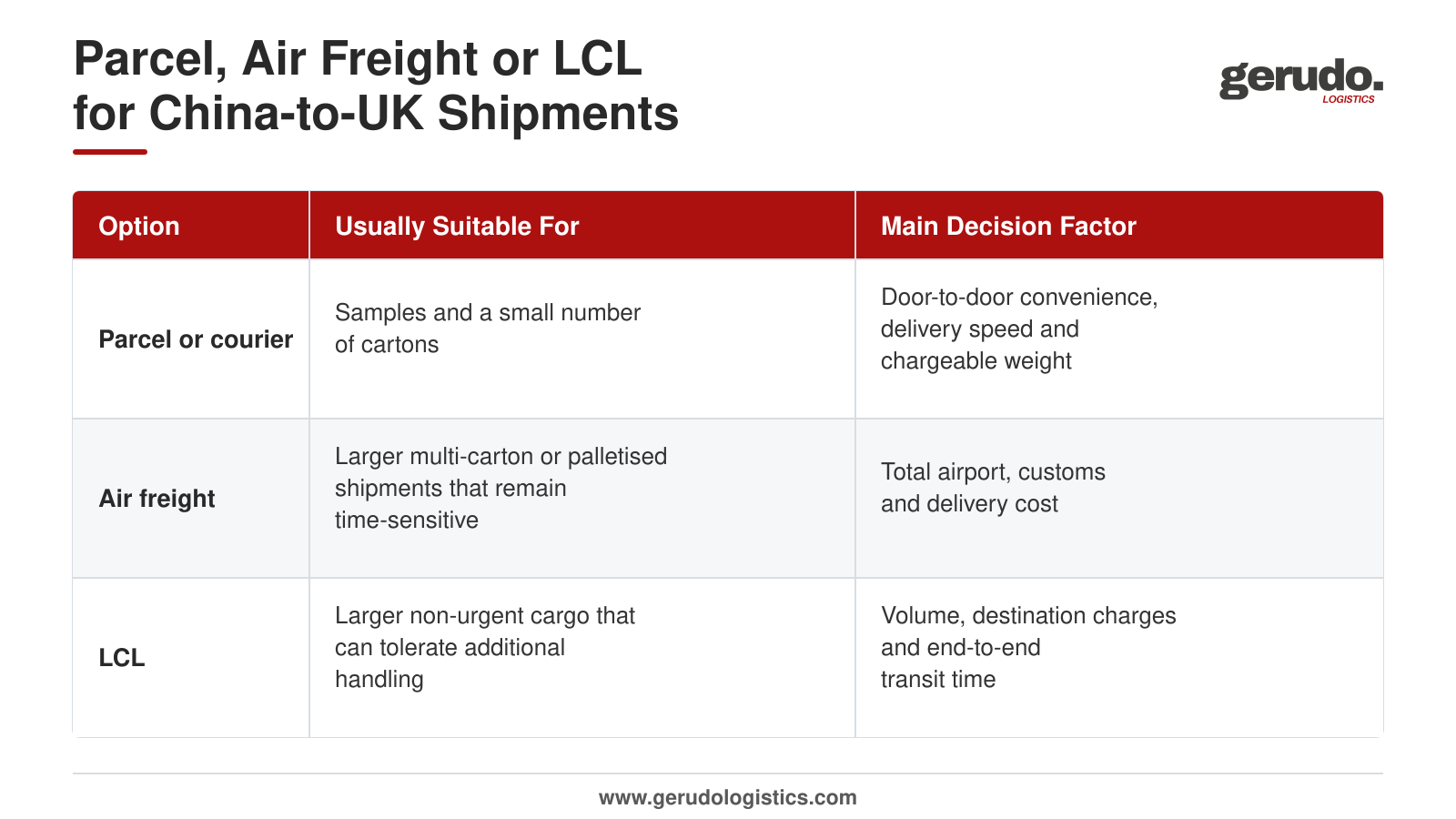
Compare complete door-to-door costs. An airport-to-airport rate does not include the same services as a courier quotation, while an LCL rate can exclude handling, destination charges, clearance and delivery.
Cargo type can reduce the available choices. LCL also involves consolidation, so the warehouse and carrier must accept the dangerous-goods classification and packing combination.
Fixed weight thresholds are only rough references. When comparing small-package shipping with bulk freight, assess the full service scope, actual weight, volume, urgency, cargo restrictions and destination cost.
China-to-UK Parcel Shipping Quote Checklist
Prepare the following packed cargo data before requesting a door-to-door rate from China to the UK:
Pickup location: Supplier address or city in China and the number of collection points.
Delivery postcode: Complete UK postcode and whether the address is residential, commercial or a fulfilment centre.
Cargo description: Specific product name, material, function and intended use.
Carton details: Quantity, gross weight and external dimensions of every packed carton.
Customs value: Transaction value or another supportable customs valuation where no sale takes place.
Commodity code: Provide it when confirmed; do not guess from a similar product.
Sales context: State whether the shipment is a commercial sale, sample, replacement or return.
Sensitive contents: Declare batteries, magnets, liquids, powders, chemicals, aerosols and dry ice.
Supporting documents: Include the SDS, battery test information or other required product records.
Required timing: Give the latest acceptable delivery date.
Delivery term: Confirm whether the quotation should be DAP or DDP.
Importer details: Provide the consignee's VAT and EORI status where relevant to the planned declaration.
Do not dispatch until the approved description, packaging and documents match the physical shipment. A product, battery or carton change can invalidate the quoted channel or price.
How Gerudo Logistics Supports Small Parcel Shipping from China to the UK
Gerudo Logistics arranges door-to-door services from China to the UK for ordinary commercial parcels as well as eligible small dangerous-goods and chemical shipments. Support can include supplier collection in China, consolidation, cargo-document review, selection of a suitable parcel channel, DAP or DDP planning, customs coordination and final delivery.
Acceptance remains shipment-specific for batteries, chemicals and temperature-sensitive products. The product data, packed quantity, packaging method and current service conditions must be reviewed before the collection and delivery plan is confirmed.
Frequently Asked Questions
Can a Freight Forwarder Use Its Own EORI Number Instead of the Importer's?
A freight forwarder cannot simply substitute its own EORI for the importer's. The customs declaration must identify the importer and declarant correctly. A customs representative can use its own EORI in its representative role, while the importer may still need a GB or XI EORI for the movement.
What Happens if a Shipment from China Marked as a Commercial Sample Is Later Sold?
Commercial samples imported under duty and VAT relief cannot be sold. HMRC permits re-export, destruction or retention with prior approval, so the importer must resolve the relief conditions before disposing of the goods in another way.
Do I Need Both a GB EORI and an XI EORI When Importing from China?
A GB EORI does not automatically replace an XI EORI. An XI EORI is usually required for declarations in Northern Ireland and certain movements involving Northern Ireland; the requirement depends on the movement and declaration, not shipment volume.
Can DDP Parcels Be Delivered to an Amazon UK Fulfilment Centre?
A DDP parcel can be delivered to an Amazon UK fulfilment centre only when it also meets Amazon's labelling, carton preparation, booking and delivery requirements. DDP clearance alone does not make the parcel ready for fulfilment-centre receipt.