How to Import Toys From China to the USA in 2026
Imagine buying remote-controlled cars and magnetic building sets from two Chinese factories. Both suppliers describe their goods as plastic toys, but one includes spare lithium batteries and the other uses strong magnets. Those details can change which shipping services accept the order and what preparation costs extra.
For importers, the starting point is what comes inside each toy set. This guide explains how those contents affect shipping from China to the USA, what to request from suppliers, and which US import requirements to complete before dispatch.
At a Glance
Cargo assessment: Include controllers, spare batteries, and refills when describing the toys.
Shipping choice: Compare accepted services using the finished carton dimensions and delivery deadline.
China-side documents: Obtain product details and the transport evidence required for the contents.
USA requirements: Prepare applicable toy certification, CPSC eFiling information, and customs documents.
Are Toys Considered Dangerous Goods for Shipping?
Toys are not automatically dangerous goods. Puzzles, plush toys, and ordinary plastic figures without regulated components can generally travel as general cargo. Batteries, certain chemicals, and magnets need further assessment.
A supplier’s description of a toy as safe for children does not establish its transport classification. The buyer needs enough information about the contents for the forwarder to assess the goods correctly.
Toys With Installed or Spare Batteries
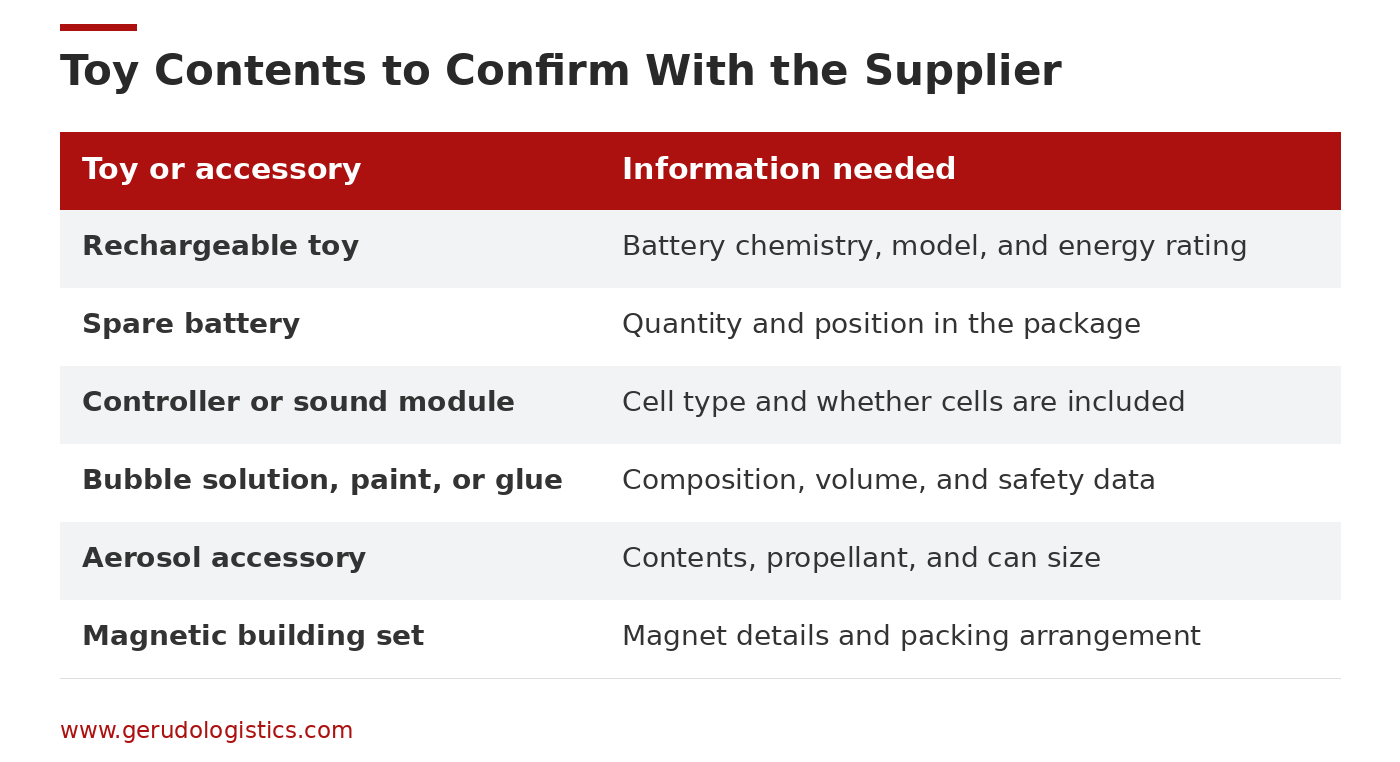
For battery-operated toys, confirm battery chemistry and packing position, two key factors in shipping batteries from China. A rechargeable car with an installed battery differs from a set with an additional battery beside it. Separate cartons of replacement batteries require their own assessment.
Check the controller as well as the main toy. Battery shape does not identify chemistry: AA-size cells and coin-shaped cells can use different chemistries, so the supplier’s specification matters more than appearance.
Toys Containing Liquids or Aerosols
A liquid refill is not automatically dangerous goods. Bubble solution, paint, or glue needs an assessment based on its composition and properties. Water-based or non-toxic descriptions do not provide enough information on their own.
Request the relevant safety data sheet, which describes the chemical’s properties and hazards. Aerosol accessories need separate attention because their contents and pressurized containers both affect the assessment.
Magnetic Toys and Hidden Magnets
Magnetic building sets are obvious examples, but magnets can also be present in motors and other accessories. Their presence calls for assessment; it does not automatically make every toy containing a magnet dangerous goods.
The relevant transport concern is the magnetic field outside the completed package. Testing a toy for magnet-ingestion hazards answers a different safety question and does not establish its transport status.
Shipping Methods for Toys From China to the USA
Choose a shipping method by comparing cargo acceptance, delivery time, and order size. An advertised parcel service may exclude the battery arrangement in the finished toy set, even when it accepts a similar toy without spare batteries.
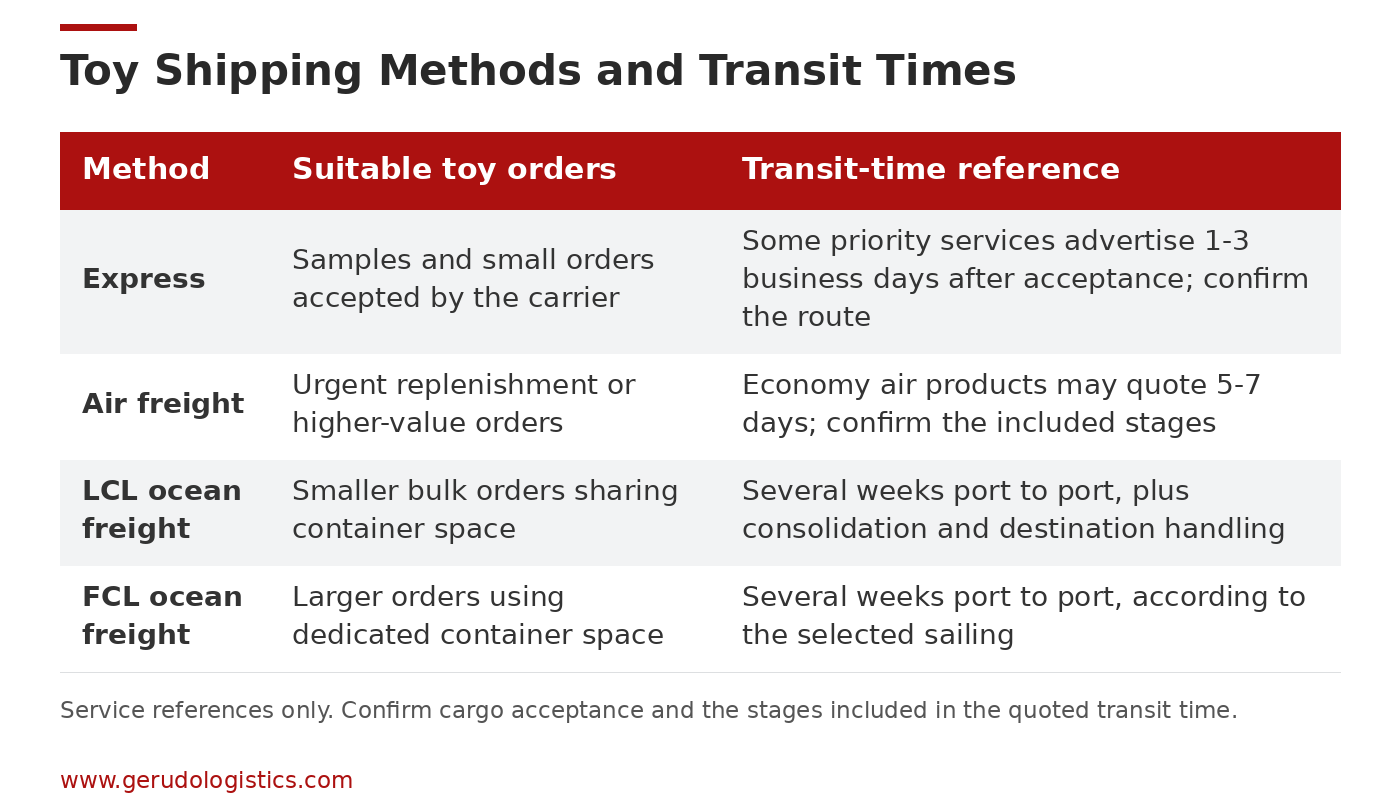
These are service references, not confirmed delivery dates. Ask for an estimate covering the goods from supplier collection to the final USA address, with any approval or clearance time identified separately.
Express Shipping for Toy Samples and Small Orders
Express shipping can suit samples or a small replenishment order when the carrier accepts the contents. Confirm acceptance through the shipping account being used before the supplier sends the cartons to the carrier.
Large toy boxes can be expensive despite their low weight because dimensional weight reflects package size. Compare the price using the finished outer carton, rather than the toy’s weight alone.
Air Freight for Urgent Toy Shipments
For lithium battery toys, installed and spare batteries can have different air transport conditions. Ordinary electronic toys with installed lithium-ion batteries generally fall under UN3481; adding spare batteries changes the packing requirements to review.
The 2026 charge provisions make this distinction important:
Packed with equipment: Under Packing Instruction 966, Section II, lithium-ion cells and batteries above 2.7 Wh must be at no more than 30% charge.
Section I shipments: The 30% limit applies regardless of size unless the required state approvals are obtained.
Installed batteries: Under Packing Instruction 967, reduced charge remains a recommendation in the general provisions; a carrier can impose stricter conditions.
The importer’s decision is whether the supplier can prepare the batteries for the accepted service before collection. Let the forwarder identify the applicable packing instruction rather than asking the factory to apply one charge rule to every toy.
For magnetic sets, acceptance can depend on the completed carton’s magnetic field. Include any required testing or shielding for magnetized cargo from China in the air freight preparation time and cost.
LCL and FCL Shipping for Bulk Toy Orders
Ocean freight is worth comparing for bulky plush toys and large playsets. Less-than-container-load (LCL) shares container space; full-container-load (FCL) gives the order dedicated container space.
The FCL versus LCL comparison needs to include handling and destination charges. For battery toys, the selected shipping line and, for LCL, the consolidator must accept the goods before the booking is confirmed.
Packing and Shipping Documents for Toys From China
The importer needs to give the forwarder an accurate description of the order, while the supplier provides the technical and packing details. This division avoids asking the buyer to classify batteries or prepare specialist transport declarations without the necessary expertise.
Confirm the Toy Contents and Carton Measurements
Before accepting a firm freight quote, request these details from each supplier:
Product description: Toy model, intended age group, and everything included in the retail set.
Battery information: Chemistry, manufacturer, model, energy rating, and installed or spare position.
Packing measurements: Carton count, units per carton, outer dimensions, and gross weight.
Photographs: An open retail set, battery markings, and the finished shipping carton.
Collection details: Factory address and the date the goods will be ready.
Use the photos to discuss protection appropriate to the toys. Large display boxes need support against crushing, plush goods need dry packing, and powered toys need protection against unintended activation.
Ask whether the quoted dimensions include the outer protection and pallets, where applicable. A quote based only on retail-box dimensions can understate the space the finished shipment occupies.
Prepare Toy Shipping Documents for Carrier Approval
The supplier’s commercial invoice and packing list need to describe the different products accurately. A single description of plastic toys can conceal rechargeable cars, magnetic sets, and replacement batteries in the same order.
Depending on the contents, the forwarder may also need:
UN38.3 test summary: Evidence covering the actual lithium battery model supplied with the toy.
Safety data sheet: Relevant information for chemical refills, aerosols, or other substances requiring assessment.
Transport assessment report: Where requested by the selected carrier.
Dangerous goods declaration: Where required, prepared through the responsible qualified party.
These documents serve different purposes. An SDS does not replace lithium battery test evidence, and a UN38.3 test summary does not establish that the finished toy meets US consumer safety requirements.
Consolidating Toys From Multiple Suppliers
Tell the forwarder which products contain batteries, magnets, or refills before arranging collection. Acceptance of one factory’s goods does not automatically cover the other products in a combined order.
If one product is awaiting review, compare holding the order with shipping the ready goods separately. The forwarder can confirm whether splitting is practical and price the additional handling, storage, and destination charges.
Ask suppliers to identify the contents of their cartons and report changes after the original assessment. An added spare battery or substituted refill can require another review; providing that information before collection gives the forwarder time to adjust the plan.
Toy Shipping Costs From China to the USA
A useful quote shows what the importer will pay for the agreed delivery scope. The lowest freight rate does not necessarily produce the lowest delivered cost when toy packaging, battery handling, and destination services differ between offers.
How Toy Packaging Affects Freight Charges
Illustrative calculation: An order of 100 cartons measuring 60 × 40 × 40 cm occupies 9.6 cubic meters (CBM). Increasing each carton’s height to 50 cm raises the volume to 12 CBM.
The order now uses 25% more space with the same number of cartons. That can increase dimensional weight for Express or air freight and space charges for LCL. It does not mean the entire shipping bill automatically rises by 25%.
Before approving larger retail packaging, compare the freight effect against its sales and protection benefits. Ask the supplier whether unused space can be reduced without weakening the packaging or changing required battery protection.
Additional Charges for Battery Toys and Mixed Orders
Have the quote identify costs that apply to this order:
Battery or dangerous goods handling: Where required by the service and cargo classification.
Preparation: Requested transport assessments, repacking, marks, or labels.
Consolidation: Receiving goods from different factories, storage, and separate departures if needed.
USA services: Brokerage, applicable customs bond costs, terminal handling, and delivery.
Provide the final warehouse address and any appointment or unloading requirements. These details let the forwarder price the destination service more accurately than a quote ending at the arrival port.
Budget for duties using the toy’s actual tariff classification, confirmed by the broker. Different products in an assortment should not automatically receive one assumed rate; check the current tariffs on China when preparing the import budget.
Combine these charges with the purchase price to compare the landed cost of the order. This gives the buyer a cost per saleable unit for evaluating the order’s margin.
US Import Requirements for Toys From China
US import preparation concerns whether the toys can enter the market legally, alongside the transport arrangements. Complete the relevant product checks while the supplier can still correct the goods, labels, or supporting records.
Toy Safety Testing and CPC Requirements
ASTM F963-23 is the current mandatory toy safety standard incorporated into federal rules. It covers toys intended for children under 14. Children’s-product third-party testing and certification generally concern products intended primarily for children 12 or younger, subject to applicable requirements and exceptions.
A CPSC-accepted laboratory can establish which tests apply to the toy’s design, materials, and age group. Relevant checks can include small parts, lead and phthalates, battery access, and required warnings.
The responsible importer must issue a Children’s Product Certificate (CPC) supported by the appropriate evidence. Request the supplier’s test reports early enough to resolve missing coverage before shipping.
Other applicable checks include:
Tracking labels: Required information on children’s products and packaging to the extent practicable.
Country of origin: Applicable US origin marking, assessed separately from tracking information.
Wireless functions: FCC authorization and labeling requirements for radio-controlled or connected toys, as applicable.
CPSC eFiling for Toy Imports
CPSC eFiling requirements took effect on July 8, 2026, for most covered imports. Goods entered from foreign-trade zones have a later compliance date of January 8, 2027.
Agree with the broker who will supply and file the certificate information. The broker can submit full certificate data or reference a certificate in CPSC’s Product Registry; uploading a certificate record to the registry alone does not complete the filing.
Customs Documents for Toy Imports
Confirm the Importer of Record and the broker handling the entry. The customs file generally needs:
Invoice and packing list: Product descriptions, quantities, values, origin, and carton details.
Transport document: The bill of lading or air waybill.
Importer arrangements: Identification, broker authorization, and a bond where required.
Product records: Applicable certificates, filing references, and accessible test evidence.
For ocean shipments, arrange ISF filing before the applicable pre-loading deadline. Ask each supplier to provide the information requested by the broker in time for that filing.
Check That Test Reports Cover the Toys Ordered
Check which toy model and version the reports cover, rather than accepting a report because the product photograph looks similar. Factory model numbers can differ from the buyer’s product codes, but the supplier needs to explain the connection.
For example, a report for a car-only set does not by itself establish coverage for a bundle with additional accessories. Ask the supplier and testing provider to confirm the relevant coverage before approving the bundle for shipment.
If a component or material changes in a way that could affect safety compliance, additional testing and a new CPC may be required. The useful question for the buyer is whether the purchased version remains covered, rather than whether every order needs a completely new test program.
Get Support for Toy Shipments From China to the USA
Gerudo Logistics is a dangerous goods specialist freight forwarder supporting shipments from China across different cargo types and packaging formats. Our team helps importers coordinate suppliers, compare suitable shipping options, and arrange consolidation for toy orders containing batteries or other regulated contents.
For a shipment review, contact us with the toy descriptions, set photos, available battery information, carton measurements, and USA destination. We can assess the available services and preparation needed for the order.
Frequently Asked Questions
Do I Need an Import License to Import Toys From China?
CBP does not generally require an import license for ordinary merchandise such as toys. Applicable customs, product safety, certification, and product-specific agency requirements still apply.
Can I Use My Chinese Supplier’s CPC?
The responsible importer cannot simply pass along the supplier’s CPC as its own certification. Qualifying supplier testing or certification can support the importer’s CPC when the required due care and access to underlying records are maintained.
Is CE Certification Accepted for Toys in the USA?
CE marking does not replace US toy compliance. European compliance documents alone do not establish that the product meets the applicable US testing and certification requirements.
Do Toy Samples Need a CPC?
Sample treatment depends on intended use. Genuine sample-only goods that will never be distributed to or used by consumers can qualify for different treatment with supporting evidence; samples given to consumers are not automatically exempt.
Can One CPC Cover Repeat Orders of the Same Toy?
One CPC can cover multiple batches of an unchanged product when the applicable conditions are met. Its production dates and identifying information must cover the new goods, and ongoing compliance and testing obligations still apply.
Can I Ship Toys Without Batteries to Simplify Shipping?
Removing batteries can simplify transport assessment if no other regulated contents remain. Batteries shipped separately need their own assessment, while the toys still need to meet applicable US safety requirements.
Are Toy Orders Under $800 Exempt From US Import Requirements?
An order below $800 does not create a toy-safety exemption. Duty-free de minimis treatment is also suspended under the current US framework, so confirm the entry method and charges rather than assuming the order is duty-free.
Conclusion
Before committing to the delivery date, establish what the suppliers still need to provide. Give those outstanding items a responsible party and a completion date so the order’s shipping plan is based on goods and documents that will actually be ready.