Why Are Demurrage and Detention Fees Higher for Reefer Containers?
If you import frozen food from China, a demurrage or detention charge on your arrival invoice will be noticeably higher than what a dry cargo importer pays for the same delay. The gap is not arbitrary - it is structural.
Reefer containers get less free time, carry higher daily rates, and generate a third cost that dry boxes never face.
This guide breaks down all three factors and shows how they play out on the Middle East, US, and European trade lanes.
Demurrage vs Detention vs Storage: What Mean for Reefer Importers
Reefer demurrage is the daily fee charged by an ocean carrier when a refrigerated container remains inside the port terminal beyond the carrier's free time allowance. The clock starts the moment the container is discharged from the vessel and available for collection.
Reefer detention is a separate charge that begins after the container has left the terminal. It runs until the empty box is returned to the carrier's designated depot. If your warehouse takes longer than expected to unload, or the depot is unavailable on the day you try to return the box, detention charges accumulate.
Storage is a third charge, billed separately by the port terminal - not the carrier. It covers the physical space your container occupies on terminal ground. Storage can run simultaneously with demurrage, meaning you receive two separate invoices for the same container sitting in the same location.
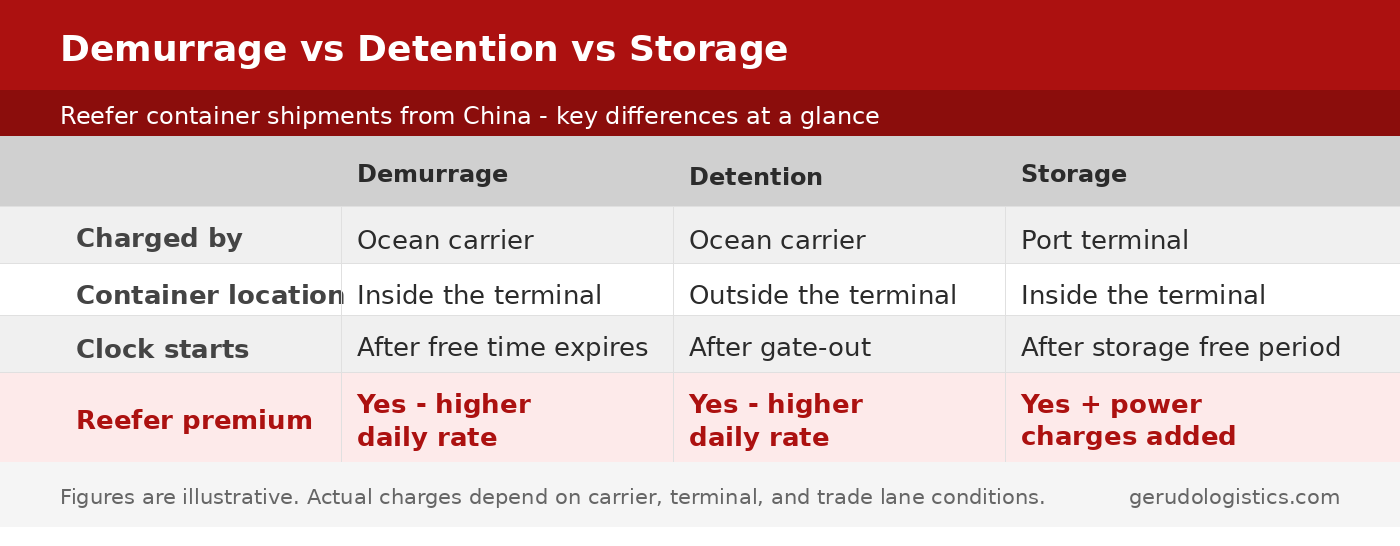
All three fees apply to dry containers as well. The reason reefer importers consistently pay more comes down to three structural differences: shorter free time, higher daily rates, and a fourth cost layer - terminal power - that dry cargo never faces.
Three Reasons Reefer Demurrage and Detention Cost More
1. Reefer Containers Get Less Free Time
For a standard dry container arriving at most major ports, carriers typically offer five to seven free days before demurrage begins. For reefer containers from China, the standard is three days. Some carriers reduce this to two days during periods of terminal congestion or on shorter trade lanes.
The practical gap is significant. An importer who needs four days to clear customs and arrange inland transport pays nothing extra on a dry box. The same four-day timeline on a reefer shipment means one to two days of demurrage charges before the container has even left the port.
Refrigerated containers are scarcer and more capital-intensive than dry boxes. Carriers set shorter free time to push faster turnover on equipment they need back in rotation quickly.
Carrier policies vary considerably:
Maersk and MSC apply a strict three-day standard. Flexibility outside long-term volume contracts is limited.
COSCO and CMA CGM are more willing to consider extended free time for established customers. Approvals of five to seven combined days are possible but require specific application and are not routine.
Any extension must be negotiated and confirmed in writing before the vessel departs China.
2. Reefer Demurrage Rates Are Higher Than Dry Cargo
When free time expires on a dry container, the first tier of demurrage typically starts at $150 to $200 per container per day at major ports.
For reefer containers on the same routes, the opening rate is $250 to $350 per container per day. This premium reflects the higher replacement cost of refrigerated equipment and the carrier's interest in recovering boxes that have an active market.
Rates are also tiered. Most carriers apply a progressive structure:
Days 1-3 over free time: opening rate applies
Days 4-7: rate increases by 30-50%
Day 8 and beyond: highest tier applies
A reefer container sitting in a terminal for ten days past free time will face a significantly higher average daily rate than the opening figure suggests. For importers planning their landed cost, the opening rate is the floor.
3. Power Charges Accumulate Separately
This is the cost layer most importers discover for the first time on their invoice.
While a reefer container sits inside the port terminal, the refrigeration unit must remain connected to the terminal's power supply to maintain the required temperature. The terminal charges for this electricity consumption separately from the carrier's demurrage fee.
Power charges typically run $20 to $50 per container per day. Critically, these charges are not covered by the carrier's free time allowance. Many terminals begin billing power charges from day two of the container's stay, regardless of whether the carrier's demurrage clock has started.
The result: a reefer importer facing a five-day customs clearance delay is paying two separate bills simultaneously - demurrage to the carrier and power charges to the terminal. A dry cargo importer in the same situation pays neither, assuming the delay falls within free time.
Reefer Demurrage and Detention Rates by Trade Lane
The numbers above describe the general framework. In practice, cost exposure varies depending on where your frozen cargo is arriving.
China to the Middle East (Jebel Ali / Dammam)
Middle East ports are among the most cost-sensitive destinations for reefer importers from China.
Key characteristics of this trade lane:
Free time: typically three days, with some carriers offering as few as two on certain services
Power charges: elevated due to ambient temperature conditions placing higher load on refrigeration units
Combined cost when free time expires: demurrage plus power charges can together exceed $400 per container per day
A two-day documentation problem at Jebel Ali costs roughly the same as a four-day problem at a European port. Advance customs clearance before vessel arrival is particularly important on this route.
China to the United States (Los Angeles / Long Beach)
The US West Coast adds a layer of complexity that other routes do not: the chassis system.
In the US, the container and the chassis it travels on are typically owned and managed by different parties. When port congestion reduces chassis availability, your drayage company may be unable to collect the container even when customs has cleared the cargo and it is ready for pickup. The reefer demurrage clock continues running regardless - and that cost lands on your invoice.
Detention on the US trade lane carries an additional complication. When the empty container is ready to be returned, it must go to the specific depot designated by the carrier. If that depot has limited appointment availability, detention charges accumulate even after unloading is complete.
Two questions to raise with your forwarder before the vessel arrives:
Has drayage been pre-booked with a confirmed pickup slot?
Has the carrier's nominated empty return depot been identified and checked for appointment availability?
China to Europe (Rotterdam / Hamburg)
European ports generally offer more predictable operating conditions, but they introduce a different risk: government inspection on arrival.
Two types apply to frozen food from China:
Veterinary inspection: applies to meat, seafood, and animal-derived products. The cargo cannot be released until the inspection authority clears it.
Phytosanitary inspection: applies to plant-based products - frozen vegetables, fruit, and processed plant ingredients - checked by the destination country's food safety authority.
When either inspection is triggered, the container stays in the terminal until cleared. The carrier's demurrage clock does not pause for government inspections.
Key points for European reefer importers:
Inspection selection is random and cannot be predicted in advance
A triggered inspection typically adds three to five days of demurrage
If you ship protein products to Europe regularly, ask your forwarder about inspection-contingent free time arrangements before booking
For a broader view of where D&D fits within your total import cost, see our guide on how to calculate landed cost when importing from China to the USA.
What a Reefer Container Delay Actually Costs
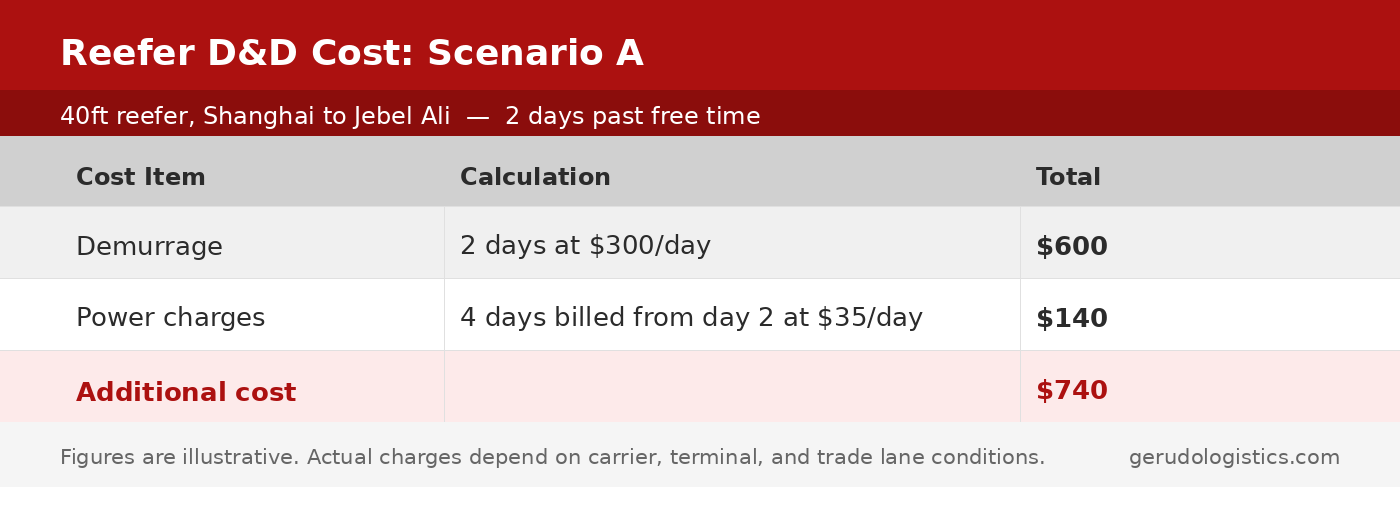
Consider a 40-foot reefer container shipping frozen seafood from Shanghai to Jebel Ali. The carrier grants three days of free time. Customs clearance takes five days due to a documentation query on the certificate of origin.
Scenario A: Two days past free time
Scenario B: Five days past free time (customs hold requires document resubmission)
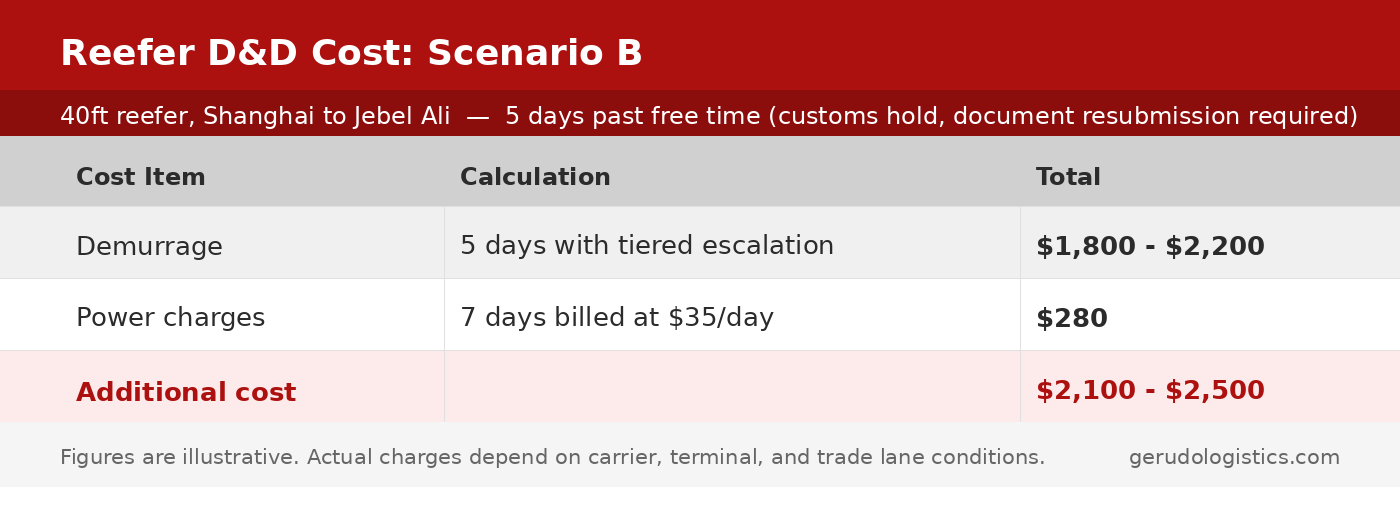
On a frozen seafood shipment where margins are already under pressure from freight costs, a $2,000 to $2,500 penalty for a documentation error is a significant hit. The same delay on a dry container would likely fall within free time and cost nothing.
These figures are illustrative. Actual charges depend on the carrier, terminal, and trade lane conditions at the time of shipment.
How to Reduce Reefer Demurrage and Detention Exposure
The most effective actions happen before the vessel arrives, not after the invoice lands. For a full breakdown of reefer cost components, see our guide on how to reduce the cost of reefer container shipping from China.
Confirm Free Time in Writing at Booking
Ask your forwarder to confirm free time in writing at booking. Do not assume the carrier's standard terms apply to your reefer shipment. The specific free time allowance for the equipment type and route should be confirmed in the booking documentation. If your clearance timeline is likely to run longer than the standard three days, request an extension at this stage - not after the vessel has sailed.
Prepare Customs Documentation Before the Vessel Arrives
Pre-clearance is the single most effective way to avoid demurrage on reefer shipments. When your documentation is filed and accepted before the vessel docks, the container can move immediately after discharge. For food shipments entering markets that require veterinary or phytosanitary inspection, ask your customs broker whether inspection applications can be pre-lodged to reduce waiting time at the terminal.
Know Your Last Free Day Before the Vessel Arrives
Your forwarder should calculate the last free day at the time of booking and share it with you. Treat it as a hard deadline. If you have not received confirmation that customs clearance and drayage are arranged 48 hours before that date, escalate immediately.
Confirm That Drayage Is Pre-Booked with a Confirmed Slot
On congested trade lanes, particularly the US West Coast, a general intention to arrange pickup is not sufficient. Ask your forwarder to confirm a specific pickup appointment and chassis availability before the container is discharged. A verbal plan that falls apart on arrival day generates demurrage that is difficult to dispute.
Verify the Empty Return Depot Before the Container Leaves the Terminal
Carriers designate specific depots for empty reefer returns. Returning to the wrong location does not stop the detention clock. Before your forwarder gates out the container, confirm the nominated depot, its operating hours, and whether an appointment is required.
Reefer Shipping from China: How Gerudo Logistics Manages Your D&D Risk
Gerudo Logistics specializes in dangerous goods and reefer shipping from China to global markets. Our operations cover Shanghai, Ningbo, Shenzhen, Qingdao, and Dalian, with regular services to the Middle East, Europe, the United States, and India.
For cold chain shipments, we manage the full sequence from pre-shipment documentation through destination customs clearance. We monitor free time deadlines on active reefer shipments and flag demurrage risk to clients before charges begin.
If you are planning a frozen cargo shipment from China and want to understand the D&D exposure on your specific route and carrier, contact our team for a route-specific assessment.
Frequently Asked Questions
Why are reefer containers given less free time than dry containers?
Reefer containers are scarcer and more capital-intensive than dry boxes. Carriers set shorter free time - typically three days versus five to seven for dry cargo - to push faster equipment turnover on assets they need back in rotation quickly.
Do power charges count as part of demurrage?
No. Power charges are billed by the terminal, not the carrier, and are separate from the carrier's free time allowance. Both charges run simultaneously when a reefer container sits in the terminal past its free time.
Can I negotiate more free time for reefer shipments?
Yes, but request it before booking confirmation. Carriers require justification and are unlikely to approve extensions after the vessel has sailed. Volume relationships with the carrier improve the chances of approval.
What happens if the carrier's nominated depot is closed when I try to return the empty?
The detention clock does not stop. You remain responsible for charges until the empty is physically returned and accepted. Confirm the depot's operating hours and appointment requirements before the container leaves the terminal.
Are demurrage and detention fees negotiable after they have been charged?
Rarely successful without documentation. If the delay was caused by the carrier - a rolled sailing or terminal outage - there is a basis for dispute. In the US, the FMC's 2024 billing rules give importers a defined dispute window. Prevention is always more effective than disputing after the fact.
Does the same reefer demurrage logic apply to LCL frozen cargo?
The dynamics described in this article apply to FCL reefer containers. LCL cold chain shipments are typically held in a temperature-controlled CFS, where the fee structure is different - storage charges from the CFS operator rather than carrier demurrage.
Conclusion
Reefer demurrage and detention are not simply a higher version of what dry cargo importers pay. They operate on shorter clocks, higher daily rates, and a separate power charge that runs from day two regardless of free time. A delay that costs nothing on a dry box can generate $2,000 or more on a reefer shipment within the same week.
The implication is clear: frozen cargo from China requires tighter pre-arrival coordination than general cargo. Confirm free time at booking, prepare documentation before the vessel arrives, and verify that your forwarder has concrete - not approximate - plans for pickup and empty return. These steps are not difficult, but they need to happen before the vessel docks, not after the invoice arrives.