Shipping EV Chargers from China: Importer Guide 2026
EV chargers are electrical charging products used for homes, commercial sites, parking areas, fleet depots, and charging projects. Importers sourcing EV chargers from China need to understand the cargo profile before pickup, because freight method, packing, documents, and battery-related checks can affect the whole shipment.
Why EV Charger Shipping Needs Early Planning
An EV charger order can look simple on a supplier quotation. The buyer sees a model number, unit price, carton quantity, and delivery promise. The freight problem usually appears later, when the forwarder asks for packing dimensions, product photos, battery details, trade terms, or destination import information.
That gap matters. A supplier may know the product well, but international shipping requires a different set of details. A wallbox charger in cartons, a portable charger sample, and a heavy DC charging station do not create the same freight plan. The same product can also move differently depending on whether it is shipped as samples, palletized cargo, or a full container order.
Before pickup in China, the importer should be able to answer three practical questions:
What exactly is being shipped?
How is it packed for international handling?
What does the destination market need before arrival?
Those questions shape the freight quote, the booking, the pickup plan, the customs documents, and the final delivery arrangement.
Start with the product type
EV charger shipments may include wallbox chargers, portable chargers, charging cables, pedestal chargers, or larger DC charging stations. The product type affects weight, dimensions, handling method, packing strength, and document wording.
A small wallbox shipment may move by express, air freight, or LCL sea freight. A large DC charging station may need crate photos, forklift loading, delivery appointment planning, and site unloading checks. Treating both as the same cargo leads to weak quotes and late changes.
Check the trade term before quoting
Trade terms decide where the supplier's responsibility ends and where the importer's logistics responsibility begins. Under EXW, the importer or forwarder usually arranges factory pickup in China. Under FOB, the supplier usually delivers the cargo to the port in China. For air freight or multimodal cargo, FCA may be more suitable than FOB.
A freight quote based on EXW is different from a quote based on FOB. If this point is unclear, the importer may compare two prices that do not cover the same service.
Match the delivery plan to the cargo
The final delivery address is part of the shipping plan. A warehouse with a forklift is different from a project site, retail address, parking facility, or installer location. Heavy chargers may require delivery appointments, unloading equipment, or local site contacts.
When the final address is unclear, the forwarder can still estimate international freight, but the door delivery cost and risk remain uncertain.
Are EV Chargers Considered Dangerous Goods When Shipping from China
Most standard EV chargers are shipped as general electrical equipment. They are not automatically Class 9 dangerous goods. The dangerous goods question appears when the shipment includes lithium batteries, battery backup, or other battery-related parts that change how the carrier reviews the cargo.
For importers, the practical distinction is simple: a standalone charger without a lithium battery is usually treated differently from lithium battery cargo. If lithium ion batteries or lithium metal batteries are shipped with, packed with, or contained in the product, the shipment may need review under Class 9 lithium battery rules before booking.
A complete battery-powered vehicle is also different from a standalone EV charger. For that related cargo type, you may refer to shipping electric vehicles from China.
Battery backup and lithium accessories
Some charger orders include battery backup units, lithium battery accessories, testing batteries, or battery-powered parts in the same shipment. These details should be disclosed before booking, because the forwarder may need to review product information before confirming the route or carrier.
If the charger order includes lithium battery products, you may refer to shipping lithium batteries from China for those components.
Smart chargers and product descriptions
Smart chargers may include app control, Wi-Fi, Bluetooth, cellular modules, RFID features, or payment-related hardware. For importers, the freight lesson is simple: describe the product clearly.
A vague invoice description such as "charger" is weak. A better description tells the broker and forwarder whether the shipment is an EV wallbox charger, portable EV charger, charging cable, or DC charging station.
Mixed EV charger shipments
Many EV charger orders include accessories such as cables, adapters, mounting brackets, spare parts, display stands, and manuals. These items should match the invoice and packing list. If accessories are packed separately, the carton count and product description should make that clear.
Mixed shipments are common. Problems begin when the documents make the cargo look smaller, simpler, or different from what is actually packed.
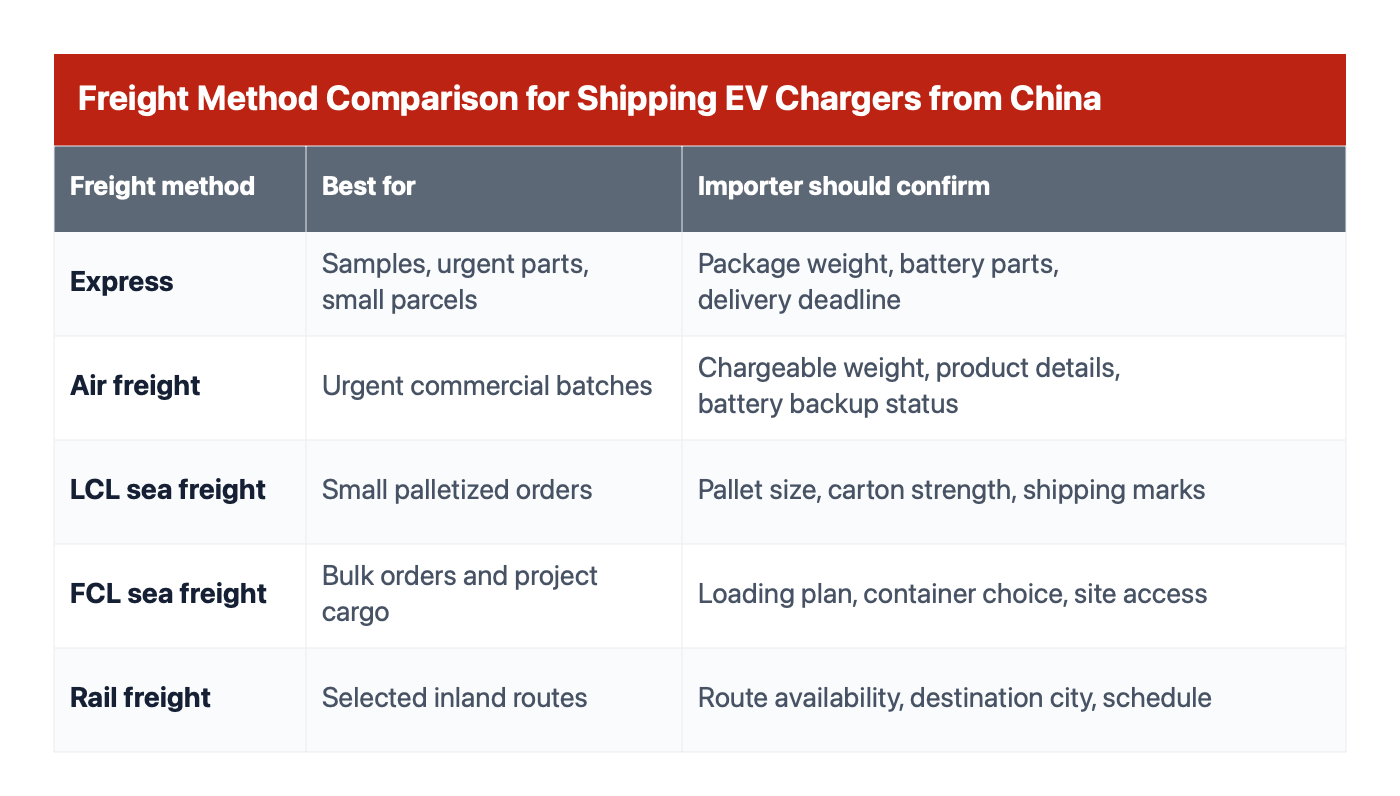
Choosing the Best Freight Method for Shipping EV Chargers from China
The best freight method depends on order size, urgency, cargo value, packing, and destination. Importers often ask for the cheapest rate first, but the better question is whether the shipping method matches the cargo profile.
Express and air freight for samples
Express and air freight are often used for samples, display units, replacement parts, and urgent small batches. Speed is the advantage. Cost and cargo review are the tradeoffs.
Before using air freight, check whether the package includes any battery backup, testing battery, or battery-powered accessory. Battery-related items can change what the carrier needs before accepting the shipment.
LCL sea freight for small commercial orders
LCL means less than container load. It is used when the cargo does not fill a full container and can be consolidated with other shipments.
LCL works for many small EV charger orders, but the cargo will pass through more handling points. Loose cartons are easier to damage or misplace. Pallets, clear labels, and accurate packing details become more important.
FCL sea freight for bulk shipments
FCL means full container load. It is usually suitable for distributor inventory, project cargo, or larger charger orders.
FCL gives the importer more control over container loading and reduces mixed handling compared with LCL. For heavy charging stations, the forwarder may still need crate size, gross weight, loading photos, and unloading details at destination.
Rail freight on selected routes
Rail freight can be an option for selected Eurasian inland routes, especially some China to Europe movements. It is not a universal option for every market.
The decision should be made after the supplier address, cargo size, destination city, and deadline are known.
Supplier Documents to Collect Before Pickup
Supplier documents are the files and details that come from the Chinese seller or factory. They help the forwarder prepare pickup, booking, cargo review, and shipping documents. They are separate from destination import documents, which usually come from the importer, consignee, or customs broker.
Commercial invoice and packing list
The commercial invoice and packing list should match the actual cargo. The invoice should show the seller, buyer, product name, model, quantity, unit value, total value, currency, and trade term. The packing list should show carton count, gross weight, net weight, dimensions, and packing method.
The product description should be specific. "EV wallbox charger" or "DC charging station" is more useful than "charger" or "electrical goods".
Product specification and photos
The specification sheet does not need to be overly technical, but it should identify the cargo clearly. Useful details include model number, charger type, power rating, connector type, communication functions, accessories, and whether any battery backup or storage component is included.
Photos are equally useful. Product photos, carton photos, pallet photos, and label photos help the forwarder see whether the goods are ready for international handling.
Product documents requested by the market
Importers should ask the supplier for available product documents requested by the buyer or destination market. These may include test reports, declarations, certificates, labels, or user manuals.
The forwarder does not replace the importer's product compliance review. Still, having product files ready before pickup reduces avoidable questions during customs clearance or buyer inspection.
Import Documents by Destination Market
Destination-side documents depend on the importer, consignee, country, product type, and shipment value. A forwarder can help organize the shipping side, but the importer should still confirm local requirements with the consignee or broker before the cargo leaves China.
The main point is responsibility. Supplier documents come from China. Import documents usually come from the importer, buyer, customs broker, or local company receiving the goods.
Europe
For Europe, importers usually need to confirm:
Importer of record details
EORI number where required
VAT information
Customs broker details
Product files requested by the buyer or market
Delivery address and consignee details
The invoice and packing list should use clear product descriptions and match the shipment.
United States
For the United States, importers should prepare:
Importer of record details
Importer number, tax ID, or EIN
Customs broker details
Buyer and consignee information
Cargo value and product description
Final delivery address
If chargers, charging cables, adapters, and accessories are packed together, the documents should make the product mix clear.
Middle East
Middle East requirements vary by country. Before pickup in China, the importer or consignee should confirm:
Local importer registration or business details
Broker or agent instructions
Product files requested by the destination market
Invoice and packing list details
Label or language requirements where applicable
Final delivery instructions
This is especially important when the cargo is going to a distributor, project contractor, or commercial installation site.
Southeast Asia
For Southeast Asia, importers should confirm:
Local tax number or importer registration
Consignee details
Product description and invoice value
Packing list details
Product files requested locally
Destination delivery plan
The final delivery location also matters. A port warehouse, distributor warehouse, project site, and marketplace facility can have different receiving rules.
Packaging EV Chargers for International Shipping
Packaging is where many EV charger shipments become more difficult than expected. A carton that is acceptable for local delivery inside China may not be strong enough for international movement, warehouse handling, LCL consolidation, or long-distance final delivery.
Wallbox chargers in cartons
Wallbox chargers are often packed in cartons. Importers should ask for carton photos and confirm whether the cartons are strong enough for stacking.
If the shipment moves by LCL, palletizing is often worth considering because it reduces loose handling and keeps cartons together.
Pallets for LCL cargo
Pallets make small commercial orders easier to move and identify. The importer should confirm pallet size, pallet count, gross weight per pallet, wrapping, and labels.
If wood packaging is used, destination rules should be checked before pickup.
Wooden crates for heavy charging stations
Heavy charging stations may need wooden crates or reinforced packing. The supplier should provide photos of the packed unit, crate dimensions, gross weight, and loading method.
If the destination address has limited unloading equipment, the delivery plan should be confirmed before the cargo leaves China.
Shipping marks and packing consistency
Shipping marks help warehouses and delivery teams identify cargo. They should match the packing list and shipment instructions.
A simple pre-shipment packing check should cover:
Carton condition before pickup
Pallet count and pallet dimensions
Gross weight per pallet or crate
Whether cartons are wrapped and strapped
Whether model numbers match the packing list
Whether fragile screens, sockets, or cable ports are protected
Whether outer marks match the invoice and packing list
These checks help prevent practical shipment disputes such as unclear labels, crushed packaging, missing cartons, and products that cannot be matched to the documents at destination.
Common Mistakes That Delay EV Charger Shipping
Most shipping delays begin before the cargo leaves the supplier. The issue is usually not one dramatic mistake. It is a small missing detail that becomes important after the forwarder tries to book freight or after the broker reviews the documents.
Booking freight with incomplete cargo details
A freight quote needs more than a product name. The forwarder needs pickup address, trade term, carton count, gross weight, dimensions, product description, and destination.
If any of these details are estimated, the quote should be treated as provisional until final packing data is available.
Using vague product descriptions
Descriptions such as "charger", "parts", or "electrical goods" can create questions. Better descriptions include "EV wallbox charger", "portable EV charger", "charging cable", or "DC charging station".
Clear wording helps the broker and carrier understand the cargo without guessing.
Treating battery details as an afterthought
If the shipment includes lithium batteries, backup power, testing batteries, or battery-powered accessories, the forwarder should know before booking. Late discovery can affect carrier acceptance, route choice, or document preparation.
A simple supplier question helps: does any item in this shipment include a lithium battery, backup battery, or energy storage component?
Assuming factory packaging is enough
Factory packaging may be built for domestic delivery, not international handling. LCL cargo may pass through several warehouses, and project cargo may require site unloading.
Packing photos help the importer catch weak cartons, unclear labels, or missing pallet information before pickup.
EV Charger Shipping Quote Checklist for Importers
A freight quote becomes more reliable when the importer sends complete cargo information at the beginning. Before requesting a quote, prepare:
Supplier name and pickup address in China
Trade term, such as EXW, FOB, or FCA
Destination country and final delivery address
EV charger type and model
Quantity by model
Carton count, pallet count, or crate count
Gross weight and cargo dimensions
Product photos and packing photos
Commercial invoice and packing list if available
Whether the shipment includes batteries, backup power, or storage parts
Preferred shipping method or delivery deadline
Estimated data can be enough for an early comparison. Before booking, the forwarder should receive final packing details from the supplier.
How Gerudo Logistics Helps Importers Ship EV Chargers from China
Gerudo Logistics helps importers turn EV charger orders from Chinese suppliers into practical shipping plans. The work starts with supplier address, product type, carton or pallet details, destination market, trade term, and delivery requirement.
For standard EV charger cargo, Gerudo Logistics coordinates with the supplier before pickup, reviews the invoice and packing list for shipping use, checks packing photos, compares freight options, and arranges pickup from the factory or supplier warehouse.
We also works with dangerous goods and battery-related cargo. Standard wallbox chargers are usually general electrical equipment, but some EV charger shipments include battery backup units, lithium battery accessories, or energy storage parts. In those cases, we can screen the cargo before booking, request the right product information from the supplier, and decide whether the shipment needs dangerous goods review before it moves.
Importers who need help preparing an EV charger shipment from China can contact us with supplier address, destination country, product type, quantity, packing details, and delivery deadline.
Frequently Asked Questions
Are EV chargers dangerous goods for shipping?
Most standard EV chargers are shipped as general electrical equipment, not automatically as Class 9 dangerous goods. Extra review may be needed if the shipment includes lithium batteries, backup power units, or battery-powered accessories.
What is the best way to ship EV chargers from China?
Small samples usually move by express or air freight. Commercial orders often move by LCL sea freight, while larger orders may be better suited for FCL sea freight.
What documents should I ask my Chinese supplier for before shipping EV chargers?
Ask for the commercial invoice, packing list, product specification sheet, product photos, packing photos, and available product documents requested by your market. If any battery-related part is included, ask the supplier to state this clearly before pickup.
What documents are needed to import EV chargers from China?
Importers usually need an importer of record, tax or importer details, customs broker information, commercial invoice, packing list, and product documents requested by the destination market. Confirm these requirements before the shipment leaves China.
Can EV chargers be shipped by sea freight?
Yes. Sea freight is commonly used for EV charger shipments, especially for commercial orders, palletized cargo, and larger charging station shipments.
Is air freight suitable for EV charger samples?
Air freight or express can be suitable for samples and urgent parts. Before booking, confirm whether the sample package includes any battery-related item.
Do import requirements change by destination market?
Yes. Import requirements can change by market, especially for importer registration, tax or importer details, broker instructions, product files, labeling, and delivery rules. Confirm these with the consignee or local broker before pickup in China.
Can Gerudo Logistics coordinate directly with my Chinese supplier?
Yes. Gerudo Logistics can communicate with the supplier about pickup details, packing information, document preparation, cargo photos, and shipping arrangements from China.
Conclusion
Importers do not need to master every technical rule before shipping EV chargers from China. They do need to understand the cargo profile before pickup: product type, packing, supplier documents, shipping method, destination import requirements, and whether battery-related parts require extra review. Clear preparation helps reduce delays at the factory, port, customs clearance, and final delivery stage.