Shipping Aluminum Profiles from China to the USA: Freight Guide and 2026 Tariff Reality Check
Aluminum profiles are extruded aluminum sections used in construction, industrial framing, architectural projects, and manufacturing equipment. China is the world's largest producer, and both standard catalog profiles and fully custom extrusions are widely available, with die lead times of two to four weeks for custom work.
This guide covers freight methods, packaging, sourcing regions, and how to calculate your full duty cost before placing an order. Tariff policy on Chinese aluminum changed in 2026, and the numbers are materially higher than most importers plan for on a first shipment.
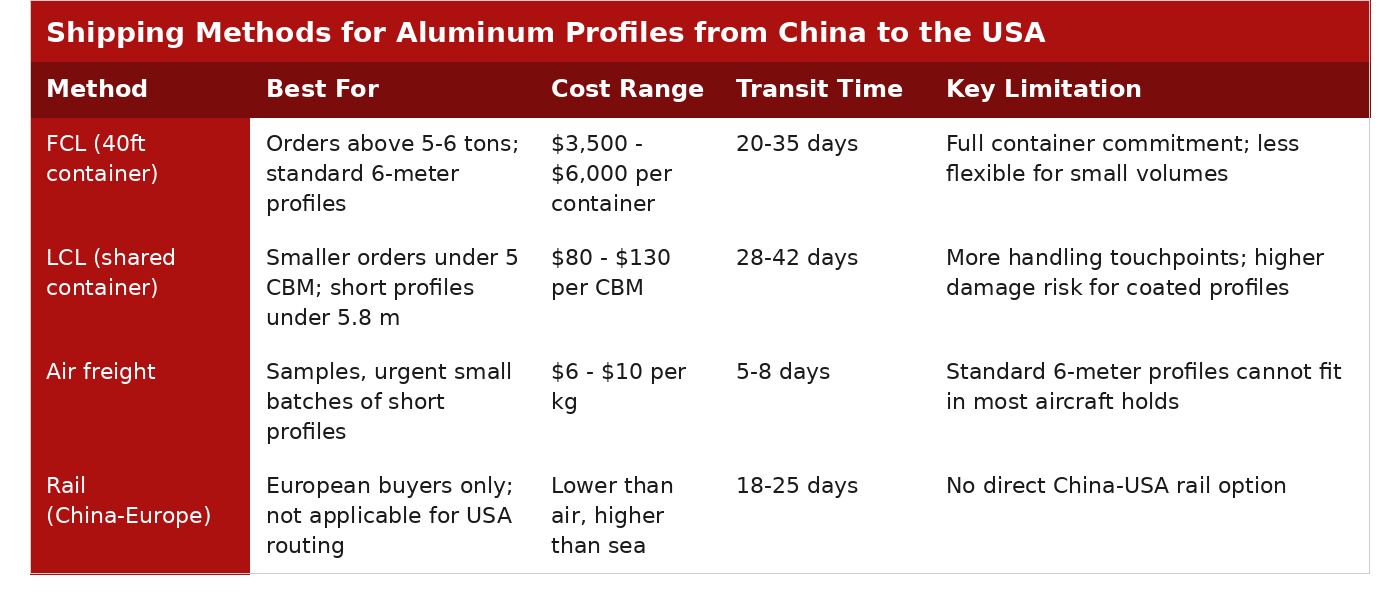
Shipping Methods for Aluminum Profiles from China
The single most important factor when planning an aluminum profile shipment is profile length relative to container dimensions.
Container Size and Profile Length
Standard architectural and industrial profiles are produced in 6-meter lengths, and a 20ft container fits profiles up to approximately 5.8 meters - so 6-meter profiles require a 40ft container. Cutting profiles to shorter lengths is an option where the application permits.
For LCL (Less than Container Load) shipments, the same constraint applies. The consolidation facility must handle 6-meter cargo, and not all warehouses accommodate that length. Confirm before booking, as some carriers also apply a length surcharge.
Air Freight Limitations for Aluminum Profiles
Air freight for profiles longer than 3 meters is generally not viable, because freighter aircraft hold dimensions prevent loading standard 6-meter aluminum bundles.
Air freight remains suitable for samples, short profile sections, and small urgent batches where length permits. For full-length profiles requiring urgent delivery, sea freight is the only practical option.
FCL vs LCL for Aluminum Profiles
The weight and length of aluminum profiles make the FCL/LCL decision more clear-cut than for most cargo types.
Below 5 metric tonnes: LCL is generally more cost-effective. At this volume, paying for unused container space outweighs the per-CBM LCL rate.
5 to 10 metric tonnes: Compare quotes for both. The decision depends on profile dimensions, how efficiently the cargo fills a container, and how many handling stages the LCL route involves.
Above 10 metric tonnes: FCL on a 40ft container is almost always better - lower cost per unit, fewer handling touchpoints, and significantly lower damage risk for surface-treated profiles.
One consideration specific to aluminum: LCL shipments pass through a consolidation warehouse and are handled multiple times before loading. For mill-finish profiles this is acceptable, but for powder-coated or anodized profiles, each additional handling stage increases the risk of surface damage. Where the finish matters, FCL is the lower-risk option even at smaller volumes.
How to Package Aluminum Profiles for Sea Freight
Most profile damage occurs at origin, not during transit. Surface-treated profiles are the most vulnerable - scratches on powder-coated or anodized finishes cannot be repaired in the field.
Before loading, suppliers should apply the following:
Protective PE film on all visible surfaces before bundling. For coated or anodized profiles, this is non-negotiable.
Pearl cotton or foam interleaving between layers within each bundle to prevent metal-on-metal contact.
Corner protectors at strap contact points to prevent crushing thin wall sections.
Wooden crating or pallets for LCL shipments, where cargo passes through a consolidation warehouse and is handled multiple times.
For FCL shipments direct from factory to port, well-strapped bundles with PE film and end caps are generally sufficient if the container is loaded correctly. Request loading photos before the container is sealed.
One detail that regularly causes US customs holds: packing lists must match the actual bundle count and weight exactly. CBP reviews Chinese aluminum entries closely, and even minor discrepancies between documentation and physical cargo can trigger an inspection hold.
Sourcing Aluminum Profiles from China
China's aluminum extrusion industry is organised around several distinct production clusters, each with a different product focus. Matching product requirements to the right region reduces quality risk and simplifies logistics.
Aluminum Profile Production Regions in China
Architectural profiles - window frames, curtain wall sections, door systems: Guangdong (Foshan, Zhaoqing) is the primary source. It is the largest cluster, with suppliers across all quality tiers and established experience with international buyers. Ships from Shenzhen or Guangzhou.
Industrial and structural profiles - T-slot framing, machine bases, structural sections: Shandong (Linyi, Zibo) and Jiangsu (Wuxi, Changzhou). Jiangsu suppliers generally carry stronger quality management systems for precision industrial work. Both regions ship from Shanghai or Qingdao.
Precision and specialty profiles - heat sinks, LED channels, tight-tolerance custom extrusions: Jiangsu and Zhejiang (Yongkang). Zhejiang handles higher-volume mixed industrial runs; Jiangsu suits tighter-tolerance precision work.
How to Find Aluminum Profile Suppliers in China
Alibaba - Most accessible starting point. Filter for verified suppliers, but treat "Gold Supplier" status as a baseline indicator only - it reflects platform tenure, not product quality. Always request a mill test certificate and a video walkthrough of the production line before shortlisting.
Global Sources - Attracts more established manufacturers with fewer trading companies posing as factories. Worth cross-referencing against Alibaba results to check consistency.
Canton Fair - Held every April and October in Guangzhou. The building materials and industrial components section includes aluminum profile manufacturers. Meeting suppliers in person and handling samples on-site reduces the verification burden significantly.
Third-party factory audit - For larger or recurring orders, an independent audit through SGS, Bureau Veritas, or a local China-based inspection firm confirms production capacity, quality systems, and export documentation capability before any money changes hands.
US Import Duties on Chinese Aluminum Profiles
Three layers of duty apply simultaneously to Chinese aluminum profiles entering the US, and the combined burden is significantly higher than most importers calculate on a first order.
Current Duty Rates on Chinese Aluminum Profiles
The current structure as of June 2026 is shown in the table below.
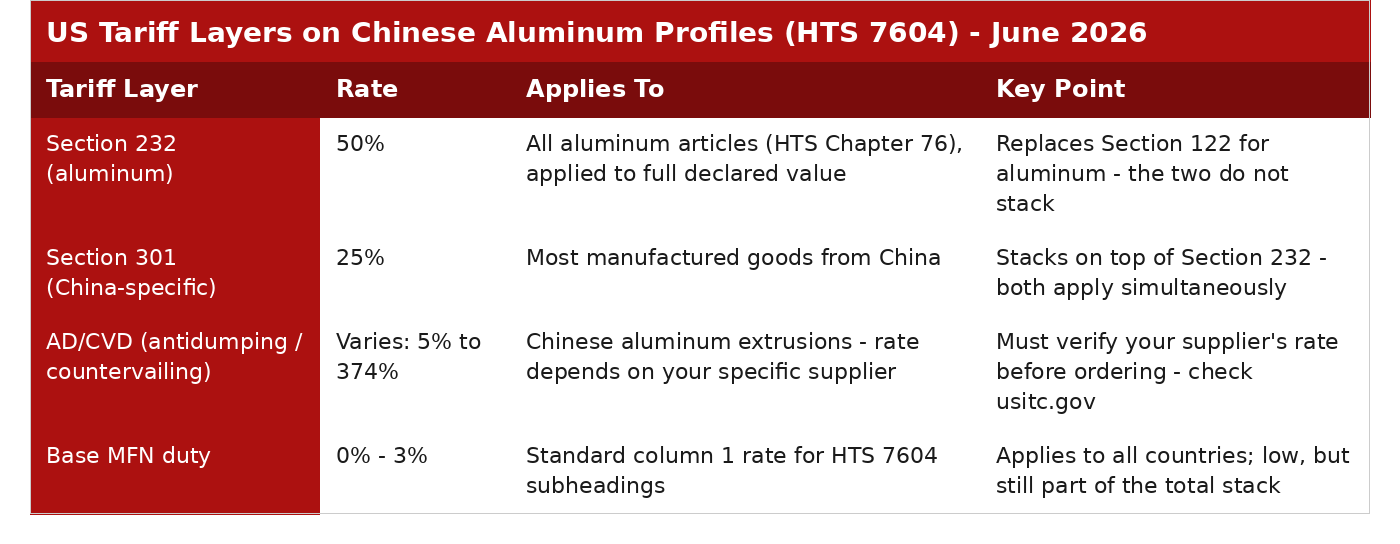
Aluminum tariff: 50% on the full declared invoice value, applied to all aluminum articles under HTS Chapter 76 regardless of country of origin.
China-specific tariff: 25% stacks directly on top. Together, these two layers create a minimum duty burden of 75% on declared value before anything else is added.
Anti-dumping duty: variable - the rate depends on the specific supplier. See the section below.
Base MFN duty: approximately 1.5% for most HTS 7604 subheadings.
The June 8, 2026 tariff update introduced temporary rate reductions for agricultural equipment and certain industrial machinery, but standard aluminum profiles under HTS 7604 are not included. The rates above apply in full.
Anti-Dumping Duty Scope and Rates
Anti-dumping duties on Chinese aluminum extrusions have been in force since 2011 and represent a separate layer on top of the tariffs above. This is where importers are most commonly caught out.
What is covered:
Anti-dumping duties apply to aluminum extrusions sold in profile form - architectural sections, T-slot framing, heat sink profiles, LED channels, and window frames classified under HTS 7604.
What may be excluded:
Finished assembled products classified under HTS 7610 are generally outside the anti-dumping scope, so a completed curtain wall system or pre-assembled window unit may not trigger it. The raw profiles used to manufacture those products would. The boundary between profile and finished assembly is genuinely complex, and any product sitting between these two categories should be confirmed with a customs broker before ordering.
The rate is supplier-specific:
Most Chinese aluminum suppliers have never applied for an individual rate review with US authorities. Without one, a supplier falls under the China-wide entity rate, which currently stands at 86.01% based on the April 2026 preliminary review results. Suppliers that have completed an individual review may have lower rates, but this cannot be assumed and must be verified before ordering.
How to Check Your Supplier's Anti-Dumping Rate
Go to usitc.gov and search for the active aluminum extrusions order (case A-570-967)
Look up the supplier by full company name under the current review period
If the supplier does not appear individually, the 86.01% China-wide rate applies
A US customs broker can run this check in a few minutes, and it should be completed before placing the purchase order.
Aluminum Profile Landed Cost Examples from China to USA
Both examples use the current China-wide anti-dumping rate of 86.01%. If a supplier holds an individual rate, the figures will differ.
Example 1 - Architectural profiles, FCL shipment to Los Angeles
A building materials importer sources 6063 window frame profiles from a Foshan supplier, shipping a full 40ft container from Shenzhen.
FOB value: $30,000
Ocean freight (Shenzhen to LA, 40ft FCL): $4,200
Marine insurance: $300
Aluminum tariff (50% of FOB): $15,000
China-specific tariff (25% of FOB): $7,500
Anti-dumping duty (86.01% of FOB): $25,803
Base MFN duty (~1.5% of FOB): $450
Customs broker and port fees: $600
Total landed cost: $83,853 - effective duty rate approximately 163% on FOB value.
Example 2 - Industrial T-slot profiles, LCL shipment to New York
An industrial equipment distributor sources 4040 T-slot profiles from a Wuxi supplier, shipping LCL from Shanghai.
FOB value: $8,000
Ocean freight (LCL from Shanghai, ~3 CBM): $480
Marine insurance: $90
Aluminum tariff (50% of FOB): $4,000
China-specific tariff (25% of FOB): $2,000
Anti-dumping duty (86.01% of FOB): $6,881
Base MFN duty (~1.5% of FOB): $120
Customs broker and port fees: $350
Total landed cost: $21,921 - effective duty rate approximately 174% on FOB value.
These figures use the China-wide anti-dumping rate. Verify the specific rate for your supplier before committing to an order.
Import Documentation for Aluminum Profiles from China
CBP reviews Chinese aluminum entries closely, and a documentation error at origin creates a problem at the US port that is slow and costly to resolve.
The following documents must be accurate and consistent with each other:
Commercial invoice - Declared value must reflect the actual transaction price. Aluminum valuation is a known CBP focus area given the trade remedy history on this product.
Packing list - Bundle count, profile dimensions, weight, and surface treatment must match the physical contents of the container exactly.
Certificate of Origin - Required for correct tariff treatment and must accurately reflect where the profiles were manufactured.
Mill test certificate - Shows alloy composition. Required by many US buyers for structural applications and supports correct HTS classification.
Anti-dumping duties are deposited at the time of entry and reviewed annually. If a supplier's rate changes in a subsequent Commerce Department review, the importer may receive a bill or a refund months after the goods cleared. This is a routine feature of how anti-dumping duty works - adjustments happen every review cycle.
Shipping Aluminum Profiles from China with Gerudo Logistics
Gerudo Logistics manages FCL and LCL shipments of industrial materials and equipment from operations in Shenzhen, Shanghai, Ningbo, and Qingdao. For aluminum profile shipments to the US, we coordinate the full China-side process:
Cargo booking and vessel scheduling from the relevant port
Customs clearance on the Chinese side
Documentation preparation, including commercial invoice review, packing list verification, and certificate of origin
Supplier collection and consolidation for LCL shipments
The objective is to ensure the US customs broker receives clean, consistent paperwork on arrival, reducing the risk of holds and delays at the port of entry.
To discuss a shipment or request a freight quote,contact our team directly.
Frequently Asked Questions
How Much Is Import Duty on Aluminum Profiles from China
The minimum combined duty rate is 75% of the declared value - a 50% aluminum tariff plus a 25% China-specific tariff. On top of this, an anti-dumping duty applies at a rate specific to your supplier. The China-wide default anti-dumping rate is currently 86.01%, bringing the effective total to over 160% for most importers. Verify your supplier's specific rate before ordering.
Does Anti-Dumping Duty Apply to All Aluminum Profiles from China
Anti-dumping duty applies to aluminum extrusions in profile form classified under HTS 7604. Finished assembled products under HTS 7610 are generally outside the scope. Any product sitting between raw profile and finished assembly should be confirmed with a customs broker before ordering.
How to Check an Anti-Dumping Rate for a Chinese Aluminum Supplier
Search the USITC database at usitc.gov for the active aluminum extrusions order (A-570-967) and look up the supplier by full company name. If they are not listed individually, the current China-wide rate of 86.01% applies. A customs broker can run this check in a few minutes.
Can Aluminum Profiles Be Shipped by Air from China
Standard 6-meter profiles cannot be loaded onto most freighter aircraft due to hold dimension constraints. Air freight is viable for samples and short profile sections under 3 meters. For full-length profiles, sea freight is the only practical option.
What Documents Are Required to Import Aluminum Profiles from China
The standard documents required are a commercial invoice, packing list, bill of lading, certificate of origin, and mill test certificate. All documents must be accurate and consistent with each other, as CBP reviews Chinese aluminum entries closely and discrepancies can trigger inspection holds.
Is a Customs Broker Required for Aluminum Profile Imports from China
Yes. Anti-dumping duty deposits must be calculated and filed at entry, which requires a licensed customs broker. This is a separate role from a freight forwarder. A freight forwarder like Gerudo Logistics coordinates the China-side process: cargo booking, Chinese customs clearance, documentation preparation, and supplier collection. Both roles are needed, and they work in parallel on the same shipment.
Did the June 2026 Tariff Update Lower Aluminum Profile Import Costs
For standard aluminum profiles, no. The June 8, 2026 rate reductions apply to agricultural equipment, certain industrial machinery, and HVAC systems. Standard aluminum profiles under HTS 7604 are not included, and the 50% aluminum tariff plus 25% China-specific tariff both apply in full.
Conclusion
Importing aluminum profiles from China is operationally manageable. The freight process is well-defined, and the documentation requirements are clear. What requires careful upfront planning is the duty calculation.
The minimum duty burden on a standard profile shipment from China is 75% of the declared value before anti-dumping duty is added, and verifying the supplier's anti-dumping rate before placing an order is the single most important step an importer can take.