Harbor Maintenance Fee for US Ocean Imports
Every ocean freight shipment arriving at a US port carries a line item that most importers only notice when the customs bill arrives: the Harbor Maintenance Fee. At 0.125% of cargo value, it is rarely the largest cost on the entry. But if you are managing regular FCL imports from China, it belongs in your cost model from day one.
This guide covers how HMF is calculated, who pays it, when it does not apply, and how it sits inside your total landed cost.
What Is the Harbor Maintenance Fee
The Harbor Maintenance Fee is a US federal charge on ocean cargo arriving at designated US ports. CBP collects it at the time of customs entry, and the funds go toward dredging and maintaining those ports.
Two things define it:
It applies only to ocean freight - air, truck, and rail imports do not pay it
There is no minimum and no maximum - the fee scales directly with your declared cargo value
The fee appears on your CBP Entry Summary (Form 7501) alongside import duties and MPF.
How to Calculate HMF
The Formula
Declared cargo value x 0.00125 = HMF
The base is the commercial value you declare to CBP on your invoice. Ocean freight and insurance are not included in the base.
Worked Examples
LCL pallet, industrial components - cargo value $20,000 - HMF = $25.00
FCL, machinery - cargo value $80,000 - HMF = $100.00
FCL, chemicals or pharma ingredients - cargo value $250,000 - HMF = $312.50
FCL, high-value DG cargo - cargo value $500,000 - HMF = $625.00
The rate has held at 0.125% since the fee was introduced. There are no scheduled changes as of mid-2026.
A Note on Declared Value
Use the actual transaction price from your commercial invoice. Undervaluing cargo to reduce HMF is a customs violation. CBP audits declared values on a risk basis, and chemical and industrial goods receive closer scrutiny. The penalty exposure far exceeds any HMF saving.
Who Pays HMF
Standard Ocean Imports
The Importer of Record (IOR) is responsible. Your US customs broker calculates the amount and files it on Form 7501 as part of your customs entry. Payment is due before cargo is released.
DDP Shipments
Under DDP terms, your freight forwarder covers HMF and passes the cost through in the overall price. Always ask for an itemized breakdown - a DDP quote that cannot separate HMF, MPF, duties, and broker fees is worth questioning.
Note that a US customs bond is also required for formal entries - confirm whether your DDP arrangement includes bond coverage or whether you need to secure one separately.
FOB and EXW Buyers
If you are buying FOB or EXW from a Chinese supplier and arranging your own freight, HMF liability sits with you as importer of record. Make sure your customs broker includes it in the entry. First-time importers managing their own freight sometimes miss this.
Foreign Trade Zone Admissions
HMF applies when goods enter an FTZ - this is a common misconception. It is paid quarterly via CBP Form 349, due within 31 days after each quarter ends. The HMF exemption applies when goods leave an FTZ for export, not at admission.
When HMF Does Not Apply
HMF is waived in the following situations:
Air, rail, and truck imports - HMF is an ocean-only fee
In-bond shipments for direct re-export - cargo must transit to a third country without entering US commerce
Ship stores, vessel equipment, and bunker fuel - carrier-side exemption
Government and humanitarian cargo - CBP certification required
Informal entries - shipments with a declared value under $2,500
Domestic coastwise movements - cargo moving between US ports on US-flagged vessels
For commercial importers sourcing from China by ocean freight, HMF applies to essentially every shipment. These exemptions cover specific operational situations.
On the Air Freight Exemption
Some importers ask whether routing by air to avoid HMF makes sense. The numbers rarely work. HMF on a $200,000 shipment is $250. The air freight premium on equivalent volume from China will almost always exceed that by a significant margin. Route by air when speed or cargo type requires it - not to save on HMF.
How HMF and MPF Compare
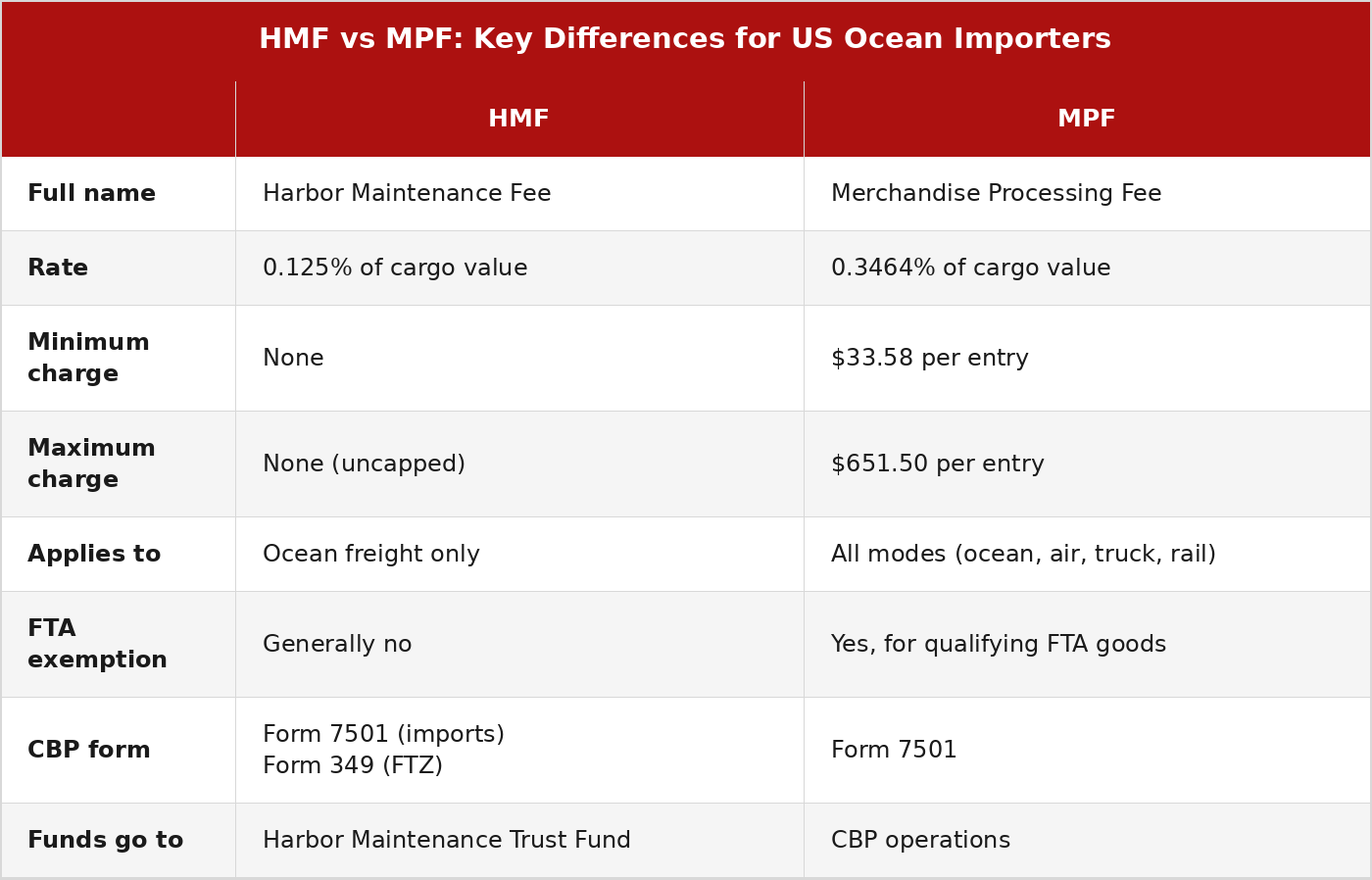
Both fees appear on the same customs entry. They are frequently confused.
The Cap Difference
MPF hits its ceiling of $651.50 at a cargo value of roughly $188,000. Above that, it stays flat. HMF has no ceiling - it keeps scaling linearly. On a $500,000 shipment, MPF costs $651.50 and HMF costs $625. They are close in absolute terms, but HMF got there by scaling while MPF was capped.
FTA Goods
MPF can be waived for goods that qualify under a US Free Trade Agreement - Canada, Mexico, South Korea, and others. HMF generally is not waived for FTA goods arriving by ocean. Since China has no FTA with the US, this does not affect China-origin imports directly. It matters when comparing China sourcing against FTA-country alternatives on landed cost.
Entry Consolidation
Each customs entry generates one MPF charge, capped at $651.50. Consolidating multiple purchase orders into one entry means one MPF. HMF is assessed on total shipment value regardless of entry count - consolidation does not reduce your HMF.
HMF in Your Total Landed Cost to USA
HMF is rarely the largest number on your customs bill. Section 301 tariffs are. But every line item in your cost model should be calculated, not estimated.
Example 1 - $100,000 FCL, Industrial Chemicals, Shanghai to Los Angeles
Product value (FOB): $100,000
Ocean freight: $3,200
Marine insurance: $1,050
Section 301 tariff (25%): $25,000
Standard import duty (3.7%): $3,700
MPF: $651.50 (capped)
HMF: $125.00
Customs broker fee: $350
Port handling / terminal: $450
Total estimated landed cost: $134,526
HMF is roughly 0.09% of total landed cost here. Section 301 tariffs are 100x bigger. Still, $125 underreported across 20 annual containers is $2,500 in unaccounted cost.
Example 2 - $300,000 FCL, Specialty Chemicals
Product value (FOB): $300,000
Ocean freight: $4,200
Marine insurance: $3,150
Section 301 tariff (25%): $75,000
Standard import duty (5%): $15,000
MPF: $651.50 (capped)
HMF: $375.00
Customs broker fee (DG): $650
Port handling/terminal: $480
Total estimated landed cost: $399,506
HMF is $375 against a $75,000 tariff bill. Getting the HTS classification right matters far more. But $375 is real, recurring, and should appear as its own line - not buried in a "misc fees" figure.
Where Landed Cost Errors Actually Happen
In our experience with DG shipments from China to the US, errors concentrate at three points:
Wrong HTS classification - changes the duty rate and Section 301 exposure
Misapplied Section 301 lists - products that were moved between lists or excluded
Fees estimated rather than calculated - HMF is one of the easiest to calculate exactly
How Gerudo Logistics Supports US-Bound DG Shipments
Gerudo Logistics specializes in dangerous goods and temperature-controlled cargo from China to global markets, including the United States.
For every US-bound shipment we manage, we prepare a pre-shipment landed cost estimate covering:
Ocean freight and DG surcharges
Marine insurance
Estimated duties and Section 301 tariffs
MPF and HMF as separate line items
We do not bundle these into an all-in figure. Each cost component is listed so you can verify it against your own calculations.
Our scope covers the China side: cargo classification, DG documentation, export compliance, and ocean transport from Guangzhou, Shenzhen, Shanghai, Ningbo, Qingdao, and Dalian. Your US customs broker handles the import entry - we coordinate the documentation handoff so the entry can be filed without delays.
For US-bound DG or high-value cargo, contact our team to discuss routing and cost structure before your order is placed.
Frequently Asked Questions
Has the HMF rate changed recently, and could it increase?
The rate has held at 0.125% since the fee was introduced. There are no confirmed changes as of mid-2026. HMF is set by statute and requires Congressional action to change - unlike MPF, which is adjusted periodically for inflation.
Does HMF apply to LCL shipments?
Yes. Each importer in a consolidated container pays HMF on their individual cargo value. The fee is not calculated on the full container - only on your declared portion.
If I use air freight to avoid HMF, does that make financial sense?
Rarely. Air freight costs $4-8 per kilogram more than ocean on China-US routes. On a 5,000 kg shipment, that is $20,000-$40,000 in extra freight to avoid $62.50-$625 in HMF. Use air freight when speed or cargo type requires it.
Is HMF included in DDP quotes from China?
It should be. A complete DDP quote covers duties, Section 301 tariffs, MPF, HMF, and broker fees. Ask for an itemized breakdown. If a forwarder cannot separate these, that is a sign the quote may carry hidden costs.
What happens if HMF is not paid?
CBP holds your cargo until the fee is settled. Late payment can result in penalties and interest. Non-payment typically means the entry was filed incorrectly - the clearance hold applies either way.
Does HMF apply to every US port?
HMF applies at designated commercial ports maintained by the Army Corps of Engineers. This covers all major US seaports - Los Angeles, Long Beach, New York/New Jersey, Savannah, Houston, Seattle, and others. Confirm with your customs broker for smaller or inland ports.
What other fees apply alongside HMF on a US ocean import?
Standard cost components on a US ocean entry from China:
MPF - 0.3464% of cargo value, min $33.58, max $651.50
Import duty - based on HTS code
Section 301 tariffs - varies by product
ISF filing - required 24 hours before vessel departure from China; late filing penalty is $5,000 per violation. See our ISF filing guide for the full requirements.
Customs broker fee - typically $150-$500 per entry
DG documentation fees - if applicable
See our guide to shipping from China to the US for a full breakdown.
Conclusion
HMF is a flat 0.125% on ocean cargo value, with no cap and almost no exemptions for standard commercial imports. The fee is small relative to Section 301 tariffs. It is also simple to calculate - there is no reason to estimate it.
Build it into your cost model. Confirm it is covered in any DDP quote. For DG and high-value chemical shipments where cargo values compound the number, contact our team to discuss the full cost picture before your order is confirmed.