Shipping Frozen Food from China to Europe: 2026 Import Guide
Importing frozen food from China to Europe requires route planning before the reefer container is booked. Product category, EU entry route, certificate requirement, European port, temperature requirement and final refrigerated delivery all affect whether the shipment can move without costly delay.
Most frozen food is shipped at -18°C or colder, but the import route can change by product type. Frozen seafood, frozen meat products, frozen vegetables, frozen fruit, frozen dumplings, frozen bakery products and frozen ready meals may use the same reefer equipment, while their EU documents and inspection requirements can differ.
This guide is written for importers who source frozen food from China and need a practical view of the Europe route. It explains what to check before booking, how BCP delays affect cost, how to compare China-Europe reefer routes, and how Gerudo Logistics supports frozen food shipments from China to European ports.
Key Checks Before Shipping Frozen Food from China to Europe
A China-Europe frozen food shipment should be planned around the product file, departure port, arrival port and final cold-chain route. These details should be confirmed with the freight forwarder in China before cargo pickup or container booking.
Prepare these points before booking:
Product name and HS code
Full ingredient list
Product photos or label
Frozen storage temperature
Carton, pallet and loading details
Production site information
Certificate requirement, where known
China pickup address and loading port
Destination country and preferred European port
Final cold store or delivery address
Required delivery deadline
The route should follow the product file. If the product category, certificate requirement or destination entry process is unclear, the shipment should be checked before the reefer container is booked.
Destination Entry Checks for Frozen Food from China
For frozen food imports into Europe, the freight plan depends on product type, ingredient composition, processing method, certificate requirement and destination port. A weak or inconsistent product file can delay the container even when the reefer unit works normally.
The route is usually shaped by:
Product name and HS code
Frozen storage temperature
Ingredient composition
Processing method
Certificate wording
Production site information
Destination port and inspection process
Destination-side entry document preparation where applicable
Final refrigerated delivery plan
The practical point is simple. If the shipment may be checked at the European entry port, the route should be selected around document timing, reefer power availability, inspection handling and final refrigerated delivery.
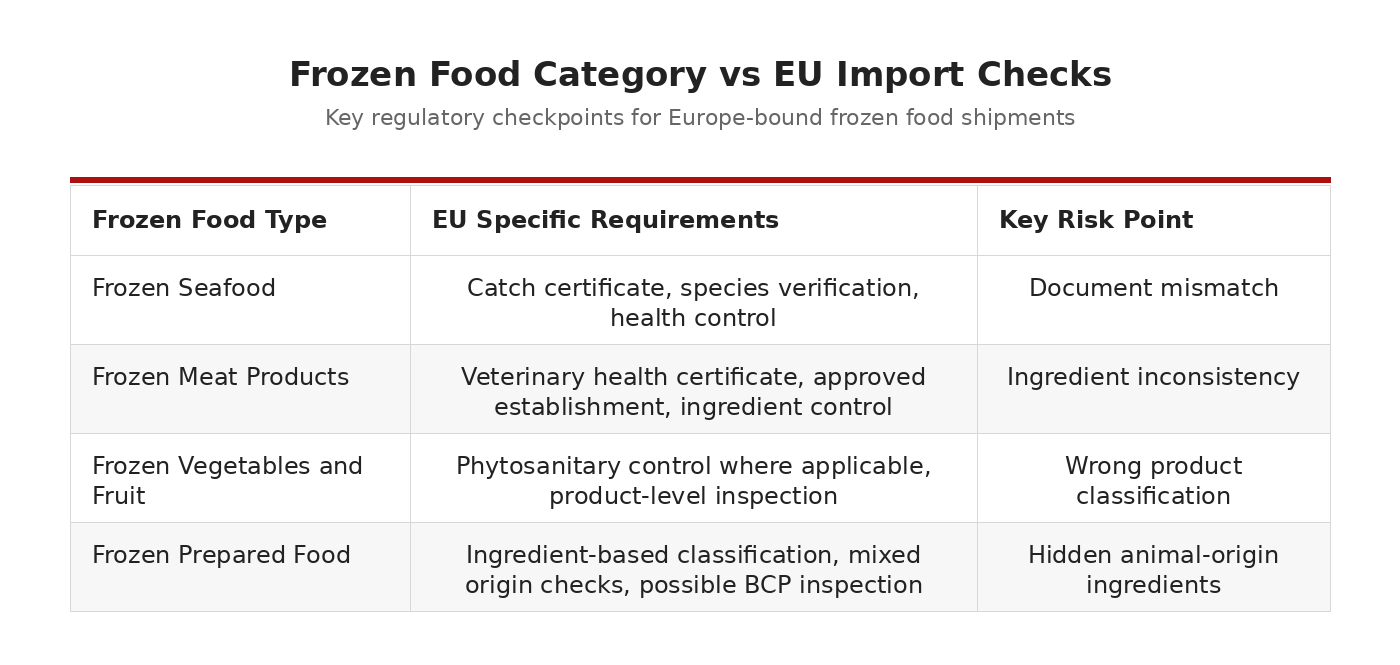
Frozen Seafood
Frozen seafood includes products such as frozen fish fillets, shrimp, squid, eel, scallops and mixed seafood products.
These shipments often need careful document review because species name, product description, catch documentation and health certificate details must match. Do not book the reefer container until the seafood file has been checked against the planned destination route.
Before booking, send the product name, species name, HS code, producer details, catch document status and frozen storage requirement to the freight forwarder in China. This helps confirm whether the planned China port, European port and certificate timing fit the shipment.
Frozen Meat Products
Frozen meat and meat-containing food can include frozen poultry, pork, beef, meat dumplings, meat buns, ready meals and mixed frozen products with meat fillings.
Production site, product description, certificate format and ingredient list must fit the planned route. If a frozen food product contains meat in the filling, sauce or prepared meal, it should be reviewed as a meat-containing product before freight booking.
The main risk is inconsistency. If the invoice, packing list, label, certificate draft and product specification describe the cargo differently, the shipment may face questions at destination.
Frozen Vegetables and Fruit
Frozen vegetables and fruit may look simple, but the document requirement still depends on product type and processing level.
A phytosanitary document may be required for some products. A washed, cut, blanched, pureed or mixed frozen product may create a different document file from a basic frozen single-ingredient product.
These products often move more smoothly than frozen seafood or meat-containing food, but the shipment still needs correct HS code, product description, temperature requirement and final cold-chain plan.
Frozen Prepared Food
Frozen prepared food is often the hardest category to classify because it may contain vegetables, meat, seafood, egg, dairy, seasoning, sauce or mixed fillings.
The commercial product name alone is too weak for freight planning. A frozen vegetable dumpling and a frozen shrimp dumpling may look similar in retail packaging, while the document file and entry process can be different.
Before booking, provide the full ingredient list, product photos, label, HS code proposal, storage temperature and production site information. Gerudo Logistics can review these details from the China freight side and flag whether the shipment needs further document confirmation before loading.
Documents Needed for Frozen Food Shipping from China to Europe
The document set depends on product category and destination country. One frozen food file will not work for every product.
Basic shipping documents usually include:
Commercial Invoice
Packing List
Bill of Lading
Certificate of Origin, where required
Product specification
HS code support
Frozen storage temperature requirement
Loading records or photos
Temperature records, where used
Food control documents may include:
Health Certificate or Official Certificate
Phytosanitary Certificate, where applicable
Catch Certificate for relevant fishery products
Production establishment information
Ingredient statement
Label or product description
Destination-side entry information prepared by the importer or local broker
The certificate description must match the cargo. The English product name, Latin species name where relevant, net weight, carton count, production lot and manufacturer details should be consistent across the file.
For seafood, catch documentation should be checked early. For meat-containing frozen food, the ingredient list should be reviewed before the shipment is treated as a simple prepared food item. For frozen vegetables and fruit, the document requirement depends on the specific product and processing level.
How to Choose the Best European Port for Frozen Food from China
The best European port is the port that fits the product category, destination entry process, final destination and refrigerated inland transport plan.
Rotterdam and Antwerp-Bruges are often practical for Benelux, western Germany and wider inland distribution. Hamburg is commonly considered for Germany, Central Europe and some northern routes. Valencia and Barcelona may fit Spain and parts of the western Mediterranean. Genoa and La Spezia may fit Italy and nearby southern markets.
Compare ports by:
Port suitability for the product
Reefer plug-in capacity
Inspection appointment process
Refrigerated trucking availability
Distance to the final cold store
Total landed cost
Risk of missed delivery appointment
Free time and demurrage exposure
A wrong port choice can make a shipment more expensive even when the ocean freight looks attractive. If the cargo may be inspected after arrival, the port decision should be checked with the freight forwarder in China before booking.
What Happens If Frozen Food Is Held at the European Port
A BCP hold is one of the main Europe-side risks for frozen food. The cargo may remain frozen, while the importer loses free days, delivery slots and cost control.
A frozen food shipment may face document review, seal verification, physical inspection, sampling or temperature record review. During this period, the reefer container must stay powered, and the cost can increase through plug-in charges, storage, demurrage, detention and cold truck rescheduling.
Claims also become harder when the file is weak. Loading photos, seal records, set point confirmation, data logger records, delivery temperature records and inspection reports are useful if the shipment faces temperature deviation, delay or cargo quality dispute.
Cargo insurance should be checked before shipment. Some policies exclude delay-related deterioration, temperature deviation or reefer machinery breakdown unless specific coverage is arranged. Confirm what evidence is required for a frozen food claim before the shipment moves.
Shipping Method for Frozen Food from China to Europe
Ocean Freight
Most frozen food moves by ocean reefer container when the volume supports full container load shipping. Ocean freight gives better cost control for full-container cargo (FCL), especially when the product has enough shelf-life margin and the inventory plan is stable.
Less than container (LCL) load reefer shipping may be possible on selected lanes, but it creates more handling points and more exposure during consolidation. For frozen food, this should be checked carefully before the importer relies on it.
China-Europe rail can be considered for some inland European destinations, but power supply, generator planning, terminal handling, border transfer and temperature record control need lane-by-lane review.
Air freight is usually used for high-value or urgent frozen cargo. It may fit samples, urgent replenishment, promotional launches or sensitive products with limited shelf life. For regular commercial volume, the cost is usually much higher than sea or rail.
How long it take from China to Europe
Ocean transit for China-Europe reefer shipping commonly falls around 30 to 45 days depending on the port pair, service, routing and final delivery point.
Door-to-door planning should include China pickup, cold storage, container loading, terminal cut-off, ocean transit, European port handling, destination checks, customs clearance and refrigerated truck delivery.
The cost of frozen food shipping from China to Europe should be checked by container size and port-to-port route first, then expanded into a landed cost plan. A port-to-port freight rate covers ocean freight between the China port and the European port. Origin pickup, cold storage, destination charges, inspection costs and refrigerated delivery are separate cost items.
For frozen food, 40'RF is usually the main commercial option because it offers better capacity and stronger equipment availability on China-Europe lanes. 20'RF can be used for smaller shipments, but availability and pricing should be confirmed before booking.
How Much Does Frozen Food Shipping from China to Europe Cost
The cost of frozen food shipping from China to Europe should be checked by container size and port-to-port route first, then expanded into a landed cost plan. A port-to-port freight rate covers ocean freight between the China port and the European port. Origin pickup, cold storage, destination charges, inspection costs and refrigerated delivery are separate cost items.
For frozen food, 40'RF is usually the main commercial option because it offers better capacity and more stable equipment availability on China-Europe lanes. 20'RF can be used for smaller shipments, but availability and pricing should be confirmed before booking.
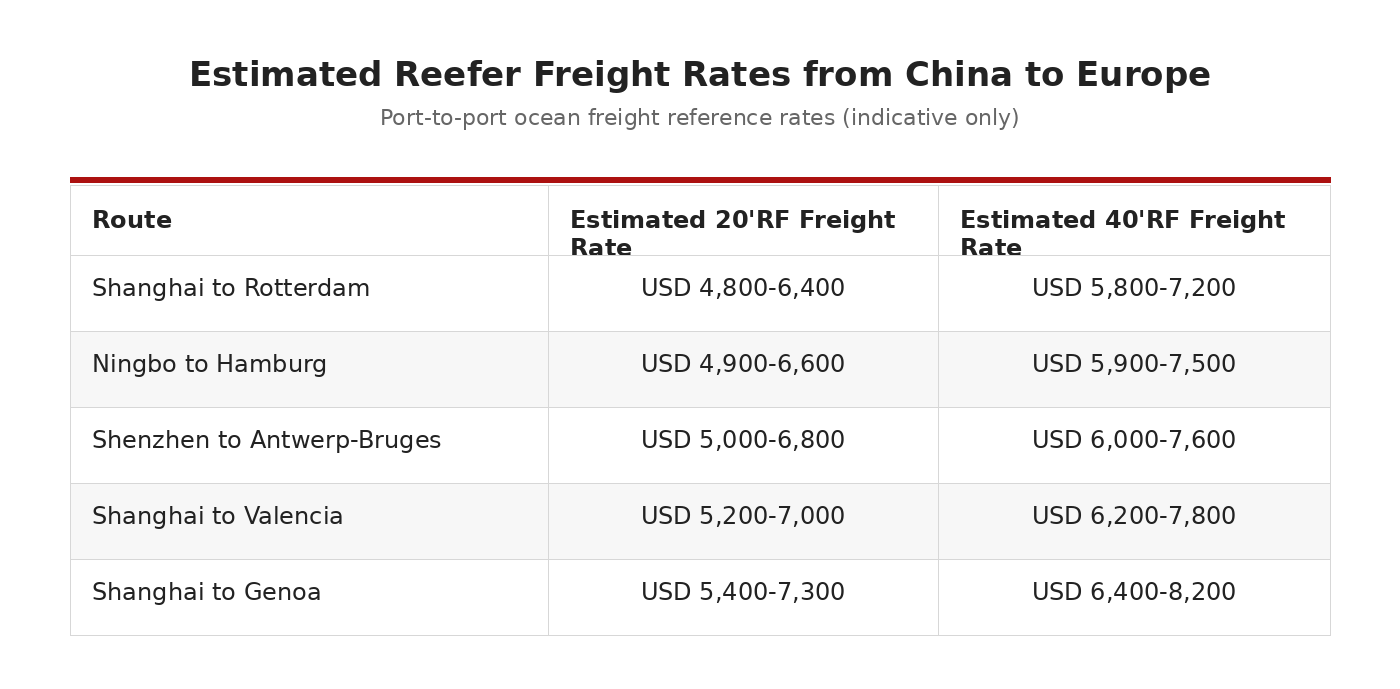
The table below gives broad reference rates for major China-Europe reefer lanes. These figures are estimated port-to-port ocean freight rates and should be confirmed with the carrier or freight forwarder before shipment.
The final landed cost may also include origin pickup, China cold storage, reefer PTI and equipment handling, terminal charges, customs documentation, temperature monitoring, destination port charges, BCP-related storage or inspection, plug-in fees, demurrage and detention, refrigerated truck delivery, destination cold storage and cargo insurance extension.
For frozen food importers, the safer way to compare routes is to compare the full landed cost. A low port-to-port freight rate can become expensive when the route creates longer inland trucking, limited reefer plug availability, BCP delay or extra storage.
How Gerudo Logistics Supports Frozen Food Shipping from China to Europe
Gerudo Logistics, headquartered in Guangzhou with operations across Shenzhen, Shanghai, Ningbo, Qingdao and Dalian, helps importers manage frozen shipments from China with reefer booking, PTI coordination, temperature requirement checks, loading supervision, origin documentation review and carrier coordination.
For shipping frozen food from Chine to Europe, we works with the importer to align the shipment plan with BCP requirements, certificate timing, TRACES or CHED preparation where applicable, reefer power needs, port selection and final refrigerated delivery.
You can contact us before booking if your frozen food shipment needs review.
FAQ About Shipping Frozen Food from China to Europe
What documents are needed to ship frozen food from China to Europe?
The basic documents usually include the Commercial Invoice, Packing List, Bill of Lading, product specification, HS code support and frozen storage temperature requirement. Depending on the product, a Health Certificate, Phytosanitary Certificate, Catch Certificate, establishment information or TRACES and CHED-related file may also be required.
Does frozen food from China need BCP inspection in Europe?
Some frozen food shipments need official controls at a BCP, especially frozen seafood, meat-containing frozen food and certain regulated food categories. The BCP requirement should be confirmed before booking the reefer container.
Does frozen seafood from China need a catch certificate in Europe?
Relevant fishery products may need catch certificate review under the EU IUU system. Since 10 January 2026, CATCH has been compulsory for EU operators and authorities handling fishery product imports.
How long does frozen food shipping from China to Europe take?
Sea freight often takes around 30 to 45 days depending on the port pair and delivery location. Plan the full door-to-door timeline, including China pickup, port cut-off, ocean transit, BCP checks, customs clearance and refrigerated delivery.
Which European port is best for frozen food from China?
The best port depends on the destination country, product category, BCP suitability, reefer plug-in capacity and refrigerated trucking route. Rotterdam, Hamburg, Antwerp-Bruges, Valencia, Barcelona and Genoa may all be valid options for different distribution plans.
How much does a reefer container from China to Europe cost?
A 40'RF container from China to major European ports may often fall around USD 5,800-8,200 for estimated port-to-port ocean freight, depending on route, season, carrier and equipment supply. A 20'RF container may be available on selected routes, but equipment and pricing should be confirmed before booking.
Does cargo insurance cover frozen food spoilage?
Spoilage coverage is not automatic under every marine cargo policy. Before shipment, confirm whether reefer breakdown, temperature deviation, deterioration and delay-related loss are covered.