Shipping Glue from China in Summer: Reefer or Dry Container?
Shipping glue and adhesive products from China in summer requires both chemical cargo review and temperature-risk planning.
Adhesives may leave the supplier warehouse in good condition, then face heat during factory loading, inland trucking, terminal waiting, customs inspection, transshipment, and ocean transit.
For importers, the main question is whether the adhesive can tolerate the full route without losing viscosity, curing early, separating, swelling packaging, leaking, or losing shelf life before it reaches the final customer.
This guide explains when dry container shipping may be enough, when thermal liner protection may help, when reefer container shipping should be reviewed, and when DG reefer handling is required for glue and industrial adhesive shipments from China.
Quick Answer for Summer Glue and Adhesive Shipping from China
Use reefer container shipping when the glue or adhesive has a written storage range, high cargo value, long summer transit, strict customer testing, or heat-sensitive chemistry. This often applies to cyanoacrylate, UV adhesive, medical grade adhesive, conductive silver paste, electronic adhesive, some epoxy systems, and solvent-based adhesive.
Dry container shipping may work for low-risk, non-DG, heat-tolerant glue on a short route. Thermal liner may reduce mild heat exposure, but it is passive protection. It should not be used as the main control method for cargo with a strict storage range or temperature record requirement.
DG adhesive cargo needs carrier approval for both the dangerous goods entry and the reefer arrangement. If SDS Section 14 shows UN 1133, UN 1950, UN 1866, UN 3082, or another DG entry, the shipment should be reviewed as a DG reefer case, not as a normal reefer booking.
Why Glue and Adhesive Shipments from China Face Heat Risk in Summer
Adhesive chemistry is the first decision point because glue is not one transport category. Water-based PVA glue, cyanoacrylate super glue, UV adhesive, PU sealant, two-part epoxy, hot melt adhesive, solvent-based contact cement, and conductive silver paste react differently when exposed to summer heat.
For some products, heat mainly causes viscosity drift, separation, microbial spoilage, package swelling, or shorter shelf life. For reactive adhesives, the risk can be premature curing, polymerization, crystallization, discoloration, or reduced bonding performance. The cargo may still look normal after arrival, but the buyer may only discover the problem during application, bonding tests, or production use.
Route exposure also matters. A standard steel dry container has no active cooling. If a loaded box waits in a hot yard, the cargo may face high internal temperatures before the ocean leg starts. China origin planning should include factory staging, loading time, inland trucking, customs inspection, terminal dwell, vessel cut-off, and transshipment.
Weekend dwell is a common example. If glue is loaded into a warm dry container on Friday and the box waits through a hot weekend, the adhesive has already faced a heat event before sailing.
Which Adhesives Need Reefer or DG Review When Shipping from China
Shelf-life sensitive adhesives
Cyanoacrylate super glue should be reviewed early for summer shipping. Heat may shorten shelf life, increase pressure in small containers, change viscosity, and reduce bonding performance. Some formulas may be screened against UN 1133 if the SDS shows adhesives containing flammable liquid.
UV adhesive, medical grade adhesive, and anaerobic threadlocker often have stricter quality expectations. Temperature exposure may affect curing performance, batch stability, light-sensitive formulas, or customer acceptance. For these products, temperature records may become part of the buyer’s quality file.
Process-sensitive industrial adhesives
Conductive silver paste and electronic adhesive are high-value cargo types where viscosity stability can be critical. Heat exposure may cause formula instability, viscosity drift, or poor process performance after arrival.
Two-part epoxy resin needs component-level review because Part A and Part B may have different storage temperatures, flash points, DG classifications, and shelf life limits. PU sealant, construction adhesive, underfill encapsulant, and specialty electronic adhesives also need closer review when the required temperature range is narrow or customer testing after arrival is strict.
Heat and pressure-sensitive packaged adhesives
Spray adhesive aerosols should be checked for UN 1950 and pressure risk. Summer heat can increase internal pressure, leakage risk, carton damage, and carrier rejection if the shipment is booked incorrectly.
Solvent-based contact cement and pressure sensitive adhesive should be screened first for flammable liquid risk. Retail glue tubes, drums, pails, IBCs, and ISO tanks of adhesive also need review based on formula and package format. Small packages can swell or leak, while larger liquid formats can raise questions about vapor pressure, package approval, marking, labeling, and DG reefer compatibility.
See our specific guide for Shipping Industrial Glue and Adhesives from China.
Common UN Numbers for Adhesive Shipping from China
UN screening helps importers understand likely DG issues before booking. The table below is a pre-screening guide. The final transport entry must match the current SDS Section 14, product formula, flash point, environmental data, package format, and transport mode.
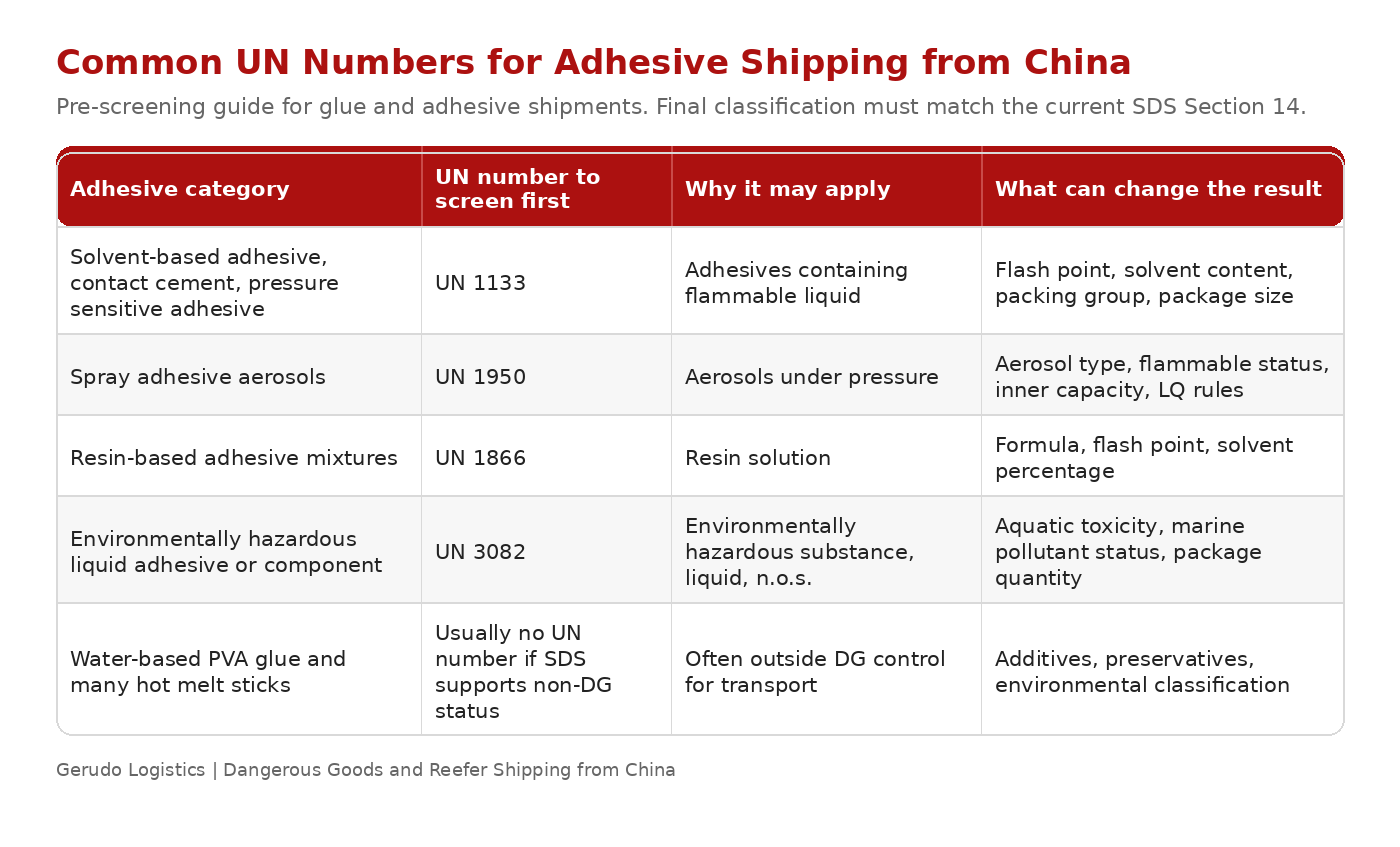
DG status changes the shipping plan because the carrier must accept the UN number, hazard class, packing group, package type, route, and reefer equipment together. A shipment may have reefer space available, but still be rejected if the DG entry or package format is not accepted on that service.
Flash point is the first warning point for many solvent-based adhesives, contact cements, flammable pressure sensitive adhesives, and resin-based formulas. Aerosol adhesive also needs pressure, inner capacity, carton strength, leakage risk, limited quantity possibility, marks, labels, and route acceptance review.
DG cut-off and reefer cut-off must be aligned before pickup. Missing the DG document deadline can cause short shipment, storage cost, repacking, or rebooking, even when reefer equipment is available.
For dangerous goods handling requirements, see Dangerous Goods Shipping from China.
Dry Container vs Thermal Liner vs Reefer Container for Adhesive Shipping
The container option should match the weakest point in the shipment. A low-risk adhesive may move safely in a dry container. A sensitive adhesive with a written storage range may need active temperature control.
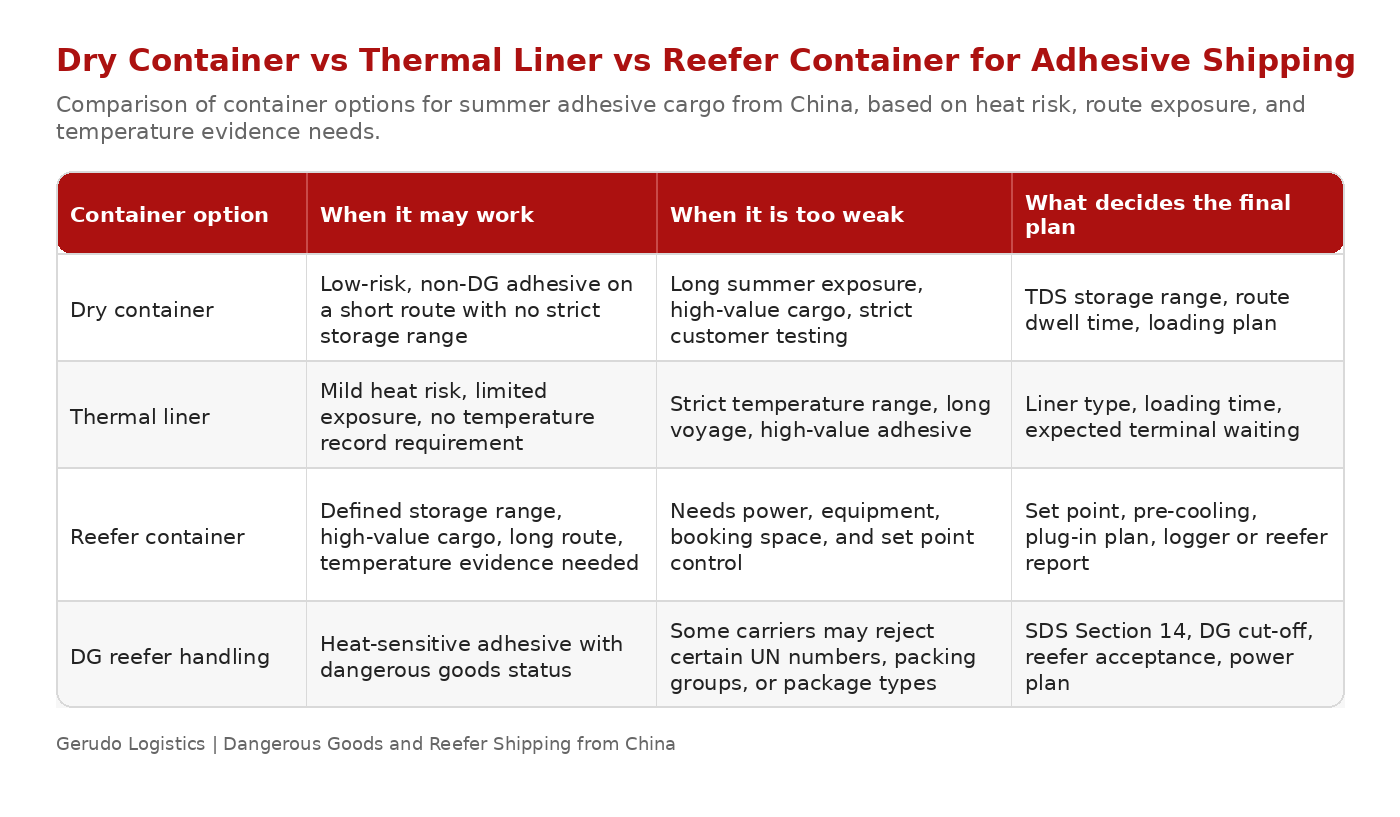
Dry container shipping is usually the lowest-cost option, but it provides no active cooling. It should be used only when the cargo documents and route exposure support that decision.
Thermal liner slows heat transfer. It can reduce mild heat exposure during short or moderate routes, but it cannot guarantee a defined cargo temperature.
Reefer container shipping provides active temperature control when the container is powered and properly managed. This option is stronger for long-haul summer shipments, strict storage ranges, high-value adhesive, and customer-required temperature records.
For general reefer planning, equipment control, and ocean freight temperature management, see Reefer Container Shipping from China.
How to Set Reefer Temperature for Glue and Adhesive Shipments
Reefer set point should come from the supplier’s written TDS, storage instruction, shelf life statement, or quality requirement. It should never be guessed from the product name alone.
A complete temperature instruction should make the target set point, allowed excursion, excursion duration, pre-cooling requirement, condensation risk, and SKU compatibility clear. If several adhesives are loaded together, they must share a compatible temperature range.
Cool handling for many industrial adhesives may be discussed around 15°C to 25°C, but this range is only a planning discussion. Some adhesives may tolerate it, some may need lower chilled handling, and some may be unsuitable for unnecessary chilling because of condensation, crystallization, or application risk.
Pre-cooled loading is important for sensitive cargo. A reefer container maintains cargo temperature during transport. It should not be treated as a fast cooling room for warm adhesive. Before pickup, the freight plan should define PTI status, pre-cooling requirement, supplier loading speed, loading time of day, truck genset requirement, and terminal plug-in arrangement.
China Origin Checks Before Shipping Adhesives in Summer
Product file review comes first.
Without the SDS or TDS, the forwarder cannot judge DG status, temperature sensitivity, storage limits, package risk, or customer acceptance exposure. A complete product file normally includes SDS or MSDS, TDS, packing list, package photos, product label photos, shelf life statement, certificate of analysis for batch-sensitive cargo, supplier summer shipping guidance, and DG declaration where applicable.
Temperature instructions should be written into the shipment file before pickup. A reefer set point mentioned only in chat is weak evidence if the cargo later fails quality testing. The booking file should make the set point, allowed excursion, pre-cooling requirement, ventilation setting, loading time, power plan, and temperature record requirement clear.
DG review must happen before the goods leave the supplier. If the shipment is picked up first and reviewed later, the importer may face repacking, re-labeling, storage cost, or a missed sailing. The main risk is mismatch between the SDS, package marks, and booking description.
Temperature evidence should also be planned before departure. For high-value or customer-tested adhesive, useful evidence may include an independent temperature logger, GPS temperature tracker where suitable, carrier reefer data report, loading photos, seal record, delivery inspection record, and insurance wording for temperature variation.
Common Mistakes in Summer Adhesive Shipping
Choosing the wrong container for shipping
The first mistake is choosing dry container, thermal liner, or reefer shipping before reviewing the SDS, TDS, storage range, and package format. A low freight rate does not mean the adhesive can tolerate summer trucking, terminal waiting, or long ocean transit.
For glue cargo, the product file decides the risk level. A water-based adhesive may still need temperature review, while a solvent-based adhesive may need both DG booking and reefer acceptance.
Treating thermal liner as temperature control
Thermal liner can reduce heat exposure, but it does not actively control temperature. It may work for lower-risk adhesive on shorter routes, but it is too weak for cargo with a strict storage range or customer temperature record requirement.
For long summer routes, transshipment lanes, high-value adhesives, or shelf-life-sensitive formulas, reefer review is usually the safer starting point.
Separating DG review from reefer planning
DG status and reefer planning must be checked together. A shipment may have reefer space available, but still be rejected if the carrier does not accept the UN number, hazard class, package type, or route.
This matters for solvent-based adhesive, aerosol spray adhesive, resin solutions, environmentally hazardous components, and cargo packed in drums, pails, IBCs, ISO tanks, aerosol cans, or mixed retail cartons.
Shipping without temperature evidence
Temperature records should be arranged before pickup, especially for high-value or customer-tested adhesive. After arrival, it is difficult to prove whether a quality failure came from production, factory storage, hot loading, port dwell, ocean transit, or destination delay.
Useful evidence may include an independent temperature logger, carrier reefer data report, loading photos, seal record, set point confirmation, and insurance wording for temperature variation.
How Gerudo Logistics Handles Temperature Controlled Adhesive Shipping from China
Shipping glue from China in summer often needs both chemical cargo review and cold chain planning.
Gerudo Logistics reviews the product data, DG status, package format, route exposure, temperature requirement, customer evidence need, and delivery terms before recommending dry container, thermal liner, reefer container, or DG reefer handling.
We handle adhesive cargo in approved formats such as retail tubes, cartridges, cartons, pails, drums, IBCs, and ISO tanks. From China origin, we coordinate supplier documents, DG booking where required, reefer space, loading timing, terminal power, customs support, temperature records, and final delivery options where available.
If your adhesive is solvent-based, flammable, heat-sensitive, high value, batch-sensitive, packed in drums or IBCs, or subject to strict customer quality rules, you can contact us before confirming the shipment plan.
Frequently Asked Questions About Shipping Glue and Adhesives from China in Summer
Can I import glue from China in summer without a reefer container?
Yes, if the product is low-risk. Dry container shipping may work for non-DG, heat-tolerant glue on a short route, but the decision should still match the product documents, route exposure, and customer quality requirements.
Do I need a reefer container to ship adhesives from China in summer?
Reefer review is recommended when the adhesive has a written storage temperature, high cargo value, long transit, strict customer testing, or a formula that may lose performance under heat.
How do I ship industrial glue internationally during hot weather?
Start with product classification and temperature sensitivity. Check the SDS, TDS, storage range, DG status, route heat exposure, and customer temperature record requirements before choosing dry container, thermal liner, reefer, or DG reefer handling.
What temperature should glue or adhesive cargo be shipped at?
There is no single set point for all glue or adhesives. Many industrial adhesives may be discussed around 15°C to 25°C, while medical, electronic, or specialty adhesives may need chilled handling based on the TDS.
Is reefer shipping more expensive than dry container shipping?
Reefer shipping is usually more expensive because it needs special equipment, power, terminal plug-in, monitoring, and route availability. The exact premium depends on season, lane, carrier, container size, and DG status.
Can I use thermal liner instead of reefer shipping?
Thermal liner may work for mild heat risk and limited exposure. It should not be used as the main control method when the product has a strict storage range or when the customer requires temperature evidence.
Does glue need to be dangerous goods to use a reefer?
Glue does not need to be dangerous goods to move in a reefer container. Non-DG water-based glue may still need temperature control to prevent spoilage, separation, or shelf life loss.
What happens if reefer power fails during transit?
Power failure must be reviewed against the temperature deviation, duration, cargo tolerance, logger record, and insurance terms. Coverage for temperature variation should be checked before the shipment begins.
Can different types of glue be mixed in one reefer?
Mixed glue cargo can move in one reefer only when the products share compatible temperature requirements, DG compatibility, packaging conditions, and customer quality rules.
How do I verify that the temperature was maintained?
Temperature proof can come from an independent logger, GPS temperature tracker where suitable, or a carrier reefer data report. For high-value adhesive, arrange the records before the cargo leaves the supplier.
Conclusion
Shipping glue and adhesives from China in summer should be planned around adhesive chemistry, storage temperature, route exposure, DG status, cargo value, and customer evidence requirements. Dry container shipping may work for low-risk cargo on shorter routes. Thermal liner can reduce mild heat exposure, but it cannot replace active temperature control when the product has a strict storage range.
For high-value, shelf-life-sensitive, flammable, aerosol, medical, electronic, or long-haul adhesive shipments, reefer review is usually the safer starting point. The final plan should match the product documents, package format, carrier acceptance, reefer set point, plug-in arrangement, and temperature record requirement before the cargo leaves the supplier.