Frozen Bakery Products from China: Sourcing, Cold Chain, and Import Guide (2026)
Supermarket bakery sections, hotel breakfast buffets, and QSR chains increasingly source frozen bakery products from China - laminated croissant dough, par-baked pizza crusts, puff pastry blocks, and egg tart shells produced at scale by Chinese factories with strong OEM capability and competitive FOB pricing.
But frozen bakery products carry risks that ambient cargo does not. Temperature control cannot lapse at any point in the journey, from factory freezer to destination cold storage. A single break in the cold chain can degrade texture, reduce shelf life, or trigger a full consignment rejection at destination customs.
This guide covers the practical decisions importers face: what products are realistic to source from China, where and how to find verified suppliers, what cold chain standards apply, and what compliance requirements matter in the key import markets.
What Frozen Bakery Products Can You Source from China
What are frozen bakery products from China? Frozen bakery products from China are raw and par-baked dough items shipped in refrigerated containers for baking or finishing at destination. The category spans laminated doughs such as croissant and puff pastry, par-baked bread and pizza bases, pastry sheets, egg tart shells, and dumpling wrappers. Chinese factories supply these products to supermarket private-label programs, hotel and airline catering operations, and foodservice chains worldwide.
The category divides into two groups. Understanding the difference affects your sourcing approach, your cold chain configuration, and your target market.
Laminated Dough, Par-Baked Bread, and Pastry Products
This is where Chinese production is strongest for international buyers. Common products include:
Laminated dough - croissant dough and puff pastry blocks for hotel bakeries, airline catering, and retail bake-off programs. The most technically demanding product type, requiring precise butter layering at controlled temperatures.
Par-baked bread and pizza crusts - partially baked bases that complete in the oven at destination. Standard for foodservice chains and supermarket private-label programs.
Egg tart shells - Portuguese-style (layered, flaky) and Hong Kong-style (shortcrust). High demand across Southeast Asia, the Middle East, and Chinese diaspora markets in the US and Europe.
Pastry sheets - thin laminated sheets used for samosas, spring rolls, and appetizer production in industrial kitchens.
Pre-proved garlic bread and baguette bases - bake-off format for supermarket in-store bakeries.
Dumpling and gyoza wrappers - circular dough skins calibrated for automated filling machines, used as an industrial ingredient by food manufacturers.
Chinese-Style Prepared Dough Products
Products such as baozi, mantou, scallion pancakes, and youtiao are exported at scale, primarily to markets with large Chinese diaspora populations. These have different HS classifications, different target buyers, and different compliance considerations.
For Chinese-style frozen food including dim sum, steamed buns, and prepared dough snacks, see our article on shipping frozen prepared food from China. This guide focuses on the bakery and dough products listed above.
Sourcing Frozen Bakery Products from China
Where Frozen Bakery Factories Are Located in China
Your supplier's location affects loading port options, inland trucking costs, and production expertise.
Guangdong (Pearl River Delta) is the main cluster for export-oriented frozen bakery. Long experience supplying Hong Kong and overseas markets, proximity to Shenzhen and Guangzhou ports, and a dense supplier ecosystem make this the starting point for most importers.
Shanghai and Jiangsu have strong capacity for hotel and airline catering-grade production. Factories here often carry more robust HACCP documentation and experience with international foodservice buyers.
Shandong has significant output for pastry sheets, dumpling wrappers, and dough-based snack products, often at lower FOB prices than Guangdong.
How to Find Frozen Bakery Suppliers in China
Online sourcing platforms are the most common starting point. Alibaba and Made-in-China.com both list hundreds of frozen bakery suppliers. Filter for "Gold Supplier" or "Verified Supplier" status and request factory audit documentation before any sampling discussion. The main challenge is distinguishing genuine manufacturers from trading companies.
For a full walkthrough of evaluating and ordering from Chinese suppliers through Alibaba, including verification steps and order protection, see our guide on shipping from Alibaba to the USA.
The Canton Fair (held in Guangzhou twice yearly) gives direct access to manufacturers exhibiting for export. The Food Products section of Phase 1 is where most frozen bakery suppliers appear. Face-to-face meetings make supplier verification faster than remote sourcing.
Direct factory outreach is worth pursuing once you have a clear product specification. Many Guangdong factories have English-speaking sales teams and handle sample requests and OEM inquiries directly.
OEM and Private Label Capability
Most mid-to-large factories offer OEM (private label) production as standard. You can typically customize recipe and formulation, shape and portion weight, packaging format, and label design. MOQ is generally one 20ft reefer container, holding roughly 10 to 18 tonnes depending on product and packaging density.
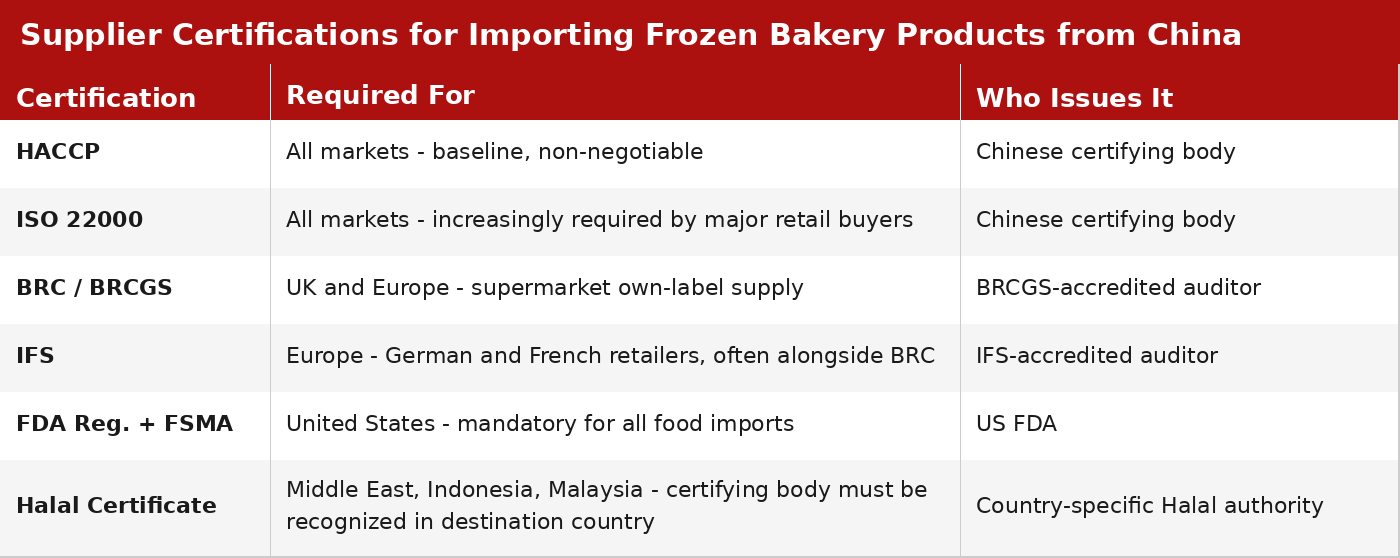
Supplier Certifications to Check Before Ordering
Ask for documentation before investing in sample shipping. The certificates that matter vary by your target market:
Sample Costs and Production Lead Times
Shipping frozen samples from China requires air freight with dry ice. Cost typically runs USD 300 to 800 per sample shipment, borne by the importer even when the factory provides the product. Production lead time after order placement is 15 to 30 days. Ocean freight adds 20 to 40 days depending on destination.
Cold Chain Requirements for Frozen Bakery Shipments
Temperature Requirements for Frozen Bakery Products
Most frozen bakery products ship at -18°C or below. Some par-baked bread products can travel at 0°C to -5°C to preserve crust texture, but this is a niche specification requiring explicit agreement with both supplier and freight forwarder before booking. When in doubt, default to -18°C.
FCL vs LCL: Choosing the Right Container Format
FCL in a 40ft High Cube Reefer is the standard format for commercial volumes. A 20ft reefer works for smaller or trial orders. LCL reefer arrangements carry higher risk because temperature control is shared across multiple consignments and the consolidation process creates exposure risk. For most frozen bakery imports, FCL is the right choice.
Pre-Trip Inspection and Temperature Monitoring
Ask your freight forwarder for a Pre-Trip Inspection (PTI) report confirming the container reached set temperature before loading. Require an IoT temperature data logger installed before the container is sealed, providing a continuous record from stuffing to destination. Without this evidence chain, insurance and carrier liability claims for temperature damage are very difficult to substantiate.
For full guidance on reefer container operations and booking from Chinese ports, see our reefer container shipping guide and reefer container booking guide.
Customs and Compliance Requirements by Market
Compliance requirements vary significantly by destination. The following covers the key certifications and customs documents required for each major import market.
United States
Certifications: FDA registration, FSMA compliance
Documents: Commercial invoice, packing list, bill of lading, Prior Notice, FSVP records
Note: Prior Notice must be filed at least 8 hours before vessel arrival. Confirm your supplier's FDA registration number before placing any order.
Middle East (GCC)
Certifications: Halal certificate (from a body recognized in the destination country), health certificate. For detailed cold chain guidance on the Middle East route, see our Middle East frozen food shipping guide.
Documents: Certificate of Origin, health certificate, Halal certificate, Certificate of Conformity (some products).
Note: Accepted Halal certifying bodies differ by GCC country. Confirm recognition in your specific destination before production begins.
Europe
Certifications: BRC or IFS, health certificate (GACC/CNCA)
Documents: Commercial invoice, packing list, bill of lading, ICS2 pre-notification, destination-language labeling
Note: Label artwork must appear in the language of the destination country. Plan translation before the factory run.
Indonesia / Malaysia
Certifications: Halal certificate (BPJPH-recognized for Indonesia), BPOM registration (Indonesia)
Documents: Certificate of Origin, health certificate, Halal certificate, import permit
Note: BPJPH Halal approval for new products can take several months. Factor this into your sourcing timeline.
For sourcing intelligence on Chinese frozen food supply chains, see our China frozen products market sourcing guide.
Reefer Shipping Costs for Frozen Bakery Products from China
Reefer containers carry a premium over standard dry containers. The main cost variables are:
20ft vs 40ft Reefer Container: Which Size to Choose
A 40ft HQ reefer costs more than a 20ft in absolute terms but delivers a lower per-CBM rate. For volumes above roughly 12 to 15 tonnes, a 40ft is almost always the better choice. Partial fill of a 40ft raises your per-unit cost, so matching container size to order volume matters.
How Origin Port Affects Your Freight Rate
Freight rates differ across Shanghai, Ningbo, and Shenzhen. Beyond the ocean rate, your supplier's distance from the loading port adds inland trucking cost. A Guangdong factory loading in Shenzhen typically has lower inland costs than one routing through Shanghai.
Seasonal Demand and Booking Lead Times
Reefer capacity tightens before Chinese New Year and during peak agricultural export seasons. Book 4 to 6 weeks in advance. Shorter lead times risk no available slots, or last-minute bookings at premium rates.
What Your Reefer Freight Quote Includes
Reefer containers consume electricity at port during dwell, both at origin and destination. Some ports pass this cost to importers as a separate line item. Confirm with your freight forwarder what is included in the quoted rate before accepting a price.
For guidance on managing and reducing reefer shipping costs, see our guide on how to reduce the cost of reefer container shipping.
How Gerudo Logistics Supports Frozen Food Imports
Gerudo Logistics is a cold chain and dangerous goods specialist freight forwarder headquartered in Guangzhou, with operations across Shenzhen, Shanghai, Ningbo, Qingdao, and Dalian. We handle temperature-controlled shipments from origin through to final delivery, covering reefer container booking, documentation review, customs clearance coordination, and cold chain monitoring throughout transit.
For frozen bakery imports specifically, this means verifying supplier certifications before cargo moves, coordinating Pre-Trip Inspections and temperature logger installation at origin, and managing documentation requirements for each destination market, including FDA Prior Notice for US-bound shipments and Halal certificate verification for the Middle East and Southeast Asia. We work with licensed customs brokers at destination ports to keep clearance timelines predictable and reduce the risk of dwell time accumulating in your reefer container.
If you are sourcing frozen bakery or dough products from China, contact us to discuss routing, compliance requirements, and landed cost.
Frequently Asked Questions to Ship Frozen Bakery Products
What temperature is required to ship frozen bakery products from China?
Most frozen bakery products ship at -18°C or below, maintained from factory to destination cold storage. Some par-baked products may have different specifications, but -18°C is the default unless your supplier confirms otherwise in writing.
Can I import frozen bakery products from China as LCL instead of a full container?
LCL reefer arrangements exist but carry higher risk. Temperature control is shared across multiple consignments, and the consolidation and deconsolidation process creates exposure risk. For most commercial volumes, FCL is the more reliable option.
What is the minimum order quantity for importing frozen bakery products from China?
Most factories require at least one 20ft reefer container as a minimum, holding roughly 10 to 18 tonnes depending on product density. OEM orders with custom formulations or packaging typically require a 40ft container minimum.
What certifications should I ask for when sourcing frozen bakery suppliers in China?
At minimum, HACCP and ISO 22000 for any market. Add BRC or IFS for European retail supply, FDA registration and FSMA compliance for the US, and Halal certification from a body recognized in your destination country for the Middle East and Southeast Asia.
How long does it take to import frozen bakery products from China?
Allow 15 to 30 days for production, plus 20 to 40 days for ocean freight. Add time for document preparation, destination customs clearance, and inland delivery. A realistic total timeline from order confirmation to warehouse receipt is 8 to 12 weeks.
Do I need FDA approval to import frozen bakery products from China to the US?
Your supplier must be registered with the FDA, and Prior Notice must be filed before the vessel arrives at a US port. Your customs broker handles the filing using information from your supplier, including their FDA registration number. Confirm registration status before placing any order.
How much does it cost to ship a frozen bakery sample from China?
Air freight for frozen samples using dry ice typically costs USD 300 to 800 per shipment, borne by the importer. The product is usually provided free by the factory. Budget this into your supplier evaluation if you are comparing multiple options.
Conclusion
China has the production scale, certification infrastructure, and OEM capability to supply serious frozen bakery import programs. The sourcing side is well-developed. The practical risks sit in cold chain execution, documentation compliance, and supplier verification before the first container ships.
Getting those three elements right before cargo leaves port is what separates a clean import from a costly hold or rejection at destination.