Shipping Electric Motorcycles from China: Complete DG and Compliance Guide (2026)
Shipping electric motorcycles from China involves three logistics challenges that need to be managed together.
First, the vehicle is large and heavy, which limits your transport options. Second, the lithium-ion battery triggers a Dangerous Goods classification that affects every stage of the shipment.
Third, destination road-use certifications need to be confirmed with the supplier before you book anything.
This guide covers the full logistics process for electric motorcycles from China in 2026: DG classification, transport mode selection, packaging decisions and their customs implications, what to confirm with your supplier before booking, and the documentation requirements on the China side.
What Makes Electric Motorcycles a DG Shipment
Electric motorcycles are classified as UN3556, Vehicle, lithium ion battery powered, Class 9 Miscellaneous Dangerous Goods. The same classification applies to other lithium-ion battery vehicles sourced from China, including e-bikes and electric balance scooters.
The lithium-ion battery is what triggers this classification. In most production models, the battery pack is built into the frame and cannot be removed without mechanical disassembly. This means the complete vehicle travels as DG cargo from the moment it leaves the factory.
Battery capacity varies significantly across the product range:
Urban commuter models typically carry 1.5kWh to 4kWh
High-performance street motorcycles can carry 10kWh or more
Off-road and trail bikes generally fall in the lower range
Battery size has a direct impact on freight decisions. It affects whether air freight is operationally viable, how much DG surcharge applies per unit on sea freight, and what additional carrier conditions apply.
On the 2025 UN number change: Prior to 2025, all battery-powered vehicles were documented under UN3171 regardless of battery chemistry. IMDG Code Amendment 42-24 and IATA DGR 66th Edition introduced a refined classification that splits the category by battery type.
UN3171 now applies only to vehicles using non-lithium chemistries such as lead-acid or nickel-metal hydride batteries. The full breakdown of these changes is covered in our IATA DGR battery shipping guide.
Using UN3171 on current documentation for a lithium-ion motorcycle is a misclassification that carriers and port authorities are actively flagging.
Choosing a Shipping Method for Electric Motorcycles
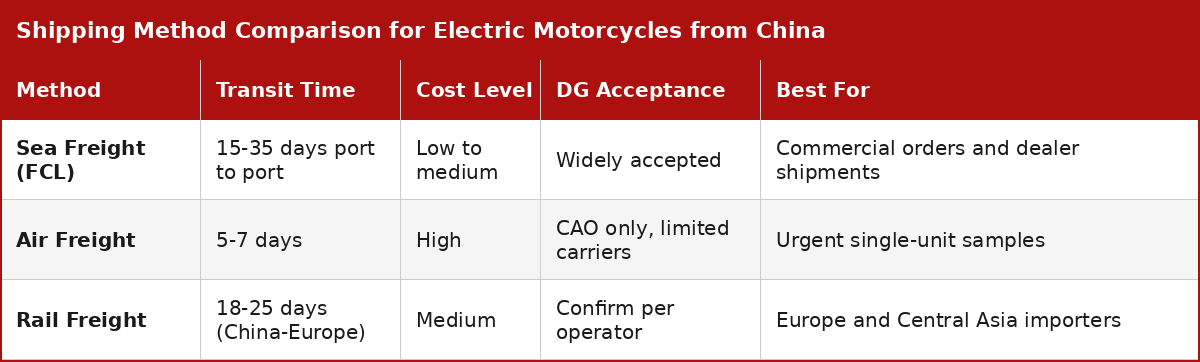
The table below gives a quick overview. Detailed guidance on each mode follows.
Air Freight
Air freight is not a realistic option for most commercial electric motorcycle shipments. The cargo is restricted to Cargo Aircraft Only (CAO) services. Passenger aircraft and most combination services do not accept it under any circumstances.
The bigger constraint is the State of Charge requirement. Under IATA DGR 67th Edition (2026), UN3556 vehicles with batteries above 100Wh must be offered for transport at no more than 30% State of Charge, or with a battery display reading no higher than 25%.
Every commercial electric motorcycle exceeds this 100Wh threshold.
Discharging a 3kWh to 10kWh battery to 30% SoC at a supplier facility before packing adds days to the pre-shipment timeline. Combined with a limited CAO carrier pool, air freight is only practical for single-unit samples with advance carrier confirmation built into the pre-shipment process.
Sea Freight
Sea freight is the standard route for electric motorcycle exports from China. For most orders, this means Full Container Load (FCL).
LCL is rarely suitable for this cargo type for several reasons:
A crated motorcycle in SKD configuration typically runs 2.2 to 2.5 metres long, 0.8 to 1.1 metres wide, and 150 to 220 kilograms per unit
Many LCL consolidators do not accept Class 9 DG cargo
Those that do apply DG surcharges that make LCL uncompetitive against FCL
Not all destination CFS facilities are licensed to receive DG cargo
Container capacity depends on packaging format. A standard 20ft container holds approximately 6 to 10 motorcycles in SKD configuration, and 12 to 16 in CKD. A 40ft container roughly doubles both figures.
As a planning guide for SKD shipments:
Up to 10 units: 1x 20ft container
11 to 20 units: 1x 40ft container
21 to 40 units: 2x 40ft containers
41 to 60 units: 3x 40ft containers
For CKD, the higher unit density means a 20ft container covers up to 16 units and a 40ft covers up to 32 units.
The container packing plan must be submitted to and approved by the carrier before loading. UN3556 self-propelled vehicles require stowage confirmation covering ventilation, stacking limits, and vehicle securing.
Applicable regulation: IMDG Code Amendment 42-24 is currently in mandatory force. Amendment 43-26 does not become mandatory until January 2028.
Rail Freight
Rail freight is a practical option on China-Europe and China-Central Asia lanes. It offers shorter transit times than sea freight and lower costs than air freight.
DG acceptance for Class 9 cargo is available on the major established rail corridors, but carrier policies for lithium battery vehicles vary by operator and border crossing. Confirm acceptance conditions for the specific route before booking.
SKD and CKD Packaging Options for Electric Motorcycles
How the motorcycle is packaged affects container utilisation, assembly requirements at the destination, and in some markets, the customs duty rate.
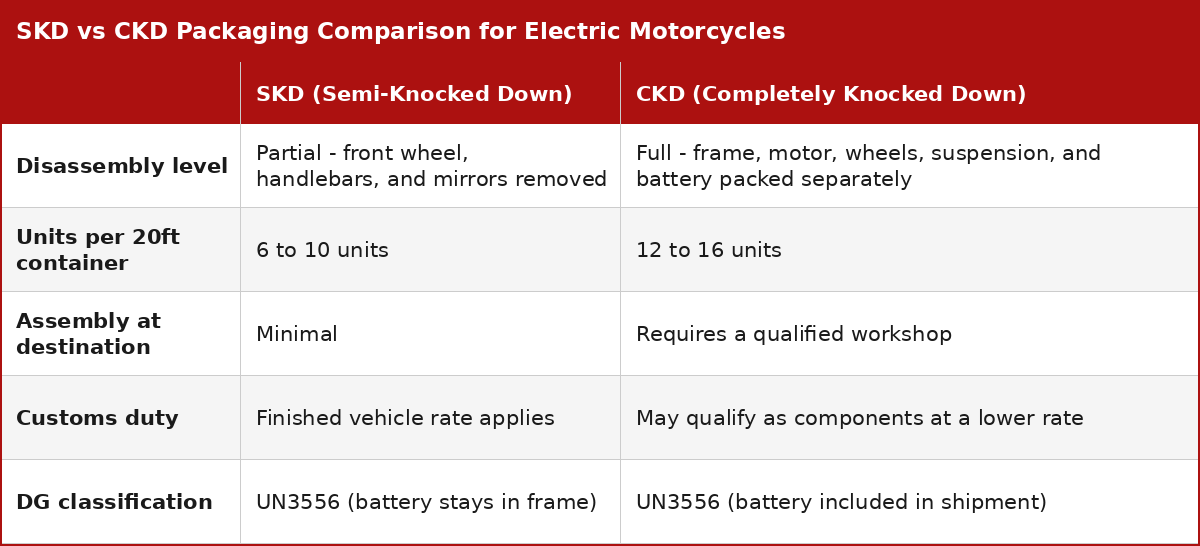
SKD (Semi-Knocked Down) is the default for most dealer and distributor shipments. The motorcycle is secured in a steel-frame or plywood crate with the axle and fork points bolted to internal support structures. The battery remains installed in the frame.
CKD (Completely Knocked Down) is worth considering when container space is a priority or when duty savings at the destination are significant. The trade-off is that the importer needs a qualified assembly operation at the destination, along with a quality inspection process before the bikes leave the workshop.
The duty classification outcome for CKD depends on destination country rules and how the local customs authority interprets the degree of assembly. Verify the applicable tariff ruling with a customs broker in the destination country before committing to this format.
For DG purposes, both SKD and CKD remain UN3556 as long as the battery is included in the shipment. The DG obligation follows the battery, not the assembly state of the motorcycle.
Assembled Shipment vs Battery-Separate Shipment
Some importers choose to ship the motorcycle frame and the battery as two separate consignments. For electric motorcycles, this is a genuine logistics option.
Why it is more realistic for motorcycles than for smaller EVs:
The frame is large and heavy enough that moving it as standard cargo produces meaningful freight savings
A number of motorcycle designs use modular or externally accessible battery packs that can be separated without full workshop disassembly
How it works:
When shipped as a complete motorcycle, the entire unit is classified as UN3556 and handled as DG cargo throughout. One booking, one set of DG documentation, and straightforward handover at the destination.
When the battery is removed and shipped separately, the frame travels as regular machinery cargo with no DG classification, standard carrier acceptance, and lower freight rates. The battery pack is classified as UN3480, Lithium ion batteries, with its own DG requirements but different carrier options and cost structures.
The trade-off is operational complexity. Two consignments must be coordinated to arrive together. The importer needs qualified technical staff at the destination to install and commission the battery, including wiring, BMS integration, and safety checks.
This works well for importers with dealer networks and service workshops. For those relying on third-party delivery to end customers, the freight savings are often offset by downstream complications.
What to Confirm with Your Supplier Before Booking
For electric motorcycles, the logistics process and the product compliance process need to run in parallel. Two areas importers frequently overlook until it is too late:
Road Registration Certifications
A motorcycle that arrives without the right certifications cannot be registered or sold for road use. These certifications are the supplier's responsibility to obtain and the importer's responsibility to request before placing the order.
Required certifications by market:
European Union: Certificate of Conformity (CoC) and EEC/e-mark type approval
United States: Department of Transportation (DOT) and EPA certification for street-legal models
These are product compliance documents, not shipping documents. They have no bearing on the freight process but must be confirmed before placing the order.
Import Duty and Tariff Exposure
Import duties for electric motorcycles from China vary significantly by destination. The HS code for electric motorcycles is 8711.60.
US importers should confirm current Section 301 tariff rates before calculating landed cost
EU importers should check whether active anti-dumping or countervailing measures apply to the specific model and manufacturer
A customs broker in the destination country is the right resource for a current tariff assessment.
Required Documents for Shipping Electric Motorcycles from China
Documentation errors are the most common reason electric motorcycle shipments are rejected at origin or held at port. The following must be confirmed before the booking is finalised.
UN38.3 Test Report
The UN38.3 test report certifies that the battery passed required safety tests: altitude simulation, thermal testing, vibration, shock, short circuit, and impact. It must match the exact battery model in the shipment. Battery cell suppliers change between production runs. Request the current report with each order and verify the battery model number against the actual production batch.
Safety Data Sheet (SDS)
The SDS must identify UN3556, the lithium-ion battery chemistry, and emergency response procedures. A multi-product SDS covering several models is typically not accepted by carriers. One SDS per product configuration is the standard requirement.
Shipper's Declaration for Dangerous Goods
The Shipper's Declaration is the primary DG transport document. It must be prepared and signed by a certified DG professional. Common errors on electric motorcycle shipments include:
Using the pre-2025 UN3171 identifier instead of UN3556
Missing packaging specification references
Incorrect net quantity per package
Any of these result in rejection at origin.
China-Side Documentation
Before cargo can be released from China, the following are required:
Dangerous Goods Packing Certificate - issued by CIQ (China Inspection and Quarantine) following inspection of the cargo and packaging at the port of loading. This is a mandatory export document for DG sea freight from China. It is separate from the international DG transport declaration and is one of the most commonly missed items by first-time shippers of this product.
Customs commodity declaration with HS code 8711.60
Export licensing, which varies by battery capacity and product specification
A China-based freight forwarder handles CIQ coordination and confirms current requirements at the port of loading.
Common Mistakes When Shipping Electric Motorcycles
Using UN3171 instead of UN3556. As of January 2025, the correct classification for lithium-ion battery motorcycles is UN3556. Carriers and port authorities are flagging UN3171 on DG declarations as a misclassification.
Missing the Dangerous Goods Packing Certificate. This China-side export document is required before the cargo can leave China. It is separate from the international DG declaration and is frequently missed by first-time importers of DG cargo.
Assuming CKD eliminates the DG requirement. A fully disassembled motorcycle with the battery included in the same shipment is still UN3556 cargo. The DG classification follows the battery, not the assembly state of the vehicle.
Booking cargo space before DG pre-approval. Carriers require DG pre-approval before accepting the booking. Confirming a sailing before submitting the DG declaration results in rollover or rejection at origin. Secure DG pre-approval first.
Overlooking road registration certifications until after arrival. Motorcycles that arrive without the necessary certifications cannot be sold or registered for road use. Returning them to China is costly. Confirm certifications with the supplier before placing the order.
Inadequate internal securing within the container. Motorcycles are heavy and top-heavy in their crated form. Insufficient bracing causes movement during transit, which can damage the vehicle and compromise the battery packaging. A written container packing plan, reviewed before loading begins, prevents this.
Frequently Asked Questions
What UN number applies to electric motorcycles in 2026?
UN3556, Vehicle, lithium ion battery powered. The 2025 regulatory update replaced UN3171 for all lithium-ion battery vehicles. UN3171 now applies only to vehicles using non-lithium chemistries such as lead-acid or nickel-metal hydride batteries.
Can I ship an electric motorcycle by air from China?
Rarely in practice. The cargo requires Cargo Aircraft Only (CAO) services, and discharging a large motorcycle battery to 30% SoC before loading adds significant lead time. Air freight works for single-unit samples with advance carrier confirmation, but sea freight is the standard route for commercial volumes.
Does disassembling the motorcycle into CKD change the DG classification?
No. As long as the lithium-ion battery is included in the shipment, the cargo is classified as UN3556 regardless of the motorcycle's assembly state.
What is the Dangerous Goods Packing Certificate and why does it matter?
It is a mandatory export document for DG sea freight from China, issued by CIQ at the port of loading following inspection of the cargo and packaging. Without it, the cargo cannot be released from China. It is separate from the international DG transport declaration.
Can I ship the frame and battery as separate consignments?
Yes. The frame ships as regular machinery cargo without DG classification. The battery ships separately under UN3480 with its own DG requirements. This requires coordinating two consignments and having qualified technical staff at the destination to install and commission the battery.
What certifications do I need to confirm with my supplier before shipping?
Road registration certifications depend on the destination: CoC and EEC type approval for the EU, DOT and EPA certification for the US, and ADR compliance for Australia. These are product compliance documents and must be confirmed with the supplier before placing the order.
Which ports in China handle electric motorcycle exports?
Ningbo and Shanghai handle the majority of volume from Zhejiang-based manufacturers. Shenzhen Yantian and Guangzhou Nansha serve Guangdong-based suppliers. DG acceptance conditions vary by terminal and should be confirmed before selecting a port of loading.
How Gerudo Logistics Handles EV Shipments from China
Gerudo Logistics specialises in dangerous goods shipping from China, with operations across Shenzhen, Guangzhou, Shanghai, Ningbo, and Qingdao.
For electric motorcycle and other EV shipments, we handle:
DG classification confirmation and documentation review under the current UN3556 framework, UN38.3 and SDS verification against the actual production batch
Shipper's Declaration preparation by certified DG professionals
CIQ coordination and Dangerous Goods Packing Certificate processing at the port of loading
carrier pre-approval before booking confirmation
and container packing plan preparation in line with IMDG stowage requirements for self-propelled vehicles.
We work with carriers that actively accept Class 9 lithium battery vehicle cargo on sea lanes to global markets.
Planning a shipment?Get in touch with Gerudo Logistics to discuss your electric motorcycle import requirements.