The Complete 2026 Guide to Importing Electric Balance Scooters from China
Shipping electric balance scooters from China is not complicated once you understand the rules. But it is different from shipping general cargo, and those differences matter at every stage — how you book space, what documents you prepare, how the supplier packs the goods.
These products are classified as dangerous goods. That classification affects which carriers will accept the shipment, how the container must be loaded, and what documentation needs to be in place before anything moves. Skipping steps does not make them disappear. It means discovering them at the port, or after a rejection.
This guide covers the full logistics process for importing electric balance scooters from China in 2026: choosing a transport mode, meeting air and sea freight requirements, getting documentation right, and avoiding the issues that cause delays.
What Makes Electric Balance Scooters a DG Shipment
The product category includes several distinct types:
Hoverboards — two-wheel self-balancing boards
Self-balancing scooters — often with a handlebar or knee-control bar
Electric unicycles (EUCs) — single-wheel, rider-balanced devices
They look different and serve different markets. For shipping purposes, they share the characteristic that matters most: a high-capacity lithium-ion battery integrated into the vehicle structure. The battery is not removable for transport.
Under international transport regulations, this configuration is classified as UN3556, Vehicle, lithium ion battery powered, Class 9 Miscellaneous Dangerous Goods. The same classification applies to e-bikes. If you are also sourcing e-bikes from China, see our guide to shipping e-bikes from China.
On the UN number change: Prior to 2025, lithium-battery vehicles were commonly documented under UN3171 (Battery-Powered Vehicle). The transition to UN3556 for lithium-ion vehicles took effect January 1, 2025, with a transition period ending March 31, 2025.
Using UN3171 on current documentation is a misclassification. Carriers and port authorities are actively flagging this. Any supplier or forwarder still issuing UN3171 for lithium-ion vehicles should be corrected immediately.
UN3171 remains valid for battery-powered vehicles using non-lithium chemistries (such as lead-acid or nickel-metal hydride). It does not apply to electric balance scooters.
Shipping Methods: Air Freight vs Sea Freight
The right choice depends on order volume, timeline, and the specific capabilities of the carrier and forwarder you are working with.
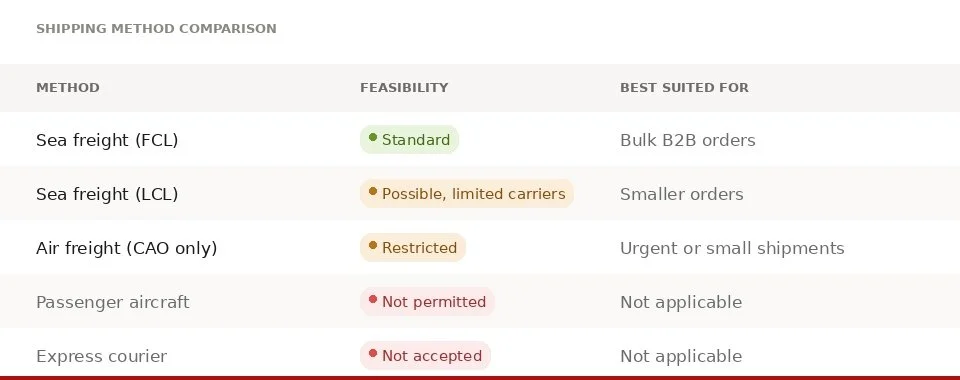
Sea freight is the primary route for commercial volumes. It offers the widest carrier acceptance, the most predictable cost structure, and the fewest operational surprises.
Air freight is technically available but constrained. It requires cargo-only aircraft, specific packaging compliance, and a forwarder with active DG air capabilities.
Express couriers do not accept UN3556 vehicles as standard service. Some carriers operate specialist DG accounts, but this is not a reliable commercial channel.
Air Freight Restrictions for Electric Balance Scooters
For importers accustomed to using air freight for urgent stock replenishment, electric balance scooters present a harder constraint than most electronics categories.
What is prohibited:
All passenger aircraft, without exception
Most combination (PAX/cargo) services
What is permitted:
Cargo Aircraft Only (CAO) services on dedicated freighter aircraft
This limits the available carrier pool significantly. Not every air cargo carrier accepts UN3556 shipments. Confirming DG acceptance before booking is not optional — it is the first step.
Key requirements under IATA DGR 67th Edition (2026):
Packing Instruction 952 applies
Packaging must pass a 1.2-metre drop test and carry UN-specification certification
Each package must be marked with the UN3556 identifier and the Class 9 label
A completed Shipper's Declaration for Dangerous Goods is required
The declaration must be prepared and signed by a certified DG professional
The 30% State of Charge requirement:
From January 1, 2026, UN3556 vehicles with batteries above 100Wh must be offered for air transport at no more than 30% of rated capacity — or with a battery display reading no higher than 25%. Both thresholds are now mandatory under IATA DGR 67th Edition. Shipments above these limits require written approval from the state of origin and the operator's state before the cargo can be accepted.
Most electric balance scooters exceed 100Wh. This rule applies to virtually all commercial products in this category. The SoC check must happen at the supplier's facility, before packing — not at the freight station.
For the full regulatory breakdown, see our2026 IATA DGR battery shipping guide.
On cost: DG air shipments carry surcharges on top of standard rates. Documentation fees, DG handling fees, and the restricted carrier pool all push the effective cost higher than equivalent general cargo air shipments. For non-urgent B2B volumes, sea freight is more practical on both cost and operational grounds.
For a product category with similar air transport restrictions, see ourguide to importing drones from China.
Sea Freight: How Electric Balance Scooters Are Typically Shipped
Sea freight is where the majority of electric balance scooter volume moves. The process is manageable. It requires preparation, but it is not operationally complex once the documentation is in order.
Applicable regulation: IMDG Code Amendment 42-24 is currently in mandatory force. Amendment 43-26 is in development but does not become mandatory until January 2028. All sea freight documentation and stowage requirements for 2026 shipments follow Amendment 42-24.
Electric Balance Scooter Shipments: FCL or LCL?
For electric balance scooters, FCL is the preferred option in most scenarios. A few reasons:
Many LCL consolidators do not accept Class 9 DG cargo
Those that do apply DG surcharges, often adding 30-50% to the per-CBM rate
Not all destination CFS facilities are licensed to handle DG cargo
Segregation requirements further narrow the LCL carrier pool
LCL is possible for smaller orders. Before committing, confirm three things: that the consolidator accepts UN3556, that the destination CFS is DG-licensed, and that applicable segregation requirements can be met.
From approximately 10-12 CBM upward, FCL is typically more cost-effective and more operationally reliable. See ourFCL vs LCL shipping guide for a full cost comparison including DG cargo scenarios.
Container Stowage Requirements Under IMDG
Self-propelled vehicles require specific stowage treatment:
Stacking height is limited (typically three tiers maximum) to maintain firefighting access
Adequate ventilation within the container is required
The carrier must approve the stowage position before sealing
This cargo cannot be treated as standard palletized freight. Container packing needs to be planned in advance. The carrier's stowage approval should be secured before the container is loaded.
Ports of loading:
Most electric balance scooters are manufactured in Guangdong province (Shenzhen, Dongguan) and Zhejiang. Common ports of loading are Shenzhen Yantian, Guangzhou Nansha, Shanghai, and Ningbo.
When selecting a port, confirm the carrier's DG acceptance conditions at that specific terminal and check the available sailing schedule to your destination port.
Required Documents for Shipping Electric Balance Scooters
Documentation errors are the most common reason electric balance scooter shipments are delayed or rejected at origin. Getting this right before booking saves time at every subsequent stage.
UN38.3 Test Report
This report certifies that the battery has passed the UN Manual of Tests and Criteria requirements: altitude simulation, thermal testing, vibration, shock, short circuit, and impact testing.
It must correspond to the exact battery model in the shipment. A generic report covering a different cell configuration is not acceptable. Battery configurations change between production runs. If the supplier has updated the cell type, a new test report is required.
Safety Data Sheet (SDS)
The SDS must identify UN3556, the battery chemistry, and emergency response procedures. A multi-product SDS covering several models is typically not accepted by carriers. One SDS per product configuration.
Shipper's Declaration for Dangerous Goods
The primary transport document. It must be prepared and signed by a certified DG professional. Common errors include:
Wrong UN number (still showing UN3171)
Missing SoC statement on air shipments
Incorrect net quantity or package count
Packing group errors
Any of these can result in rejection at origin.
Packaging specification
The declaration must be supported by documentation confirming that UN-certified packaging has been used and that the packages comply with drop test requirements.
China-side documentation
Before the cargo can be released from China, the following are typically required:
CIQ (China Inspection and Quarantine) inspection for lithium battery products at most major ports
Customs commodity declaration with the correct HS code
Dangerous goods export licensing, which varies by battery capacity and product type
Your China-based freight forwarder should handle this. They can confirm current CIQ requirements at the specific port of loading and ensure the origin declaration aligns with the transport documentation.
For a full breakdown of lithium battery documentation requirements, see our guide to shipping batteries from China.
UN3556 Packaging and Labeling Requirements
Packaging compliance for UN3556 shipments is structural, not just a labeling requirement.
Packaging must:
Carry UN-specification certification (marked with the UN mark on the carton)
Withstand a 1.2-metre drop test without damage or leakage
Include adequate internal cushioning to prevent movement
Secure each device individually within the outer packaging
Required markings on each package:
Class 9 Miscellaneous Dangerous Goods label
UN3556 identifier
Proper shipping name: "Vehicle, lithium ion battery powered"
Net quantity
Shipper and consignee information
SoC at the packing stage:
For air shipments, SoC discharge must happen at the supplier's facility before the goods are packed. It cannot be done at the freight station. Include it in the purchase order or pre-shipment QC checklist.
For sea shipments, IMDG does not impose a mandatory SoC limit for UN3556 vehicles. Some carriers apply their own. Confirm this at the booking stage.
Common Mistakes When Shipping Electric Balance Scooters
These are the issues that appear repeatedly on electric balance scooter shipments.
Using the wrong UN number
Some suppliers and smaller forwarders still issue documentation with UN3171. Ensure all manifests and declarations state UN3556. Carriers are actively flagging the outdated classification.
UN38.3 report mismatch
The test report must match the specific battery in the shipment. Suppliers sometimes change cell suppliers between production runs without flagging it. The mismatch is usually discovered at the port.
Request the current UN38.3 report with each order and verify the battery model number against the actual product before booking.
SoC non-compliance on air shipments
Carriers reject cargo at acceptance if SoC documentation is missing or the stated level exceeds the limit. Build the discharge step into the supplier's pre-shipment checklist and request written SoC confirmation with the packing list.
Booking without DG pre-approval
Carriers require DG pre-approval before accepting the cargo. Booking space first and arranging documentation after leads to rollover or rejection at origin.
Submit the DG declaration and packaging specification to the carrier before confirming the booking. A DG-experienced forwarder handles this sequence as standard.
Container loading errors
Exceeding the stacking limit within the container is a compliance violation. If discovered at the port, the container may need to be repacked before departure.
Brief the warehouse team on stacking restrictions before loading begins and ask your forwarder to provide a written packing plan.
Frequently Asked Questions
What UN number applies to electric balance scooters in 2026?
The correct classification is UN3556, Vehicle, lithium ion battery powered. This replaced UN3171 for lithium-ion vehicles from January 2025, with the transition period ending March 31, 2025. UN3171 still applies to battery-powered vehicles using non-lithium chemistries. For all electric balance scooters with lithium-ion batteries, UN3556 must appear on every piece of shipping documentation.
Can electric balance scooters be shipped by air in 2026?
Yes, but only on Cargo Aircraft Only (CAO) services. Passenger aircraft do not accept these products under any circumstances. The carrier pool is limited, costs are higher than general cargo air, and documentation requirements are strict. For most B2B volumes, sea freight is more practical.
Is the 30% SoC rule mandatory in 2026?
For air transport, yes. Under IATA DGR 67th Edition, the limit is now mandatory for UN3556 vehicles with batteries exceeding 100Wh, with a battery display reading no higher than 25% also accepted as compliant. Shipments above these thresholds require written approval from the state of origin and the operator's state.
What documents are required?
The core set: UN38.3 Test Report, Safety Data Sheet (SDS), Shipper's Declaration for Dangerous Goods, and UN-specification packaging documentation. CIQ inspection documentation and the correct origin customs declaration are also required, depending on the port of loading and the product.
Can these products be shipped via LCL?
LCL is possible but restricted. Many consolidators refuse Class 9 DG cargo. Those that accept it apply surcharges that significantly increase the per-CBM cost. From around 10-12 CBM upward, FCL is typically more cost-effective and more operationally straightforward.
Does sea freight have a SoC limit for electric balance scooters?
No mandatory limit under current IMDG regulations. Individual carriers may apply their own. Confirm at the booking stage.
How Gerudo Logistics Handles These Shipments
Gerudo Logistics specialises in dangerous goods shipping from China, with operations across Shenzhen, Guangzhou, Shanghai, Ningbo, and Qingdao.
For electric balance scooter shipments, we handle:
DG classification confirmation and documentation review (including UN3556 compliance)
UN38.3 and SDS verification against the actual product
Dangerous Goods Declaration preparation by certified DG professionals
Carrier pre-approval and DG acceptance confirmation before booking
Container packing plan in line with IMDG stowage requirements
Origin-side CIQ coordination and customs clearance
We work with carriers that actively accept Class 9 lithium battery vehicle cargo on both sea and air lanes. Importers who have encountered rejections or documentation issues on previous shipments are welcome to contact us with the specifics.
Planning a shipment?Contact Gerudo Logistics to discuss your requirements.