How to Ship Liquid Resin from China: A Complete Import Guide
China is the dominant global supplier of liquid resins - from industrial epoxy systems used in composites and coatings to UV-curable photopolymers used in 3D printing and dental applications. If you source any of these products from Chinese manufacturers, your shipment may be classified as dangerous goods before it reaches the port.
That classification matters for three reasons: it affects which carriers will accept your cargo, what documentation you need at Chinese customs, and what your destination market requires before release. Getting it wrong means held cargo, return shipments, or fines.
This guide covers how to classify your liquid resin correctly, what the shipping process looks like across four major destination markets, and what to prepare before the first booking.
Are Liquid Resins Dangerous Goods?
The short answer is: most are, but not all.
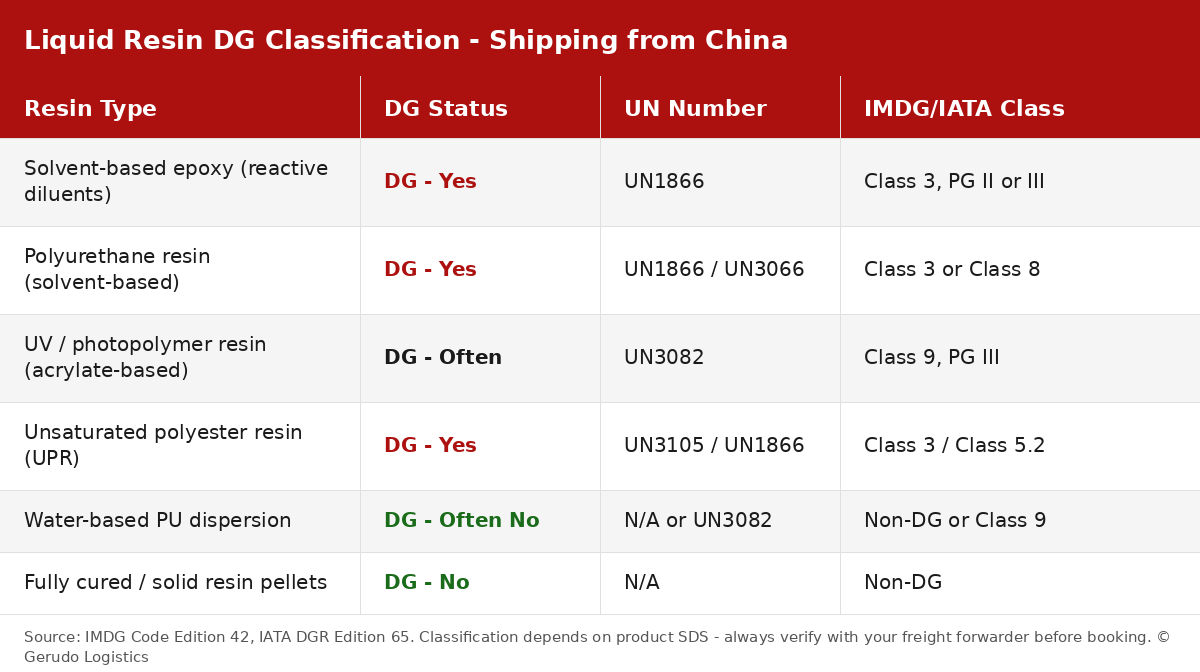
Liquid resin is not a single product category. The term covers epoxy resins, polyurethane resins, UV photopolymers, unsaturated polyester resins, and water-based dispersions. Each has a different chemical composition, and that composition determines whether the shipment is DG.
The IMDG Code and IATA DGR do not classify products by their commercial name. They classify them by physical and chemical properties - primarily flash point, reactivity, and toxicity. Your supplier's Safety Data Sheet (SDS, formerly MSDS) is the starting document for every classification decision.
Start with these three questions:
Does the resin contain flammable solvents or diluents with a flash point at or below 60°C? If yes, you are likely looking at Class 3 (Flammable Liquids).
Is the resin an acrylate-based photopolymer without flammable solvents but with environmental hazard data? Class 9 (Miscellaneous Dangerous Goods, UN3082) is the likely result.
Is the resin fully water-based with a flash point above 93°C and no reactive components? It may be non-DG, but this requires SDS confirmation - not an assumption.
Resins that appear non-hazardous at room temperature can still be DG. UV resins used in 3D printing, for example, frequently carry a marine pollutant designation under IMDG because uncured acrylate monomers are toxic to aquatic life. That alone triggers Class 9 requirements on ocean freight.
Common Liquid Resin Products from China
These are the most common liquid resin products sourced from China. Most are DG - many importers only discover this when the carrier rejects the booking.
3D printing resin (SLA/DLP/LCD) - UV-curable photopolymer, typically Class 9 (UN3082) with a marine pollutant flag.
Jewelry casting resin - UV or heat-cure formulations, usually Class 9; some solvent-based variants fall under Class 3.
Nail UV gel / nail phototherapy resin - Acrylate-based, Class 9 (UN3082); frequently misdeclared as cosmetics.
Dental resin (crown, model, surgical guide) - Photopolymer resin, Class 9; subject to additional medical device documentation in some markets.
Epoxy floor coating resin - Solvent-based systems are Class 3; water-based versions may be non-DG depending on flash point.
Wood coating and furniture resin - Solvent-based formulations are Class 3; confirm flash point with your supplier before booking.
Marine epoxy - Two-part system; resin base is Class 3 or Class 9, hardener ships separately as a separate DG entry.
Electronic potting and encapsulation resin - Typically Class 9 (UN3082); check for halogen content if importing into the EU.
Automotive composite resin - Usually unsaturated polyester (Class 3) or epoxy (Class 9); high-volume shipments typically move by FCL.
Craft and DIY casting resin - Sold in small bottles, Class 9 (UN3082); courier shipment requires DG-approved service and quantity limits apply.
If your product is not on this list, share the SDS with your forwarder before booking. The SDS is the only reliable way to confirm DG status.
Shipping Modes for Liquid Resin from China
Choosing the right transport mode for liquid resin depends on your volume, classification, and urgency. DG status narrows your options at each mode.
Sea Freight (FCL and LCL)
Sea freight is the standard channel for bulk resin shipments - typically anything above 500kg per consignment. Class 3 resins are accepted by all major ocean carriers under IMDG segregation rules. Class 9 (UN3082) resins are also widely accepted, though some carriers apply additional stowage restrictions for marine pollutants.
FCL (Full Container Load) gives you full control over segregation and works cleanly for most resin types. A 20ft container handles 15-20 metric tonnes of resin depending on density.
For Class 3 resins in drums, ensure the container is loaded and braced to prevent drum movement during transit - this is a carrier inspection point at major Chinese ports.
LCL (Less than Container Load) is available for smaller volumes but adds complexity for DG cargo. Not all consolidation stations in China accept DG LCL, and your forwarder needs to confirm an approved DG-capable consolidation facility is available on your route.
Transit times for DG LCL are typically 5-10 days longer than FCL on the same lane due to staging requirements.
Estimated sea freight transit times from China:
China to USA West Coast (Los Angeles/Long Beach): 14-18 days
China to USA East Coast (New York/Savannah): 28-35 days
China to Rotterdam (Europe): 28-35 days
China to Singapore/Port Klang (Southeast Asia): 8-14 days
China to Jebel Ali (UAE/Middle East): 18-25 days
Air Freight
Air freight for liquid resin is possible but heavily restricted by IATA DGR. The key factors:
Class 3 resins with a flash point below 23°C (PG I or II) are generally prohibited on passenger aircraft and face quantity limits on cargo aircraft.
Class 9 (UN3082) UV resins are accepted on both passenger and cargo aircraft in quantities up to 30L per package, with proper inner packaging and labeling.
Formulations containing certain acrylate monomers above specified concentrations may be refused by individual airlines regardless of UN classification.
Air freight transit time is 5-8 days door-to-door for most destinations. Costs run roughly USD 5-9/kg for chemical cargo on DG-approved channels, significantly higher than standard air freight. For 3D printing resin sold in small quantities to distributors with urgent replenishment needs, it is viable. For bulk industrial resin, it is rarely justified.
Express Courier (DHL, FedEx, UPS)
Major couriers accept non-DG water-based resins and some Class 9 UV resins under their dangerous goods programs, subject to volume limits (typically 1L or 1kg per inner container, 4L or 4kg per outer). Each courier has its own acceptance criteria, and these differ by destination country.
For any resin classified as Class 3, courier shipment requires a certified DG shipper declaration and pre-approved packaging. Many couriers restrict Class 3 liquid shipments to specific service levels (non-express) and apply fuel plus DG surcharges that can double the base rate.
Do not attempt to ship DG resin through standard (non-DG) courier channels by mislabeling as non-hazardous. Chinese customs has strengthened inspection of liquid chemical packages at major hubs, and misdeclared shipments are subject to seizure and penalties for both the shipper and the consignee.
Packaging Requirements for DG Resin
UN-certified packaging is required for all DG liquid resin. Carriers and Chinese customs both check for this. If your supplier cannot show you the UN mark on the packaging, the shipment will be rejected before it leaves.
Common formats:
Drums (20L - 200L): Used for epoxy, polyurethane, and most solvent-based resins. The same rules apply to industrial glue and adhesive shipments in the same DG class.
IBCs (1,000L): For larger orders. Must be UN-certified and suited to the specific resin type. For volumes above 14,000L, see our guide on ISO tank container shipping from China.
Small bottles in outer cartons: Standard for 3D printing resin and craft resin. Bottles must be sealed and the outer carton must be UN-approved for the product's hazard class.
For photopolymer resins, packaging must block light. Uncured resin starts to cure if exposed - opaque bottles are a product requirement.
Before booking, ask your supplier to confirm the UN mark on the packaging. If they cannot, your forwarder will flag it and the shipment will not move.
DG Shipping Considerations by Destination Market
DG transport rules are consistent across IMDG and IATA regardless of destination. However, each market has its own DG handling procedures, carrier acceptance rules, and one or two extra documents that affect how your shipment clears. Here is what matters in each region.
USA
Most liquid resins clear US ports without issue when DG documentation is complete. One document trips up most importers: the TSCA certification. This is a short statement confirming whether the chemical substances in your resin comply with EPA rules. CBP requires it on every chemical import entry. Missing it results in a hold that delays release and runs up demurrage costs.
For FBA importers: Amazon requires pre-approval for any DG resin sent to fulfillment centers. Submit the SDS and receive written approval before shipping inventory. Resins rejected at the FBA intake stage are returned at your cost.
For a full walkthrough of US clearance for liquid chemical cargo, see our guide on shipping liquid chemicals from China to the USA.
Europe
DG resin clears EU ports under standard IMDG documentation. The additional layer to confirm before shipment is REACH registration - verify that the chemical substances in your resin are registered in the ECHA database, or that your Chinese supplier has appointed an Only Representative. Most established resin types are already registered. The risk sits with newer specialty UV formulations introduced in the last 2-3 years.
GHS-compliant labeling in English (or the destination country's language) is required for product entry into the EU supply chain. If your supplier ships with Chinese-language labels only, plan for re-labeling at your EU warehouse.
Southeast Asia
Singapore handles DG cargo efficiently through PSA terminals. Most DG resins clear without additional pre-approvals beyond standard IMDG documentation and a GHS-compliant SDS.
Malaysia and Thailand require GHS-aligned SDS documentation and apply their own national hazardous substance lists. Check your resin's components against the relevant national list before the first shipment. This is a one-time step per product, done before you book.
Indonesia has stricter chemical import controls and some resin precursors appear on the Ministry of Industry's controlled substances list. For new-to-market importers, working with a local importer of record is the lower-risk path.
Middle East
UAE (Jebel Ali) is the main DG entry point for the Gulf. Most resin shipments clear through standard IMDG documentation. The SDS must be in English and GHS-compliant. Jebel Ali Free Zone handles DG cargo routinely and port dwell times are predictable for properly documented shipments.
Saudi Arabia looks more closely at two-component epoxy systems. Some amine-based curing agents appear on controlled substance lists and may require an import permit. Check what is in the hardener with your supplier before booking Saudi-bound two-part epoxy systems.
For all GCC destinations, GHS-compliant SDS and correct DG labeling are the two most common reasons for a port hold if missing. Get these confirmed at origin.
Documentation Checklist for Importing Liquid Resin from China
Chinese customs has strengthened documentation checks for liquid chemical cargo. The following documents are required for every DG resin shipment from China:
Commercial Invoice: Must accurately describe the product, including chemical composition, UN number if applicable, and HS code. Discrepancies between the invoice and DG declaration trigger inspection holds.
Packing List: Item-level detail including number of packages, net and gross weight, and packaging type.
Bill of Lading (B/L) or Airway Bill (AWB): Must reference the DG declaration for hazardous cargo.
SDS (Safety Data Sheet): English-language, GHS-compliant. Chinese GB/T format alone is not sufficient for international shipments.
DG Declaration: Required for all classified DG cargo. Ocean freight follows IMDG format; air freight uses the IATA Shipper's Declaration format.
UN Packaging Certification: Evidence that the packaging used has passed the required UN performance tests for the product's class and PG.
Chinese Chemical Control License: Required for certain substances under China's chemical management regulations. Your forwarder confirms whether your specific resin requires one before the booking is finalised.
For USA-bound shipments, add:
TSCA Certification statement (Positive or Negative)
ISF (Importer Security Filing): Filed by your customs broker 24 hours before vessel departure from China.
Our detailed documentation guide covers the full document set: Essential Documents for Dangerous Goods Shipping from China.
Work with a Specialist DG Freight Forwarder
Gerudo Logistics is a dangerous goods & chemicals specialist freight agent headquartered in Guangzhou, with operations across Shenzhen, Shanghai, Ningbo, Qingdao, and Dalian. We handle liquid resin and chemical shipments under IMDG and IATA compliance frameworks across all major DG classifications - Class 3, Class 5, Class 8, and Class 9.
For liquid resin importers, our process starts before the booking.
We review your SDS, confirm the correct classification and UN number, verify packaging certification, and prepare the complete DG documentation set. We coordinate with DG-approved ocean carriers and DG-capable consolidation facilities for both FCL and LCL shipments, and we manage origin Chinese customs declaration including chemical control license verification where required.
We serve importers across the USA, Europe, Southeast Asia, and the Middle East on a regular lane basis. For multi-destination resin distribution programs, we design routing that gets the documentation right for each market before the shipment leaves China.
If you are planning a liquid resin shipment from China, contact our team for a compliance review and freight quotation.
Frequently Asked Questions
Are liquid resins always classified as dangerous goods for international shipping?
No. Classification depends on the product's SDS, not its commercial name. Solvent-based epoxy and most UV photopolymer resins are DG; some water-based dispersions with high flash points are not. Always confirm with your forwarder before booking.
Can I ship UV resin or 3D printing resin by air from China?
Yes, in most cases. UV/photopolymer resins classified as Class 9 (UN3082) are accepted on passenger and cargo aircraft within quantity limits. However, some high-acrylate formulations face airline-specific restrictions. Confirm acceptance with your carrier before booking.
What HS codes apply to liquid resins from China?
Common codes under Chapter 39 include: 3907.30 (epoxy resins), 3907.91 (unsaturated polyesters), and 3909.50 (polyurethanes). The exact subheading affects your duty rate, so verify with a customs broker before your first shipment.
Do I need a TSCA certification to bring resin into the USA?
Yes. CBP requires a TSCA certification on every chemical import entry. Most standard commercial resins qualify for Negative Certification, meaning they are not subject to TSCA requirements. Industrial or novel formulations may require Positive Certification - confirm with your customs broker.
How does the curing agent for polyester or epoxy resin ship separately?
Curing agents such as MEKP (methyl ethyl ketone peroxide) are classified as Class 5.2 Organic Peroxides - a separate DG class from the resin base. They must be packed, labeled, and declared independently. Co-packing a resin base and its curing agent in the same outer packaging violates IMDG segregation rules. For more background, see our Class 5 DG shipping guide.
Can I ship liquid resin as LCL from China?
Yes, but DG LCL requires a consolidation facility approved for hazardous cargo. Not all LCL stations in China accept DG. Your forwarder needs to confirm availability on your specific route before booking.
What is the typical transit time for resin by sea from China to the USA?
West Coast ports (Los Angeles, Long Beach): approximately 14-18 days port to port. East Coast ports (New York, Savannah): approximately 28-35 days. Add 3-7 days for Chinese customs processing and inland delivery at destination.
Conclusion
Shipping liquid resin from China is manageable, but you need to get the DG classification right before booking. The SDS from your supplier is the starting point - without it, you cannot confirm DG status, select compliant packaging, or prepare accurate documentation.
For importers sourcing across multiple markets, what you need to check differs by destination. TSCA for the USA, REACH registration status for Europe, national hazardous substance lists in Southeast Asia, and GHS documentation for Gulf ports. Each adds one or two extra steps on top of the standard DG transport rules.
The practical rule is simple: share your SDS with your freight forwarder before placing any order with a Chinese supplier. Classification, packaging confirmation, and document preparation take time - and they cannot be rushed at the port gate.