Shipping Automotive Parts from China: A Freight Guide for Airbags and Safety Devices
Automotive airbag modules, inflators, and seat belt pretensioners are among the most consistently misdeclared cargo categories in China's export trade. Carrier bookings get rejected, customs holds shipments, and deadlines pass - almost always because the cargo bypassed the UN3268 Dangerous Goods declaration, or because supplier documentation failed to confirm Class 9 status.
These components contain pyrotechnic inflators designed to trigger rapid gas deployment on impact. That chemical function places them under international Dangerous Goods regulations as Class 9, UN3268 - regardless of how a supplier labels them on a commercial invoice.
For importers sourcing these components from Chinese manufacturers, compliance falls on both sides of the shipment. The Chinese exporter must provide the correct classification documentation before customs clearance.
The freight forwarder must secure DG-approved carrier space, declare the cargo accurately, and ensure container compliance at every stage. A gap at either end means delays, cargo holds, or rejection.
This guide covers how UN3268 components are classified, how they move by sea and air, what documents a compliant shipment requires, and what packaging standards apply.
What Is UN3268 and Which Automotive Safety Devices Does It Cover
UN3268 is the United Nations designation for "Safety Devices, Electrically Initiated" - Class 9 Miscellaneous Dangerous Goods under the IMDG Code and IATA Dangerous Goods Regulations.
Products that fall under this classification include:
Airbag modules (driver, passenger, side curtain, knee)
Airbag inflators and pyrotechnic gas generators
Seat belt pretensioners
Pyrotechnic battery disconnect switches (pyroswitches)
Pedestrian hood lifters
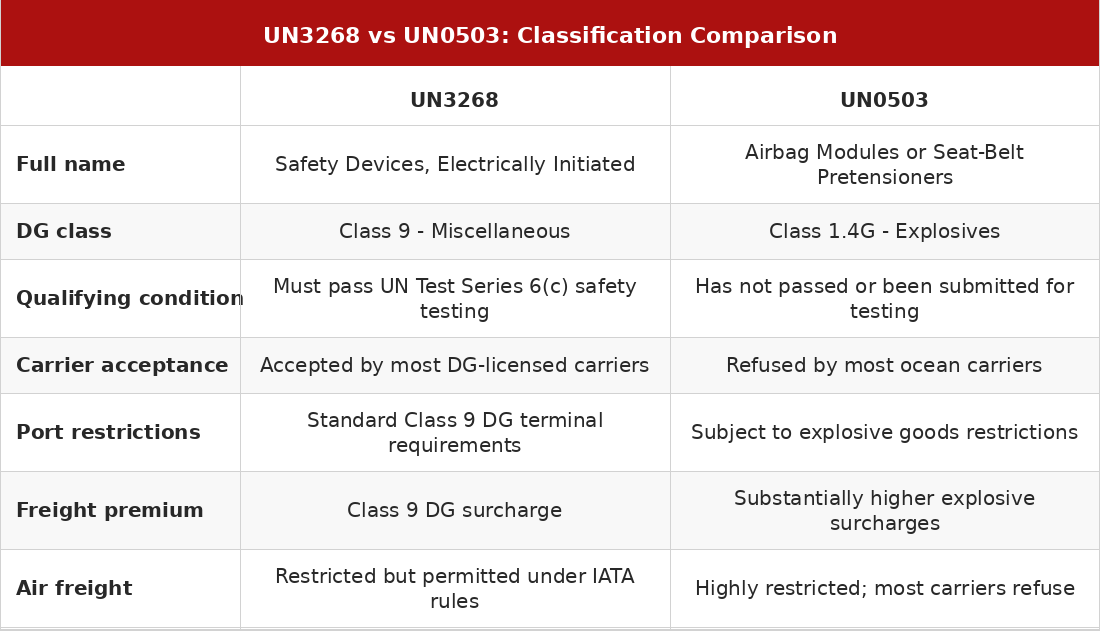
The Class 9 designation is conditional. Products must pass UN Test Series 6(c) - a set of safety tests proving the device will not detonate, fragment, or project hazardous material outside its packaging when triggered in transit.
Products that fail this testing - or have never been submitted for it - classify instead as UN0503, Class 1.4G Explosives. Most ocean carriers accept UN3268 cargo. Most refuse UN0503 outright.
Always confirm with your Chinese supplier that their product carries the UN3268 designation and that the supporting test documentation exists before placing a purchase order.
How to Ship UN3268 Airbags from China by Sea and Air
Sea Freight
FCL (Full Container Load) is the standard routing for UN3268 airbag shipments. Most DG-licensed ocean carriers accept Class 9 cargo, provided:
The DG nature is declared at the time of booking - not at cut-off
All documentation is complete and verified before vessel departure
The container is correctly placarded on all four walls
Standard public LCL consolidation is not an option for most UN3268 shipments. Class 9 pyrotechnic articles cannot be co-loaded with general cargo in public consolidation channels. The alternative is DG-specialist LCL - a dedicated consolidation service operated by licensed DG forwarders. These channels exist but require advance planning and are not available on every lane.
Container placarding is mandatory under IMDG. All four vertical walls of the container must display Class 9 hazard diamonds - seven alternating black and white stripes on the upper half, a blank lower half with the numeral "9". The UN3268 number must appear on each placard or on an adjacent orange panel.
Main DG-capable departure ports from China:
Shanghai (Waigaoqiao and Yangshan deepwater terminal) - highest volume; dedicated DG handling areas at both terminals
Ningbo-Zhoushan - established DG handling on Europe and US West Coast lanes
Qingdao - primary northern China DG hub; well-positioned for Middle East and North Asia routes
Shenzhen (Yantian) - key departure point for Guangdong-based manufacturers
Air Freight
Air freight for UN3268 is permitted under IATA rules but subject to strict quantity limits per package. On passenger aircraft, the limit is typically 25 kg net per package. Cargo-only aircraft allow up to 100 kg net per package.
Many Chinese carriers apply internal restrictions stricter than the IATA baseline on pyrotechnic articles. Hong Kong is frequently used as an alternative departure hub, where cargo airlines tend to have broader acceptance policies for Class 9 pyrotechnic goods. For time-sensitive shipments, discuss Hong Kong routing with your forwarder before confirming a booking.
Standalone Auto Parts Export vs Vehicle-Bundled Export from China
Standalone Parts Export
Airbag modules and inflators ship as independent automotive components. They are declared under HS code 8708.95 (verify the specific sub-heading with your customs broker before filing) and handled as UN3268 DG cargo at every stage of transit.
The buyer is typically a parts importer, after-sales distributor, or tier-one OEM supplier receiving components for local assembly. Full DG documentation is required throughout - this is the model this guide primarily addresses.
Vehicle-Bundled Export
Airbags pre-installed in a complete vehicle export under the vehicle's HS code (8703 or 8704). The DG classification is managed by the vehicle manufacturer as part of the type approval process. The importer handles standard vehicle customs clearance rather than a DG shipment.
If your business involves importing complete Chinese electric or combustion vehicles rather than standalone components, the logistics framework is different.
Complete electric vehicles may also carry lithium battery systems subject to separate DG classification requirements - our guide to shipping lithium batteries from China covers that in detail.
For the full vehicle import process, see our guide to shipping electric vehicles from China.
Destination Market Requirements for UN3268 Automotive Imports
Europe
EU safety regulations drive sustained OEM demand for Chinese airbag components, but European vehicle manufacturers apply strict supplier qualification standards.
Confirm product specifications meet European OEM requirements at the procurement stage - not at the point of shipment
DG handling surcharges apply at Rotterdam, Hamburg, and Antwerp; build these into your landed cost calculation
Carrier DG acceptance on specific vessel services is not guaranteed; confirm before booking
For a full overview of sea freight options on this lane, see our guide to FCL shipping from China to Europe.
United States
Section 301 tariffs under HTS 8708.95 add directly to the landed cost of Chinese automotive parts.
Verify the current tariff rate with your customs broker before finalizing pricing - rates adjusted across 2024 and 2025
Products entering the US market must meet FMVSS 208 (frontal impact occupant protection standard); confirm compliance at procurement, not at the shipment stage
For FCL and LCL freight options on this lane, see our China to USA shipping guide.
Middle East
Dubai's Jebel Ali port serves as the region's primary transshipment hub, with a significant share of cargo re-exported onward to Gulf and wider regional markets.
Confirm the final destination country's import requirements before shipping; cargo re-exported after arrival may trigger additional permits or inspections
UAE and Saudi Arabia each maintain local road authority type approval requirements for automotive safety components; verify these apply to your specific product
For routing and freight options on this lane, see our guide to shipping from China to the Middle East.
Southeast Asia
The ASEAN-China FTA may reduce applicable tariffs on eligible HS sub-headings for shipments to member markets including Vietnam, Thailand, and Indonesia.
Verify whether your cargo qualifies for FTA tariff reduction and confirm your forwarder can handle the Certificate of Origin filing
DG terminal capability varies significantly by country and port; confirm handling capacity before booking
Documentation Required to Ship UN3268 Safety Devices from China
A compliant UN3268 shipment requires documents from two sources: Chinese customs clearance and the shipping file that travels with the cargo.
Chinese Customs Documents
These three must be in place before the cargo is presented to Chinese customs:
Dangerous Goods Packaging Certificate (Wei Bao Zheng) - issued by a China Customs-authorized inspection body; certifies the packaging meets UN performance standards for the specific goods being shipped
Material Safety Data Sheet (MSDS) - must reference the specific product model and UN3268 designation; a generic product-family MSDS is typically insufficient at Chinese export
Cargo Transportation Conditions Identification Report - issued by a qualified third-party testing institution (such as the Shanghai Research Institute of Chemical Industry); confirms the article qualifies for Class 9 transport
Shipping Documents
These accompany the cargo through transit and destination clearance:
Commercial invoice - referencing HS code 8708.95, with the sub-heading verified by your broker
Packing list - detailed breakdown of contents, quantities, and package weights
Shipper's Declaration for Dangerous Goods - the formal DG declaration required for every UN3268 shipment; must state the UN number, DG class, and packing group
Bill of Lading - must carry DG notation with UN3268 number and Class 9 classification
Certificate of Origin - required for markets where tariff preferences apply (such as ASEAN-China FTA lanes)
On misdeclaration: Shipping UN3268 articles as general cargo to avoid DG surcharges is a serious violation under Chinese maritime and customs law. Consequences include cargo seizure, financial penalties, and a formal downgrade to the exporter's customs credit rating. Any supplier willing to misdeclare is a material counterparty risk.
UN3268 Packaging Standards Under IMDG Packing Instruction P902
Packing Instruction P902 sets the sea freight packaging requirements for UN3268 articles. This is the exporter's and forwarder's responsibility - but importers should verify their Chinese supplier is meeting these standards before shipment, as non-compliant packaging is a common cause of cargo rejection.
The requirements cover three areas:
Outer packaging must be UN-certified - fiberboard boxes, wooden crates, or steel drums are all acceptable formats, provided they carry the UN approval marking. Standard commercial packaging without UN certification is not permitted.
Inner protection requires each device to be individually wrapped to prevent electrostatic discharge and short circuit, and cushioned against mechanical shock. Inflator units are typically packed in custom-fit foam inserts for this reason.
Labeling requires every package to carry a Class 9 hazard label and UN3268 marking. Missing or incorrect labels are one of the most common causes of DG cargo rejection at port.
For shipments moving by air, additional packaging requirements apply on top of the sea freight standard. If a shipment may travel by both modes at different legs, the packaging should meet the stricter of the two standards from the outset.
Why UN3268 Automotive Cargo Requires a Specialist DG Freight Forwarder
China's automotive and NEV export category is complex because most major component types carry a DG classification. A single consolidated shipment may involve multiple UN numbers - lithium battery packs (UN3480/UN3481), pyrotechnic safety devices (UN3268), or both together in a complete vehicle. Each carries its own carrier acceptance rules, documentation requirements, and packaging standard.
Generalist forwarders routinely fall short here. What a specialist handles that others don't:
Confirmed DG space on approved carriers, not last-minute rejections at booking
Documentation management across multiple UN numbers in one shipment
Container compliance and placarding verified before port cut-off
Customs clearance at both origin and destination under DDP terms
Gerudo Logistics works with importers sourcing across the full range of Chinese automotive and NEV cargo. Whether you are importing lithium battery systems, complete electric vehicles, or automotive components under multiple DG classifications, we manage the process end to end - from our operations across Shenzhen, Shanghai, Ningbo, Qingdao, and Dalian to your destination market.
To discuss your cargo requirements, contact our team.
FAQ
Q: What products fall under the UN3268 classification?
UN3268 covers electrically initiated automotive safety devices including driver and passenger airbag modules, side curtain airbags, seat belt pretensioners, pyrotechnic battery disconnect switches, and pedestrian hood lifters. The classification applies to the complete assembled module or inflator unit, provided it has passed UN Test Series 6(c) testing.
Q: Can UN3268 airbags ship via standard LCL?
Standard public LCL channels generally decline Class 9 pyrotechnic cargo due to carrier segregation policies. FCL is the default routing for most UN3268 shipments. DG-specialist LCL operated by licensed dangerous goods forwarders is an option for smaller volumes, but availability varies by lane and requires advance coordination.
Q: What is the difference between shipping standalone airbag components and airbags installed in a vehicle?
Standalone components ship under HS 8708.95 and require full UN3268 DG documentation throughout the transport chain. Pre-installed airbags in a complete vehicle export under the vehicle's HS code, with DG compliance managed by the vehicle manufacturer as part of type approval. The importer handles vehicle customs clearance rather than a dangerous goods shipment.
Q: What documents are required for a UN3268 shipment?
The Chinese customs package requires a Dangerous Goods Packaging Certificate (Wei Bao Zheng), a product-specific MSDS, and a Cargo Transportation Conditions Identification Report. The shipping file requires a commercial invoice with the HS code, packing list, Shipper's Declaration for Dangerous Goods, and a DG-noted Bill of Lading. A Certificate of Origin is additionally required where tariff preferences apply at destination.
Q: Are there quantity restrictions on air freight for UN3268 articles?
Yes. Under IATA PI 961, passenger aircraft are typically limited to 25 kg net per package. Cargo aircraft under PI 962 allow up to 100 kg net per package. Many Chinese carriers apply stricter internal limits, and Hong Kong is commonly used as an alternative departure hub to access cargo airlines with broader acceptance for Class 9 pyrotechnic goods.
Q: What happens if UN3268 cargo is misdeclared as general goods?
Chinese maritime and customs law treats misdeclaration of dangerous goods as a serious violation. The cargo is subject to immediate seizure, the exporter faces financial penalties, and their customs credit rating is formally downgraded. Any Chinese supplier willing to misdeclare cargo on a buyer's request is a significant counterparty risk independent of the regulatory consequences.
Conclusion
UN3268 airbag components have a clear shipping path - by sea via FCL on DG-approved carriers, and by air under IATA restrictions - but it requires documentation, packaging, and carrier selection to be handled correctly from the outset.
For standalone component importers, the compliance burden sits largely on the Chinese export side. The Wei Bao Zheng, MSDS, and transportation conditions report must all be current and product-specific before cargo moves.
For importers receiving airbags as part of complete Chinese vehicles, the DG compliance sits with the vehicle manufacturer and the import process is different.