Shipping Liquid Chemicals from China to the USA (2026 Guide)
Your container arrives at the Port of Los Angeles. Your customs broker calls.
CBP has placed a hold on the shipment. The TSCA certification is missing. The Safety Data Sheet does not meet OSHA's format requirements.
Demurrage starts accruing. Your production schedule stops.
This is one of the most common and most preventable problems in chemical importing. Liquid chemicals from China face tighter regulatory scrutiny at US ports than almost any other cargo type. One missing document is all it takes.
This guide covers what you need to get right before your shipment leaves China, covering classification, documentation, compliance requirements, and the costs most importers miss.
How liquid chemicals ship from China to the USA
Ocean freight is the default mode for liquid chemical shipments. Air freight works for small, urgent quantities but carries strict restrictions for dangerous goods liquids.
Transit times by US coast
West Coast (Los Angeles, Long Beach, Seattle): 14 to 20 days
East Coast (New York/New Jersey, Savannah): 28 to 35 days via the Panama Canal
Gulf Coast (Houston): 30 to 35 days
Air freight restrictions
IATA regulations tightly limit hazardous liquids on aircraft:
Strict volume limits per package
Many DG classes restricted to cargo-only aircraft
Some flammable and toxic liquids barred from certain routes entirely
For bulk orders, ocean freight is the only realistic option.
US ports of entry for chemicals
Houston, the largest chemical hub in the US, serves the Gulf Coast petrochemical complex
New York/New Jersey and Savannah, primary entry points for East Coast and Midwest manufacturing supply chains
Los Angeles/Long Beach, the highest overall container volume port, commonly used for West Coast distribution
Packaging formats
Three container types cover the full volume range for liquid chemical shipments:
Drums (steel or HDPE): for small batches and high-hazard products in limited quantities
IBCs (Intermediate Bulk Containers): mid-volume shipments, typically around 1,000 liters per unit
ISO Tanks: bulk volumes up to 26,000 liters per container
Choosing the wrong format for your volume and DG class affects both cost and compliance. For bulk shipments via ISO tank, our ISO tank shipping guide covers the full process from T-code to tank return.
How chemical classification determines your shipping options
IMDG classification is the first decision in any liquid chemical shipment. Whether your product travels as dangerous goods or non-dangerous goods determines its packaging requirements, carrier acceptance, documentation path, and customs treatment on both sides.
Do not rely on supplier descriptions
Classification under the IMDG Code is based on the chemical's physical and chemical properties. A supplier confirming a product is "safe to ship" is not a classification.
The three main liquid DG classes in China-to-USA trade
Class 3 Flammable Liquids: flashpoint at or below 60 degrees Celsius. Common examples include solvents, thinners, alcohols, and adhesives.
Class 6.1 Toxic Substances: can cause harm through ingestion, inhalation, or skin contact. Includes pesticides, certain acids, and chemical intermediates.
Class 8 Corrosive Substances: causes severe damage to living tissue or cargo on contact. Includes sulphuric acid, sodium hydroxide solutions, and battery fluids.
If your chemical falls into any of these classes, it travels as dangerous goods. That classification triggers stricter packaging rules, carrier approval requirements, and mandatory documentation at both the Chinese export and US import stages.
China's Dangerous Goods Appraisal Report
GACC (China's General Administration of Customs) requires a Dangerous Goods Appraisal Report for all hazardous chemical exports. This document is issued by an officially accredited third-party testing laboratory. It confirms the product's DG classification and its suitability for transport.
Without this report, GACC will not release the cargo. A supplier who misdeclares a hazardous chemical as non-hazardous to skip this step faces cargo seizure and penalties under Chinese law.
TSCA and EPA compliance for US chemical imports
The Toxic Substances Control Act (TSCA) is the single biggest compliance hurdle for liquid chemical imports. Every chemical shipment entering the US must carry a TSCA Import Certification. A missing or incorrect certification is the most common cause of CBP holds at US ports.
Two types of TSCA certification
Your customs broker files one of two certifications through CBP's ACE system when submitting your customs entry:
Positive certification: you confirm that all chemical substances in the shipment comply with all applicable TSCA rules. The chemical must be on the TSCA Inventory and not subject to any restriction barring its import.
Negative certification: you confirm that the substances are not subject to TSCA. Use this for chemicals regulated under other US laws, such as foods, drugs, cosmetics, and pesticides.
Checking the TSCA Chemical Substance Inventory
Before filing a positive certification, verify your chemical's CAS number against the EPA's TSCA Inventory.
Two outcomes are possible:
On the Active Inventory: it is an existing chemical substance. You can import it, but check whether it carries any restrictions on use, handling, or import volume.
Not on the Inventory: it is a new chemical substance. You cannot import it commercially until the manufacturer files a Pre-Manufacture Notice (PMN) with the EPA and receives clearance. This process can take several months.
Penalties for incorrect certification
Filing a false TSCA certification carries substantial civil and criminal penalties. Ignorance of a chemical's inventory status is not a legal defence.
Verify TSCA status before placing your order. Do not leave this check until after the shipment has left China.
US customs clearance for liquid chemical shipments
Chemical entries involve multiple federal agencies. Understanding the process and its triggers keeps your shipment moving.
Importer Security Filing
The ISF 10+2 must be submitted to CBP at least 24 hours before your cargo loads onto the vessel in China. A late or missing ISF triggers an automatic $5,000 liquidated damages penalty from CBP. Your customs broker files this on your behalf.
Formal entry and PGA triggers
Once your shipment arrives at a US port, your broker files the formal customs entry. For liquid chemicals, this automatically notifies Partner Government Agencies:
FDA reviews pharmaceutical intermediates and food-grade chemical substances
PHMSA is triggered for highly hazardous chemical classifications
Any PGA review extends clearance time. Build this into your delivery schedule.
HTS classification
Every chemical must be assigned a 10-digit code under the Harmonized Tariff Schedule (HTS). Most liquid chemicals fall under Chapter 28 (inorganic chemicals) or Chapter 29 (organic chemicals), two of the most technically complex chapters in the tariff schedule.
Misclassification is treated by CBP as a material misstatement. The consequences include:
Back-duty payments with interest
Intensive examination targeting on future shipments
Formal CBP audit of your import history
Use a customs broker with Chapter 28 and 29 experience from the start.
Documentation checklist
The most common cause of port holds is a data mismatch between documents. A different product description on your commercial invoice versus your SDS is enough to trigger a compliance review.
What you need on the China side
Commercial invoice and packing list — declares cargo value, weight, and packaging detail for Chinese customs clearance
GHS-compliant SDS (English) — required for terminal handling and carrier DG acceptance at the Chinese port
Dangerous Goods Appraisal Report — mandatory for all hazardous chemical exports; issued by an accredited Chinese testing laboratory
UN spec packaging certificate — confirms your drums, IBCs, or tanks meet international structural standards for DG transport
What you need on the US side
Importer Security Filing (ISF 10+2) — filed by your customs broker 24 hours before loading in China; missing this triggers an automatic $5,000 CBP penalty
Bill of Lading — confirms shipper, consignee, and cargo details; required for customs entry filing
OSHA GHS-compliant SDS (US format) — must include 16 sections, US occupational exposure limits, and a 24-hour US emergency contact; a Chinese-format SDS will be rejected
TSCA Import Certification — positive or negative compliance statement filed by your broker through CBP's system at entry
Additional costs specific to liquid chemical imports
The standard landed cost framework for China-to-USA shipments (freight, duty, MPF, HMF, and brokerage) is covered in our landed cost guide. For current Section 301 tariff rates on chemicals, see our China tariffs guide.
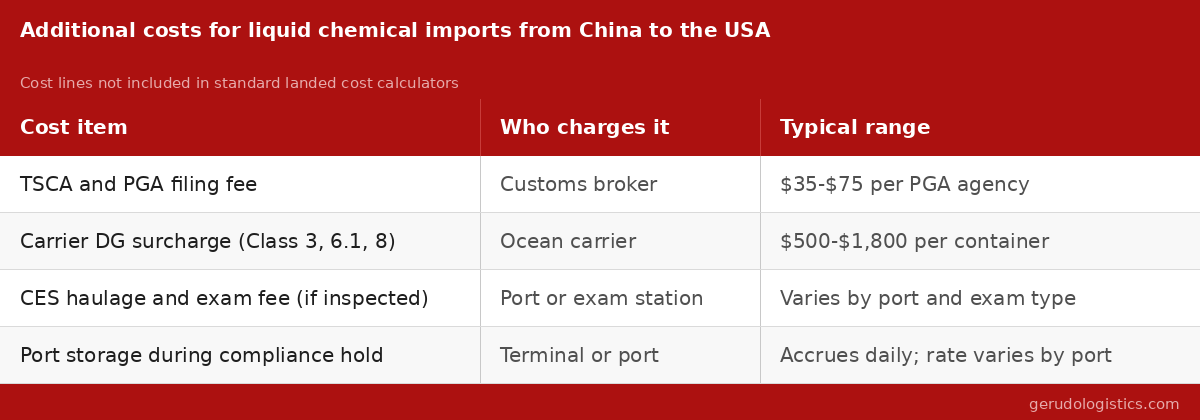
Liquid chemical shipments carry three additional cost lines that most online calculators do not include.
TSCA and PGA filing fees
When your broker transmits the TSCA certification and PGA notifications through ACE, a fee applies per agency. Typical range: $35 to $75 per PGA transmission. These fees are easy to miss when comparing broker quotes that only show the base entry fee.
Carrier DG surcharge
Ocean carriers apply a hazardous cargo surcharge to cover special stowage requirements for dangerous goods. For Class 3, 6.1, and 8 liquid chemicals, surcharges run higher than those applied to Class 9 cargo such as lithium batteries. Importers moving from electronics to chemical cargo regularly underestimate this line.
Inspection and exam costs
If CBP or EPA selects your container for physical examination, you cover all related costs:
Haulage to the Centralized Examination Station (CES)
Exam and handling fees at the station
Port storage accruing throughout the inspection period
TSCA and EPA compliance holds can last days to weeks. Correct documentation is the most cost-effective way to reduce that risk.
Common mistakes US chemical importers make
Using a Chinese-format SDS
OSHA requires SDS documents to follow a 16-section GHS format for the US market. A Chinese manufacturer's SDS commonly has these problems:
References Chinese regulatory standards instead of US ones
Omits US occupational exposure limits and safety thresholds
Lacks a 24-hour US emergency response telephone number such as CHEMTREC
Carriers will reject a non-compliant SDS at booking. CBP will reject it at port. Request the US-format SDS from your supplier before confirming the shipment.
Not checking every component in a mixture
Importers regularly purchase chemical formulations without asking for a full ingredient breakdown. If any substance in a mixture is missing from the TSCA Active Inventory, the entire shipment is non-compliant on arrival.
Verify the CAS number of every listed ingredient in the SDS before placing your order.
Misclassifying the HTS code
Many liquid chemicals can fit more than one HTS subheading, with significantly different duty rates between them. Selecting a code based on general product description rather than chemical composition creates exposure to back-duty assessments and CBP audit.
Use a licensed customs broker with Chapter 28 and 29 experience for the initial classification.
Shipping liquid chemicals from China with Gerudo Logistics
Gerudo Logistics is a dangerous goods specialist freight forwarder headquartered in Guangzhou, with operations across Shenzhen, Shanghai, Ningbo, Qingdao, and Dalian. We handle specialist cargo across all IMDG hazard classes, managing liquid chemical shipments in any packaging format, from drums and IBCs through to ISO tanks.
For China-to-USA chemical shipments, our scope covers cargo classification and DG documentation review before booking, China-side export customs clearance, carrier acceptance coordination, and US-side compliance support including TSCA certification preparation and SDS format review. We arrange door-to-door and DDP delivery to major US ports and inland destinations.
To request a compliance review and full landed cost breakdown for your next liquid chemical shipment from China, contact our team.
Frequently asked questions
Can all liquid chemicals be imported from China to the USA?
Most liquid chemicals can be imported if they comply with TSCA and carry the correct documentation. Prohibited substances, chemical weapons precursors, and certain EPA-restricted compounds cannot be imported. Confirm your chemical's TSCA inventory status before placing a purchase order.
What is TSCA certification and who files it?
TSCA certification is a signed declaration that your shipment either complies with all applicable TSCA rules (positive) or is exempt because it falls under a separate US regulatory framework, such as food, drug, cosmetic, or pesticide law (negative). It is filed electronically by your licensed customs broker through CBP's ACE system when the formal customs entry is submitted.
What happens if CBP rejects my shipment for TSCA non-compliance?
CBP will deny entry. You typically have 30 days to either export the cargo out of the US or have it destroyed under CBP supervision. All storage, return freight, and destruction costs are your responsibility.
Can I import chemical samples without full TSCA compliance?
You still need a TSCA certification, but small quantities imported solely for research and development may qualify for the R&D Exemption. The chemical must be used under the supervision of a technically qualified individual, with strict company recordkeeping. Confirm the exemption criteria with your customs broker before shipment.
How long does a CBP inspection take for a liquid chemical shipment?
A non-intrusive X-ray scan typically adds 1 to 3 days to the clearance timeline. If CBP or EPA selects the container for a physical exam or chemical sampling, the process can run from 7 days to 3 weeks depending on exam station capacity and laboratory turnaround.
Do I need a separate SDS for the US market?
Yes. A Chinese-format SDS will be rejected by carriers at booking and by CBP at port. You need a 16-section OSHA GHS-compliant version with US-specific regulatory references and a US emergency contact number. Request it from your supplier before confirming the shipment.
Who files the ISF for my chemical shipment?
The ISF is filed by your customs broker on behalf of the importer of record, at least 24 hours before vessel loading in China. If you are buying on CIF terms with a supplier-nominated forwarder, confirm in writing who is responsible for ISF filing before cargo is booked.
Conclusion
Liquid chemical shipments clear US customs on documentation. The cargo itself is straightforward. What causes port holds is a missing TSCA certification, an SDS in the wrong format, or an HTS code that does not match the product.
Run the classification check, the TSCA inventory verification, and the document review before your order is placed. Work with a customs broker who knows Chapters 28 and 29, and choose a freight forwarder with US representation and direct DG experience.