How to Import CNC Machines from China
Chinese CNC machines cost 30-50% less than equivalent equipment sourced locally. That price gap is real - but it only holds if the logistics are handled correctly.
CNC machines are precision equipment, and the wrong shipping method or a missed pre-shipment check can result in a machine that arrives intact but fails its first calibration test.
This guide covers what you need to know to ship CNC machines from China without losing that cost advantage.
At a Glance
Most common shipping method: FCL in a 20ft or 40ft container
Typical door-to-door transit: 4-7 weeks
Open top container required if machine height exceeds 2.28m
Pre-shipment checks: moving parts secured, fluids drained, ISPM-15 packaging confirmed, English wiring diagram included
Core documents: Commercial Invoice (with model and serial number), Packing List, Bill of Lading, Certificate of Origin, ISPM-15 proof, cargo insurance certificate
Cargo insurance: all-risk coverage recommended; typically 1-1.5% of shipment value
Why CNC Machines Require Specialist Freight Handling
Most heavy machinery can tolerate a degree of rough handling during transit. CNC machines cannot.
The internal components that give these machines their value are calibrated to very tight tolerances:
Linear guides and ball screws are precision-ground to tolerances measured in microns
Spindle assemblies can shift out of alignment from sustained vibration over a long ocean voyage
Control systems and servo drives are sensitive to moisture and impact
The damage is often not visible on arrival. The machine powers on without issue, but fails its first calibration check. By then, it is difficult to establish whether the damage happened in transit, at the factory, or during installation.
Size and weight range is another factor. A desktop CNC router might weigh 50kg. A gantry-type machining center can exceed 20 tonnes. These two machines need completely different logistics plans.
A freight forwarder without experience in precision machinery will treat both the same way. The same applies to other heavy equipment categories - see our guide onshipping small construction equipment from China for a comparison.
CNC Machine Dangerous Goods Requirements
CNC Machine applies to more CNC machines than most importers expect. Two situations come up consistently:
1 Control system batteries
Most CNC controllers - Fanuc, Siemens, Mitsubishi, and others - contain a non-rechargeable lithium metal battery used to retain parameter data when the machine is powered off.
The classification is UN 3091 (Lithium metal batteries contained in equipment). Whether full DG declaration is required depends on the battery's lithium content - most single-cell batteries fall below the exemption threshold, but your supplier should confirm the battery specification and provide UN38.3 documentation before shipment.
Ask your supplier for the battery model number and the relevant section of the SDS (Part 14 - Transport Information).
2 Coolant and lubricating fluids
Residual cutting fluid or hydraulic oil left inside the machine can cause internal corrosion during transit. Depending on composition, these may also require dangerous goods documentation. Used machines carry higher risk than new ones.
3 Accessories in the crate
Some suppliers pack maintenance kits alongside the machine - anti-rust sprays, touch-up paint, industrial adhesives. These can trigger Class 2 or Class 3 DG requirements and should never travel as general cargo inside the machine crate.
Confirm with your supplier whether the control system batteries require UN38.3 documentation, and ask your freight forwarder to review any accessories before booking.
For shipments that involve dangerous goods handling, you can learn more aboutdangerous goods shipping from China and what the process involves.
Shipping Methods for CNC Machines from China
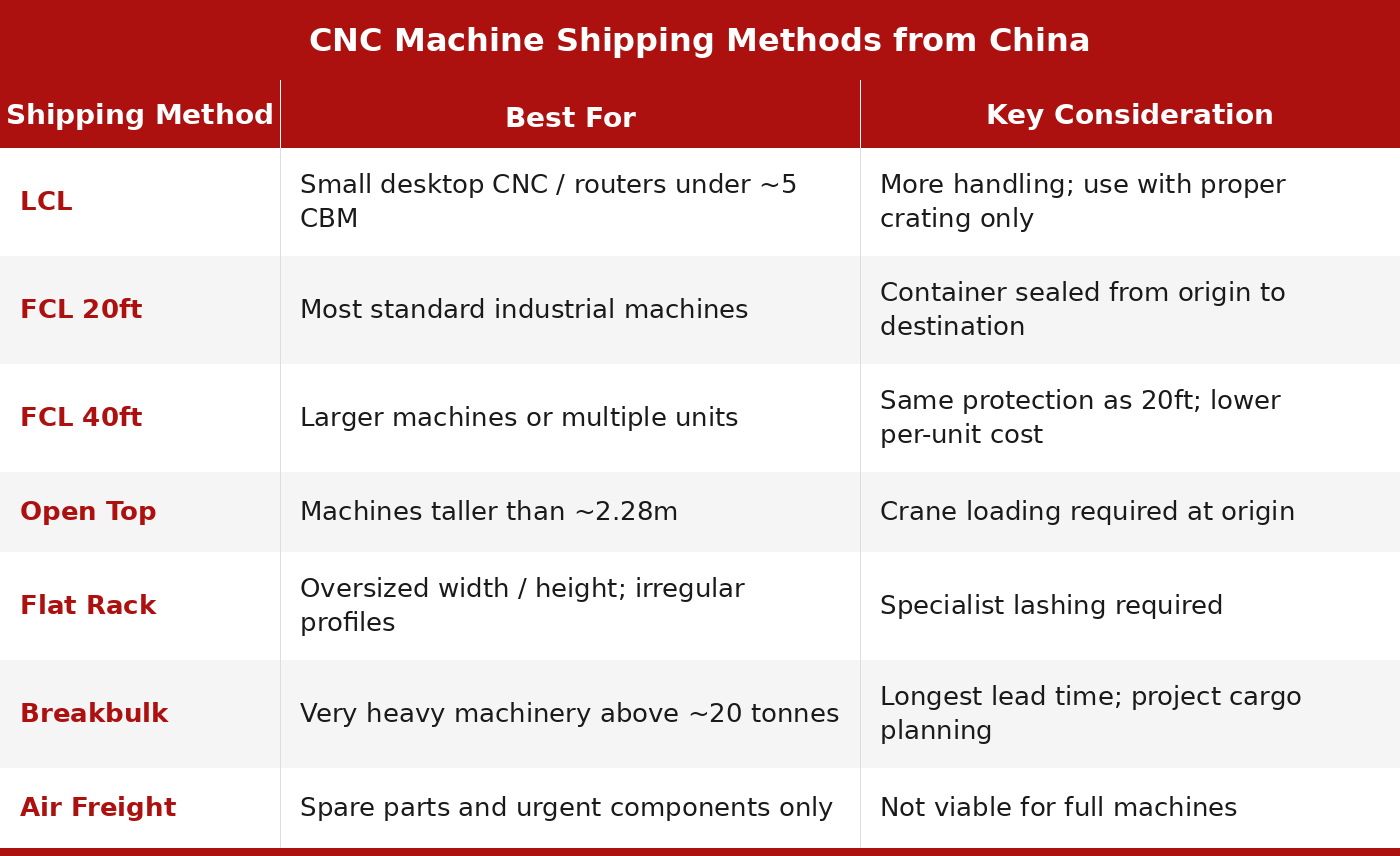
The most important decision when importing a CNC machine is how it moves. The right method depends on the machine's size, weight, and configuration - not on cost alone.
LCL (Less than Container Load)
Best for small machines: desktop routers, compact engravers, benchtop mills under roughly 3-5 CBM
Your machine shares a container with other cargo, which keeps costs down
More cargo handling events means more risk for precision equipment
Only a reasonable option when the machine is properly crated and the forwarder has experience with precision cargo consolidation
Suitable for first-time single-unit purchases where machine size permits
FCL 20ft Container
The standard choice for most industrial CNC machines
The container is sealed at origin and not opened until the destination port - no additional handling
A 20ft container fits most mid-range vertical machining centers and smaller horizontal machining centers
Offers the best protection for precision equipment in this size range
FCL 40ft Container
Appropriate when the machine footprint is larger, or when importing multiple units together
Reduces per-unit shipping cost when buying more than one machine
Same protection advantages as a 20ft FCL
Open Top Container
Required when machine height exceeds the standard container door clearance of approximately 2.28m
The machine is crane-loaded from above at origin
Common for machining centers with tall column structures or vertical travel heights
Carries a freight premium over standard FCL but is routinely used for this type of cargo
Flat Rack
Used for machines that exceed standard container dimensions in height or width, or that cannot be loaded through a door
The cargo sits on a steel platform without side walls or a roof, and is secured with lashing for ocean transit
Typical for oversized industrial routers, large gantry systems, and machines with irregular profiles
Breakbulk
For the heaviest and largest equipment, generally above 20-25 tonnes, or machines that cannot fit even on a flat rack
Requires specialist heavy-lift vessels and full project cargo planning
Longer lead times and more complex coordination than container options
Air Freight
Not a practical option for full CNC machines due to weight and cost
Genuinely useful for replacement parts: a failed control board, a damaged spindle motor, precision components needed urgently to restore production
The high cost per kilogram is justified when machine downtime is expensive
CNC Machine Pre-Shipment Checklist
There are specific things to verify with your supplier before the shipment leaves, because problems found at the destination port cost far more to fix than problems caught beforehand.
Battery documentation is confirmed
Ask your supplier for the control system battery model number and SDS document.
Confirm whether UN38.3 documentation is required based on the battery's lithium content
If your machine has multiple battery packs, total lithium content may exceed exemption thresholds - confirm with your freight forwarder
Moving parts are secured for transit
The spindle head, work table, tool changer arm, and gantry all need to be mechanically locked before the machine moves
Ask your supplier to confirm this in writing and include it in the shipping documentation
If parts arrive unsecured and the machine is misaligned on delivery, establishing liability becomes complicated
Machine fluids have been drained
Confirm this directly rather than assuming it is handled
Residual coolant can pool inside the machine body and cause corrosion during a multi-week ocean transit
Some fluid compositions may also require specific documentation at customs
An English-language wiring diagram is included
Chinese industrial machines frequently use electrical colour-coding that differs from IEC or NFPA standards used in Europe and North America
Your installation team will need an English wiring schematic to work safely with the machine
If the supplier cannot provide one, raise this before the purchase order is finalised - it is easier to negotiate before payment than after
Packaging meets ISPM-15 requirements
Most countries require that wooden packaging materials used in international shipments - crates, pallets, blocking timber - be heat-treated to kill pests, certified under the ISPM-15 standard, and stamped with the official IPPC mark
Without this, your shipment can be held at the destination port for fumigation at your cost, or refused entry entirely
Confirm ISPM-15 compliance with your supplier before the machine is crated
Destination receiving conditions are ready
A large CNC machine cannot be moved with standard warehouse equipment
Confirm that your facility has a forklift with rated capacity matching the machine weight, or arrange crane services in advance
Check door widths, floor load ratings, and access routes if the machine is going into an existing building
Import Documents for CNC Machine Shipments
Customs clearance for industrial machinery is clear when the paperwork is complete and accurate. Delays almost always trace back to missing or incorrect documents.
Standard Documents
Commercial Invoice - include the machine model number, serial number, and a specific description. "Machine" or "equipment" is not sufficient and will trigger customs queries
Packing List - detailed breakdown of all packages, including contents, dimensions, and gross weight
Bill of Lading - issued by the carrier; the primary title document for the cargo
Certificate of Origin - required by some destination countries for duty rate determination
ISPM-15 compliance documentation - proof that wooden packaging meets phytosanitary requirements
Machine specification sheet - technical specs commonly requested by customs for classification
Cargo insurance certificate - evidence of coverage for the shipment value
Destination-Specific Requirements
Some destinations require additional documentation for machines with electronic control systems:
USA - FCC declaration may be required for certain control electronics. US importers also need to file an ISF (Importer Security Filing) at least 24 hours before vessel departure - see ourISF filing guide for US importers for details
EU - CE documentation is required
Confirm the specific requirements for your destination with your customs broker before the machine ships.
CNC Machine Shipping Transit Times by Region
Transit time depends on which Chinese port the machine ships from, the destination port, and the shipping method. Port selection should be driven by factory location, not habit or assumption. Routing a machine from a Guangdong factory through Shanghai to save on container rates often costs more in inland transport than it saves on the ocean leg.
Approximate port-to-port sea freight transit times from major Chinese ports:
US West Coast (Los Angeles / Long Beach): 14-18 days from Shanghai/Ningbo; 20-25 days from Qingdao
US East Coast (New York / Savannah): 28-35 days from major Chinese ports
Northern Europe (Rotterdam / Hamburg / Felixstowe): 25-32 days from major Chinese ports
Middle East (Jebel Ali / Dammam): 18-25 days from major Chinese ports
Southeast Asia (Singapore / Jakarta / Manila): 7-14 days from major Chinese ports
Australia (Sydney / Melbourne): 18-24 days from major Chinese ports
Add 5-10 days for customs clearance and final delivery to your facility. For open top and flat rack shipments, allow additional lead time for specialist loading coordination at the origin port.
Total door-to-door time for a standard FCL shipment is typically 4-7 weeks from order confirmation to delivery. Plan production schedules and installation timelines around this, not around the shorter estimates suppliers often quote.
Common Mistakes That Delay or Damage CNC Shipments
Most problems with CNC machine imports are avoidable. In our experience coordinating heavy machinery shipments, the same issues come up repeatedly.
Choosing the Wrong Freight Forwarder
A forwarder that handles standard general cargo will not know to ask about moving part securements, ISPM-15 compliance, or open-top requirements for tall machines. These details determine whether a machine arrives in calibration or needs expensive repair before it can run. Always confirm that your forwarder has handled precision industrial machinery, and ask for specific examples.
Skipping Cargo Insurance
All-risk marine cargo insurance typically runs 1-1.5% of the cargo value. On a $50,000 machine, that is $500-750. Without it, any transit damage - a dropped crate, a flooded container, a handling incident at port - becomes a dispute with no financial recourse. Declining coverage to save a few hundred dollars on a capital purchase of this size is not a sound trade-off.
Vague Cargo Description
"Machine" or "industrial equipment" on a commercial invoice is a red flag for customs officers. It invites physical inspection, which can add one to two weeks to your clearance timeline and generate additional port storage fees. Use the full description: machine type, brand, model number, and serial number.
Failing to Confirm ISPM-15 Packaging
Most countries require wooden packaging materials - crates, pallets, blocking timber - to carry an IPPC heat-treatment stamp. Without it, your shipment can be held at the destination port for fumigation, or refused entry entirely.
This is one of the most consistent causes of avoidable arrival delays. Confirm ISPM-15 compliance with your supplier before the machine is packed, not after it has already shipped.
Destination Site Not Prepared for Delivery
Large CNC machines require appropriate receiving equipment on arrival. A 6-tonne machining center cannot be moved with a standard 3-tonne warehouse forklift. If the right equipment is not in place when the machine arrives, it sits at the port while you arrange alternatives - and port storage fees accumulate by the day.
Confirm forklift capacity, floor load ratings, and door clearance at your facility before the machine ships.
Why Choose a Specialist Freight Forwarder for CNC Machines
Gerudo Logistics is a China-based freight forwarder specialising in complex and sensitive cargo. Headquartered in Guangzhou with operations across Shenzhen, Shanghai, Ningbo, Qingdao, and Dalian, we provide end-to-end logistics from factory pickup to final delivery under DDP terms.
Our services include:
Sea freight - FCL, LCL, open top, flat rack, and breakbulk for heavy and oversized cargo
Air freight - for urgent components and time-critical deliveries
Dangerous goods shipping - fully compliant handling under IATA, IMDG, and ADR for any cargo that requires DG documentation
Customs clearance coordination - documentation support and clearance management at the destination
Door-to-door and DDP delivery - full responsibility from origin to your facility, including duties and local delivery
Multi-port coordination - routing optimised by factory location across all major Chinese ports
To discuss your shipment requirements,contact our team.
Frequently Asked Questions for CNC Machine Shipping
Can I import a single CNC machine without filling a full container?
Yes. LCL shipping works for smaller machines up to roughly 3-5 CBM. For larger industrial machines, the cost difference between LCL and a 20ft FCL is often smaller than expected - and FCL gives better protection because the container stays sealed from origin to destination.
How do I know if my machine needs an open top container or a flat rack?
Check the machine height in transport position. Standard container doors clear approximately 2.28m. If your machine exceeds that, an open top or flat rack is required. Get the exact dimensions from your supplier and share them with your freight forwarder before booking.
What happens if my CNC machine arrives with alignment or calibration issues?
Document the machine condition immediately on delivery - photos and video before unpacking. All-risk marine cargo insurance covers transit damage, but claims must be filed promptly. This is why cargo insurance is not optional for high-value precision equipment.
Do I need to ask my supplier to drain the coolant before shipping?
Yes, confirm it directly. Most suppliers do this as standard, but exceptions exist. Residual coolant can cause internal corrosion over a multi-week ocean transit, and some coolant types may require DG documentation.
How long does it take to ship a CNC machine from China?
Port-to-port sea freight is 14-35 days depending on origin and destination. Add 5-10 days for clearance and delivery. Total door-to-door for a standard FCL shipment is typically 4-7 weeks.
Conclusion
The price advantage of importing CNC machines from China is real. Protecting it through transit comes down to three things: choosing the right shipping method for the specific machine, confirming a short checklist of pre-shipment requirements with your supplier, and working with a freight forwarder that understands precision machinery. Get those right, and the savings hold.
If you are importing other types of industrial equipment from China, visit ourmachines and equipment shipping guides.