How to Import Electric Forklifts from China: The Ultimate 2026 Guide
Sourcing electric forklifts directly from Chinese manufacturers can reduce per-unit costs by 40-60% compared to purchasing through Western distributors or dealers. For warehouse operators, logistics companies, and equipment dealers, that margin is wide enough to justify a structured import program.
The logistics require more preparation than standard machinery. Most electric forklifts carry lithium battery packs that trigger Class 9 dangerous goods requirements under IMDG and IATA regulations. Your freight forwarder needs carrier approvals, documentation, and a compliant process in place before the shipment loads.
This guide covers shipping costs by destination, transit times, HS codes, compliance requirements for lithium battery models, and the step-by-step import process from China.
What Types of Electric Forklifts Does China Manufacture
China produces the full range of electric forklift types for export. Understanding the categories matters because each type has different dimensions, weights, and compliance considerations.
Counterbalance electric forklifts (3-wheel and 4-wheel)
The most commonly imported type
Capacity range: 1 tonne to 10 tonnes
HS code: 8427.20.8090 (self-propelled trucks, electric, other)
4-wheel models typically require partial disassembly for container loading
Reach trucks and narrow-aisle trucks
Designed for high-rack warehouse operations
Mast height can reach 12 metres
HS code: 8427.10.0000 (self-propelled works trucks, front-end loading, with a lifting device)
Longer overall height means container planning is critical
Electric pallet trucks and stackers (walkie and ride-on)
Lower capacity, compact dimensions
HS code: 8427.20.8090 (most configurations) or 8427.90.0000 for manually propelled variants
More straightforward to containerise; multiple units per container
Order pickers
Used in e-commerce fulfilment and parts distribution
HS code: 8427.10.0000 or 8427.20.8090 depending on configuration
Verify with your customs broker before shipment
Heavy-duty electric forklifts (5-10 tonne)
Less common in Chinese export volumes but available from Heli and Hangcha
Large battery packs often require individual DG declaration per unit
HS codes are the universal language of international trade. Administered by the World Customs Organization and used by over 200 countries covering 98% of global trade, your HS code determines the duty rate your shipment attracts, which compliance documentation customs expects, and how your goods are classified at every border they cross.
For electric forklifts, the distinction between 8427.10 and 8427.20 can affect both the applicable tariff rate and the documentation requirements at destination.
Knowing your correct code before approaching a supplier or forwarder is the foundation of accurate landed cost calculation and compliant import planning. Verify your classification with our HS code guide before placing your purchase order.
All lithium battery packs rated above 100Wh fall under IMDG Class 9 dangerous goods classification for ocean freight. In our experience, virtually every industrial forklift battery exceeds this threshold by a wide margin. A standard 48V/400Ah battery pack contains approximately 19,200Wh. Treat DG compliance as the default for any electric forklift shipment.
How Much Does It Cost to Ship Electric Forklifts from China
Forklifts are heavy, dense cargo. A standard 2.5-tonne counterbalance forklift weighs roughly 3,500 kg gross with packaging.
This weight-to-volume ratio means FCL (Full Container Load) ocean freight is almost always the right shipping method for commercial volumes.
Sea Freight Costs (FCL)
The table below shows indicative FCL ocean freight rates from major Chinese export ports (Shanghai, Ningbo, Shenzhen, Qingdao) in 2026. Rates are subject to fuel surcharges and peak season adjustments.
Lithium battery forklifts classified as Class 9 dangerous goods typically attract a DG surcharge of $200-$400 per booking, depending on the carrier and port of loading. Confirm DG surcharge amounts with your forwarder before finalising landed cost calculations.
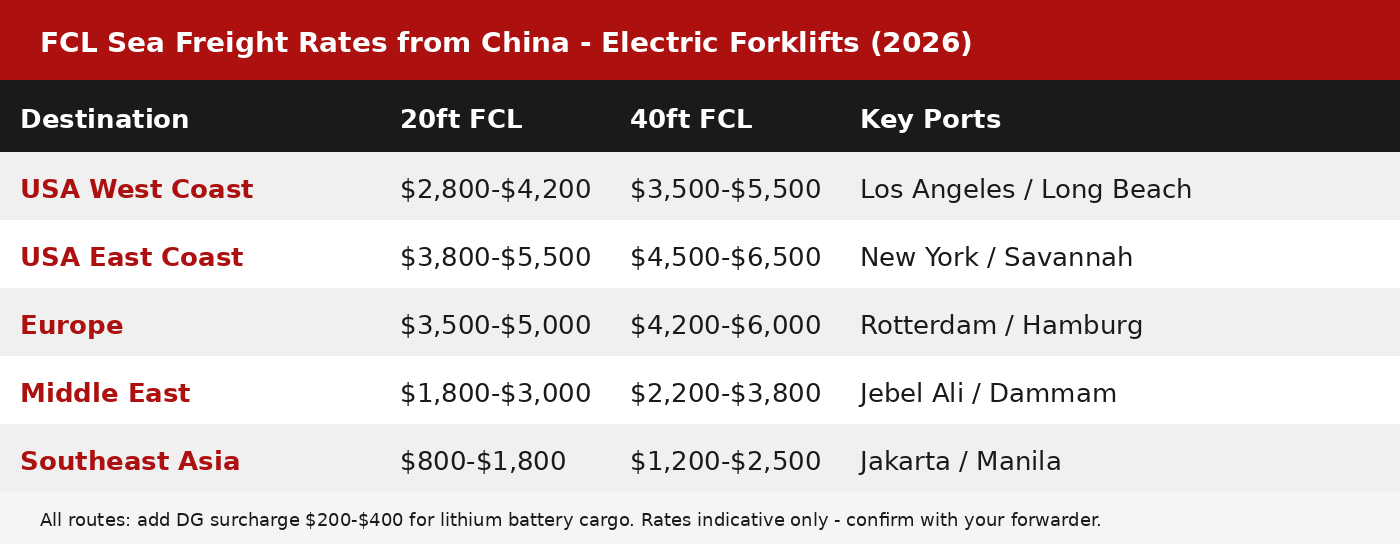
Rates are indicative only. Confirm current rates with us.
Container loading capacity:
A standard 40ft container typically holds 6-10 counterbalance forklifts (3-wheel, 1.5-2.5 tonne class) after partial disassembly
Reach trucks and narrow-aisle trucks require additional planning due to mast height
Compact pallet stackers and walkie trucks can fit 15-25 units per 40ft container
LCL and Air Freight
LCL (Less than Container Load) is viable for single-unit sample orders or compact pallet stackers. Expect ocean freight rates of $100-$180 per CBM from China. LCL carrier acceptance of Class 9 DG cargo varies. Confirm with your forwarder before booking.
Air freight is impractical for counterbalance forklifts due to weight and size. For compact electric pallet jacks under 500 kg, air freight rates range $5-$10 per kg from China. Lithium battery cargo on air requires specific carrier approval and documentation under IATA DGR regulations.
Import Duties by Destination
United States: Electric forklifts under HS 8427.20 and 8427.10 are subject to current Section 301 tariffs on Chinese-origin goods. Tariff rates on this category have shifted multiple times through 2025-2026. Verify the current applicable rate with your customs broker before finalising landed cost. Do not rely on any figure quoted more than 60 days prior.
European Union: Standard MFN customs duty on industrial trucks (HS 8427) is 1.7%. Verify with your customs broker whether any current EU trade measures apply to your specific HS code before committing to large volumes.
Middle East and Southeast Asia: Duty rates vary by country and bilateral trade agreement. Confirm applicable rates with your customs broker before purchase order placement.
How Long Does Shipping Take from China
Ocean freight port-to-port transit times from major Chinese export ports:
China to USA West Coast (Los Angeles/Long Beach): 14-18 days
China to USA East Coast (New York/Savannah): 25-35 days
China to USA Gulf Coast (Houston): 28-38 days
China to Europe (Rotterdam/Hamburg): 25-32 days
China to Middle East (Jebel Ali): 18-25 days
China to Southeast Asia (Jakarta/Manila): 8-14 days
Add 5-10 days to all figures above for export documentation finalisation, destination customs clearance, and inland delivery.
Factory lead times add substantially to total timelines:
Standard stock models (Heli, Hangcha production lines): 2-4 weeks
Custom specifications, OEM branding, or non-standard battery configurations: 6-10 weeks
CE or specific market certification documentation adds time. Confirm with your supplier before placing the purchase order.
A realistic total timeline from confirmed purchase order to delivery is 10-16 weeks. Build this into your planning, especially for programmes tied to warehouse opening dates or seasonal operational needs.
Top Electric Forklift Manufacturers in China
Three manufacturers have consistent export track records and documentation readiness for major markets:
Heli (HELI)
Anhui Heli Co., Ltd. is China's largest forklift manufacturer and one of the top 10 globally by volume. Their electric counterbalance range covers 1-10 tonnes across 3-wheel and 4-wheel configurations.
Key points for importers:
CE certification available for EU-bound units
Established dealer and parts networks in North America, Europe, and Southeast Asia
G2 and G3 series are the primary export models
Hangcha (HC Forklift)
Hangcha Group has grown into a significant export player, particularly for lithium-ion models. Their X Series lithium-ion counterbalance range offers opportunity charging capability and is engineered for multi-shift operations.
Key points for importers:
Strong lithium-ion product line with documented UN38.3 certification
Active export distribution in Europe and Southeast Asia
Competitive on price relative to Heli for comparable specifications
EP Equipment
EP Equipment focuses specifically on compact electric material handling, including walkie pallet trucks, stackers, and sit-down counterbalance forklifts up to 3.5 tonnes. They have established retail presence in European markets.
Key points for importers:
CE-certified product range
Compact models are well-suited for container loading efficiency
More limited heavy-duty range than Heli or Hangcha
Quality varies significantly across Chinese manufacturers. Brands with established export distribution and documented certification history in your target market carry lower compliance risk than smaller factories competing on price. Always request existing test reports before production begins.
Where to Source Electric Forklifts from China
Online Channels
Alibaba and Made-in-China are the most widely used starting points. Filter for suppliers with factory-verified status, Trade Assurance coverage, and documented export experience to your target market. Trading companies frequently list products alongside manufacturers. Verify factory status before proceeding.
Direct Factory Contact
Contacting manufacturers directly, particularly Heli, Hangcha, and EP Equipment, gives access to dedicated export departments with experience in CE documentation, UN38.3 certification, and customs compliance requirements. For orders above 5 units, a direct relationship is worth pursuing.
Canton Fair and Trade Shows
The Canton Fair (held twice yearly in Guangzhou) includes material handling equipment exhibitors and allows in-person product inspection and certification package review. For new sourcing relationships involving higher-value or custom-specification orders, in-person evaluation is worth the investment.
Compliance Requirements Before Your Shipment Loads
This is the section that separates electric forklift imports from most general machinery. Get these right before the shipment loads. Fixing compliance failures at the destination port is significantly more expensive.
Lithium Battery Packs: Class 9 Dangerous Goods (IMDG)
Any electric forklift containing a lithium battery pack rated above 100Wh is classified as IMDG Class 9 Miscellaneous Dangerous Goods for ocean freight. Every commercial forklift battery falls into this category.
A compliant shipment requires:
UN38.3 test certification for the battery pack. This must come from the battery manufacturer, not the forklift assembler.
IMDG-compliant DG declaration prepared by a certified DG specialist
MSDS (Material Safety Data Sheet) for the battery
Battery state of charge (SoC) at or below 30% at time of loading, confirmed and documented
Ocean carrier DG acceptance confirmation before the booking is finalised. Carriers vary on Class 9 lithium cargo acceptance by route.
Failure to declare lithium battery cargo correctly is the most common compliance failure in this product category. It can result in shipment rejection at the port of loading, fines, and significant delays.
CE Marking for EU-Bound Forklifts
CE marking is mandatory for industrial trucks sold in EU member states, covering the Machinery Directive (2006/42/EC) and applicable electromagnetic compatibility requirements. Request the full Declaration of Conformity from your supplier and confirm they hold the underlying technical file.
A CE declaration without a verifiable technical file carries legal and liability risk for the importer. Ask for the file before placing your order.
UL Listing for Chargers (USA)
Electric forklifts do not face EPA engine emissions requirements. Battery chargers imported for US use should carry UL listing or equivalent certification for insurance and safety compliance purposes. Confirm charger certification with your supplier before the purchase order is finalised.
Shipping Battery product from China to USA? Read our guide and get your shipping advice.
Charger Voltage Specification
Standard Chinese factory chargers are configured for 220V single-phase supply. Your local voltage standard may differ:
USA/Canada: 120V single-phase (residential), 208-240V (industrial)
Europe: 230-240V single-phase, 400V three-phase (industrial)
Middle East: 220-230V (varies by country)
Specify your required voltage and phase configuration to the manufacturer before production. Retrofitting the wrong charger on arrival adds cost and delay.
How to Ship Electric Forklifts from China: Step by Step
Step 1: Verify product compliance before committing to a supplier
Request:
UN38.3 test certification for the battery pack
CE Declaration of Conformity (EU-bound units)
UL charger certification (US-bound units)
Confirmation that charger voltage matches your destination requirement
Compliance gaps at this stage are significantly cheaper to resolve than at the port of destination.
Step 2: Establish Incoterms and select your freight forwarder
FOB (Free on Board) is the standard choice for experienced importers. Under FOB, you control freight and insurance from the moment goods are loaded onto the vessel at the Chinese port.
Select a freight forwarder with documented experience handling oversized machinery and Class 9 DG cargo from China. These are two separate competencies and not all forwarders have both.
Step 3: Plan container loading and prepare for partial disassembly
Counterbalance forklifts typically require:
Mast removal or tilting
Overhead guard removal or folding
Proper securing with chains and dunnage inside the container
Battery SoC confirmation and documentation before the container is sealed
Confirm the disassembly and re-assembly requirements with your supplier and your receiving team before shipment.
Step 4: Prepare documentation during the production period
Core document set:
Commercial invoice (with correct HS code)
Packing list
Bill of Lading
Certificate of Origin
UN38.3 test report for battery pack
IMDG DG declaration
MSDS for battery
For US-bound shipments, your forwarder must file the ISF (Import Security Filing) 24 hours before the vessel departs China. Missing this deadline causes automatic holds.
Step 5: Confirm DG booking acceptance with the ocean carrier
This step must be completed before the container is loaded. Your freight forwarder should obtain written confirmation from the carrier that Class 9 DG cargo is accepted on the specific vessel and route.
Carrier policies vary by vessel, route, and current DG load levels. Confirm in writing before loading.
Step 6: Manage customs clearance and final delivery
Customs clearance typically takes 3-7 business days under normal conditions. Physical inspections extend this. Ensure your customs broker has the complete documentation set well before the vessel arrives at the destination port.
Final delivery requires heavy equipment transport capability. A standard truck is not sufficient for counterbalance forklifts. Arrange delivery with a carrier experienced in oversized industrial equipment and confirm your receiving location has appropriate unloading equipment.
How Gerudo Logistics Handles Electric Forklift Shipments from China
Electric forklifts combine two areas where most forwarders have gaps: oversized industrial machinery and Class 9 dangerous goods compliance.
At Gerudo Logistics, we manage both in a single integrated workflow. Our operations team handles:
DG documentation package - UN38.3 certification review, IMDG-compliant DG declaration preparation, MSDS coordination, and pre-shipment battery SoC confirmation at or below 30%
Ocean carrier DG acceptance - we confirm booking acceptance for Class 9 lithium cargo before your container loads
Container loading supervision - mast disassembly, securing specifications, and loading documentation for FCL shipments
Export customs clearance from our operations across Guangzhou, Shenzhen, Shanghai, Ningbo, and Qingdao
Door-to-door delivery under DDP or DAP terms, including destination customs clearance and inland heavy equipment transport
We handle single-unit sample shipments and multi-container commercial programmes under the same compliance standard. In our experience, the DG paperwork is where most first-time forklift importers encounter delays. Working with a forwarder who treats it as standard workflow makes a material difference to your timeline.
To discuss your electric forklift import programme,contact us!
Frequently Asked Questions
What HS code applies to Chinese electric forklifts?
Most electric counterbalance forklifts and reach trucks use HS 8427.10.0000 or 8427.20.8090 depending on configuration. Walkie pallet trucks may fall under 8427.90.0000. Verify the correct classification with your customs broker before shipment, as the applicable HS code affects both the duty rate and whether Section 301 tariffs apply for US imports.
Are all electric forklifts classified as dangerous goods?
Yes, in practice. Any lithium battery pack above 100Wh triggers IMDG Class 9 classification for ocean freight. All commercial-grade electric forklift batteries significantly exceed this threshold. Treat DG compliance as standard for every electric forklift shipment.
What documentation is required for the battery pack?
The minimum package is: UN38.3 test certification, IMDG DG declaration, and MSDS. Battery state of charge must also be confirmed at or below 30% at time of loading. This documentation must be in place before the carrier will accept the booking.
How many electric forklifts fit in a 40ft container?
For standard 3-wheel counterbalance forklifts in the 1.5-2.5 tonne class, expect 6-10 units per 40ft container after partial disassembly. Compact walkie stackers and pallet trucks can reach 15-25 units. Reach trucks and heavy-duty models require individual loading plans based on mast height and machine dimensions.
Do electric forklifts require EPA compliance for US import?
No. EPA small engine emissions standards apply to gasoline and diesel engines. Electric forklifts are exempt from EPA engine compliance requirements. Battery chargers should carry UL listing or equivalent certification for insurance and safety compliance purposes.
What is a realistic total timeline from order to delivery?
Plan for 10-16 weeks: 2-6 weeks for production, 2-5 weeks for ocean transit, and 1-2 weeks for destination clearance and inland delivery. Custom specifications or non-standard documentation requirements add time at both the production and compliance stages.
Can I import a single electric forklift from China?
Yes. A single unit typically ships LCL or as a sole-use 20ft container depending on dimensions and weight. DG compliance requirements are identical regardless of shipment size. A single forklift still requires full UN38.3 certification and IMDG documentation.
Conclusion
Importing electric forklifts directly from Chinese manufacturers offers a significant cost advantage for warehouse operators, equipment dealers, and logistics companies. The price gap relative to Western-brand alternatives holds even after freight, duties, and compliance costs are factored in.
The logistics process requires more attention than standard machinery. Lithium battery packs make every electric forklift a Class 9 dangerous goods shipment. That means carrier approval, DG documentation, and battery charge state management before the container loads. Partial disassembly for container loading adds a further planning step.
These requirements are manageable with the right freight partner. Choose a forwarder with documented experience in both Class 9 DG compliance and oversized industrial equipment from China. Verify product certifications before production begins. Budget for the DG surcharges and landed costs that apply to your specific destination market.
Those three steps cover the majority of issues that turn a clean import into a delayed one.