ISF Filing for Ocean Freight from China to the USA: Complete 2026 Guide
Most ISF violations do not happen because importers ignored the requirement. They happen because one data field arrived late, a booking reference changed after filing, or a supplier gave the wrong factory address. CBP can issue liquidated damages of $5,000 per violation - and the charge lands weeks after the cargo has already cleared. By then, the shipment is in your warehouse and the problem is on your bond.
This guide covers what ISF requires, who is responsible, what data you need from your Chinese supplier, how the filing deadline works, and what penalties look like when things go wrong. It also covers the customs bond requirement and what makes DG cargo a higher-risk category for ISF errors.
What Is ISF Filing (10+2)?
Import Security Filing (ISF) is a mandatory pre-loading data submission required by U.S. Customs and Border Protection (CBP) for all ocean freight entering the United States. It is commonly called "10+2" because the submission has two parts:
10 data elements provided by the importer
2 additional elements submitted by the ocean carrier
ISF is a security filing. Its purpose is to allow CBP to screen cargo for risk before it is loaded onto a vessel in China. The filing deadline is set against the departure port, which means compliance happens well before goods reach the United States.
The requirement applies to all commercial ocean shipments bound for the United States. Air freight, express courier shipments (DHL, FedEx, UPS), and cross-border truck movements are not covered by ISF.
Who Is Responsible for ISF Filing?
The Importer of Record is legally responsible for ISF - for its accuracy, its completeness, and its timing. That responsibility does not transfer to a freight forwarder or customs broker when they handle the actual submission. If the filing is late or wrong, the penalty falls on the importer's customs bond.
Three parties are involved in every ISF submission. Understanding who owns what prevents the gaps that cause most violations.
Importer of Record
The Importer of Record owns the outcome. All 10 importer-side data elements must be accurate, and the filing must reach CBP before the 24-hour loading deadline. Appointing a broker to handle submission does not change this accountability.
Licensed U.S. Customs Broker
The customs broker submits ISF through the Automated Broker Interface (ABI) and returns a filing confirmation. Brokers can catch formatting errors and flag missing fields - but the filing reflects the data provided to them. Inaccurate supplier data produces an inaccurate filing.
China-Side Freight Forwarder
On China-origin shipments, the forwarder coordinates booking details, tracks document cutoffs, and collects the supplier information the broker needs to file accurately - manufacturer address, stuffing location, and consolidator details. When a B/L reference changes or a stuffing address shifts at the last hour, the forwarder is usually the first to know.
Most ISF failures happen at the handoff between these three parties. A B/L reference changes and the forwarder does not notify the broker in time. A supplier confirms the wrong stuffing address and nobody checks it against the booking. One internal owner per handoff, with any booking change treated as a trigger to review the ISF immediately, prevents most of these failures.
When Must ISF Be Filed?
ISF must be submitted at least 24 hours before cargo is loaded onto the vessel at the Chinese port of departure. The clock runs from loading time at the origin port - not from vessel departure, and not from arrival in the United States.
In practice, your real deadline is earlier than the regulatory minimum. Document cutoff at most Chinese ports closes 24 to 48 hours before vessel departure, which means you need complete supplier data well before the vessel leaves. A booking confirmed on Monday for a Thursday departure gives you a narrow window - especially if your supplier is slow to confirm the stuffing location.
Treat booking confirmation as your trigger to start collecting ISF data, not the document cutoff.
Common timing failures:
Supplier sends final packing details after the document cutoff
Booking reference changes and the ISF is not updated to match
Friday or Saturday departures where weekend cutoffs are missed
Late-stage consolidation that changes the stuffing address
What Data Do You Need from Your Chinese Supplier?
The ISF requires 10 data elements from the importer side, plus 2 from the ocean carrier. The fields break into three groups depending on who holds the information.
What you provide as the importer:
Buyer name and address
Importer of Record number
Consignee name and address
Ship-to party (final U.S. delivery address)
HS code - Harmonized System classification code, usually confirmed with your customs broker
What your Chinese supplier must provide:
Seller name and address
Manufacturer name and address (the actual factory, not a trading company)
Country of origin
Container stuffing location - the physical address where goods were loaded into the container
Consolidator name and address, if a third-party consolidation warehouse is used
What the ocean carrier submits separately:
Vessel stow plan
Container status messages
Three fields cause most ISF errors in practice: Manufacturer, Container Stuffing Location, and HS code. The manufacturer field is wrong when a trading company sits between the factory and the buyer. The stuffing location is wrong when cargo is moved to a consolidation warehouse after booking. The HS code creates problems when classification is finalized late or changed after filing.
Build a simple requirement into your supplier process: all three of these fields must be confirmed at booking, not at packing.
Pre-Filing Checklist
Before your customs broker submits ISF, run through these points:
Manufacturer name and address confirmed as the actual factory, not a trading company
Container stuffing location matches the physical loading address, not an office or sales address
HS code agreed with your customs broker and consistent with the commercial invoice
Bill of Lading reference matches the booking confirmation from the carrier
Consignee and Ship-to Party details are complete and correctly spelled
Consolidator address confirmed if cargo is moving through a third-party warehouse
This takes five minutes at booking. Fixing a mismatch after the vessel departs takes considerably longer.
ISF Penalties - What Happens If You File Late or Wrong?
CBP enforces ISF compliance through liquidated damages under the importer's customs bond. The standard exposure:
Late filing: $5,000 per violation
Inaccurate or incomplete filing: $5,000 per violation, up to $10,000 per shipment
Missing filing: $5,000 per violation
Beyond financial penalties, two operational consequences make late or inaccurate ISF costly:
Do Not Load (DNL) hold: CBP stops your cargo from being loaded at the Chinese port until the issue is resolved
Customs exam at the U.S. port: non-compliant ISFs can trigger inspection, adding fees, port storage charges, and delivery delays
B/L mismatch is a separate and common failure. CBP cross-references the Bill of Lading number in your ISF against the B/L transmitted by the ocean carrier. If the two do not match, CBP treats the filing as incomplete.
This can happen even when the ISF was filed on time - a booking revision, a reissued B/L, or a missed update is enough. Any change to the B/L reference after ISF submission requires an immediate update to the filing.
Repeat violations increase scrutiny on future shipments. CBP tracks compliance history at the importer level.
Penalties can sometimes be mitigated if the importer demonstrates a good compliance record and corrected the error promptly. That process requires working with a licensed customs broker and is not guaranteed.
Customs Bond Requirement for ISF
A customs bond is required to file ISF. You have two options:
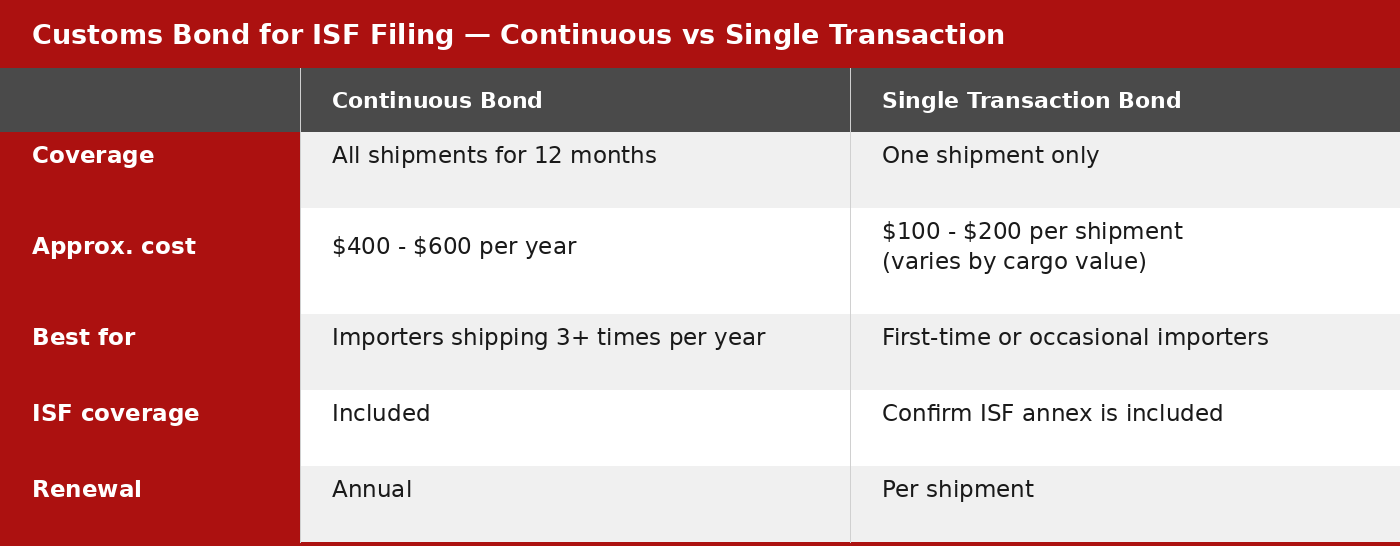
If you import regularly from China, a continuous bond is almost always cheaper over the course of a year. A single transaction bond makes sense only if you import once or twice annually and have no ongoing compliance obligations.
One practical note: not all single transaction bonds automatically include ISF coverage. When purchasing one, confirm with your customs broker that the ISF annex is included - otherwise your ISF filing has no bond backing it.
For a detailed breakdown of bond types, cost calculations, and what the current tariff environment means for bond sufficiency, see our guide to US customs bonds for China imports.
Special Considerations for DG Cargo
For standard general cargo, an HS classification error in ISF is a data quality problem. For dangerous goods shipments, the same error can conflict with the DG declaration already filed on the same shipment - creating a document mismatch that CBP flags during risk screening.
Three ISF data fields carry extra weight for DG cargo.
HS Code Accuracy Matters More for Chemicals
DG products often have multiple plausible HS classifications depending on concentration, formulation, or end use. A chemical classified under one HS code may carry a different UN number under IMDG. When the ISF HS code conflicts with the commercial invoice or DG documentation, the filing draws CBP attention.
Filing a preliminary HS code and updating it after booking is common practice for general cargo. For DG shipments, that approach carries more risk.
Manufacturer Must Be the Actual Factory
For DG shipments, the actual manufacturer matters beyond the ISF data requirement. It affects the validity of the Safety Data Sheet (SDS), the IMDG DG Declaration, and any product-specific certifications. When a trading company is listed as the manufacturer in the ISF instead of the actual factory, it creates a chain-of-custody inconsistency that can complicate inspections.
Stuffing Location Must Reflect Where DG Packing Happened
DG cargo is sometimes moved to specialist packing facilities after initial booking, especially for goods requiring compliant UN-certified packaging. A stuffing address that reflects the original warehouse rather than the actual DG packing site is one of the more common data errors on DG shipments.
The ISF form and deadline are identical for DG and general cargo. The cost of getting individual fields wrong is higher, and the benefit of locking data early is greater.
How Gerudo Logistics Supports Your ISF Compliance
ISF compliance for ocean shipments from China depends on getting accurate supplier data before the document cutoff. That is where coordination on the China side determines whether the filing goes smoothly or runs into problems at the last hour.
Gerudo Logistics manages ocean freight from Chinese ports across Guangzhou, Shenzhen, Shanghai, Ningbo, Qingdao, and Dalian. For U.S.-bound shipments, this includes:
Coordinating the export documentation timeline against vessel cutoffs
Aligning supplier data - manufacturer, stuffing location, consolidator - with booking details
Working with the importer's appointed U.S. customs broker to ensure ISF information is complete before vessel departure
For DG shipments - chemicals, hazardous materials, and regulated cargo of any class - this coordination extends to the full documentation package. SDS, DG Declaration, and UN-certified packaging verification all need to align with the ISF data before loading.
If you are planning ocean freight from China to the United States and want to understand how compliance costs fit into your total landed cost, our landed cost guide for China-USA shipments covers the full picture, including DG surcharges that most general calculators leave out.
Contact Gerudo Logistics to discuss your shipment requirements.
Frequently Asked Questions
Q: Who is legally responsible for ISF filing? The Importer of Record is legally responsible for the accuracy and timeliness of ISF, even when a customs broker or freight forwarder handles the actual submission. If the filing is late or wrong, the penalty falls on the importer's customs bond.
Q: When exactly must ISF be filed for shipments from China? ISF must be submitted at least 24 hours before cargo is loaded onto the vessel at the Chinese port. In practice, document cutoffs close 24 to 48 hours before vessel departure, so usable supplier data is needed earlier than most importers expect.
Q: Does ISF apply to LCL shipments? Yes. ISF applies to all ocean freight shipments bound for the USA, regardless of whether they are FCL or LCL. For LCL cargo, the consolidator information becomes a required data field.
Q: What is an ISF match and why does it matter? An ISF match occurs when the Bill of Lading number in the ISF matches the B/L number transmitted by the ocean carrier. Without this match, CBP treats the filing as incomplete. B/L references sometimes change after initial booking - when they do, the ISF must be updated immediately.
Q: What is the difference between ISF penalties and customs duties? ISF penalties are separate from import duties and tariffs. An importer can pay all applicable duties correctly and still receive a liquidated damages notice for a late or inaccurate ISF. The two are assessed independently. For current China tariff rates, see our guide to current tariffs on Chinese goods.
Q: What happens if CBP issues a Do Not Load (DNL) hold? Cargo cannot be loaded at the Chinese port until the ISF issue is resolved and CBP lifts the hold. This can delay departure by days, potentially causing the shipment to miss the vessel entirely and roll to the next available sailing. Re-booking fees, additional port storage, and revised delivery timelines all follow.
Conclusion
ISF is a pre-loading requirement, which means every deadline and every data error happens on the China side of the shipment - before you have any direct visibility into what is going wrong. By the time a hold or penalty notice reaches you, the window to prevent it has already closed.
The practical approach is to treat ISF data collection as part of your booking process, not your documentation process. Confirm supplier details at booking. Verify the stuffing location before the document cutoff. Make sure your customs bond covers ISF. And for DG cargo, lock your HS classification early - changing it after filing creates document conflicts that are harder to explain than they are to prevent.