China Shipping Market Update August 2026
Typhoon Dolphin tore through the Zhejiang and Shanghai coastline in early August, forcing Ningbo to suspend container gate operations, feeder services and vessel movements from August 7.
It's one of several developments reshaping shipping from China this month — alongside continued route changes on Asia-Europe lanes, a new US tariff, tighter EU cargo screening, and freight rates that moved in different directions depending on the lane.
Early-August ocean freight rates were mixed. Shanghai–Los Angeles and Shanghai–Genoa saw the clearest declines, New York and Rotterdam held broadly stable, and Jebel Ali moved higher on continued Gulf-connected pressure.
This Month’s Five Key Developments at a Glance
Typhoon Dolphin disrupted port, trucking and air cargo operations around Shanghai and Ningbo.
Selected Gemini services continued returning to the Suez Canal.
A new 12.5% Section 301 tariff took effect on covered China-origin products after the Section 122 surcharge expired.
Updated EU ICS2 cargo description screening took effect on August 3.
The US introduced a reduced-size limited quantity mark option effective September 3.
Typhoon Dolphin Disrupts East China Shipping
Typhoon Dolphin reached the East China coast in early August and caused operational restrictions across Zhejiang and Shanghai. Ningbo suspended several port activities from August 7, including container gate operations, feeder services and vessel movements.
Shanghai also experienced severe rainfall, flooding and widespread flight cancellations. The disruption affected ocean freight, air cargo and inland transport across the Yangtze River Delta.
The main operational effects included:
Container gate and vessel movement restrictions
Delayed truck collection and terminal delivery
Suspended barge and feeder connections
Revised berthing windows and vessel schedules
Flight cancellations at Shanghai airports
Port reopening does not immediately restore the original schedule. Terminals must process accumulated containers, carriers must revise vessel windows, and empty equipment may need to be repositioned.
Delays may therefore continue after the immediate weather restrictions end.
Dangerous goods cargo can also require renewed carrier approval when the vessel, sailing or departure port changes.
Reefer shipments may face additional pressure where terminal plug capacity or gate-in windows are limited.
The disruption does not affect every Shanghai or Ningbo shipment equally. Actual delays depend on the terminal, sailing, cargo-ready date and recovery of local trucking services.
More Gemini Services Return to the Suez Canal
Maersk and Hapag-Lloyd have continued the gradual return of selected Gemini services to the Red Sea and Suez Canal.
The AE15 service moved from the Cape of Good Hope route to the trans-Suez route in July, with a Jeddah call added for August. On August 10, the carriers also announced that the AE19 service would begin using the trans-Suez route.
AE19 connects Asia with the Mediterranean, Saudi Arabia and Europe. The revised routing can shorten the sailing distance compared with the Cape of Good Hope route.
This is not a complete network-wide return to Suez. Gemini services may continue to follow different routings, and carriers can revise individual services according to security and operational conditions.
A shorter route also does not guarantee an earlier delivery. Port rotation, berth availability and transshipment reliability still determine the final transit time. Dangerous goods and reefer acceptance may also change when the vessel or connection plan is revised.
The gradual return of selected services could release effective capacity on Asia-Europe routes. Its effect on freight rates will depend on how many services return and whether the revised schedules remain stable.
New Section 301 Tariffs Replace the Expired US Surcharge
The United States introduced a temporary 10% import surcharge under Section 122 on February 24, 2026. The measure expired on July 24 after reaching its statutory 150-day limit.
A new forced labor-related Section 301 measure took effect on the same day. The United States Trade Representative imposed an additional 12.5% tariff on covered products of China as part of an action involving 60 economies.
The expiry of the Section 122 surcharge therefore did not produce a general 10-percentage-point reduction for China-origin imports. For covered products, one additional tariff ended as another took effect.
The new Section 301 action includes product exemptions and an in-transit provision for qualifying goods loaded before July 24 and entered before the stated deadline. The 12.5% tariff does not apply automatically to every product imported from China.
The final import cost can still include:
Normal customs duty: Based on the confirmed HTS classification
Existing China Section 301 tariffs: Applied to products covered by earlier trade actions
New Section 301 tariff: An additional 12.5% on covered China-origin products
Section 232 measures: Applied to specified steel, aluminum and other products
AD/CVD: Product, producer and country-specific antidumping or countervailing duties
Articles and parts already subject to Section 232 are exempt from the new forced labor-related Section 301 measure. Other exemptions are identified in the annexes to the final action.
The existing China Section 301 tariffs and the new measure remain separate. A product can fall within both unless an exclusion or another applicable provision changes the treatment.
Machinery, metal parts, batteries and chemicals may require several tariff checks. The full landed cost for a shipment from China to the USA therefore depends on the HTS code, entry date and applicable trade measures.
China-origin container volumes entering the United States were high in July, partly because some importers moved cargo before the tariff change. This frontloading could reduce part of the usual August demand, although its effect will vary by product and destination.
The EU Updates ICS2 Cargo Description Screening
The EU Import Control System 2, or ICS2, uses Entry Summary Declaration data to assess cargo before it enters or transits the European Union.
An updated stop-word list took effect on August 3, 2026. It targets descriptions that are too broad to identify the actual goods for customs risk analysis.
Terms such as “parts,” “equipment,” “chemicals” or “food products” may be insufficient without a specific product name, material, function or processing condition. Descriptions across the commercial invoice, packing list and shipping instructions need to identify the cargo consistently.
For example:
Chemicals: State the identifiable product name or intended use.
Machinery: Identify the machine or component and its function.
Food cargo: State the product and whether it is frozen, chilled, dried or concentrated.
Battery products: Identify the product and battery configuration.
All consignments entering or passing through the EU by any transport mode have required a valid Entry Summary Declaration since June 1, 2026. The August update changes description screening within that existing filing process.
The carrier or filing agent normally submits the declaration, but the description depends on information supplied by the importer and supplier. Generic descriptions can cause filing rejection, correction requests or shipment delays.
Cargo descriptions forFCL shipping from China to Europe should therefore be finalized before the shipping instructions and ENS data are submitted.
The US Allows a Reduced-Size Limited Quantity Mark
The US Pipeline and Hazardous Materials Safety Administration published a final rule on August 4 allowing a reduced-size limited quantity mark on the shipping label of certain packages.
The rule takes effect on September 3, 2026. It applies to eligible limited quantity packages transported by highway, rail or vessel.
The reduced-size option does not apply to air transport and cannot replace the required limited quantity mark on an overpack. The material, quantity and package must already qualify for the relevant limited quantity provisions.
Existing compliant limited quantity marks do not automatically need to be replaced. The rule adds another marking option rather than changing the underlying classification or packaging requirements.
For shipments arriving from China, the new option is most relevant to US domestic distribution. The international package and the US shipping label may be subject to different marking conditions.
The existing classification and packaging requirements forlimited quantity dangerous goods shipping from China continue to apply.
Regional Freight Rate Snapshot for August 2026
The figures below are early-August market benchmarks for standard 40ft dry containers. The US and Europe trends compare the August 6 rates with the July 2 benchmarks. More recent weekly movements are identified separately.
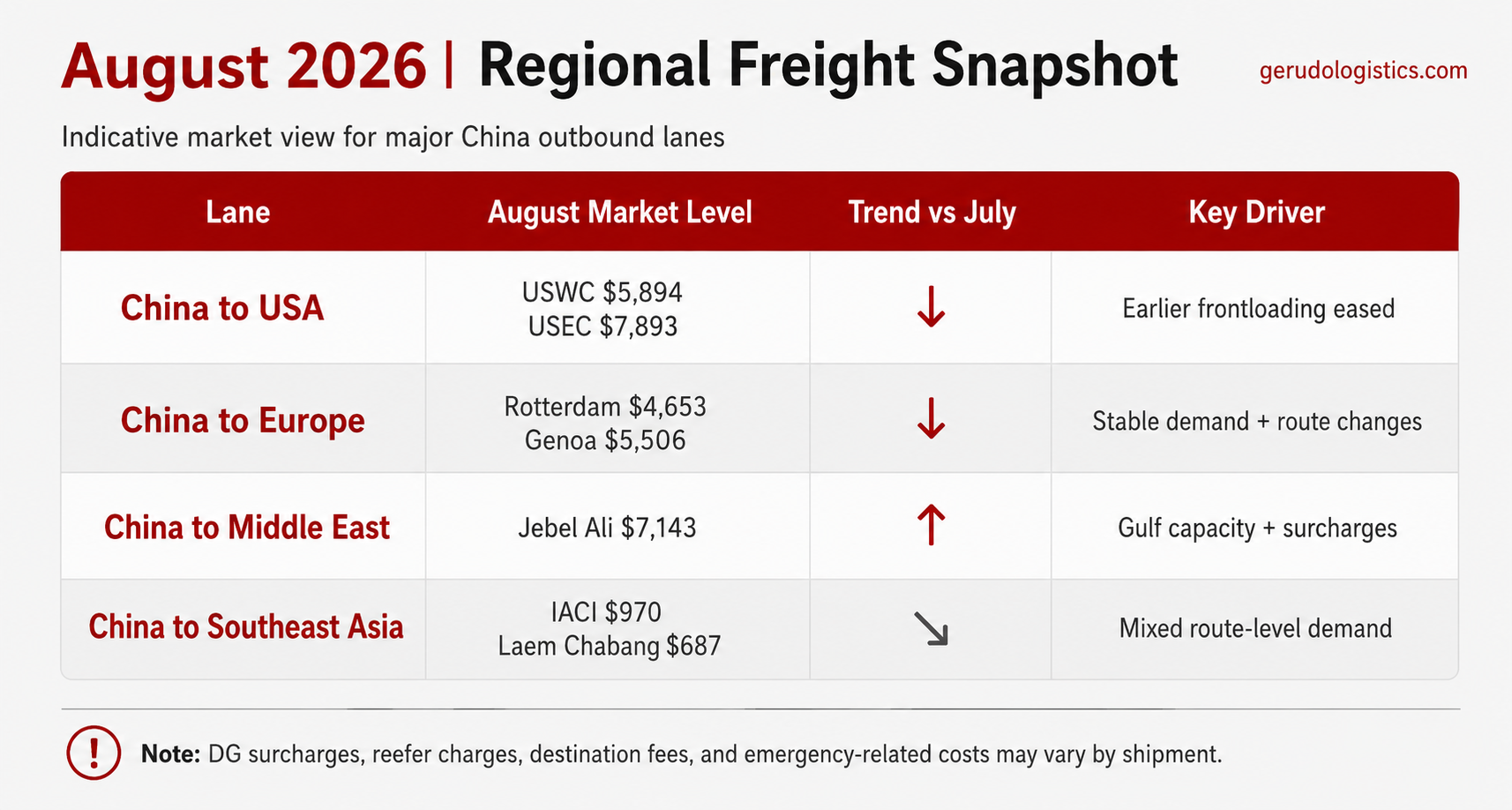
The benchmarks apply to standard 40ft dry containers. Dangerous goods, reefer and oversized cargo require shipment-specific rates and carrier acceptance.
China to USA
Compared with July 2, the early-August Shanghai to Los Angeles rate was 7.2% lower at USD 5,894 per 40ft container. Shanghai to New York was almost unchanged, falling 0.1% to USD 7,893 per 40ft container.
The most recent weekly movement went in the opposite direction. During the week ending August 6, Shanghai to Los Angeles increased 3%, while Shanghai to New York rose 4%.
The weekly rebound reflected the partial implementation of August General Rate Increases and firm short-term volumes. At the same time, July frontloading continued to place downward pressure on the broader monthly market.
August outlook: Transpacific rates are likely to remain volatile. The early-August weekly increase has not yet reversed the monthly decline on the West Coast or produced a meaningful monthly increase on the East Coast.
China to Europe
Compared with July 2, Shanghai to Rotterdam was 0.6% lower at USD 4,653 per 40ft container and remained broadly stable. Shanghai to Genoa was 13.4% lower at USD 5,506 per 40ft container.
During the week ending August 6, Rotterdam held steady, while Genoa fell by a further 2%. The Mediterranean route therefore showed a clearer decline than North Europe.
Carriers continued using blank sailings to manage capacity. The gradual return of selected services to Suez could add downward pressure if it releases more effective capacity, although many services still use the Cape of Good Hope route.
August outlook: North Europe rates are likely to remain broadly stable in the near term. Mediterranean rates have fallen more clearly, but blank sailings and route-specific capacity changes may limit further reductions.
China to Southeast Asia Freight Rates: China to Indonesia
Drewry’s Intra-Asia Container Index increased 1% to USD 970 per 40ft container in early August. The regional average concealed significant differences between individual routes.
Shanghai to Laem Chabang fell 23% to USD 687 per 40ft container. Reduced waiting times at Laem Chabang helped release capacity on that route.
The regional index and individual port-pair rates can move in opposite directions. Thailand, Indonesia, Vietnam and the Philippines may therefore show different trends during the same period.
August outlook: China-Southeast Asia rates are likely to remain mixed. Available regional capacity limits a broad increase, while weather disruption, feeder changes and port congestion may temporarily tighten individual routes.
China to Middle East
Shanghai to Jebel Ali increased 7% in early August to USD 7,143 per 40ft container. This was stronger than the wider Intra-Asia market and reflected continued pressure on Gulf-connected services.
Some carriers also introduced fuel or security-related surcharges. CMA CGM introduced an Emergency Fuel Surcharge from August 1, with rates varying by trade direction, cargo type and shipment category.
Its published long-haul head-haul levels were USD 150 per TEU for dry cargo and USD 165 per TEU for reefer cargo. These amounts do not apply universally to every carrier or China-Middle East booking.
August outlook: Gulf quotations are likely to remain firm and uneven. Fuel, security and cargo-specific surcharges can increase the all-in amount even when the underlying ocean freight remains stable.
Frequently Asked Questions
Are shipping rates from China increasing in August 2026?
The direction depends on the route and comparison period. Early-August rates were lower than July on the Shanghai–Los Angeles and Shanghai–Genoa routes, while the week ending August 6 produced a short-term increase on the two Transpacific routes.
Can cargo still be shipped from China to the Middle East in August 2026?
Regular services continue to major Middle Eastern ports. Availability and final pricing depend on the destination, carrier, route and cargo type, while some services remain subject to fuel or security-related surcharges.
What tariffs apply to imports from China to the US in August 2026?
The temporary 10% Section 122 surcharge expired on July 24. A new 12.5% forced labor-related Section 301 tariff took effect for covered China-origin products on the same day. Normal customs duty, existing Section 301 tariffs, applicable Section 232 measures and AD/CVD can also apply.
Is August part of the peak shipping season from China?
August is normally part of the planning period for cargo required before the year-end retail season. In 2026, some US cargo moved earlier because of tariff uncertainty, while weather disruption and carrier capacity controls continue to affect individual routes.
Which Chinese ports can handle dangerous goods and chemical shipments?
Dangerous goods shipments can be arranged through ports including Shanghai, Ningbo, Shenzhen, Guangzhou, Qingdao, Tianjin, Dalian and Xiamen, subject to terminal and carrier acceptance. The available port depends on the cargo classification, packing group, container type, destination and current local restrictions.
Planning an August Shipment from China
Regional benchmarks indicate general market direction but do not determine the availability or final cost of an individual shipment.
Gerudo Logistics provides shipment-specific routing assessments and freight quotations based on cargo requirements, origin, destination, cargo-ready date, carrier acceptance and current sailing schedules.
Contact our specalist to request a current quotation!