5H Customs Hold for Imports from China: What It Means and How to Resolve It
The phrase “5H customs hold” can be confusing at first glance because the code looks like it refers to time “5 hours”. To clarify, the “5H” is a CBP disposition code used in US import processing, not a five-hour inspection period.
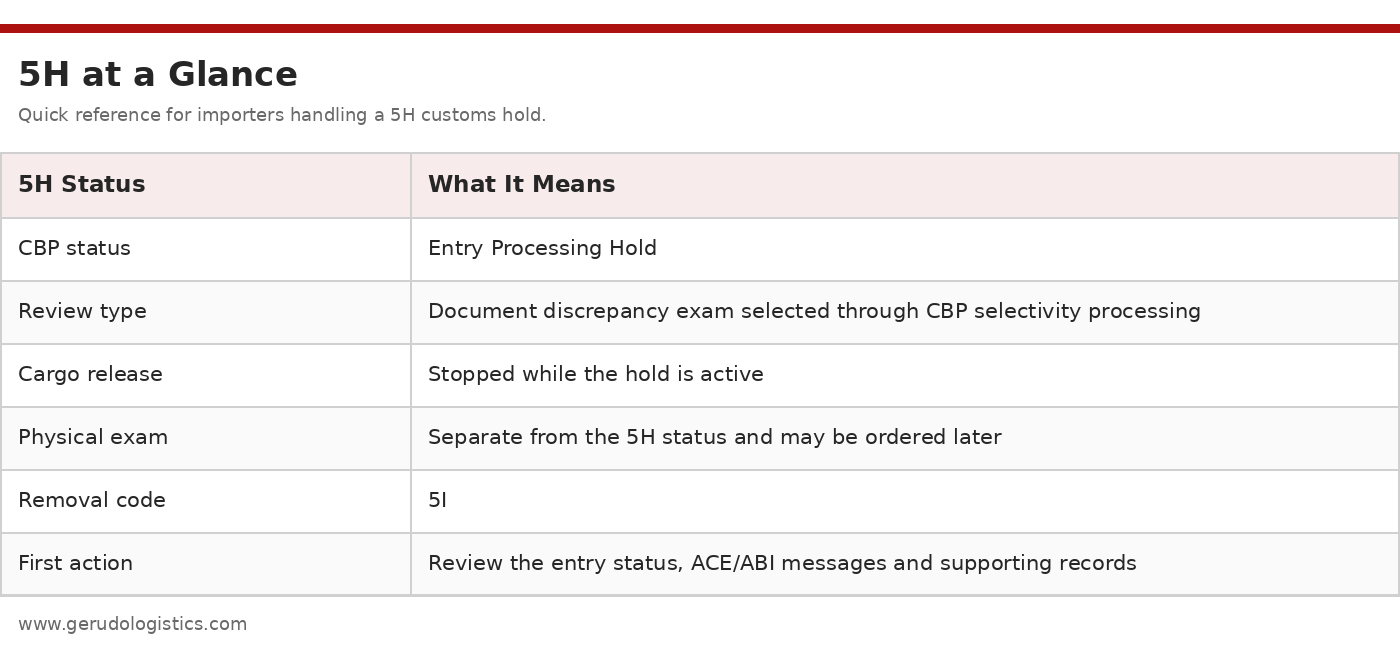
A 5H customs hold means U.S. Customs and Border Protection (CBP) has stopped cargo release because the customs entry was selected for a document discrepancy exam. It does not mean the container has already been opened for a physical inspection.
For an importer, the priority is to identify what part of the entry CBP is reviewing, provide the right supporting information or correction, and keep the shipment under control while clearance is delayed.
This guide explains what a 5H hold means, how to identify the discrepancy behind it, how the hold is resolved, and what the delay can mean for different types of cargo.
How a 5H Customs Hold Works
5H is a CBP disposition code for an Entry Processing Hold. CBP generates the code through selectivity processing when an entry posting is targeted for a document discrepancy exam. Cargo release remains blocked while the hold is active.
In practical terms, CBP is reviewing the customs entry and the information supporting it before allowing the cargo to continue. The 5H code identifies the type of review, but it does not identify the exact field or document being questioned. Some freight providers refer to this as a “5H customs inspection”, but the CBP status itself is an entry-processing hold; a physical cargo examination is a separate action.
When the Entry Processing Hold is removed, CBP uses 5I — Entry Processing Hold Removed.
5H vs 4H, 8H and 9H Customs Holds
You may also heard of the 4H, 8H or 9H. The codes look similar, but they send the customs-clearance team to different parts of the filing.
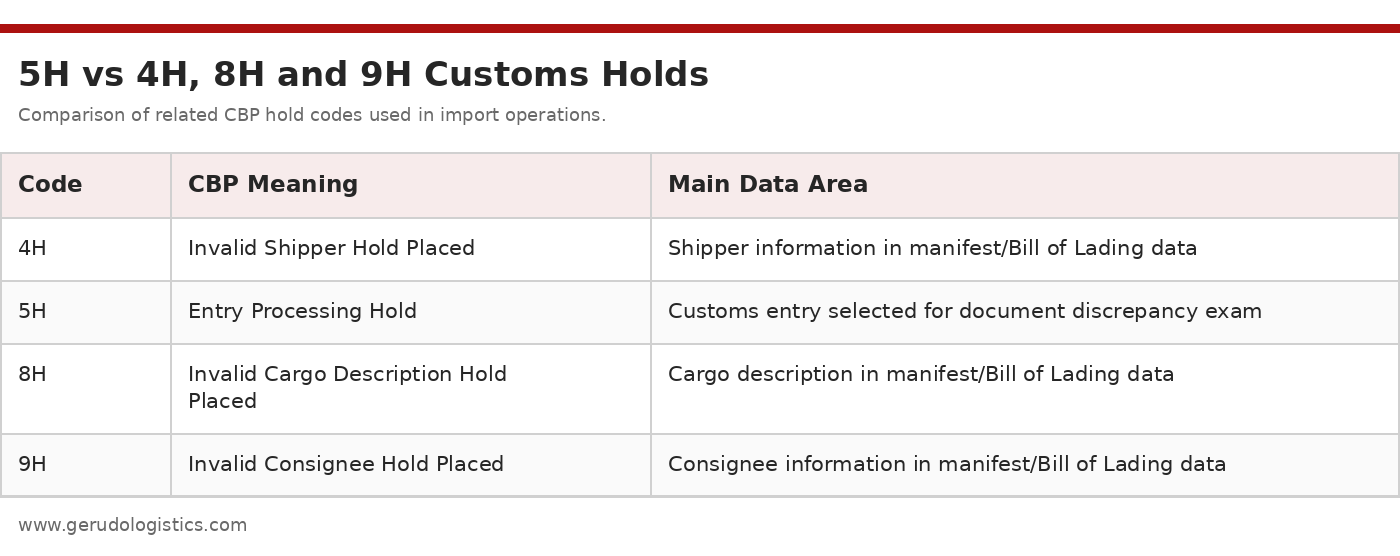
The 4H, 8H and 9H codes point towards specific manifest or Bill of Lading information. A 5H sits at the entry-processing stage after an entry posting has gone through CBP selectivity processing. A 9H therefore directs attention to consignee data, while a 5H requires the team to identify the discrepancy behind the customs entry.
Finding the Discrepancy Behind a 5H Hold
A 5H confirms that the entry is under document review, but the code itself does not provide a complete explanation of the discrepancy. The importer and customs broker need to review the Automated Commercial Environment (ACE) status, Automated Broker Interface (ABI) messages and any CBP request associated with the entry. The supporting shipment records can then be compared with the information used for customs clearance.
The order of review matters. If the available ACE or broker message points to value, start with the transaction record rather than rechecking every unrelated document. If it points to product identity or classification, move first to the specification and classification basis. This keeps the response focused and reduces the risk of introducing information that does not answer the discrepancy CBP is reviewing.
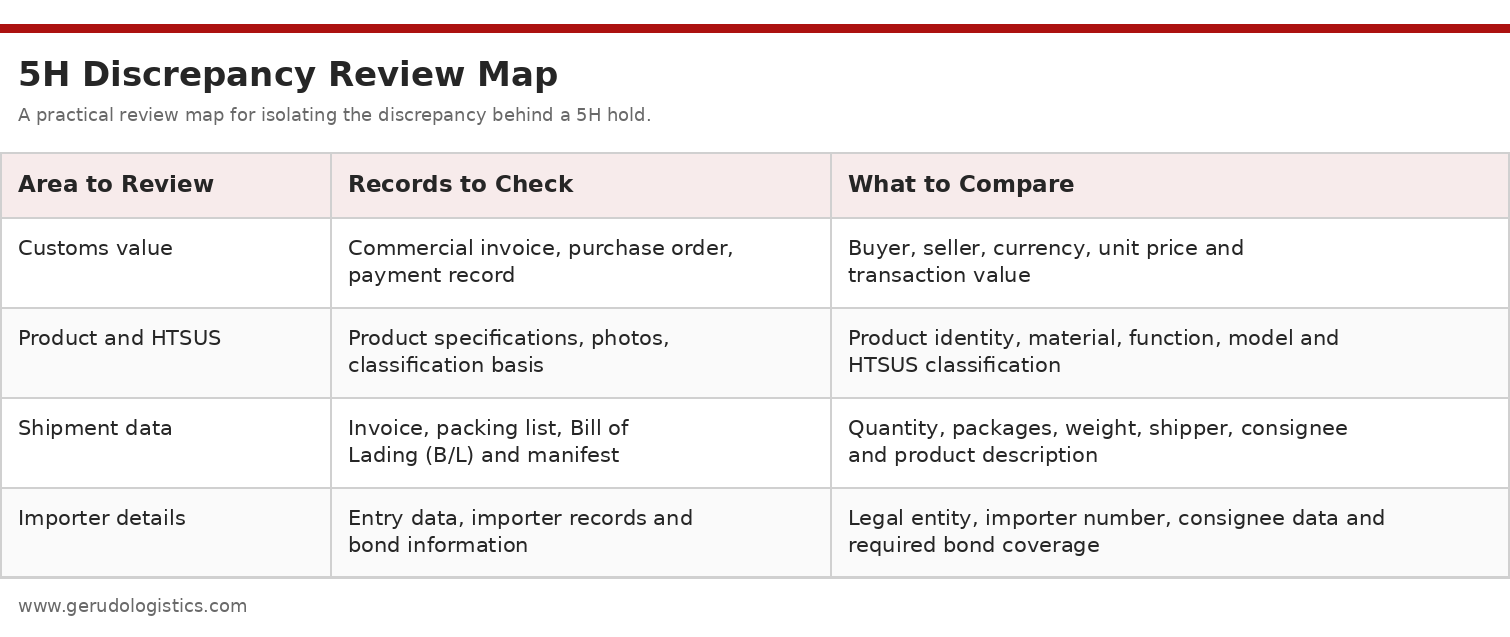
This is a review map for an existing 5H, not a CBP list of automatic 5H triggers.
Product descriptions deserve particular attention because vague wording can make several entry checks harder at once. Terms such as “accessories”, “parts”, “samples” or “equipment” may not identify the actual product clearly enough. Describing lithium battery packs only as “electronic accessories”, for example, does not clearly communicate the product identity needed for classification and compliance review.
The same principle applies to customs value. If CBP is reviewing the declared transaction value, the useful response is evidence supporting the actual sale, such as the purchase order and payment record. Creating a different commercial invoice after arrival can introduce another inconsistency instead of resolving the original question.
If the shipment has not yet reached the USA, the objective is different. Our guide on how to avoid US customs holds when shipping from China covers the pre-shipment checks that can reduce avoidable documentation and entry problems.
Additional Checks for China-Origin Imports
A 5H hold is not specific to goods from China, and the customs process for resolving it is the same as for imports from other origins. The difference is that a China-origin entry can involve additional tariff and origin data that also need to remain consistent with the underlying commercial records.
In addition to the basic invoice, shipment and importer information above, review the HTSUS classification and any applicable Chapter 99 tariff treatment, the declared customs value, and the country-of-origin information used in the entry. If CBP is reviewing one of these areas, the supporting records from the Chinese supplier should match the data filed in the U.S. entry rather than being recreated after the shipment arrives.
These China-specific checks do not mean that Section 301 tariffs or origin issues automatically caused the 5H. They are additional entry elements that may need to be reviewed when identifying the discrepancy behind the hold.
Steps to Resolve a 5H Customs Hold
Once a 5H is confirmed, the objective is to isolate the discrepancy and respond without creating new conflicts in the entry record. Customs clearance and the physical cargo operation also need to be managed together because the shipment can continue accumulating time and charges while release is stopped.
1. Confirm the exact status and affected entry.
Do not work from a general message saying the shipment is “held by customs”. Confirm the 5H disposition code, the affected entry or B/L and whether another CBP or Partner Government Agency action is active. A shipment can have several release issues at the same time, so the team needs the complete status before deciding what to fix.
2. Review the entry and related ACE/ABI messages.
The importer and customs broker should check the filed entry, status notifications and any CBP communication connected to it. The aim is to turn the broad 5H status into a specific question that can be answered. China-side commercial and shipping records may be needed where the filed entry must be compared with the underlying transaction.
3. Collect evidence for the specific discrepancy.
A value question can require transaction records. A classification question can require specifications, composition data, product photographs or technical documents. An origin question needs records supporting where and how the goods were produced. More documents are not necessarily better: several versions of an invoice or supplier statement can create new contradictions instead of answering the original issue.
4. Correct or support the entry through the proper customs process.
If information in the entry is wrong, the formal correction needs to be handled through the appropriate U.S. customs procedure. If the original commercial information is accurate, the entry may instead need evidence explaining or supporting what was originally declared.
CBP can also use Form 28, Request for Information, when it needs more information to evaluate an entry, while Form 29, Notice of Action, may be used when CBP proposes or takes action affecting the entry. Neither form is a mandatory stage of every 5H case.
5. Keep control of the shipment while clearance is delayed.
Monitor container free time, terminal storage, demurrage, carrier deadlines and delivery appointments. If CBP later requires a separate physical examination, the cargo may also need a new trucking movement, examination-facility appointment or revised final-delivery plan.
How Long a 5H Hold Can Last
There is no fixed processing time for every 5H hold. A discrepancy supported by a clear commercial record can move differently from a case involving classification questions, a formal information request or an additional examination.
The frequently mentioned 30-day rule belongs to a different legal stage. Under 19 U.S.C. §1499, merchandise that enters formal customs detention is subject to statutory procedures for detention and a final admissibility determination. Failure to make a final admissibility determination within 30 days after detained merchandise is presented for customs examination can be treated as a decision to exclude the merchandise, subject to the statutory conditions.
The appearance of a 5H code alone does not establish that this formal detention period has started. If the underlying entry issue later develops into formal detention or a wider admissibility dispute, CBP can ultimately exclude merchandise, after which export or another permitted disposition may be required depending on the final decision.
For an importer, the more useful question is what information CBP is still waiting for and whether the required response has been provided.
Costs That Can Continue During a 5H Hold
The exact financial impact cannot be calculated from the 5H code alone. It depends on the port, terminal, carrier, container type, free-time terms, cargo and whether a separate examination is ordered.
The main cost exposure can include:
Terminal storage: Charges can begin once the applicable free period expires.
Demurrage or equipment charges: Carrier charging rules continue according to the applicable terms.
Truck and warehouse rescheduling: Release after the original delivery appointment may require a new truck or receiving slot.
Exam-related movement: A separately ordered physical examination can add drayage and facility charges.
Special-cargo handling: Dangerous goods and refrigerated cargo can continue generating handling, transport or power-related costs during the delay.
A customs delay can therefore affect several connected parts of the delivery plan rather than creating only one daily storage charge.
How a 5H Hold Affects Different Cargo Types
The CBP status remains the same, but its operational effect changes with the cargo. General cargo provides the baseline: the main exposure is port dwell and schedule disruption. Dangerous goods add handling and transport restrictions, while temperature-controlled cargo adds continuous cold-chain requirements.
General Cargo
For ordinary dry cargo, a 5H mainly extends port dwell and disrupts the planned delivery schedule. Unlike dangerous goods or reefer cargo, general cargo normally does not add a separate hazardous-material handling or temperature-control layer, so its exposure is concentrated in the storage, carrier and rescheduling costs described above.
Release can still affect the delivery plan after the customs issue is resolved. The original truck or warehouse appointment may no longer be available, and a separately ordered physical examination can add another movement before final delivery. The main commercial effect is therefore lost schedule certainty as well as additional port cost.
Dangerous Goods
Dangerous goods face the same customs-entry problem, but the cargo continues to be regulated as dangerous goods throughout the delay.
Take a container of UN3480 lithium-ion batteries as an example: the dangerous-goods booking, packaging and transport documents can all be correct while a separate discrepancy in the U.S. customs entry results in a 5H.
The hold reduces the flexibility available when the logistics plan changes. If a separate examination requires the container to move, the selected trucker and receiving or examination facility need to be able to accept the dangerous goods involved. A movement that is straightforward for ordinary dry cargo may require additional coordination for batteries, flammable liquids, corrosive materials or other regulated cargo.
The financial exposure is not a fixed “DG 5H surcharge”. It comes from any additional storage or handling conditions, qualified transport, revised appointments and DG-specific arrangements required by a changed movement plan.
Customs-entry review and dangerous-goods transport compliance should also remain separate in the diagnosis. A 5H on dangerous goods should not send the team directly to the Safety Data Sheet (SDS), Dangerous Goods Declaration or battery test records unless the identified discrepancy actually concerns product identity or classification.
Temperature-Controlled Cargo
For refrigerated and frozen cargo, the cold chain continues while customs release is stopped. A reefer container normally still needs power at the terminal, so the temperature set point, plug-in status and container alarms remain important throughout the delay. Reefer power and monitoring costs can also continue while the cargo waits.
The commercial risk goes beyond port charges. Frozen seafood, frozen food, chilled products and other temperature-sensitive cargo can lose quality, shelf life or commercial value if the required temperature is not maintained. If CBP later orders a physical examination, the parties involved also need to confirm how temperature will be controlled during transfer, waiting and examination handling.
For temperature-controlled cargo, customs clearance and cold-chain management therefore run in parallel. Our guide to customs clearance for reefer containers from China explains the clearance requirement and temperature-control process.
If the refrigerated cargo contains food, also confirm whether the U.S. Food and Drug Administration (FDA) or another agency has a separate action affecting release.
Shipping From China to the USA With Gerudo Logistics
Gerudo Logistics help your shipments from Chinese suppliers through international freight, U.S. customs-clearance support and destination delivery.
Our China-to-USA work includes general cargo as well as selected shipments that require more detailed transport planning, including dangerous goods and temperature-controlled cargo.
Managing the shipment from China keeps the supplier, commercial records, international transport and destination handling connected. When a clearance delay occurs after arrival in the USA, Gerudo Logistics can coordinate the shipping and destination parties while the importer and U.S. customs-clearance team work through the entry issue.
Frequently Asked Questions About 5H Customs Holds
Is a 5H hold only used for imports from China?
No. 5H is a CBP entry-processing disposition code and is not specific to China-origin cargo. This guide focuses on shipments from China because that is the trade lane covered by Gerudo Logistics.
Can air freight receive a 5H hold?
Yes. A 5H is tied to entry processing rather than a marine container. Air cargo can therefore be affected, although its storage and delivery consequences differ from ocean freight.
Can an LCL shipment receive a 5H hold?
Yes. Less-than-container-load (LCL) cargo can also be affected by an entry-processing hold. The operational impact depends on how the entry, Bill of Lading and consolidation are structured.
Can a DDP shipment receive a 5H hold?
Yes. Delivered Duty Paid (DDP) terms do not prevent CBP from placing an entry-processing hold. The commercial arrangement determines who manages the import process, but CBP still controls cargo release.
Who pays storage and demurrage during a 5H hold?
Responsibility depends on the carrier, terminal, Incoterm and commercial arrangements for the shipment. A customs hold does not suspend the applicable charging rules, so free time and accrued costs should be monitored during the delay.
Can my freight forwarder remove a 5H hold?
No. CBP controls the disposition code and decides when the hold is removed. A freight forwarder can coordinate shipment records and logistics, while the importer and licensed customs broker handle the customs-entry response required for the case.