Frozen Food Shipping from China to the USA: Costs, Customs and Cold Chain Guide
China is one of the largest sources of frozen food entering the United States. Frozen seafood, vegetables, prepared meals, and meat products arrive daily at US ports from Shanghai, Ningbo, Qingdao, and other Chinese export hubs.
The logistics side is manageable. The compliance side has real consequences when things go wrong and for Chinese-origin food, the stakes at the US port of entry are higher than for most other origins.
Most problems happen after the cargo arrives, when documents are wrong, filings are missed, or the importer did not know what was expected of them before the shipment departed.
This guide covers what actually happens from the moment your frozen food leaves China to the moment it clears US customs: whether FDA or USDA controls your import, what most first-time importers do not know they are responsible for, what a port hold costs, and what documents you need.
FDA vs USDA: Which Rules Apply to Your Frozen Food Import
This is the first thing to sort out -- before you engage a freight forwarder, before you place an order.
FDA and USDA-FSIS (Food Safety and Inspection Service) run entirely different clearance processes.
Bringing in a customs broker experienced with FDA-regulated goods for a shipment that falls under USDA or the reverse creates problems before your cargo reaches the examination stage.
FDA covers frozen seafood, vegetables, fruit, dairy, and most prepared foods.
USDA-FSIS covers frozen meat, poultry, and processed meat products above a minimum meat content threshold.
The practical split: a frozen pork dumpling falls under USDA. A bag of frozen shrimp falls under FDA. If your product sits near the boundary, confirm the classification with your freight forwarder before placing any order.
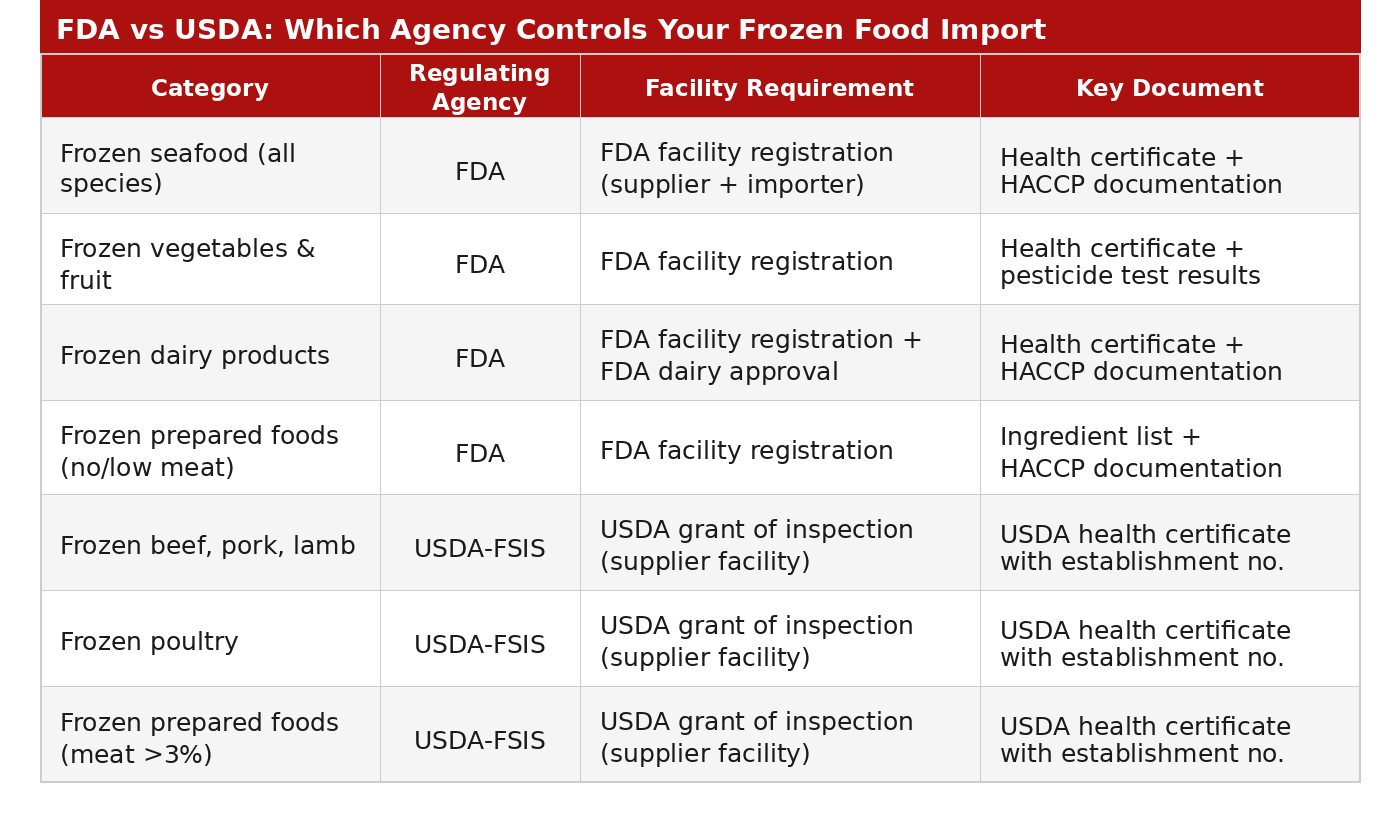
FDA covers frozen seafood, vegetables, fruit, and most prepared foods. USDA-FSIS covers frozen meat and poultry.
The boundary matters most for prepared foods. A frozen pork dumpling falls under USDA. A vegetable spring roll falls under FDA. If your product sits near the line, confirm the classification with your freight forwarder before the first shipment.
The key practical difference:
If your product is USDA-regulated, your Chinese processing facility must hold a USDA grant of inspection before a single carton can enter the US. This is a facility-level approval that USDA-FSIS issues directly. China's approved establishment list is publicly searchable. If your supplier is not on it, the shipment will be refused at entry -- regardless of what other certifications the factory holds.
Check the FSIS foreign establishment database before placing any order for meat or poultry. This is a five-minute check that can save you a container's worth of problems.
Who Is Responsible If Your Chinese Supplier Fails a US Food Safety Check?
You are. This surprises a lot of first-time importers.
Under the Foreign Supplier Verification Program (FSVP), the US importer is legally responsible for verifying that their Chinese supplier meets US food safety standards. FDA does not do this verification for you. If your supplier's practices fall short and product reaches the US market, the compliance failure is yours.
Before your first shipment, three things need to happen:
Get your supplier's food safety documentation on file. Request their HACCP plan and most recent audit records. Confirm their FDA facility registration is current -- you can check this in FDA's online database. Keep both filed under the supplier's name.
Set up an ongoing verification process. FSVP is not a one-time checklist. It requires periodic verification -- which can be as simple as an annual review of the supplier's audit records or periodic product testing. Most importers handle this through a food safety consultant.
Keep records for two years. FDA can request your FSVP records at any time, not only during a port examination. Importers who treat FSVP as a one-time setup task get caught when FDA asks for records they never kept.
If you are new to US food imports, your freight forwarder or a food safety consultant can help you set this up. The cost is modest compared to a shipment refusal.
What Do You Need to File Before Your Frozen Food Arrives in the US?
FDA requires Prior Notice for every food shipment entering the United States. It is an electronic notification giving FDA advance information about what is on the vessel, who produced it, and where it came from.
Key points:
Must be filed no later than 8 hours before the vessel arrives at the US port of entry
Your freight forwarder handles the filing -- confirm it is included in their service scope before you engage them
A missed or deficient filing results in FDA placing a hold on your cargo
The most common errors that cause holds at this stage:
Incorrect FDA facility registration number for the Chinese manufacturer
Country of origin listed for the final product rather than its ingredients
Product description that does not match the commercial invoice
Before your broker submits, cross-check these three fields against your shipping documents. The underlying information comes from you and your supplier. If it is wrong, the hold that follows is yours to resolve at the port.
What Happens If US Customs Holds Your Frozen Food Shipment?
When your reefer container arrives, it goes through automated risk screening by CBP and FDA. Most shipments from established importers with clean records clear without physical examination. For Chinese-origin food, examination rates are higher than for most other origins.
When FDA places a hold, one of three things happens:
Document review. FDA checks your paperwork and releases the cargo without opening the container. This adds 2 to 5 days to clearance. It is the most common outcome.
Sampling and lab testing. FDA pulls product samples for laboratory analysis -- usually for pesticide residues, additives, or pathogens. Results take 7 to 21 days. Your cargo sits at the terminal the entire time.
Refusal of admission. FDA determines the product is adulterated, misbranded, or from an unregistered facility. The shipment must be exported back to China or destroyed under FDA supervision. All costs are yours.
What a hold actually costs:
Your reefer container keeps drawing power at the terminal during any hold. Plugging fees at major US ports run $75 to $150 per day. A 10-day sampling hold adds $750 to $1,500 in terminal power charges -- on top of whatever demurrage the shipping line is accruing.
If CBP selects your container for a Centralized Examination Station (CES) inspection, the container moves off-dock to an examination facility. CES costs run $1,500 to $3,000 and are entirely your expense. This is separate from terminal charges.
The best way to keep examination rates down over time is a clean compliance record -- consistent documentation, the same registered supplier, no prior refusals.
What Documents Do You Need to Import Frozen Food from China to the USA?
The document list splits into three clear categories.
What your freight forwarder handles:
Customs entry filing
FDA Prior Notice submission
HTS classification and duty calculation
Coordination with FDA or USDA during any examination
What your Chinese supplier provides:
Commercial invoice -- FOB value and freight listed separately (US Customs calculates duties on CIF value, so bundling freight into the FOB figure inflates your duty basis)
Packing list
Bill of lading
GACC export registration certificate
Health certificate issued by Chinese authorities
HACCP documentation
Temperature monitoring data logger report covering the full transit
What you need to have on file:
Your supplier's FDA facility registration certificate
Their most recent food safety audit records
Your FSVP verification records for this supplier
Additional requirements by product category:
Frozen seafood: For certain species, SIMP (Seafood Import Monitoring Program) documentation is required, covering harvest location, vessel, and chain-of-custody data.
Frozen meat and poultry: The health certificate must carry your supplier's USDA grant of inspection number. Without it, USDA will not clear the shipment.
Frozen vegetables: Pesticide residue test results are frequently requested for Chinese-origin product. Have recent test reports ready before the shipment arrives.
Retail and foodservice programs: BAP certification (Best Aquaculture Practices) is required by most major US supermarket chains for seafood. Confirm your end buyer's certification requirements before shortlisting suppliers.
How Do You Keep Frozen Food at Temperature on a 25-Day Ocean Crossing?
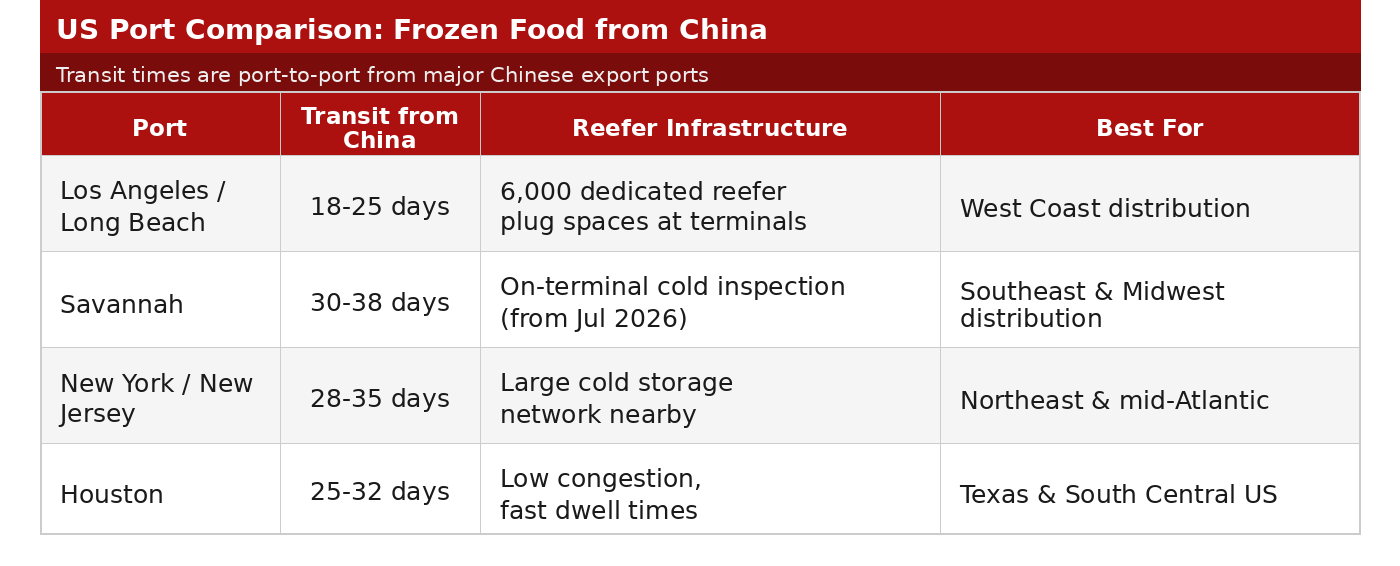
A 40-foot High Cube reefer container is the standard equipment for commercial frozen food shipments from China to the US. Transit times from major Chinese ports to Los Angeles or Long Beach run 18 to 25 days. East Coast ports add 10 to 14 days.
Three things your freight forwarder should confirm before the container is sealed:
Pre-Trip Inspection (PTI). The reefer unit must be inspected and confirmed to have reached operating temperature before loading. A PTI report dated before stuffing is the first link in your cold chain evidence.
Independent data logger. A separate temperature recording device -- not just the container's built-in sensor -- should run from stuffing to discharge. This is your evidence if a temperature excursion occurs and you need to file an insurance claim. FDA and CBP increasingly request temperature records during port examinations.
Product loaded at -18°C or below. The reefer container maintains temperature -- it does not lower it. If product loads warm, it will not reach -18°C before arrival.
These are your freight forwarder's responsibilities. But confirm them in writing before the shipment departs. If a cold chain failure occurs, the consequences,product rejection, insurance disputes, a damaged relationship with your buyer, fall on you.
For detailed reefer container specifications and temperature monitoring requirements, see our [reefer container shipping guide].
Which US Port Is Best for Frozen Food from China?
Port choice affects more than transit time. For frozen food, it affects how your cargo moves through inspection and how quickly it can reach cold storage after arrival.
Los Angeles / Long Beach
The main entry point for Chinese frozen food. Transit times run 18 to 25 days. Long Beach has added 6,000 dedicated reefer plug spaces at its terminals, giving importers reliable power during port dwell. Cold storage infrastructure in the greater LA basin is well developed. The trade-off is higher congestion than East Coast ports -- dwell times can extend during peak season.
Savannah
Transit times of 30 to 38 days from China. As of July 2026, Savannah opened a new on-terminal refrigerated inspection facility where USDA inspections for frozen meat, seafood, and produce can be completed without moving cargo off-dock. This matters for cold chain integrity -- off-dock CES moves are one of the more common points where temperature excursions occur.
The port area has close to 2.4 million square feet of refrigerated warehouse space nearby, making it a strong option for Southeast and Midwest distribution.
New York / New Jersey
Transit times of 28 to 35 days. Well-established cold chain infrastructure and a large cold storage network in the surrounding area. A practical choice if your buyers are in the Northeast or mid-Atlantic. Carrier service frequency on the China route has improved as the port's import volume grew significantly in 2025.
Houston
Transit times of 25 to 32 days. Less congested than West Coast ports, with competitive reefer container dwell times. The right option if your distribution is concentrated in Texas or the South Central US.
The right port depends on where your buyers are. Inland drayage from port to cold storage can easily offset ocean freight savings if you choose the wrong entry point. Factor both into your landed cost calculation.
How Much Does It Cost to Ship Frozen Food from China to the USA?
Reefer freight from China to the US West Coast currently runs $4,000 to $6,500 for a 40-foot High Cube container. East Coast adds $1,000 to $2,000 depending on routing. A realistic landed cost breakdown:
Ocean freight (40ft HQ reefer, West Coast): $4,000 to $6,500
Origin handling and inland transport in China: $300 to $600
Reefer power surcharges at origin port: $200 to $400
Destination terminal handling: $400 to $700
Customs brokerage: $200 to $500
Marine cargo insurance: 1% to 1.5% of cargo value
CES examination if selected: $1,500 to $3,000
Terminal plugging fees during any FDA hold: $75 to $150 per day
A few points worth noting:
Reefer rates move seasonally. Southeast Asian fruit harvests in spring absorb reefer equipment, tightening availability and pushing rates up on China export routes.
CES examination is not rare for Chinese food. Budget for it as a realistic possibility on first shipments from a new supplier.
Plugging fees add up faster than expected. A two-week sampling hold at $100 per day is $1,400 in power charges before the container moves.
Import duties apply on top and vary by product category and HTS code. For current tariff rates on Chinese frozen food, see our [China import tariff guide].
For a full cost breakdown specific to frozen seafood, see our [frozen tilapia import cost guide].
Shipping Frozen Food from China to the USA with Gerudo Logistics
Gerudo Logistics is headquartered in Guangzhou with operations across Shenzhen, Shanghai, Ningbo, Qingdao, and Dalian. We handle frozen food shipments -- seafood, meat, vegetables, and prepared foods -- from Chinese processing facilities to the US market as part of our cold chain freight forwarding services.
For US-bound frozen food programs, we cover:
Reefer container booking and Pre-Trip Inspection coordination at Chinese origin ports
Temperature monitoring from stuffing through destination port handover
Documentation preparation including GACC health certificate coordination and FDA Prior Notice filing
DDP delivery for importers who want a single point of accountability from Chinese factory to US warehouse
We work with importers on first-container trial shipments and ongoing container programs. Contact our team to discuss your product category, routing, and documentation requirements.
Frequently Asked Questions
FDA vs USDA -- how do I know which applies to my product?
FDA covers frozen seafood, vegetables, fruit, dairy, and most prepared foods. USDA-FSIS covers frozen meat and poultry, including processed meat products above a minimum meat content threshold. If your product is near the boundary -- a prepared food with meat content -- confirm the classification with your freight forwarder before your first shipment.
What is FSVP and do I need to comply?
If you are importing food into the US commercially, FSVP applies to you. It requires you to verify that your Chinese supplier meets US food safety standards and to keep records of that verification for two years. FDA can request these records at any time. The starting point is getting your supplier's HACCP documentation and FDA registration on file before the first shipment.
How long does customs clearance take for frozen food from China?
With complete documentation and a correctly filed Prior Notice, routine clearance takes 1 to 3 days after vessel arrival. A document review hold adds 2 to 5 days. Laboratory sampling can extend clearance to 2 to 3 weeks. Budget reefer plugging costs for the full potential hold period.
What happens if FDA refuses my shipment?
Refused shipments must be exported back to China or destroyed under FDA supervision. All costs -- return freight, destruction fees, and accumulated terminal charges -- are yours. Your Chinese supplier has no legal liability under US law.
Do I need a license to import frozen food from China?
There is no general import license for food. You need FDA facility registration as an importer, and your Chinese supplier's facility must be FDA-registered. For meat and poultry, the supplier facility must hold a USDA grant of inspection. For organic-labeled products, USDA NOP certification is required.
What should I ask my Chinese supplier for before the first shipment?
Current FDA facility registration certificate
HACCP plan and most recent audit records
GACC export registration certificate
Product specification sheet with full ingredient list and additive disclosure
Recent batch test reports
For seafood: relevant aquaculture or catch certificates depending on species
Conclusion
Importing frozen food from China to the US is operationally straightforward once you have the right structure in place -- the right documents, the right port for your distribution footprint.
The issues that derail shipments almost always come down to preparation gaps: a supplier without the correct facility approval, a Prior Notice with a wrong registration number, a landed cost calculation that did not account for a CES hold.
None of these are complicated problems, but they are expensive ones to discover at the port. Get the compliance side sorted before the container is sealed, and the logistics side will follow.