Shipping Solar Panels from China: Freight and Container Guide
Most commercial solar panel orders from China move by FCL sea freight in 20GP or 40HQ containers. The final shipping plan depends on the module packing, pallet quantity, destination requirements and whether the order also includes batteries or other solar equipment.
This guide covers shipping options, container capacity, packing, complete solar systems, customs requirements, major-market import rules, transit times and current ocean freight references.
At a Glance
Main shipping mode: Ocean freight is the usual choice for commercial solar panel orders.
Container quantity: A 20GP or 40HQ has no fixed panel count because module dimensions and factory pallet configurations vary.
Main cargo risk: Glass breakage, frame damage, pallet movement and hidden cell damage are the main transport risks.
Battery storage: Panels-only cargo usually moves as general cargo. Lithium battery storage adds separate DG classification and carrier-acceptance requirements.
Shipping Options for Solar Panels From China
Commercial panel orders usually move by sea because pallets occupy significant container space. FCL handles most larger orders, while LCL suits smaller quantities. Air freight mainly serves samples and urgent replacement shipments.
FCL Sea Freight
A dedicated container keeps panel pallets together during the main ocean journey and avoids the shared consolidation stages associated with LCL. A 20GP suits some smaller commercial orders, while 40HQ containers are common for larger pallet quantities.
Container selection depends on final pallet dimensions, pallet count and gross weight. For orders between a few pallets and a full container, comparing FCL and LCL shipping from China requires the same cost basis, including consolidation and destination handling rather than the base ocean rate alone.
LCL Sea Freight
LCL suits trial orders, replacement modules, samples and limited pallet quantities. The cargo shares container space with other shipments and passes through consolidation facilities at origin and destination.
The extra handling increases exposure to pallet tipping, compression and contact with surrounding cargo. As shipment volume rises, the total cost gap between LCL and FCL often narrows. No single CBM threshold applies to every solar panel order because packing, destination charges and route conditions differ.
Air Freight
Air freight is mainly used for sample panels, urgent replacements or a small quantity needed for a time-sensitive project. Airlines charge by actual or volumetric weight, whichever is higher, which makes full commercial pallet quantities expensive.
For regular stock and project orders, ocean freight remains the normal transport method.
Solar Panel Packing and Container Loading
Container planning uses the dimensions and weight of the finished pallets. Individual panel dimensions alone do not show how much container space the shipment will occupy.
Factory Packing for Solar Panels
Commercial PV modules are commonly packed vertically in manufacturer cartons and secured as pallet units with edge protection and straps.
The packing data used for container planning includes:
Exact panel model and total quantity
Module dimensions and unit weight
Panels per pallet
Final pallet dimensions
Gross weight per pallet
Total number of pallets
Solid wood pallets and crates used in international shipping are subject to ISPM 15 treatment and marking requirements. Processed wood products such as plywood fall outside the same treatment requirement under the standard.
Repacking sometimes improves container use, but the revised arrangement still needs suitable protection for lifting, inland trucking and the ocean journey. A different pallet configuration also changes the dimensions used for container planning.
Solar Panels per 20GP and 40HQ
There is no standard number of solar panels for one container. Official manufacturer packing specifications show substantial differences between module formats.
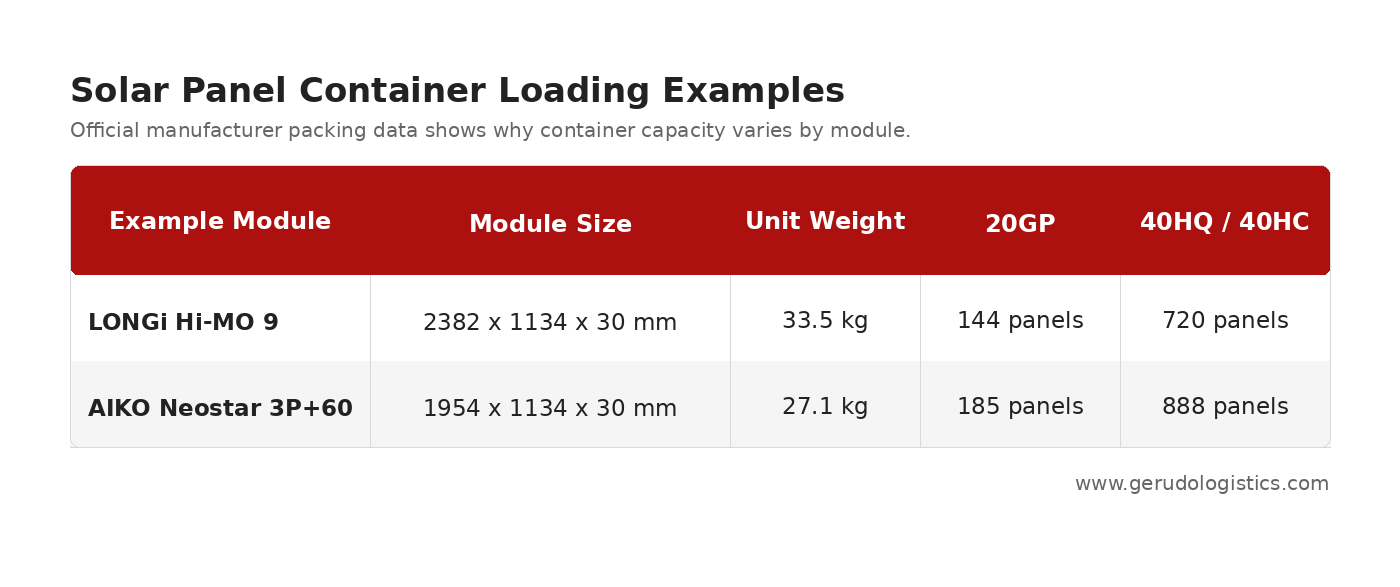
The two examples differ by 168 panels in a 40-foot high-cube container. An estimate such as “around 700 panels per 40HQ” is therefore too broad for a real booking.
Final container capacity is calculated from the approved factory packing configuration, pallet layout, container payload and available equipment.
Damage Risks During Shipping
The most visible transport damage includes broken glass, bent frames, crushed cartons, loose straps, pallet movement and moisture exposure. Damage to one pallet can affect several modules rather than a single unit.
Solar cells also develop internal cracks after mechanical stress even when the outer glass remains intact. Extra pre-shipment or arrival inspections are sometimes used for higher-value projects where hidden damage is a contractual or quality concern.
Cargo insurance provides financial protection against covered transport losses. When visible damage is found at destination, photographs, delivery records and survey evidence support the claim process.
Shipping Complete Solar Systems From China
Solar projects often contain more than panel pallets. Inverters, mounting rails, cables, electrical accessories and storage equipment frequently form part of the same order, sometimes from several Chinese factories.
Panels With Inverters and Mounting Equipment
Inverters have a denser cargo profile than panel pallets, while mounting rails and frames create long packages. A combined container plan therefore uses the dimensions and weights of every product group.
Multi-supplier consolidation works best when cargo-ready dates are close enough to avoid long storage periods. Large gaps between suppliers increase domestic trucking and warehouse costs, which reduces the freight saving from one combined container.
How Battery Storage Changes a Solar Panel Shipment
Lithium battery storage adds a regulated DG component to an otherwise general-cargo solar order. The battery portion introduces separate requirements for classification review, carrier acceptance, booking lead time and transport documentation.
The relevant cargo information includes battery chemistry, rated Wh, configuration and how the storage unit is supplied within the system. These factors determine the applicable transport entry and DG requirements.
The detailed classification criteria and document requirements belong to the lithium battery shipping from China guide. Cabinet and containerized storage systems follow the more specific BESS shipping requirements.
Within a solar panel shipment, the key distinction is that the panel pallets remain general cargo while the battery portion changes the booking conditions for the combined shipment.
Shipping Documents and Customs Clearance for Solar Panels
Panels-only cargo uses a defined set of commercial and transport documents. Mixed solar equipment orders require clearer product descriptions because different components often use different customs classifications.
Core Shipping Documents
The main documents for a standard ocean shipment are:
Commercial Invoice: Buyer and seller details, product description, model, quantity, unit value, total value, currency and Incoterm.
Packing List: Pallet count, panels per pallet, package dimensions, net weight and gross weight.
Bill of Lading: The ocean transport document used for carriage and cargo release under the selected B/L arrangement.
Certificate of Origin: Required where the destination, trade arrangement, buyer or customs procedure requires formal origin evidence.
Product conformity documents: Required where the destination market applies testing, registration or conformity rules to the specific PV product.
For FCL shipments, the carrier also requires a Verified Gross Mass (VGM) before vessel loading. The China customs declaration uses the commercial and cargo information from the shipment documents.
Battery storage adds the applicable DG transport documents for the regulated portion of the shipment.
Solar Panel HS Classification
Photovoltaic cells assembled in modules or made up into panels generally fall under HS 8541.43 at the international six-digit level. National customs tariffs extend the code with additional digits for the final declaration.
A complete solar shipment often contains several classifications. Inverters, batteries, rails, cables and electrical accessories remain separate products for customs purposes even when they arrive in the same container.
Clear product descriptions on the commercial invoice and packing list keep those product groups separate during customs declaration.
Solar Panel Import Requirements in Major Markets
Destination requirements vary even when the same solar panels and shipping method are used. The main differences involve tariff treatment, product conformity, registration and supply-chain documentation.
USA
Crystalline silicon photovoltaic modules commonly fall under HTSUS 8541.43.0010, subject to the exact product characteristics. Solar shipments also involve several USA-specific requirements:
ISF filing: Ocean shipments fall under Importer Security Filing requirements before vessel loading.
AD/CVD exposure: Certain crystalline silicon photovoltaic cells and modules from China remain within active antidumping and countervailing duty proceedings.
Origin information: Cell origin and manufacturing information affect the scope of applicable trade measures.
Supply-chain traceability: Polysilicon and other upstream materials remain relevant under the UFLPA framework.
Tariff review: The HTS classification alone does not establish the total duty payable where additional solar-specific trade measures apply.
The current USA tariff structure for goods from China provides the broader tariff context outside these solar-specific measures.
Europe
Solar panels entering the EU combine normal customs requirements with environmental and product-market obligations:
EORI number: Required for customs operations in the EU.
EU tariff classification: The full CN/TARIC classification determines the customs treatment of the modules.
Import VAT: VAT treatment depends on the member state and the import arrangement.
WEEE obligations: Photovoltaic panels fall within the EU WEEE framework. The party defined as the producer under the relevant member state's rules carries the applicable registration and waste-management obligations.
Additional solar equipment: Inverters, batteries and other electrical components follow their own conformity and regulatory requirements.
A conformity document for one component of a solar system does not automatically cover other products in the same container.
Middle East
Solar product requirements are set at country level across the Middle East. Saudi Arabia and the UAE use different conformity systems.
Saudi Arabia
For solar photovoltaic products covered by the applicable Saudi technical regulations, the main requirements include:
SASO technical regulations: The applicable regulation depends on the exact PV product or system.
Saber registration: Regulated products follow the applicable Saber conformity process.
Product conformity certification: Products within scope require the relevant conformity documentation before clearance.
Test reports: Supporting test documentation forms part of the conformity process where required by the applicable regulation.
IECEE recognition: Solar photovoltaic products within the relevant scope require the applicable Saudi IECEE National Recognition Certificate.
The exact requirement depends on the product category and whether the shipment contains individual modules or a wider solar system.
UAE
Regulated solar and electrical products within the UAE Ministry of Industry and Advanced Technology framework follow the applicable conformity requirements for their product category:
Product conformity approval: Regulated products require conformity assessment under the relevant UAE framework.
Accredited laboratory reports: Product categories that require laboratory testing use reports from an ISO/IEC 17025 accredited laboratory.
Technical documentation: Product specifications and supporting technical files form part of the conformity application where required.
International conformity reports: IECRE or other accepted international test documentation applies to product categories covered by those schemes.
Separate requirements for system components: Modules, inverters, batteries and other electrical products follow the requirements assigned to their own product category.
The product scope determines the applicable conformity path for the shipment.
Solar Panel Shipping Transit Times and Costs
Solar panels use regular container services once accepted for carriage. Transit time and ocean freight depend on the route, carrier, service and sailing date rather than the panel wattage.
Typical Sea Freight Transit Times
Current 2026 schedules give the following planning ranges for common routes:
Shanghai to Los Angeles: about 13 to 19 days
Shanghai to New York: about 34 to 35 days
Shanghai to Rotterdam: about 32 to 39 days
Shanghai to Jebel Ali: about 18 to 21 days
Ningbo to Jeddah: about 27 days
These times cover the main ocean journey. Factory pickup, LCL consolidation, customs clearance and final delivery add time outside the sea leg.
August 2026 Ocean Freight References
The following figures are indicative 40ft / 40HQ FCL ocean freight references for panels-only general cargo in August 2026.
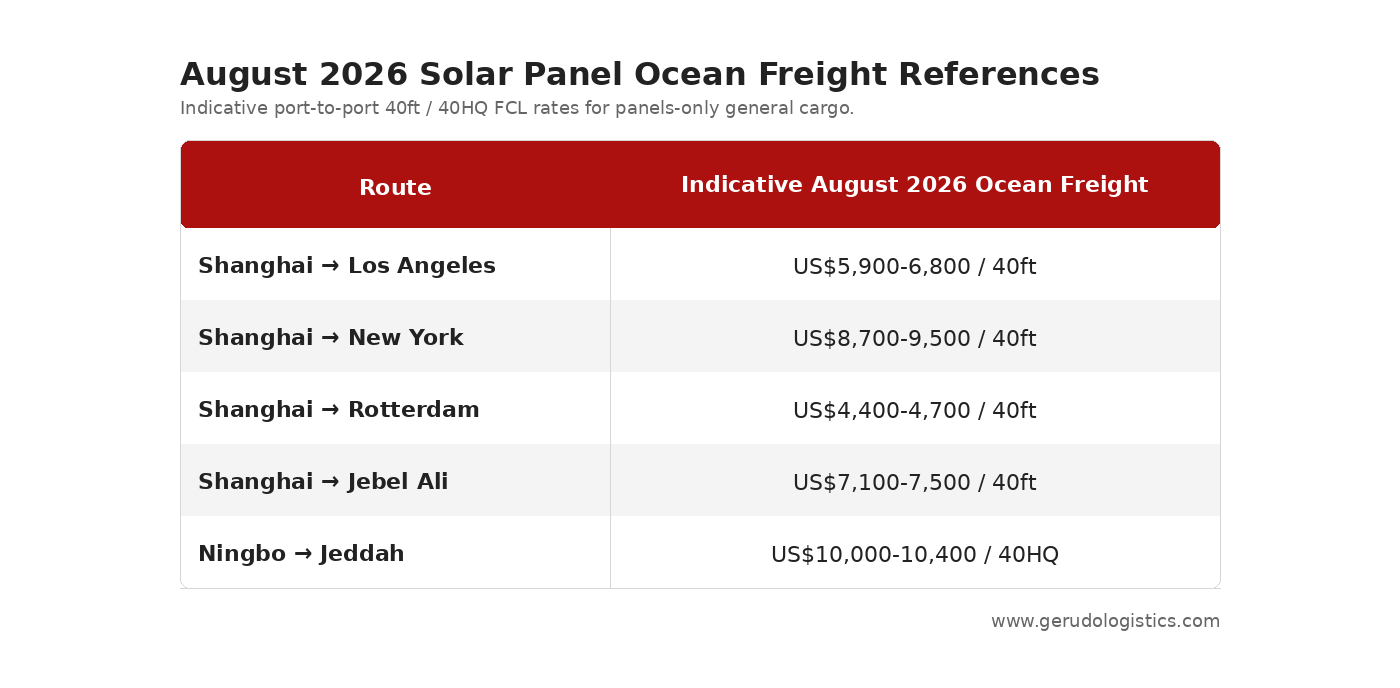
These figures represent ocean freight only. Origin terminal handling, documentation, destination terminal charges, customs clearance and inland delivery are outside the quoted range unless the carrier rate specifically includes them.
What Affects the Final Shipping Cost
Beyond the base ocean rate, final transport cost reflects the Chinese pickup location, loading port, container type, origin handling, destination terminal charges, customs clearance and final delivery. LCL also adds consolidation and handling charges at origin and destination.
Packing efficiency changes the freight allocation per panel. The earlier LONGi and AIKO examples place 720 and 888 modules respectively in a 40HQ. Similar container freight therefore produces different transport costs per module.
Incoterms change what the quoted price includes. EXW, FOB, CIF and DDP place different pickup, origin, destination and customs costs inside or outside the seller's price, so quotation comparisons require the same cost coverage.
Solar Panel Shipping Support From China
Gerudo Logistics handles solar panel shipments through Guangzhou, Shenzhen, Shanghai, Ningbo, Qingdao and Dalian. Our service covers FCL and LCL freight, multi-supplier consolidation, customs coordination and final delivery based on the packed cargo and destination.
For solar projects that include battery storage, Gerudo Logistics coordinates the dangerous goods portion alongside the general solar equipment. One logistics plan can cover panels, inverters, mounting equipment and storage products when the cargo combination meets the carrier's acceptance requirements.
Contact our team with your shipment details including the panel model, pallet configuration, pickup location, destination and any battery storage in the order.
Frequently Asked Questions
How Are Solar Panels Shipped From China?
Most commercial orders move by ocean freight in 20GP or 40HQ containers. LCL suits smaller pallet quantities, while air freight is mainly used for samples and urgent replacement panels.
How Many Solar Panels Fit in a 40HQ Container?
The quantity depends on the exact module and factory pallet configuration. Manufacturer packing data provides the correct basis for container capacity.
Is FCL or LCL Better for Shipping Solar Panels?
FCL is common for larger pallet quantities and reduces shared-container handling during the main ocean journey. LCL remains suitable for smaller, well-packed orders where a full container would leave substantial unused space.
Are Solar Panels Dangerous Goods?
Standard photovoltaic modules without battery storage usually move as general cargo. Lithium battery storage adds a regulated DG component to the shipment.
Can Solar Panels and Lithium Batteries Ship Together?
Yes. The battery portion requires the applicable classification, carrier acceptance and DG transport documentation for the combined shipment.
What Documents Are Needed to Ship Solar Panels From China?
A standard panels-only ocean shipment normally uses a commercial invoice, packing list and bill of lading. A Certificate of Origin and product conformity documents are added where the destination or transaction requires them.
How Much Does It Cost to Ship Solar Panels From China?
Cost depends on the route, container size, pallet configuration and included services. In August 2026, indicative 40ft FCL ocean rates on the routes above range from about US4,400 on Shanghai-Rotterdam to more than US10,000 on Ningbo-Jeddah.