Can You Mix DG and General Cargo in One Container? A Complete FCL Guide
When you have a part-load of dangerous goods and a batch of general cargo ready to ship, the instinct is to consolidate them into one container. It reduces the freight cost per unit and simplifies the booking on paper.
Whether that consolidation is actually possible depends on the International Maritime Dangerous Goods (IMDG) Code requirements for your specific cargo, and on the carrier accepting the booking.
This guide covers the container-level decisions that matter for DG shippers: when FCL is the right approach, when dangerous goods must travel in a dedicated container, what IMDG segregation rules mean in practice, and what documentation applies specifically to full container load DG shipments.
The Short Answer on Mixing DG and General Cargo
In most cases, dangerous goods and general cargo can travel in the same full container. That is the starting point, not the full answer.
The more useful question is which specific dangerous goods, under which IMDG conditions, with what additional documentation, and with what consequences for the general cargo if the DG side encounters a problem at port.
Some cargo is prohibited outright from sharing a container with anything else. Some class combinations cannot be co-loaded regardless of how goods are arranged inside the box. And even when mixing is permitted, a documentation error on the DG portion can hold the entire container at the terminal — including every carton of general goods packed alongside it.
Choosing the Right Container for Dangerous Goods Cargo
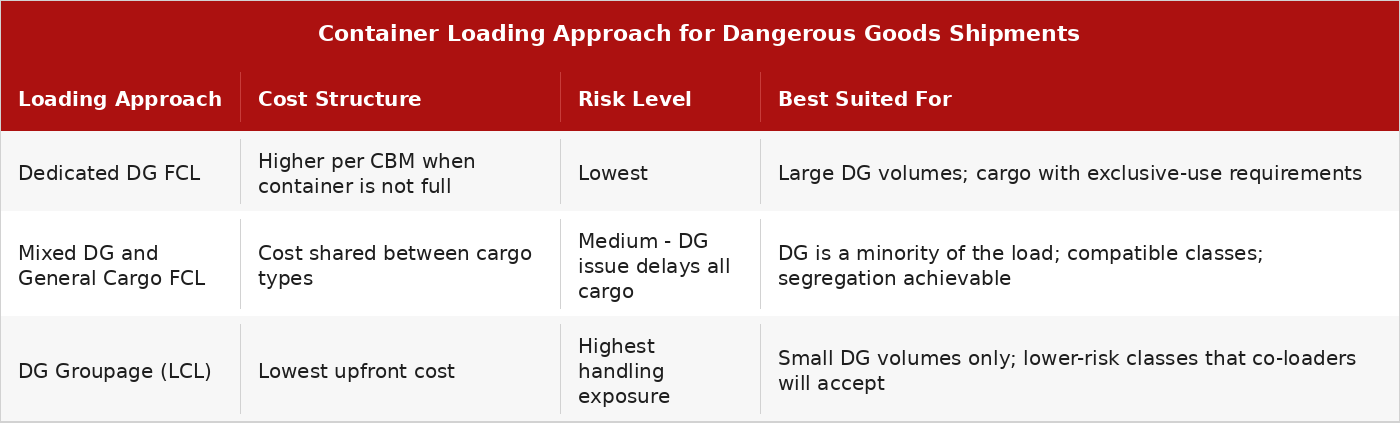
Full container load shipping is the standard approach for dangerous goods of any meaningful volume. Most LCL consolidators decline DG cargo entirely, or accept it only for lower-risk classes. The co-loading environment creates segregation and documentation complexity that the majority of groupage operators are not set up to manage.
A sealed FCL container also reduces the number of handling points between origin and destination. DG cargo moving through multiple warehouse stages — as it does in any LCL consolidation — has more opportunities for documentation to be checked, cargo to be inspected, and shipments to be rejected mid-route.
Once FCL is confirmed, the choice between a 20-foot and a 40-foot container is not purely a volume decision for DG cargo. Dangerous goods tend to be dense — drummed chemicals, packaged liquids, and heavy industrial products fill a container's weight limit before they fill its cubic space.
A standard 20-foot container offers roughly 25 to 28 cubic meters of loading space but has a maximum payload of around 28,000 kilograms. Dense DG cargo often reaches that weight ceiling well before the container is physically full.
A 40-foot container nearly doubles the available volume for a modest increase in ocean freight.
For light or mixed DG cargo, the cost per cubic meter is lower in a 40-foot. For genuinely heavy cargo — drummed liquids, industrial chemicals in large packaging — the 20-foot is often more practical because weight fills the box before space does.
For dense DG cargo that reaches the weight limit well before the box is full, a 40-foot container means paying for cubic space that the shipment can never fill.
When Dangerous Goods Must Move in an Exclusive-Use Container
Certain dangerous goods entries in the IMDG Code specify that the container must be used solely for that shipment. N
othing else — general cargo or other DG — may be loaded alongside it. This is known as an exclusive-use container requirement, and it is a mandatory provision attached to specific UN entries, not a carrier preference.
Class 1 explosives are the category most commonly subject to this restriction. Certain toxic gases, some infectious substances, and selected entries in other classes carry the same requirement. Whether your specific product falls under this provision depends on its UN number and the IMDG entry for that product — not the class number alone.
The practical consequence is straightforward: the remaining container space cannot be filled with general goods, even if the DG portion occupies only a fraction of the box.
The container must be dedicated to that one consignment. Co-loading anyway creates a documentation mismatch that export inspection or destination customs will identify.
Confirming whether the exclusive-use provision applies is part of the pre-booking assessment.
The cargo classification of your product determines the applicable UN entry, and a DG-experienced forwarder flags any exclusive-use restriction before the container booking is placed. Finding it at the loading stage means reorganizing a shipment under time pressure, which rarely ends without additional cost.
Mixing DG and General Cargo in One Container and the Real Risks
When mixing is permitted and the classes are compatible, co-loading DG with general cargo is a practical choice. The risks that come with it affect the general cargo just as directly as the dangerous goods.
The most consequential risk is documentation-driven detention. If the DG paperwork contains an error — an incorrect packing group, a quantity discrepancy, a missing shipper's declaration — customs or the terminal authority can hold the entire container.
The general cargo inside cannot be released while the DG issue remains open. That process can take anywhere from a day to several weeks, and demurrage and storage charges accumulate against the whole container in the meantime.
Marine cargo insurance on a mixed DG container needs specific attention before the shipment is booked. Standard cargo coverage may not automatically extend to damage caused by a failing or leaking DG package within the same container. Confirm the coverage terms with your insurer in advance, not after a claim arises.
Carriers also retain the right to reject a mixed DG container at the inspection stage, even when documentation appears correct. Some terminals apply stricter co-loading restrictions than the IMDG minimum, particularly at ports with recent DG incident history.
A booking that passes initial acceptance can still be rejected at the port gate. For more on what happens when DG cargo is stopped, see DG Cargo Detained at Chinese Customs: Causes, Costs, and How to Get It Released.
How IMDG Segregation Rules Determine What Can Share a Container
The IMDG Code assigns a segregation level to every combination of dangerous goods classes. There are four levels, and each one specifies the minimum physical separation required between those two types of goods during transport. The level that applies to your cargo determines whether co-loading in a single container is physically possible at all.
"Away from" is the least restrictive level. It requires meaningful physical separation but does not necessarily mean separate containers. With a proper stowage plan, goods at this level can sometimes be co-packed in the same box. Whether that is achievable in your specific case depends on the individual cargo entries and the stowage arrangement — it is confirmed at the planning stage, not assumed.
"Separated from" means the goods must travel in different containers. No stowage arrangement inside a single box satisfies this requirement. If your DG cargo requires this level of separation from any other dangerous goods in the same shipment, those goods need their own container.
"Separated by a complete compartment or hold from" and the fourth level — longitudinal separation — operate at the vessel level. They describe how different containers are positioned relative to each other on the ship. These requirements cannot be met inside a single container under any circumstances.
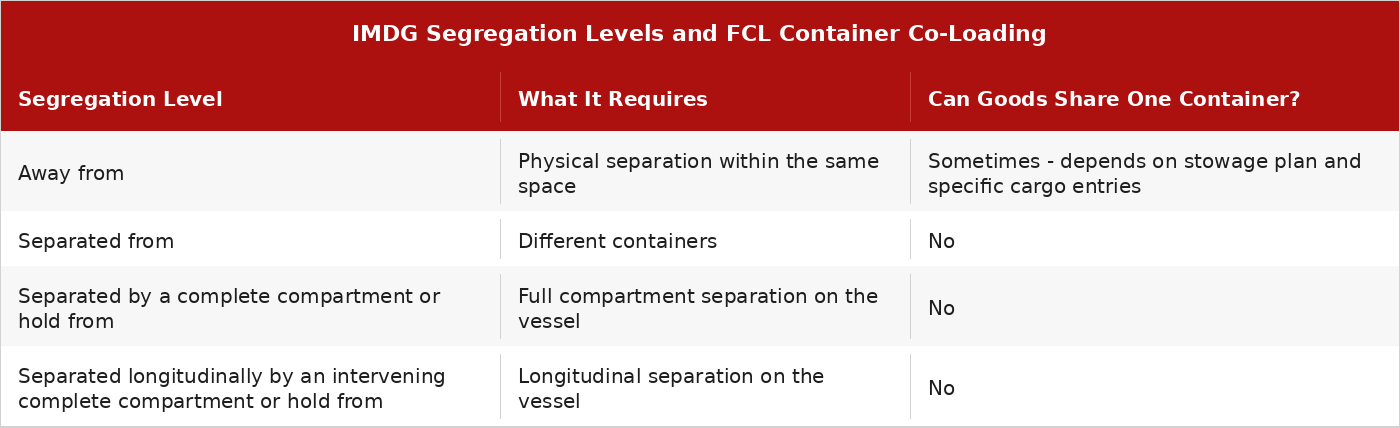
The segregation levels in the table above apply to combinations of different DG classes within one container. They are separate from the exclusive-use provisions that apply to individual cargo entries. Both sets of requirements need to be checked before a co-loaded DG container is booked.
For a detailed breakdown of dangerous goods liquid shipments and how packaging format affects the FCL decision, see How to Ship Dangerous Goods Liquids from China: Drums, IBCs, and ISO Tanks Explained.
The Container Packing Certificate and Why It Matters for FCL DG Shipments
An FCL DG shipment requires one document that rarely comes up in LCL shipping: the Container Packing Certificate, commonly abbreviated as CPC. Some jurisdictions refer to it as the Container/Vehicle Packing Declaration.
The CPC certifies that the goods inside the container were packed in compliance with the applicable dangerous goods regulations. It confirms that packages are correctly identified, that UN-certified packaging has been used where required, that segregation requirements have been observed inside the box, and that the container itself is suitable for the cargo it carries. It is signed by the person responsible for the physical packing — not the freight forwarder, and not the carrier.
In a mixed DG and general cargo container, the CPC covers all the contents. The person signing it confirms that the stowage plan accounts for both the dangerous goods and the general cargo, and that their combined loading arrangement meets the applicable requirements. This document cannot be prepared after the container is sealed and the details estimated from a packing list. It must reflect the actual loading as it happened.
The CPC works alongside the Dangerous Goods Declaration in the shipping document set.
The DGD describes and classifies the dangerous goods, and the CPC confirms how they were physically loaded into the container. A discrepancy between the two — different quantities, different package counts, incompatible stowage descriptions — is one of the most reliable ways to get a DG container flagged at export inspection.
How Physical Securing Requirements Change for DG Cargo
General cargo needs to be secured inside a container against the forces of ocean transit. For dangerous goods, the same requirement applies — but the consequence of inadequate securing is different. A shifting general cargo carton may arrive damaged. A shifting drum of flammable liquid that fails its packaging during transit may trigger a cargo incident.
Blocking and bracing for DG cargo means physical measures that prevent packages from moving in any direction. Dunnage bags, timber frames, strapping, and void-fill materials are all used depending on the cargo and the container configuration. The objective is that no DG package can shift far enough to contact an incompatible package, strike a container wall with significant force, or have its packaging integrity compromised.
In a mixed container, the general cargo introduces additional variables. Heavier general goods positioned near DG packaging add load and impact risk if they shift. Lighter goods that are not well secured can migrate into the DG portion of the container during a rough passage. The loading sequence and stowage plan need to address both cargo types together — not treat them as two independent loads that happen to share a box.
Loading supervision — where a trained person inspects and documents the container packing before it is sealed — is the practical way to ensure the Container Packing Certificate reflects what was actually loaded. This is one of the concrete reasons experienced DG forwarders include loading supervision in their FCL DG process rather than leaving it to the factory floor.
Why Importers of Dangerous Goods Work with Gerudo Logistics
Gerudo Logistics specializes in dangerous goods shipping from China across all hazard classes. We handle DG shipments in any packaging format — drums, IBCs, ISO tanks, or other configurations — as part of our standard service.
The decisions covered in this guide — container type, segregation assessment, exclusive-use confirmation, CPC preparation, and loading supervision — are handled by our team as part of the shipment planning process, before the container booking is placed. In our experience, the problems that delay DG containers at port consistently originate in the pre-loading stage: a classification that was not confirmed, a document that was not cross-checked against the actual load, or a stowage plan that was not reviewed until after the vessel cut-off passed.
We manage the full shipment process from cargo classification and packing compliance through to carrier booking, export documentation, and door-to-door delivery under DDP terms where required. Our operations cover Guangzhou, Shenzhen, Shanghai, Ningbo, Qingdao, and Dalian, giving access to all major DG export ports in China.
If you are planning a DG FCL shipment and want the documentation and stowage plan assessed before the booking is confirmed, contact our team to discuss the details.
Frequently Asked Questions for Hazmat Shipping from China
Can DG and General Cargo Share an LCL or Groupage Container?
LCL consolidators mix cargo from multiple shippers in one container, which means the segregation and documentation requirements apply across all cargo in the box — including shipments from companies the co-loaders have accepted separately. Most simply decline dangerous goods for this reason. Specialist DG groupage services exist for certain classes and routes, but availability is limited and the booking process is more involved than standard LCL.
Who is responsible for completing the Container Packing Certificate?
The CPC must be signed by the person responsible for physically packing the container — typically the factory, warehouse, or loading team. The freight forwarder can coordinate and review the document, but the signature must come from someone who was present and responsible for the loading. The shipper bears overall responsibility for ensuring the certificate is completed accurately before the container is sealed and moved.
If the DG in a mixed container is detained at port, what happens to the general cargo?
The general cargo cannot be released independently while the DG issue remains unresolved. The entire container is held until the problem is cleared — whether that is a document correction, a packaging inspection, or a classification dispute. Resolution timelines range from one day to several weeks depending on the port and the nature of the problem, and demurrage charges accumulate against the full container during that period.
Can two different DG classes travel in the same container?
It depends on the segregation level between those specific classes. If the level is "away from," co-packing may be achievable with correct stowage. If the level is "separated from" or higher, the classes require separate containers. The applicable level is determined by the specific IMDG entries for each product, not by the class number alone, and needs to be confirmed before the booking is placed.
Is co-loading DG with general cargo actually cheaper than a dedicated DG FCL?
The freight cost is lower when the container space is shared across cargo types. The full cost calculation also needs to include the documentation complexity, the insurance coverage confirmation for the general cargo, and the exposure of the entire container to detention if the DG paperwork contains an error. For importers who ship DG regularly, a dedicated DG FCL is often more predictable in total landed cost even when the unit rate is higher.
Do all carriers accept mixed DG and general cargo bookings?
No. Acceptance depends on the carrier, the route, the DG class involved, and sometimes the specific port of loading or discharge. Some carriers apply restrictions beyond the IMDG minimum for certain product categories, and these can vary from one sailing schedule to the next. Confirming carrier acceptance for a mixed DG booking is part of the pre-shipment process and should be done before the loading date is fixed.
Conclusion
The decision to co-load dangerous goods with general cargo has consequences that run through the entire shipment if the documentation or stowage is not handled correctly. Most of the problems that cause DG containers to be held at port are avoidable if the classification, segregation check, and document preparation happen before the loading date.
Whether the cargo needs an exclusive-use container, how segregation requirements affect what can share the box, and how the CPC aligns with the DGD — these are questions worth settling before the factory starts loading, not after the container is sealed and the vessel cut-off is approaching.