Container Types for Dangerous Goods and Chemical Shipping from China
Choosing the wrong container type for a dangerous goods shipment from China does not just mean paying more. It means a carrier rejection at booking, a compliance hold at the origin port, or a cargo disposal order at destination. The container type is a compliance decision before it is a cost decision.
This guide covers every container type used for dangerous goods and chemical cargo shipped from China - what each one accepts, what it costs, and how to match your cargo to the right equipment before you approach a forwarder.
Can You Ship Dangerous Goods in a Standard Dry Container?
The short answer is yes - for most DG cargo, a standard dry container is the correct equipment. The longer answer is that IMDG imposes strict rules on what can go inside one, how it must be stowed, and what it cannot travel alongside.
Standard dry containers - the 20ft, 40ft, and 40ft high cube - are the default equipment for packaged dangerous goods across most hazard classes. These cargo types all ship routinely in dry containers from Chinese ports:
Class 3 flammable liquids (in drums or IBCs)
Class 8 corrosives (in UN-certified packaging)
What IMDG actually requires inside a dry container is correct segregation. Certain DG classes cannot be stowed together, and some classes cannot travel alongside foodstuffs, animal feed, or medicines. Your forwarder will confirm the segregation requirements at booking - this can affect which vessel services accept your cargo.
In addition, DG cargo must be placed in a designated stowage position on the vessel - this is why confirming carrier acceptance early is essential for all DG bookings.
DG surcharges apply on top of standard ocean freight for all dry container DG shipments. Typical ranges for 2026:
Class 3, 8, and 9: $200 to $500 per container
Class 5.1 and Class 6.1: $400 to $800 per container (stricter stowage requirements)
Confirm the applicable surcharge with your forwarder at the time of booking, as rates vary by trade lane and carrier.
A standard dry container is not sufficient when your cargo requires ventilation to prevent gas buildup, temperature control during transit, top-loading access due to size, or bulk liquid containment above what packaged formats can handle. Those scenarios require the specialized equipment covered below.
Packaging formats used inside a dry container for liquid DG depend on your volume:
Small to medium volumes: drums (up to 200L per unit, suited to high-hazard or small-batch cargo) or IBCs (around 1,000L per unit, suited to mid-volume liquid chemicals)
Above ~17,000L: ISO tank is typically the more economical option, and the minimum filling rate requirement (80% of tank capacity) makes it the only practical format at that volume
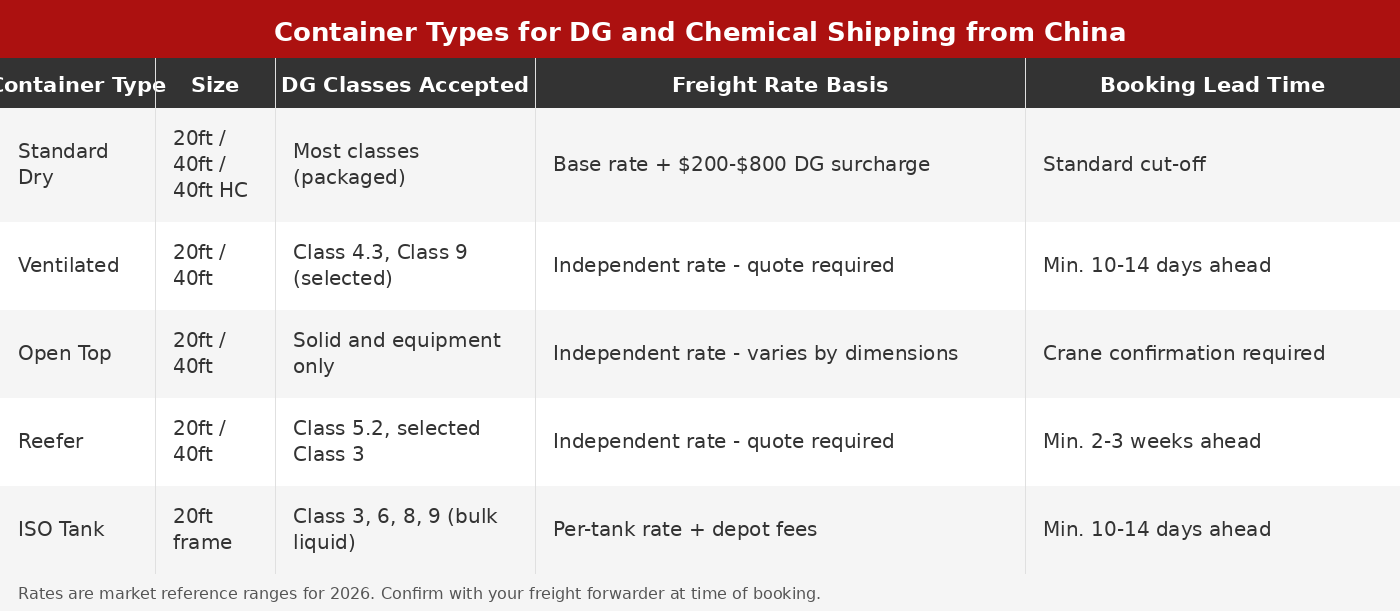
Container Types for DG and Chemical Cargo
Ventilated Container
A ventilated container is a dry container modified with vent openings along the lower and upper sidewalls, allowing passive airflow through the unit during transit. It looks similar to a standard dry container from the outside, but the ventilation openings are visible along the base rails and roof line.
The cargo case for a ventilated container is specific: goods that emit gases, vapors, or moisture during storage, where buildup inside a sealed container creates a fire, explosion, or toxicity risk. Common examples shipped from China include:
Class 4.3 materials such as calcium carbide (UN 1402) and sodium metal, which react with moisture to release flammable gas
Class 9 cargoes such as carbon black and wet hides
Practical limitations are significant and affect booking lead time. Key points to confirm before committing to a dispatch schedule:
Availability is limited - Qingdao and Shanghai typically carry small quantities; Guangzhou and Ningbo can be tight
Minimum booking lead time is 10 to 14 days before vessel cut-off
Some carriers require advance written confirmation of the ventilation requirement
If your supplier is inland, confirm the trucking provider can also handle the equipment type
Cost for ventilated containers is independently quoted. Rates are generally higher than standard dry container rates due to the limited equipment pool, but the exact premium varies by trade lane and carrier. The DG surcharge for your cargo class applies on top of the container freight rate.
Open Top Container
An open top container has a removable steel or fabric roof, allowing cargo to be loaded from above by crane. The side walls and end walls are structurally identical to a standard dry container. During transit, the opening is covered by a waterproof tarpaulin secured to the container frame.
The cargo case for an open top is oversized chemical equipment that exceeds the internal height of a standard container (2.35m on a standard 20ft or 40ft unit). Typical cargo includes industrial reactors, distillation columns, pressure vessels, and storage tanks.
If this equipment qualifies as dangerous goods due to residual contents or hazardous coatings, an open top is typically the only feasible option.
One hard restriction: liquid DG cargo cannot travel in an open top container. Drums or IBCs of flammable liquids, corrosives, or toxic liquids require a standard dry container. The tarpaulin covering does not meet the containment standard for liquid DG under IMDG, and carriers will reject such bookings.
Cost for open top shipments is independently quoted and does not follow a simple premium over dry container rates.
If your cargo is in-gauge (fits within the container frame with the roof removed), pricing is closer to a standard dry container plus an equipment surcharge.
If your cargo is out of gauge (OOG) - meaning it exceeds the standard container height of 2.35m or width of 2.35m once loaded - it occupies additional vessel slots and the freight rate is typically several times that of a standard container.
Confirm your cargo dimensions with your supplier before requesting a quote.
Packaging formats for open top cargo are not applicable in the conventional sense - the cargo itself is the equipment. Where DG classification applies due to residual contents, confirm the handling requirement with your forwarder before booking.
Reefer Container
A reefer container is a standard dry container with an integrated refrigeration unit, capable of maintaining a precise temperature setpoint throughout the voyage. Power is supplied by the vessel at sea and by reefer plug points at the terminal during port calls.
Two categories of DG cargo from China require temperature control:
Class 5.2 organic peroxides - many have a Self-Accelerating Decomposition Temperature (SADT), which is the temperature above which the cargo begins to decompose on its own, generating heat and pressure that can lead to fire or explosion. IMDG mandates a specific temperature range for each Class 5.2 product; some require a maximum of +20°C, others -10°C.
Selected Class 3 flammable liquids with very low flash points or boiling points, where elevated temperatures during tropical routing increase vapor pressure to unsafe levels.
Carrier acceptance for DG reefer bookings is significantly more restricted than for standard reefer cargo. Key constraints to verify before booking:
Not all carriers that accept reefer shipments will accept DG reefer on the same lane
Class 5.2 requires a specialized stowage position on the vessel
Some carriers limit DG reefer acceptance to specific vessel services only
In our experience, DG reefer bookings on China-to-USA lanes require a minimum of two to three weeks lead time beyond the standard cut-off.
Cost for reefer DG shipments is independently quoted and cannot be estimated as a fixed premium over dry container rates. Rates vary significantly by trade lane, carrier, and temperature requirement. The DG surcharge for the relevant class applies in addition to the reefer freight rate.
Packaging formats inside a reefer DG container follow the same rules as a standard dry container - drums or IBCs for liquid cargo, UN-certified packaging for solids. The temperature control requirement must be reflected in the shipping documentation and declared on the DG Declaration, but it does not change the packaging format itself.
ISO Tank for Bulk Liquid Chemicals
An ISO tank is a cylindrical pressure vessel mounted within a standard ISO frame, designed to carry bulk liquids. The tank must be certified to a T-code (a certification number that defines which chemicals the tank is approved to carry) that matches your cargo's UN number - your forwarder will confirm which T-code applies and whether the required equipment is available on your trade lane.
ISO tank becomes the practical option for bulk liquid DG in Class 3, 6, 8, and 9 once volumes are sufficient to meet the minimum filling rate required under IMDG.
A standard 20ft ISO tank has a capacity of 21,000 to 26,000 liters, and IMDG requires a minimum fill of 80% to prevent liquid surge during transit. This means a single ISO tank booking typically requires at least 17,000 to 19,000 liters of cargo. Below that threshold, IBCs in a standard dry container are the more practical format.
Before the booking can be confirmed, three things must be in place:
A clean certificate from the previous cargo cycle
T-code verification against your UN number
A confirmed receiving depot at destination
Minimum lead time is 10 to 14 days before cut-off. For cargo requiring specialized tank types, equipment availability may require longer planning horizons. For a full breakdown of T-codes, documentation requirements, and the cost comparison against drums and IBCs, see our guide to DG liquid container formats.
Cost for ISO tank leasing:
Short-haul routes (China to Southeast Asia): approximately $400 to $800 per trip
Long-haul routes (China to Europe or the US): approximately $1,200 to $2,000 per trip
Origin and destination depot fees: $150 to $350 per cycle
These figures cover leasing only. Ocean freight is quoted separately by the carrier on a per-tank basis, comparable to a 20ft container slot.
Packaging format: ISO tank serves as both the container and the packaging format simultaneously - cargo is loaded directly into the tank with no inner packaging required.
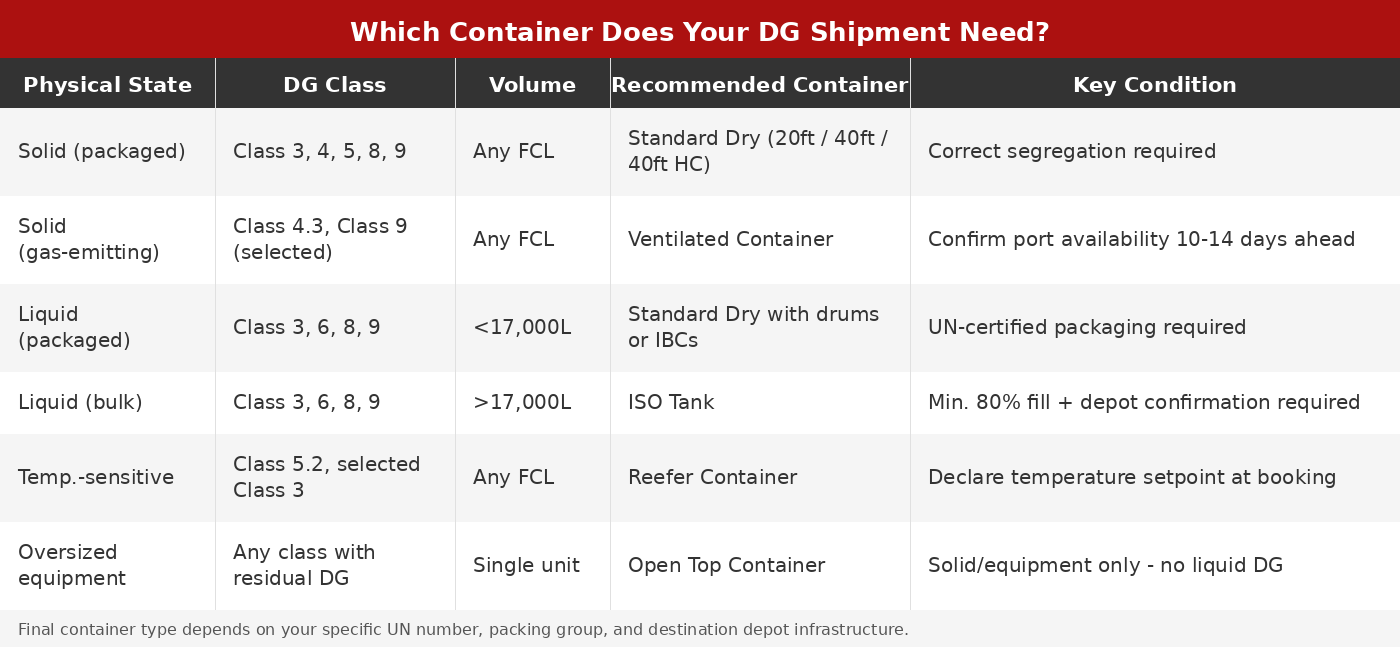
Which Container Does Your DG Shipment Need?
The table below maps cargo physical state, DG class, and volume to the appropriate container equipment. It is a starting reference - the final determination depends on your specific UN number, packing group, and destination depot infrastructure.
Shipping DG and Chemical Cargo from China with Gerudo Logistics
Gerudo Logistics is a dangerous goods and chemical cargo specialist freight forwarder headquartered in Guangzhou, with operations across Shenzhen, Shanghai, Ningbo, Qingdao, and Dalian. We handle DG and chemical shipments across Class 3, 4.1, 5.1, 6, 8, and 9 - in standard dry containers, ventilated containers, open top containers, reefer containers, and ISO tanks.
Our team brings dedicated DG expertise across China's major export ports, with bilingual support and end-to-end execution from cargo classification through to final delivery. We understand the port-specific acceptance policies, carrier DG requirements, and documentation standards that determine whether a shipment moves on schedule or gets held.
We manage China customs clearance, DG documentation, and door-to-door DDP delivery to the your market country including Middle East, Europe, and the United States, Indonesia.
To confirm the right container type for your DG shipment from China, contact our team.
Frequently Asked Questions
Can all DG classes ship in a standard dry container? Most packaged DG cargo ships in a standard dry container under IMDG, provided segregation requirements are met. The exceptions are cargo requiring ventilation (Class 4.3 and selected Class 9), temperature control (Class 5.2 and selected Class 3), bulk liquid volumes requiring ISO tank (subject to minimum filling rate), and oversized units requiring top loading (open top).
What is a DG surcharge and why does it apply? A DG surcharge is an additional fee levied by ocean carriers to cover the extra handling, documentation review, and stowage management required for dangerous goods. It applies on top of the standard container freight rate and ranges from $200 to $500 per container for common classes such as Class 3 and Class 8, and $400 to $800 for higher-hazard categories.
How far in advance do I need to book a ventilated or open top container? A minimum of 10 to 14 days before vessel cut-off is required for ventilated containers, given limited fleet availability at most Chinese ports. Open top containers are more widely available but still require advance coordination for crane handling. Both types should be confirmed with your forwarder before committing to a supplier dispatch date.
Can liquid DG cargo travel in an open top container? No. Open top containers are restricted to solid cargo and equipment under IMDG. The tarpaulin covering does not meet the containment standard required for liquid dangerous goods. Packaged liquid DG must travel in a standard dry container or, at bulk volumes, in an ISO tank.
What documentation does a reefer DG shipment require beyond a standard DG booking? In addition to the MSDS, DG Declaration, and packing certificate required for all DG ocean freight, a reefer DG booking must specify the required storage temperature and the maximum permitted temperature deviation. For Class 5.2 organic peroxides, both the required storage temperature and the maximum permitted temperature must be declared separately on the booking and on the DG Declaration.
Is ISO tank the only option for bulk liquid DG above 17,000 liters? ISO tank is the standard option once volumes meet the minimum filling rate requirement - a standard 20ft ISO tank requires at least 80% fill, meaning approximately 17,000 to 19,000 liters minimum. For one-off or smaller shipments, a high-loaded IBC configuration in a 20ft dry container is the more practical format, though per-liter cost is higher and IBC reconditioning at destination needs to be confirmed in advance.
Conclusion
Container type selection for dangerous goods cargo comes down to three factors: the physical state of your cargo, its IMDG hazard class and packing group, and your shipment volume. Most packaged DG ships in a standard dry container. Specialized equipment covers the compliance requirements that a dry container cannot meet.
The decision needs to be made before production is complete. Changing container type after a booking is confirmed causes delays that compound through the supply chain. Confirm the equipment requirement with a specialist DG forwarder at the planning stage, and verify carrier acceptance on your specific trade lane before locking in a dispatch date.