The Hidden Cost of US Customs Bonds for China DG Cargo Imports (2026)
Your shipment arrives at the port of Los Angeles. Documentation is complete, your inland carrier is on standby, and the container has been offloaded. Then US Customs and Border Protection (CBP, the federal agency responsible for controlling the movement of goods across US borders) flags the entry: no customs bond on file.
Port storage charges start accumulating immediately. Getting the bond in place takes two to three business days you were not planning for.
A customs bond is a mandatory requirement for commercial imports from China. Any shipment with a declared value of $2,500 or more requires an active bond before CBP will release the goods. This applies across all shipping modes: ocean, air, full container load (FCL), and less than container load (LCL).
This guide covers what a customs bond is, which type suits your situation, how to calculate the correct coverage amount, and what is changing under the June 2026 Executive Order on customs enforcement.
What Is a US Customs Bond?
A US customs bond is a legally required financial guarantee that importers must file with CBP before commercial goods can be cleared into the United States. It ensures the importer will pay all duties, taxes, and applicable fees owed to the US government. Without an active bond on file, CBP will not release your shipment.
The bond is a contract between three parties: you as the importer of record (the principal), a surety company licensed by the US Treasury that issues the bond, and CBP as the beneficiary. If you fail to pay duties or violate customs regulations, CBP files a claim against the bond. The surety pays CBP first, then recovers that amount from you.
The bond is a credit guarantee for your regulatory obligations to the US government. Marine cargo insurance is a separate product that covers physical loss or damage to your goods in transit.
When Is a Customs Bond Required?
A customs bond is required in two situations.
The first trigger is the $2,500 threshold. This is the point at which CBP requires a formal entry, the standard clearance process for commercial imports. Nearly every commercial shipment from China reaches this value. For shipments below this threshold, different rules apply. See our China to USA small packages guide for a full breakdown.
The second trigger applies regardless of shipment value. Certain goods are regulated by US federal agencies beyond CBP, referred to as Partner Government Agencies (PGAs, meaning any US agency with legal authority over specific imported goods). If your goods fall under PGA oversight, a customs bond is required even if the shipment value is below $2,500.
The PGA agencies most relevant to importers sourcing from China are:
FDA (Food and Drug Administration): food and beverages, dietary supplements, cosmetics, pharmaceuticals, and medical devices
EPA (Environmental Protection Agency): industrial chemicals, pesticides, and certain cleaning and maintenance products
DOT (Department of Transportation): dangerous goods and hazardous materials, including chemicals, flammable liquids, batteries, and other cargo classified under international DG (dangerous goods) regulations
Dangerous goods exported from China fall under DOT and EPA oversight on the US side, making them PGA-regulated at any shipment value. This also changes how the bond amount is calculated, which is covered in the next section.
In our experience, this is the trigger that catches chemical and DG importers most off-guard. The classification is determined by the product category, not the order size. A $1,500 sample of industrial solvent still needs an active bond before CBP will process the entry, and discovering that gap after the cargo has left China creates a clearance problem with no easy fix.
For a full breakdown of what DG cargo documentation must include, see our dangerous goods declaration guide.
Types of US Customs Bonds
There are two main bond types for importers. The right choice depends on how often you ship and which transport mode you use.
Single Entry Bond
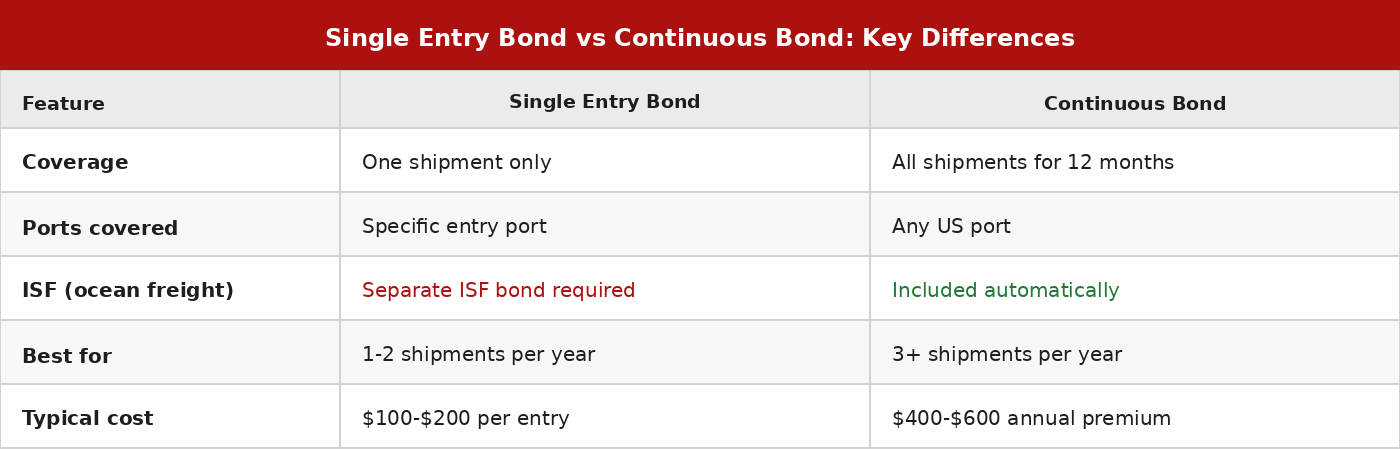
A Single Entry Bond (SEB) covers one customs entry only. Once that shipment clears, the bond closes and you need a new one for the next shipment.
For ocean freight, there is an added complication. Regardless of whether you ship FCL or LCL, CBP requires importers to submit an Importer Security Filing (ISF, a pre-shipment cargo data declaration) at least 24 hours before the vessel departs China. The ISF carries its own separate bond obligation. Importers using single entry bonds must purchase a dedicated ISF bond for each ocean shipment on top of the standard entry bond, meaning two bonds per ocean shipment every time.
In our experience, the ISF bond requirement is the detail most often discovered only after the cargo is already at the port. At that point the vessel departure window is tight, and there is no time to arrange a missing bond without risking a missed sailing or an ISF penalty.
An SEB is appropriate when you:
Are importing for the first time or testing a new supplier
Ship once or twice per year
Use air freight, which does not carry the ISF requirement
Continuous Bond
A Continuous Bond covers all your imports across any US port for a 12-month period. It satisfies the ISF obligation automatically for every ocean shipment, with no additional bond application per entry.
The annual premium for a standard $50,000 Continuous Bond typically runs $400-$600, paid to the surety company. Set it up once through your customs broker and renew annually.
A Continuous Bond makes sense when you:
Import three or more times per year
Ship by ocean regularly from China
Source across multiple Chinese ports or suppliers
At three or more shipments per year, a Continuous Bond is almost always cheaper in total than buying individual entry bonds and ISF bonds per shipment. Importers who switch from SEB to Continuous also consistently underestimate how much administrative time they recover by eliminating per-shipment bond applications.
How Much Bond Coverage Do You Need?
The bond amount is the maximum coverage CBP can claim if you default, which is separate from the premium you pay. You pay the surety company a premium in exchange for them underwriting that coverage level on your behalf.
Continuous Bond
CBP calculates the required Continuous Bond coverage at 10% of the total duties, taxes, and fees you paid in the previous 12 months. The minimum is $50,000.
Annual duties of $300,000: 10% equals $30,000, so the bond defaults to the $50,000 minimum
Annual duties of $700,000: required bond coverage rises to $70,000
Annual duties of $1,200,000: required bond coverage rises to $120,000
If your annual duty payments increase and your bond is not updated, CBP can issue a bond insufficiency notice that pauses all new entries until coverage is raised. A notice does not come with much warning. Entries are paused immediately, which means shipments already in transit can arrive at port and sit there while the bond update is processed and confirmed. This has become more common for importers whose tariff bills grew substantially following the tariff changes of 2025-2026.
Single Entry Bond
For standard cargo, an SEB equals the entered value of the goods plus estimated duties and fees.
For goods regulated by a PGA (including dangerous goods under DOT and chemicals under EPA), the SEB must equal three times the total entered value of the shipment. A $40,000 chemical shipment requires an SEB of $120,000. In our experience, importers who plan on a standard SEB and then learn the 3x rule applies at the bonding stage typically face a one to two day delay while the replacement bond is arranged, with port storage accumulating the entire time.
This calculation also depends on the DG classification being confirmed accurate before the bond is filed. If CBP reassesses the product category at the US port, the bond amount and the entry both need to be reworked from the same starting point.
How Rising Tariffs and the 2026 Executive Order Affect Your Bond
The tariff increases of 2025-2026 have pushed bond requirements higher for many China importers. Because a Continuous Bond must equal 10% of annual duties, higher tariff rates translate directly into higher required coverage. Importers who calibrated their bond correctly two years ago may now find their coverage is insufficient.
On June 3, 2026, the US government signed an Executive Order directing CBP to further increase minimum bond levels and tie coverage requirements more closely to importer risk profiles. Specific implementing rules are scheduled to be issued within 180 days. For importers currently at the $50,000 minimum with growing volumes, reviewing your bond amount now is simpler than resolving a shipment hold mid-transit.
For a full breakdown of current tariff rates on Chinese goods by product category, see our guide to current tariffs on China.
For a complete picture of how bond costs factor into your total import budget, see our landed cost guide for China-US imports.
How to Get a Customs Bond
Work through a licensed US customs broker. They arrange the bond with a treasury-approved surety company and file it with CBP through the Automated Commercial Environment (ACE, CBP's online trade processing platform). You will need your legal business name, importer number (EIN for US companies), expected shipment frequency, and estimated annual duty payments. A Single Entry Bond is typically active within one to two business days. A Continuous Bond takes three to five business days.
Arrange the bond before your cargo departs China. Applying after the vessel has sailed means port storage charges are accumulating before coverage is in place.
A professional freight forwarder helps you navigate the timing and information gaps that most commonly derail this process. For DG and regulated cargo, that means confirming accurate cargo classification before your broker calculates coverage, flagging the ISF bond requirement for ocean shipments, and aligning the vessel departure schedule with bond activation.
DG cargo carries additional cut-off deadlines that factor into this timing. See our DG shipment cut-off guide for the specific timelines. Getting these details coordinated across both sides of the chain is where importers most often get caught out.
Shipping DG Cargo from China to the United States
Gerudo Logistics manages the full logistics chain for DG and cold chain cargo, from collection in China through international transit to delivery coordination in destination markets. We are headquartered in Guangzhou with operations across Shenzhen, Shanghai, Ningbo, Qingdao, and Dalian.
Our specialization is dangerous goods and hazardous chemicals. We do not arrange customs bonds, file ISF declarations, or process US import entries. Those are your licensed US customs broker's responsibility.
Where our work directly affects your US clearance outcome is the DG classification and cargo documentation that travels with the shipment. For PGA-regulated goods, an incorrect classification means your customs broker is filing the entry on the wrong product category and the bond was sized on the wrong basis from the start. When CBP reassesses at the US port, a bond shortfall and a cargo hold arrive at the same time.
Getting that documentation right before the cargo moves is how we prevent that outcome. To discuss your next shipment,contact our team.
Frequently Asked Questions for China-US Shipment
When is a customs bond required for imports from China?
A bond is required for any commercial shipment valued at $2,500 or more. Goods regulated by US federal agencies including the FDA, EPA, and DOT require a bond regardless of shipment value.
What is the difference between a Single Entry Bond and a Continuous Bond?
A Single Entry Bond covers one shipment and expires once that entry clears customs. A Continuous Bond covers all imports across any US port for 12 months and automatically satisfies the ISF filing requirement for ocean freight, removing the need for a separate bond per shipment.
How much does a Continuous Bond cost?
The annual premium for a standard $50,000 Continuous Bond typically runs $400-$600, paid to the surety company. Importers with annual duty payments above $500,000 will require higher coverage and a correspondingly higher premium.
Why is the bond amount higher for dangerous goods and regulated cargo?
For goods regulated by the FDA, EPA, or DOT, a Single Entry Bond must equal three times the total entered value of the shipment. Standard cargo bonds are based on entered value plus estimated duties, which is a significantly lower figure for most shipments.
How do current China tariffs affect my bond requirement?
A Continuous Bond must equal 10% of your total annual duties. As tariff rates on Chinese goods increased substantially in 2025-2026, many importers' annual duty bills grew, pushing required bond coverage above the $50,000 minimum. If your duty payments have changed significantly, review your bond amount before the next shipment.
What did the June 2026 Executive Order change for importers?
Signed on June 3, 2026, the order directed CBP to raise bond minimums and strengthen vetting of importers, brokers, and freight forwarders. Implementing rules are scheduled within 180 days. Importers currently at the $50,000 minimum with growing volumes should review their coverage before the new rules take effect.
How long does it take to get a customs bond?
A Single Entry Bond is typically active within one to two business days through a licensed customs broker. A Continuous Bond takes three to five business days to activate in CBP's ACE system.
Conclusion
A customs bond is a standard import condition, but it creates real costs and delays when the type is wrong, the coverage is undersized, or it is arranged too late. For importers of dangerous goods and regulated cargo from China, the requirements are stricter and the calculations differ from standard merchandise, making it worth getting right before the shipment leaves port.
The practical starting point is your US customs broker, who can confirm the right bond type for your import frequency, calculate the correct coverage for your product category and current duty profile, and file the bond before your cargo departs China.