US Country of Origin Marking for Imports From China
A China-origin product can still face a US Customs marking issue when its label is missing, difficult to find, or easy to remove. The same risk applies when the label uses "Made in PRC". The physical mark must identify the legal country of origin and remain visible to the person who ultimately receives the product.
For most goods shipped from China to the USA, the country of origin must appear in English. The correct wording and marking method depend on the product, its packaging, its manufacturing history, and any exception under 19 CFR Part 134.
At a Glance
Most China-origin products imported into the USA must carry a country-of-origin mark such as "China", "Made in China", or "Product of China". The mark must be easy to find, legible, and sufficiently permanent. The product itself normally carries the mark, although package marking or an exception may apply to certain goods. CBP does not accept "Made in PRC" as a substitute for the country name.
What US Country of Origin Marking Requires
For goods imported from China into the USA, Section 304 of the Tariff Act of 1930 and 19 CFR Part 134 govern country-of-origin marking. The article or its permitted container must identify the legal country of origin. This requirement applies at importation unless the product qualifies for a specific marking exception.
The ultimate purchaser is generally the last person in the USA who receives the product in the form in which it was imported. For finished retail goods, this is usually the retail buyer. If an imported component undergoes substantial transformation during manufacturing in the USA, the US manufacturer may become the ultimate purchaser.
Country-of-origin marking is a physical identification requirement. Stating China on the commercial invoice or customs entry does not satisfy Part 134 when the article or its permitted container must also carry the country name. The customs entry must separately declare the correct origin.
How US Customs Determines Country of Origin
CBP determines country of origin from where a product was manufactured, produced, or grown. When production takes place in several countries, the country where the last substantial transformation occurs is generally the country that must appear in the origin marking.
Substantial transformation occurs when processing creates an article with a new name, character, or use.
For a mixed-origin product, CBP considers the role of the main components and the extent of the manufacturing completed in China. It also examines whether the components lose their original identity and whether the finished product performs a different function. No single factor controls every product.
China may be the country of origin: Processing in China creates a finished article with a new name, character, or use, even if some components were made elsewhere.
China does not become the country of origin: Work in China is limited to simple assembly or minor processing that does not substantially transform the components.
Goods made in another country retain their original country of origin when activities in China are limited to:
Storage and inspection
Sorting and consolidation
Repacking and relabeling
This distinction is particularly relevant for goods routed through China. A Chinese loading port does not determine origin, and neither does a bonded movement or a new set of commercial documents.
For a complex supply chain, the importer should obtain the bill of materials and a description of the manufacturing completed in each country. If those records do not produce a clear answer, the importer can request a binding ruling from CBP before relying on a country-of-origin mark.
How to Mark China-Origin Goods for the USA
Use the English Country Name
Under 19 CFR 134.45, the marking must normally identify the country of origin by its English name. For products determined to be China-origin, commonly accepted wording includes:
China
Made in China
Product of China
CBP has repeatedly found that Made in PRC is unacceptable because the abbreviation does not clearly identify China to the ultimate purchaser. Importers should also avoid relying on country codes such as CN.
For assembled products, "Assembled in China" may be appropriate when the country-of-origin analysis confirms that China is the country of final assembly for marking purposes. The wording cannot establish China as the origin by itself.
Mark the Product or Its Permitted Container
The product itself is the default place for the country-of-origin mark. Marking only the packaging is acceptable when the container marking reasonably indicates the product's origin or another exception under 19 CFR Part 134 applies.
The correct location depends on what reaches the ultimate purchaser:
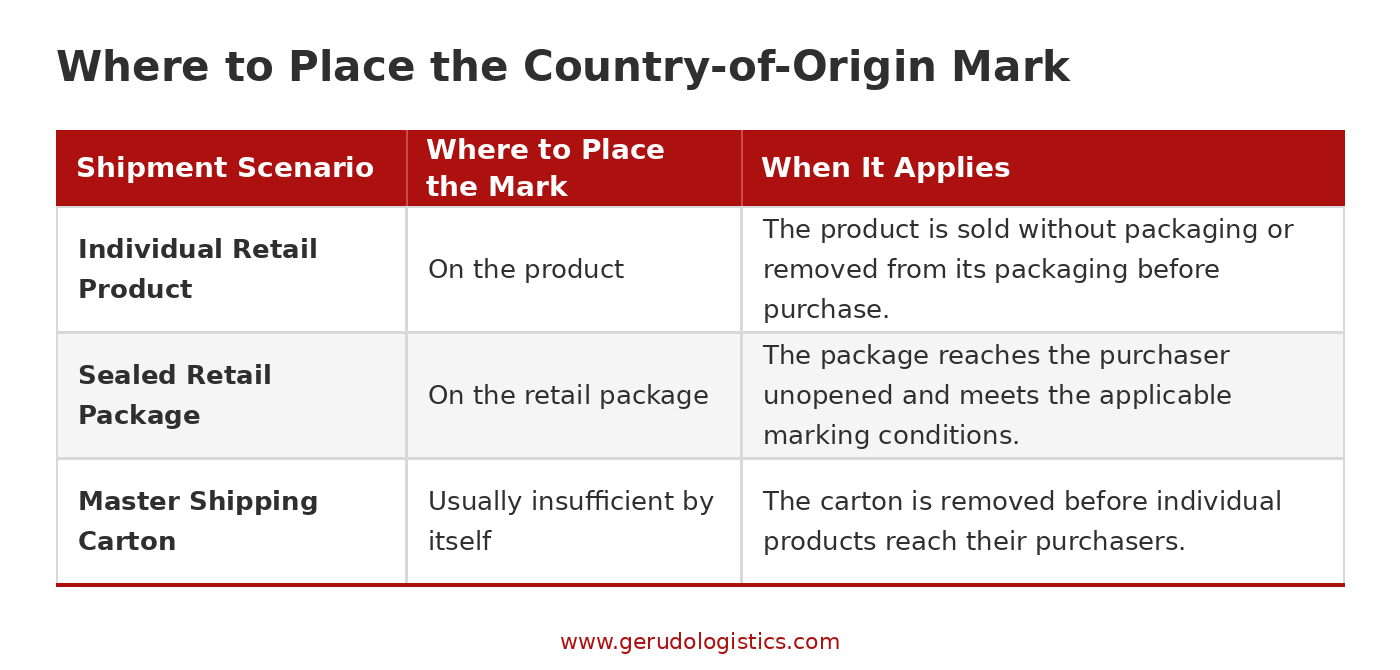
Small size, difficult surfaces, or retail packaging do not automatically create an exception. The importer must confirm that the product or container qualifies under the applicable provision.
Make the Mark Visible and Permanent
CBP does not prescribe one marking method for every product. The selected method must suit the product and remain legible through normal distribution, storage, display, and handling.
A country-of-origin mark can be molded, etched, engraved, printed directly on the product, or applied with a secure label or tag. An adhesive label can satisfy the requirement when it remains attached until the product reaches the ultimate purchaser unless deliberately removed.
The mark must be easy to find and read without strain. It should not be hidden beneath another label, placed inside a part that requires disassembly, or printed with insufficient contrast against the background.
For dangerous goods, the country-of-origin mark is separate from the UN number, proper shipping name, hazard labels, and packaging certification marks. It must not obscure or be confused with any required transport marking or label.
For chilled or frozen cargo, the label material and adhesive need to remain legible and attached through low temperatures, moisture, and condensation.
Place the Origin Mark Near US References
Packaging or products may display a US geographical reference, such as a distributor address or "Designed in USA". They may also show the name of a US city. If the reference could mislead the purchaser about where the product was made, 19 CFR 134.46 applies. The actual origin must then appear in close proximity and in at least a comparable size.
The origin must be preceded by wording such as "Made in" or "Product of". For example, a package displaying "Designed in USA" may need "Made in China" nearby. A small origin mark placed on a different panel may fail to correct the misleading impression.
Who Is Responsible for the Country of Origin Marking?
Several parties handle the origin information, but the Importer of Record (IOR) remains responsible for the accuracy of the US customs entry. Applying the physical mark and declaring the origin are connected tasks handled by different parties.
Manufacturer or supplier: Provides the bill of materials, manufacturing locations, and production details used to determine origin. The supplier normally applies the approved mark to the product or permitted packaging.
Importer of Record: Confirms the legal origin, checks that the marking complies with the applicable requirements, and retains the supporting records. Using a licensed customs broker does not transfer entry responsibility away from the IOR. The Importer of Record guide for shipments from China to the USA explains how that responsibility applies.
Customs broker: Prepares and files the customs entry using the information supplied by the IOR. The broker can identify missing or conflicting information, but filing the entry does not make the broker responsible for manufacturing facts that were never disclosed.
Freight forwarder: Coordinates the shipment information shared between the supplier, importer, and customs broker. The forwarder can flag inconsistencies in the documents or cargo details, but it does not issue a binding country-of-origin determination.
The product mark, retail packaging, commercial invoice, and customs entry must identify the same legal country of origin. The wording does not need to be identical. For example, a product marked "Made in China" and an invoice stating "Country of Origin: China" communicate the same origin.
A supplier address, seller location, or Chinese loading port does not replace manufacturing evidence. When the available information conflicts, the IOR must resolve the discrepancy before filing the customs entry. Another party cannot determine origin from the shipping documents alone.
Special Marking Rules for Certain Products
Some products require a specific marking method or an additional country-of-origin disclosure. A general adhesive label that works for an ordinary consumer product may be insufficient for these categories.
Products Requiring Permanent Metal Marking
Under 19 CFR 134.43, knives, scissors, razors, surgical instruments, laboratory instruments, pliers, hinged hand tools, vacuum containers and related parts generally require a permanent origin mark. Accepted methods include die stamping, cast-in-the-mold lettering, etching, engraving, or a metal plate secured by welding, screws, or rivets.
Separate statutory requirements apply to certain iron or steel pipes and fittings, compressed gas cylinders, and manhole covers or frames. The required method can include cast-in-the-mold lettering, etching, engraving, or another method specified by 19 U.S.C. 1304. When a cylinder contains a regulated gas, its country-of-origin marking remains separate from the cylinder specification marks and dangerous goods transport labels.
Watches, Clocks and Timing Apparatus
Watches, clocks and timing apparatus are subject to the special marking provisions in Chapter 91 of the HTSUS and 19 CFR 11.9. The movement, case and certain dials can have separate marking requirements, so marking only the completed retail product may be insufficient.
The prescribed information must be applied using the method and location required for the relevant component. An adhesive sticker does not replace a mandatory permanent marking that must be engraved, stamped, cut, or molded.
Native American-Style Products
Jewelry, pottery, rugs, baskets and similar products incorporating Native American-style designs can require an indelible country-of-origin mark. The mark is normally applied by cutting, stamping, engraving or another permanent method.
For jewelry, the mark can appear on the clasp or another conspicuous part of the product. A permanently attached metal or plastic tag can also be used. Secure string tags or adhesive labels are permitted only when the prescribed permanent method is technically or commercially infeasible.
Textile, Wool and Fur Labels
Most textile and wool products sold in the USA must carry a label stating the country of origin, fiber content and responsible business identity. These FTC requirements apply alongside the general CBP marking requirements.
For garments with a neck, the country of origin normally appears on a label attached at or near the inside center of the neck. Other textile products require a conspicuous and accessible label. Fur products have additional disclosure requirements, and the origin of the fur material can differ from the origin of the finished garment.
These categories do not cover every product with a special marking requirement. The importer must confirm the applicable rule from the product description, material, construction, and HTSUS classification. Labels required by the FTC, FDA, CPSC, or another agency do not replace the CBP country-of-origin mark unless a specific exception applies.
What Happens if CBP Rejects the Marking?
CBP can withhold release or demand redelivery when goods are not legally marked. A marking violation can be corrected, removed from the USA, or destroyed under CBP supervision. The available path depends on where the goods are located when CBP identifies the problem.
CBP issues a marking notice: The importer receives Customs Form 4647 or its electronic equivalent. The notice identifies the marking problem and instructs the importer to arrange correction or redelivery.
Release is withheld or redelivery is required: Goods still in CBP custody can remain on hold until the marking is corrected or the required security is provided. If the goods have already been released, CBP can require them to be returned to customs custody. The importer generally has 30 days from the redelivery notice unless CBP grants additional time.
The goods are corrected: The importer can arrange for the product or permitted container to be properly marked under CBP supervision. The port may accept a certificate of marking supported by a marked sample instead of direct physical supervision.
Uncorrected goods leave the USA: If correction is not completed, the goods can be removed from the USA or destroyed under CBP supervision. Goods in examination packages that are not corrected, removed from the USA, or destroyed within the permitted period can be moved to general-order storage for disposition.
The importer pays the costs of remarking, handling, storage, and CBP supervision. An additional marking duty equal to 10% of the final appraised value can apply if the goods remain noncompliant before liquidation. The same exposure applies unless the goods are removed from the USA or destroyed under CBP supervision. This charge is separate from the ordinary customs duties on the goods.
Failure to comply with a redelivery demand can also create liquidated damages under the customs bond. Under 19 CFR 134.54, the amount can equal the entered value of the articles that were not properly marked or returned.
Country-of-origin marking is one of several issues that can interrupt customs release. The guide to avoiding US customs holds covers broader entry and document discrepancies that can place imports from China on hold.
How Gerudo Logistics Supports Shipping from China to the USA
Gerudo Logistics has developed extensive experience in freight from China to the USA. Its services combine bilingual communication, end-to-end support, specialized cargo capabilities, and coverage across China's major ports.
USA Shipping Experience: Regular work with shipments to the USA gives the team a practical understanding of available routes and delivery requirements. It also helps the team identify issues that can affect cargo entering the country.
Bilingual End-to-End Support: Chinese- and English-speaking team members support customers throughout the shipment, making communication easier for overseas importers working with suppliers in China.
Specialized Cargo and Port Coverage: Dangerous goods and cold-chain logistics are the company's main service areas. Gerudo Logistics also handles general freight through teams covering major ports across China.
Contact us to discuss your next shipment from China to the USA.
Frequently Asked Questions
Is There a Minimum Font Size for a "Made in China" Label?
There is no universal minimum font size under 19 CFR Part 134. The marking must be conspicuous and readable without strain, while certain US references on the product or packaging can trigger additional proximity and comparable-size requirements.
What Happens if Imported Products Are Repacked in the USA?
Repacking must not conceal the existing country-of-origin mark. If it does, the new retail container must show the origin, and the importer may need to certify compliance or notify a subsequent repacker in writing.
Does an Online Product Listing Replace the Physical Origin Mark?
No. Showing "Made in China" on an ecommerce listing does not replace the mark required on the imported article or its permitted container unless a marking exception applies.
Do Product Samples Need Country-of-Origin Marking?
Samples are not automatically exempt. An exception may apply when the importer will use the articles and they are not intended for sale, although the outermost container may still need an origin mark.
If a Product Is Exempt, Does Its Outer Container Still Need Marking?
Usually, yes. The outermost container in which an exempt article reaches the ultimate purchaser generally must show the article's country of origin unless the container also qualifies for an exception.
Does Country-of-Origin Marking Determine the Customs Duty?
The wording printed on the product does not determine the duty rate. Customs treatment depends on the product's HTS classification, customs value, and legally determined origin. Changing the label does not change the actual origin or applicable China duties.