How to Find and Verify the Right HS Code When Importing from China
The HS code you declare at customs is not just a reference number. It determines your duty rate, whether Section 301 tariffs apply, and whether your shipment clears without examination.
Get it wrong and you face underpayment penalties or years of overpaid duties. For dangerous goods and chemical cargo, the consequences go further: misclassification can trigger a hold, a referral to a regulatory agency, or a forced return shipment.
This guide covers how the Harmonized System works, how to find and verify the right code before you ship, what to do when a classification is disputed, and why DG and chemical cargo carries higher classification risk than most product types.
How the Harmonized System Is Structured
Understanding what an HS code is in shipping terms starts with the World Customs Organization (WCO). The Harmonized System (HS) is a global product classification framework that assigns a numerical code to every traded product. Over 200 countries use the same six-digit base code, covering more than 98% of global merchandise trade.
The six digits work in layers:
First two digits - the chapter (broad product category)
Next two digits - the heading within that chapter
Final two digits - the subheading (more specific product type)
For example, lithium-ion batteries fall under Chapter 85 (electrical machinery), heading 8507 (electric accumulators), subheading 8507.60. The six-digit base is 8507.60.
Beyond six digits, each country adds its own extensions for duty rates and statistical tracking. That is why the same product can carry a different full code in the US versus the EU, even when the first six digits match.
HTS, HS, and Schedule B - Which Code Do You Actually Need
Depending on the context, you may encounter the terms tariff code, HS code, HTS number, or harmonized tariff code. These all refer to variations of the same classification system, but with important differences in scope and legal application.
Here is what each term means:
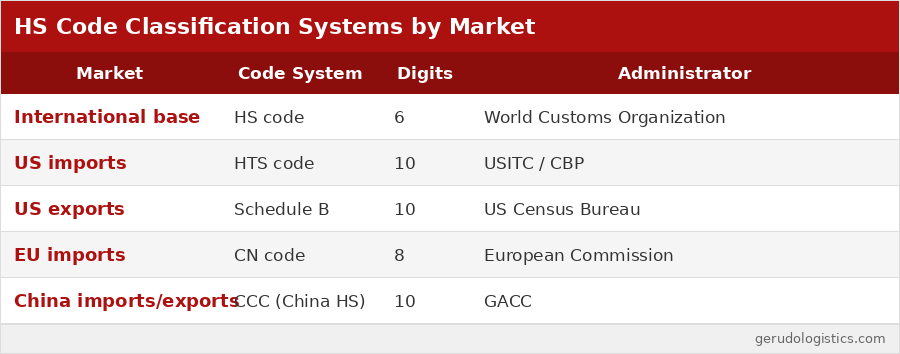
HS code - the internationally standardized six-digit base, administered by the WCO. Every country uses it as a starting point, but six digits alone are not enough for an import declaration.
HTS code (Harmonized Tariff Schedule code) - the US-specific 10-digit import classification. The first six digits match the HS base; the remaining four are added by the US for duty rates, statistical tracking, and trade remedy application. CBP requires the full 10-digit HTS code on all import declarations.
Schedule B - a separate US export classification system, also 10 digits. It shares the same HS base but diverges at the seventh digit for some products. If you are importing, the HTS code governs. Schedule B applies to exports only.
CN code (Combined Nomenclature) - the EU import classification system, eight digits.
CCC (China Customs Commodity Code) - China's 10-digit system for imports and exports, administered by GACC.
How to Find the Right HS Code Step by Step
Knowing how to determine a harmonized tariff code for a specific product requires working through several layers: product description, material, function, and the classification rules that apply when two headings compete. The steps below work for any product, with DG and chemical cargo examples throughout.
Step 1: Write a Precise Product Description
Before opening any lookup tool, write a description that covers three things:
Physical form (liquid, gas, solid, aerosol, powder)
Primary material or chemical composition
Intended use or application
Generic labels produce unusable results. Compare these examples:
Refrigerant:
Weak: "chemical product"
Better: "R-410A hydrofluorocarbon refrigerant mixture, liquefied, in cylinders, for air conditioning systems"
Adhesive:
Weak: "adhesive"
Better: "solvent-based contact adhesive, flammable, in aerosol cans, for industrial bonding applications"
The difference matters. Adhesives can fall under Chapter 35 (glues and prepared adhesives) or Chapter 38 (chemical preparations) depending on composition.
Refrigerants classify differently depending on whether they are a single-compound substance or a mixture. Both distinctions affect the duty rate and Section 301 tariff exposure.
Step 2: Identify the Primary Function and Essential Character
For simple products, function drives classification. For composite goods, customs looks for the product's essential character - the attribute that defines what the product fundamentally is.
Essential character can be determined by:
Value of the key component
Weight or volume
The component's role in the finished product
Practical examples for DG cargo:
A lithium battery pack built into a power tool classifies as a power tool (Chapter 84 or 85), not as a battery.
A standalone lithium battery pack sold separately falls under heading 8507.
Energy Storage Systems (ESS) - the large battery cabinets exported from China for commercial and industrial storage - generally classify under 8507.60 as lithium-ion accumulators, when the cells are the essential character of the product.
This distinction directly affects the HTS subheading, the applicable Section 301 tariff list, and the IMDG special provisions required for transport. All three must align.
Step 3: Confirm the Primary Material
Material often determines the chapter, independent of what the product does. A container made of steel falls under Chapter 73; the same container made of plastic falls under Chapter 39.
For chemical products, the key question is whether the substance is:
A chemically defined pure compound - classifies under Chapters 28 or 29
A formulated preparation - classifies under Chapters 30 through 38
Isopropyl alcohol (IPA) is a clear example. Pure IPA at high concentration classifies under 2905.12 in Chapter 29. An IPA-based surface cleaning preparation - the same chemical, formulated with other ingredients - may classify under 3814 or 3824 in Chapter 38. The chapter change affects the duty rate and can determine whether Section 301 tariffs apply.
Step 4: Search the Official HTS Lookup Tool
To find the HTS code for your product, start with the official government database for your destination market:
US imports: hts.usitc.gov - the USITC HTS lookup tool, free and regularly updated
EU imports: TARIC database at the European Commission's customs portal
China export reference: the GACC's China Customs Commodity Code list
Use specific search terms based on your Step 1 description. Search for "solvent-based adhesive" rather than "adhesive." Search for "hydrofluorocarbon mixture refrigerant" rather than "refrigerant gas." The more specific the input, the more useful the output.
Do not stop at the first result. The first match is rarely the most accurate one.
Step 5: Compare Headings and Subheadings
Once you have candidate headings, read the article description for each one in full. Chapter notes and section notes take legal precedence over the heading title itself. A heading that looks correct can be excluded by a chapter note.
For chemical products, this is the step where most classification errors happen. The chapter notes for Chapters 28 through 38 contain specific rules about:
Purity thresholds that distinguish compounds from preparations
Mixture definitions
Product exclusions not visible from the heading titles
Read the notes before confirming any code.
Step 6: Apply the General Rules of Interpretation
When a product fits more than one heading, the WCO's General Rules of Interpretation (GRIs) determine the correct classification. They apply in order:
GRI 1 - the most specific description takes precedence
GRI 2 - covers incomplete or unassembled goods
GRI 3 - when two headings describe the product equally, the one appearing last in the schedule prevails
In our experience, most classification disputes that reach CBP involve GRI 3 situations. A product legitimately fits two headings, and the importer chose one without recording the reasoning.
Documenting that reasoning at the point of classification is what separates a defensible filing from a vulnerable one.
Where to Look Up HS Classification Officially
For an HTS lookup, always use official government tools as your primary source. Third-party classification websites carry no legal weight and are often not updated when tariff lists change.
Key official resources:
US HTS lookup: free, searchable, updated regularly
US CBP binding rulings: archive of past CBP classification decisions; the most useful resource for contested or ambiguous codes
EU Binding Tariff Information (EBTI)
WCO HS nomenclature: the authoritative source for the six-digit base and the explanatory notes used in disputes
Section 301 tariff lists: to check whether a specific HTS code appears on the Section 301 lists
A note on your China supplier's export code: The 10-digit CCC code on your supplier's China export documents is a useful starting reference for the six-digit HS base. It is not a substitute for your own verification.
The Importer of Record in the destination country holds legal responsibility for the declared import code, regardless of what the supplier provided.
How to Verify Your Classification Before Shipping
Running a database search and selecting a code is not verification. For high-value shipments or products you will import repeatedly, two formal options provide legal protection.
Option 1: Pre-import review by a licensed customs broker
A licensed broker reviews your product documentation and proposed HTS number before goods ship. They identify classification risks before the shipment arrives at port.
For complex chemical products, or products that sit at the boundary between two chapters, this review pays for itself on the first shipment where a dispute is avoided.
Option 2: CBP Binding Ruling (Ruling Letter)
You submit a formal request to CBP before importing. CBP classifies your product and issues a Ruling Letter that is legally binding on all CBP officers nationwide. This gives certainty for all future shipments of the same product.
File through CBP's eRulings portal
Include a detailed product description and your proposed HTS number
Process takes several weeks to a few months
Most practical for products you plan to import repeatedly
For EU imports, the equivalent is a Binding Tariff Information (BTI) decision, issued by the customs authority of the relevant EU member state. A BTI is valid for three years across all EU member states.
Option 3: China export-side Advance Classification Ruling
For products where classification is ambiguous on the China export side, your supplier can apply to GACC for a formal advance ruling before the first shipment. This ruling is known as Advance Classification Ruling. It is legally binding at all Chinese ports of exit. Once issued, it eliminates the risk of China customs challenging the declared export code during examination.
This step is separate from a CBP Binding Ruling. Both can be obtained for the same product - one covering the China export side, the other covering the US import side.
As a China-based freight forwarder, Gerudo can coordinate this process with your supplier on your behalf.
For DG cargo, where a classification error affects both duty liability and transport compliance documentation at the same time, a broker pre-clearance review is standard practice on first shipments.
What to Do When a Classification Is Disputed
Classification disputes arise in two situations: CBP challenges your declared code at entry, or you discover after the fact that you have been using the wrong code.
If CBP reclassifies your goods at entry
CBP may issue a revised duty assessment after examination. If you disagree, you have 180 days from the date of liquidation to file a Protest under 19 U.S.C. § 1514, submitted through CBP's ACE portal.
Your Protest filing should include:
The relevant HTS heading language and subheading description
The GRI rule you relied on and why
Applicable chapter and section notes
CBP rulings on similar products from rulings.cbp.gov
WCO explanatory notes for the chapter in question
If CBP denies the Protest, the next step is an appeal to the Court of International Trade (CIT).
If you identify a past classification error yourself
CBP's Prior Disclosure program lets importers voluntarily report classification errors before CBP opens an investigation. A Prior Disclosure limits penalty exposure to unpaid duty plus interest, without the penalty multiplier that applies when CBP discovers the error independently.
Classification disputes common in DG and chemical shipments
In our experience, the most common disputes in this category involve three situations:
Compound vs. preparation boundary - whether a product is a chemically defined pure compound (Chapters 28-29, generally lower duty, sometimes outside Section 301 lists) or a formulated preparation (Chapters 30-38, different duty treatment). The distinction turns on purity levels and whether additional ingredients change the classification character.
Lithium batteries: standalone vs. in equipment - 8507.60 versus 8507.80. This changes both the HTS subheading and the applicable IMDG special provision for transport documentation.
Aerosol products - whether the product classifies as the active substance it contains or as an aerosol preparation. This affects both the HS code and the DG class declared on shipping documents.
For any dispute, the strongest position combines a written GRI analysis, one or more CBP rulings on similar products from rulings.cbp.gov, and the relevant WCO explanatory notes.
Why DG and Chemical Cargo Carries Higher Classification Risk
The classification process is the same for all cargo. For dangerous goods and chemical products, three specific factors make errors more likely.
Chemical chapters have narrower boundaries
Chapters 28 through 38 cover inorganic chemicals, organic compounds, pharmaceuticals, fertilizers, paints, adhesives, essential oils, and miscellaneous preparations. Products that look similar commercially can land in different chapters based on:
Purity levels
The presence of additives or solvents
How the product is described in chapter notes
A formulated paint stripper and a pure solvent may look identical on a product datasheet but classify in different headings with different duty rates.
Section 301 exposure is code-specific
The HS code tariff rate on your goods depends on the precise HTS subheading, not the general product category. HFC refrigerants illustrate this clearly:
R-134a (single-compound HFC) classifies under 2903.41
R-410A (HFC mixture) classifies under 3824.74
Both have appeared on Section 301 lists at different rates during 2024-2026. A wrong subheading in either direction means a repeatable cost error on every shipment. For a full breakdown of how Section 301 tariffs work by HTS code, see our guide to current China tariffs.
Transport classification and customs classification are separate
A product shipped as UN 1263 (paint, Class 3 flammable liquid) under IMDG still requires the correct HTS code for customs. These two systems do not cross-validate each other. A shipment correctly documented for DG transport compliance can still carry a wrong HTS code - and the importer is liable for both, independently.
Why DG and Chemical Cargo Needs Specialist Classification Support
Gerudo Logistics is China-based freight forwarder headquartered in Guangzhou, with operations across Shenzhen, Shanghai, Ningbo, Qingdao, and Dalian. Every DG shipment we handle involves two parallel compliance tracks: transport classification under IATA, IMDG, or ADR, and customs classification under the applicable national tariff schedule.
Our team reviews both tracks before a shipment is confirmed.
For chemical cargo where the HS code sits at a chapter boundary - products that could fall under Chapter 29 or Chapter 38, aerosols where the active substance and the preparation classify differently, or battery products where the standalone versus in-equipment distinction affects both customs and IMDG documentation. We flag the classification question to the importer before documentation is finalized.
We handle specialist cargo across all packaging formats: drums, intermediate bulk containers, ISO tanks, and specialized packaging for Class 1 through Class 9 goods.
For importers sourcing the same chemical product into multiple markets, we coordinate classification requirements across destination countries so that the China export code, the destination import code, and the transport DG documentation remain consistent.
If you have questions about HS code classification for a China shipment,contact our team.
Frequently Asked Questions
What is the difference between an HS code and an HTS code?
The HS code is the internationally standardized six-digit base administered by the World Customs Organization. The HTS code is the US-specific 10-digit import classification built on that base, used for determining duty rates, Section 301 tariff applicability, and customs filing requirements.
Can I use the HS code my Chinese supplier provides?
No. Chinese suppliers provide their China customs export code, and while the first six digits are internationally standardized, the remaining digits for your destination country may differ. The Importer of Record must verify the full code against the destination country's tariff schedule - the US HTS or the EU TARIC, for example.
What happens if I declare the wrong HTS code?
At minimum, you owe the correct duty plus interest. If CBP determines the error was negligent or intentional, penalties can reach four times the unpaid duty amount. Voluntary self-correction through CBP's Prior Disclosure program significantly limits penalty exposure.
How do I get a legally binding classification from CBP before I import?
File a ruling request through CBP's eRulings portal with a detailed product description and your proposed HTS number. CBP issues a Ruling Letter that is binding on all CBP officers. The process takes several weeks to a few months and is most practical for products you will import repeatedly.
Do DG products classify under a different system than regular goods?
The HS classification system applies the same way to all goods. Chemical and DG products are harder to classify correctly because multiple chapters cover overlapping product types, and the dividing lines depend on purity levels, formulation, and chapter notes rather than the product's commercial name.
What is the impact of Section 301 tariffs on HS codes?
Section 301 tariffs target specific HS codes with additional duties. Even when product descriptions appear similar, a code that falls on the Section 301 list can see duties jump from 0% to 25% or higher. Check current lists at ustr.gov.
What should I do if CBP disputes my declared HS code at entry?
You have 180 days from liquidation to file a Protest under 19 U.S.C. § 1514 through CBP's ACE portal. Support your position with the HTS heading language, the applicable General Rule of Interpretation, relevant chapter notes, and CBP rulings on similar products from rulings.cbp.gov.
Conclusion
The HS code classification decision sits with the Importer of Record. Using official HTS lookup tools, applying the GRI framework, and verifying the code before documents are finalized prevents disputes rather than resolving them after goods have already arrived.
For dangerous goods and chemical cargo, where chapter boundaries are narrower and a classification error affects both customs duty liability and transport compliance at the same time, the cost of getting it wrong on a first shipment is higher than in most other product categories. Start with a precise product description, use official government tools, and request a CBP Binding Ruling for any product where genuine ambiguity remains.